Archive
SpaceX does it again!
Today SpaceX made their second successful launch out of two attempts of their Falcon 9 rocket. They put their Dragon capsule in orbit, and returned it to land on target in the Pacific Ocean. As always Emily Lakdawalla of the Planetary Society has the information. This is fantastic news.
While just about all NASA rockets are built by private companies, they are built to NASA specifications in cost plus bids, which often have cost overruns. The plus in cost plus means the contractors are guaranteed profits. The new commercial firms design and build their own systems based on the general requirements provided by NASA. Whatever they come up with must of course be certified by NASA. NASA’s also paying, but it’s a fixed amount, so the companies can make out like a bandit, or lose their shirt.
Congratulations SpaceX!
12/08/10 – Ephemeris – This weeks bright planets
Wednesday, December 8th. The sun will rise at 8:06. It’ll be up for 8 hours and 55 minutes, setting at 5:02. The moon, 3 days past new, will set at 8:06 this evening.
Lets take a look at the bright planets for this week. Mars is very low and lost in the evening twilight as is Mercury. The planet Jupiter is up in the southern sky in the early evening. It is a spectacular sight in a telescope with its four satellites, shifting their positions, and the cloud bands running in the directions of the satellites. Jupiter will pass due south at 7:13 p.m.. It is the brightest starlight object in the evening. It’s located below the Circlet in Pisces now and will set at 1:01 a.m. The ringed planet Saturn will rise at 2:43 a.m. in the east southeast. It’s located in the constellation Virgo this year. It’s rings are opening nicely for telescopic observers. Venus is brilliant in the morning sky and will rise at 4:25 a.m. in the east southeast.
* Times are for the Traverse City/Interlochen area of Michigan. They may be different for your location.
12/07/10 – Ephemeris – The Hyades star cluster
Tuesday, December 7th. The sun will rise at 8:05. It’ll be up for 8 hours and 56 minutes, setting at 5:02. The moon, 2 days past new, will set at 7:00 this evening.
The bright orange star Aldebaran is the most westerly bright star of winter Aldebaran appears at the upper left tip of a letter V group of stars that is the face of the bull. It appears above the constellation of Orion low in the east. Aldebaran isn’t actually part of the group, called the Hyades star cluster. The cluster is about 151 light years away, while Aldebaran is 65. The Hyades is the closest star cluster to us, and allows astronomers to measure the distance of even more distant star clusters. It has been determined to be moving in space relative to the sun to the northeast in our sky, and away from us. It will lose its V shape in time. It shares this motion with another star cluster the Praecepe cluster in Cancer which is just rising at 9 p.m.
* Times are for the Traverse City/Interlochen area of Michigan. They may be different for your location.
12/06/10 – Ephemeris – The Pleiades in mythology
Monday, December 6th. The sun will rise at 8:04. It’ll be up for 8 hours and 57 minutes, setting at 5:02. The moon, 1 day past new, will set at 5:55 this evening.
Visible in the east in the evening sky can be spotted a small group of stars. It’s called the Pleiades or Seven Sisters. The Pleiades are really spectacular when seen in binoculars. It is remarkable that both the Greeks and the American Plains Indians saw this group as female stars fleeing from danger. In the former case they were fleeing the constellation Orion the giant hunter of the winter sky who is nearer the eastern horizon, and in the latter case a giant bear. Legend has it that the maidens fled to the top of Devils Tower in Wyoming. It’s said that the claw marks of this bear are seen in the walls of the tower. The maidens were then spirited from the top of the tower to the heavens, where we see them today. Whichever story you like the Pleiades is worth searching for.
* Times are for the Traverse City/Interlochen area of Michigan. They may be different for your location.
12/03/10 – Ephemeris – GTAS program: In Search for the Star of Bethlehem
Friday, December 3rd. The sun will rise at 8:01. It’ll be up for 9 hours and 1 minute, setting at 5:03. The moon, 2 days before new, will rise at 7:00 tomorrow morning.
The Search for the Star of Bethlehem, will be presented at this evening’s meeting of the Grand Traverse Astronomical Society at Northwestern Michigan College’s Rogers Observatory starting at 8 p.m. This is my generally biennial presentation. We’ll check out the Biblical passages that mention the star, Johannes Kepler’s discovery that started the search some 1600 years later, ancient Chinese records, ancient writers all contribute to the evidence. Thanks to Kepler, Newton, Einstein and others plus the power of today’s computers and software we can go back and see the skies, and computer generated recreations of planet positions to see what the star might have been. The observatory’s located south of Traverse City on Birmley Road.
* Times are for the Traverse City/Interlochen area of Michigan. They may be different for your location.
12/02/10 – Ephemeris – The constellation of Auriga the Charioteer2
Thursday, December 2nd. The sun will rise at 8:00. It’ll be up for 9 hours and 3 minutes, setting at 5:03. The moon, 3 days before new, will rise at 5:47 tomorrow morning.
The constellation Auriga the charioteer is half way up the sky in the east at 9 p.m. It is a pentagon of stars, with the brilliant star Capella at one of its corners. Capella represents a she goat he’s carrying. A narrow triangle of stars nearby Capella is her kids. The Kids is an informal constellation or asterism. Within and near that pentagon, binoculars and telescopes will find several star clusters, groups of hundreds of stars born in the clump we still see them in. These star clusters will appear as fuzzy spots in binoculars. One called M38 is near the center of the pentagon. Another, M36 is to the east of it. Still another star cluster, M37, is farther east, just outside the pentagon. The M designations come from Charles Messier who 2 centuries ago ran into them while looking for comets.
* Times are for the Traverse City/Interlochen area of Michigan. They may be different for your location.
How the Search for the Star of Bethlehem Began
For this December’s meeting of the GTAS I will present my biennial program In Search of the Star of Bethlehem. I’ve been alternating this program with Biblical Cosmology, as a change of pace.
This posting will supplement and illuminate the presentation, not replace it. Here we’ll look at the origins of the search for what became known as the Star of Bethlehem and of the search for what the star was. We’ll start at the beginning with the only reference to the star found in the Bible, in the second chapter of Matthew. The translation here is from the New American Bible.
The story
After Jesus’ birth in Bethlehem of Judea during the reign of King Herod, astrologers from the east arrived one day in Jerusalem inquiring, “Where is the newborn King of the Jews? We observed his star at its rising and have come to pay him homage.” At the news King Herod became greatly disturbed, and with him all Jerusalem. Summoning all of the chief priests and scribes of the people, he inquired of them where the Messiah was to be born. “In Bethlehem of Judea”, they informed him. “Here is what the prophet has written: And you, Bethlehem, land of Judah, are by no means least among the princes of Judah, since from you shall come a ruler who is to shepherd my people Israel”. Herod called the astrologers aside and found out the exact time of the star’s appearance. Then he sent them to Bethlehem after having instructed: “Go and get detailed information about the child. When you have found him, report it to me so that I may go and offer him homage too.” After their audience with the king, they set out. The star, which they had observed at its rising went ahead of them until it came to a standstill over the place where the child was. They were overjoyed at seeing the star, and on entering the house, found the child with Mary his mother.
The story teller
The story is told in the Gospel of Matthew. Who was Matthew? We don’t know. Scholars are quite sure that he wasn’t the apostle Matthew. Much of the material of the Gospel of Matthew is taken from the Gospel of Mark, written by John Mark, a young associate of St. Paul. A source for Mark, and possibly Matthew and Luke was a now lost source, called by Biblical scholars called Q, from the German word Quelle, which means simply Source. It could have been written or even an oral tradition of the sayings of Jesus.
Mark’s Gospel is dated to about AD 70. While Matthew’s is somewhat later. He seemed cognizant of the destruction of Jerusalem in AD 70. Matthew’s audience for his Gospel seems to be Jewish Christians, and he emphasizes that Jesus is the fulfillment of Biblical prophesy.
The only other nativity narrative in the Gospels is that of Luke. Though not contradictory, the nativity stories of Matthew and Luke are completely different with few points in common. One wonders how Luke could omit the visit of the magi or the flight to Egypt, had he known. Maybe he didn’t. Luke’s audience was more non Jewish and not as interested in Jesus as fulfillment of biblical prophesy.
Most Biblical scholars agree that the Gospels are not biographies in the modern sense of the word, and may not be, I hate saying this, the Gospel truth. Where did the writer of Matthew get the goings on in King Herod’s court some 70 years after the fact? I suppose there were leaks, just like there’s leaks in our President George III’s recent administration. Even so there’s bound to be some alteration and embellishment over time. This tendency to embellish stories more with time is seen with the apocryphal or “hidden” gospels written later on which relate, rather fanciful accounts of Jesus’ childhood.
The search begins
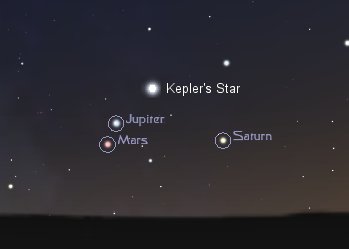
Kepler's Star and the planets
The search for the Star of Bethlehen began in 1604, with the appearance of a supernova in the constellation of Ophiuchus. At the bottom of this page is a representation of the sky near the end of twilight on the night Johannes Kepler discovered the supernova, October 9, 1604. It was near a close grouping of the three planets Jupiter Saturn and Mars. He calculated a similar grouping of the same three planets in 6 B.C. after Jupiter and Saturn pass three times in a triple conjunction the previous year.
He speculated that a nova appeared near that grouping too, and that the appearance of the planets and the “New” star prompted the magi to journey to Judea to pay homage to the newborn King of the Jews. The question is: was there a “new” star or a nova or supernova visible near the planets in 6 BC?
This is an excerpt of my December 2005 article in the GTAS publication the Stellar Sentinel
12/01/10 – Ephemeris – This Week’s Bright Planets
Wednesday, December 1st. The sun will rise at 7:59. It’ll be up for 9 hours and 4 minutes, setting at 5:03. The moon, 3 days past last quarter, will rise at 4:32 tomorrow morning.
Lets take a look at the bright planets for this week. Mars is very low and lost in the evening twilight as is Mercury. The planet Jupiter is up in the southern sky in the early evening. It is a spectacular sight in a telescope with its four satellites, shifting their positions, and the cloud bands running in the directions of the satellites. Jupiter will move due south at 7:39 p.m.. It is the brightest starlight object in the evening. It’s located below the Circlet in Pisces now and will set at 1:26 a.m. The ringed planet Saturn will rise at 3:08 a.m. in the east southeast. It’s located in the constellation Virgo this year. It’s rings are opening nicely for telescopic observers. Venus is in the morning sky and will rise at 4:36 a.m. in the east southeast.
* Times are for the Traverse City/Interlochen area of Michigan. They may be different for your location.
 Bob Moler's Ephemeris Blog