Archive
Comet Lovejoy is growing a new tail
Wow! It looks like C/2011W3 Lovejoy is growing two new tails, a faint ion tail and a brighter dust tail.
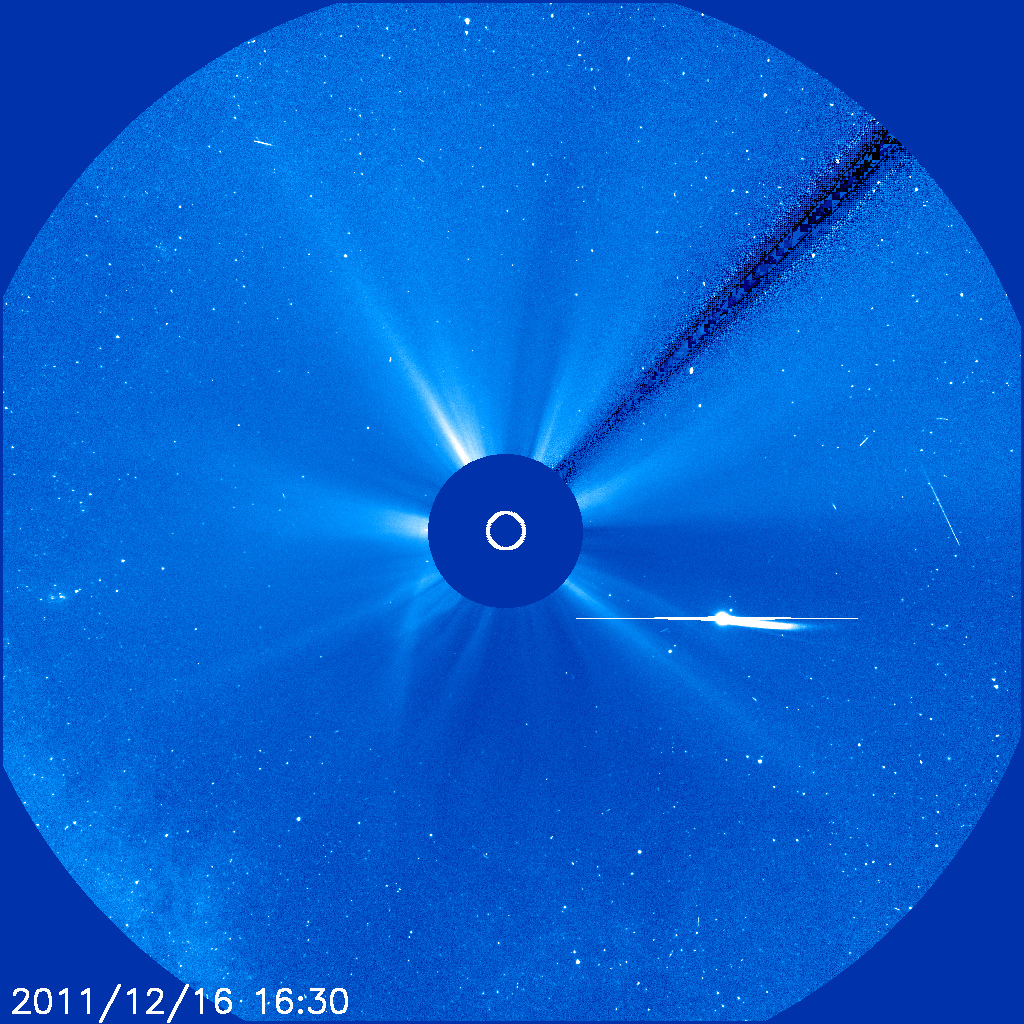
Comet Lovejoy growing new tails. Courtesy ESA, NASA, LASCO C3 group.
The old tail is still visible.
Lovejoy Lives!
Barely.
The Solar Dynamics Observer (SDO) detected Comet Lovejoy (C/2011W3) leaving the sun, but thousands of times fainter than it went in. the LASCO C3 and C2 images that I’ve seen for 9:30 UT show the ghost of Lovejoy’s tail. See Below:
Ghost of Comet Not So Past
Sorry, couldn’t help it. It’s the season I guess. However reports of Lovejoy’s death may have been exaggerated. Sorry Mr. Twain.
Update 8:38 a.m.
I dashed off the above as soon as I got up this morning. It wasn’t until later looking at spaceweather.com’s animation of the LASCO C3 images that I found that the over bright star to the lower left of the sun was what’s left of Comet Lovejoy. I took a quick look at Stellarium and saw no planets in that position, so I thought it may have been an artifact. So it appears Lovejoy lost all its volatile components and is probably a bare nucleus like the progenitor of the Geminid meteor shower 3200 Phaethon. I wonder if the brightness of it will change its size estimates?
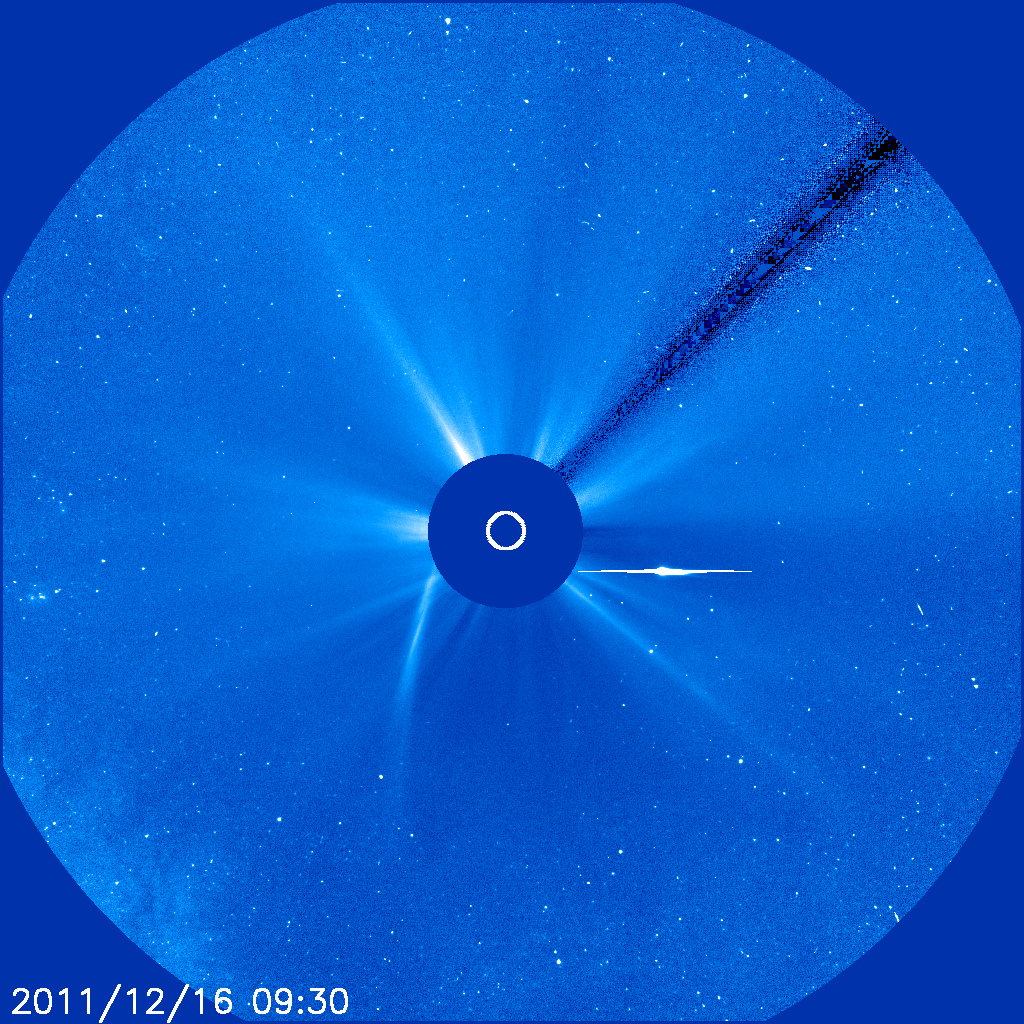
Ghost tail of Comet Lovejoy. Courtesy of ESO, NASA and the LASCO team.
12/16/11 – Ephemeris – The constellation Orion rising
Friday, December 16th. The sun will rise at 8:12. It’ll be up for 8 hours and 50 minutes, setting at 5:03. The moon, 1 day before last quarter, will rise at 11:49 this evening.
At 9 p.m. the constellation of Orion the giant hunter will be rising in the east southeast, with its belt stars nearly vertically aligned. The belt stars are contained within a tilted rectangle of four bright stars that’s leaning to the left. The brightest of the top stars is Betelgeuse a bright red star. It’s a huge red giant star. Both top stars are Orion’s shoulders. The other shoulder star is Bellatrix. The bottom stars are Orion’s knees. The brightest, diagonally opposite from Betelgeuse is Rigel, a bright blue-white giant star. The other knee star is named Saiph. Orion is home to a beautiful nebula or cloud of gas, which we’ll explore later this winter, visible in binoculars it is located right and below Orion’s belt stars.
* Times, as always are for the Traverse City/Interlochen area of Michigan.
Addendum
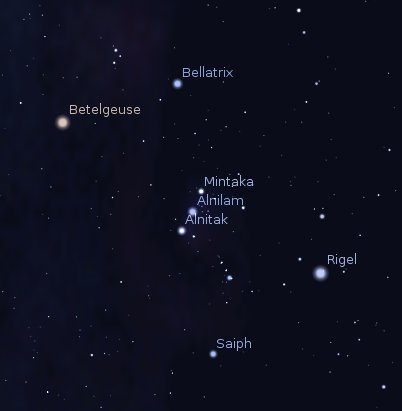
Orion with star names
 Bob Moler's Ephemeris Blog