Archive
01/17/2012 – Ephemeris – The Great Orion Nebula part 1
Ephemeris for Tuesday, January 17th. The sun will rise at 8:15. It’ll be up for 9 hours and 15 minutes, setting at 5:30. The moon, 1 day past last quarter, will rise at 3:43 tomorrow morning.
One of the great questions of Christian theologians of Galileo’s time was why God would create stars that no human could see with the naked eye. Galileo’s primitive telescope showed a myriad of formerly invisible stars. Starting with Galileo, astronomers have shown that the stars weren’t made for man, and neither are the stars eternal. Stars are born and die, some spectacularly as supernovae. In the constellation of Orion the hunter, below the three stars of his belt are what appear another three stars hanging down as his sword.. Looking at what appears as the middle star with binoculars or a telescope one can detect a haze, a nebula astronomers call it. This is the Great Orion Nebula, even now the birthplace of stars.
* Times, as always are for the Traverse City/Interlochen area of Michigan.
Addendum
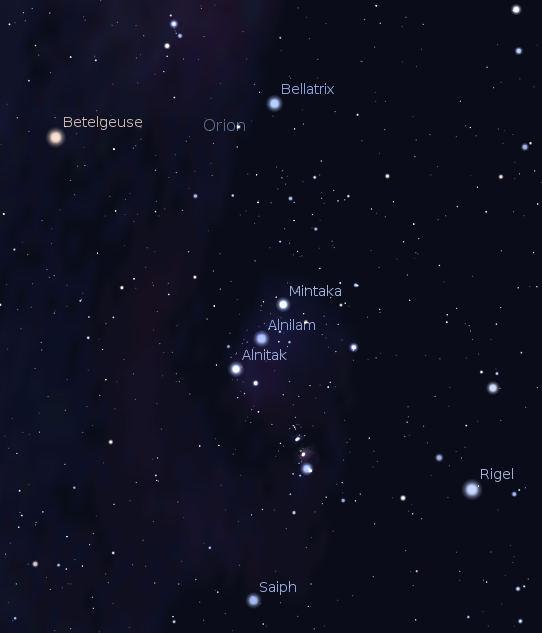
Torso of Orion centered on his belt. Created using Stellarium.
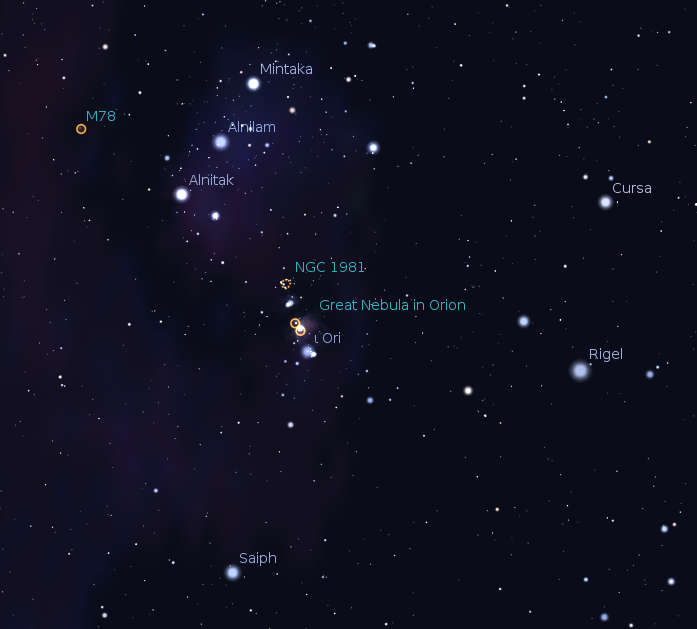
The lower part of Orion with the Great Orion Nebula. Created using Stellarium.
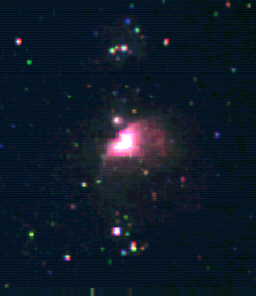
Great Orion Nebula in Orion's sword. My old photograph.
Note: The Great Orion Nebula usually photographs red due to the great abundance of the element hydrogen. However at low light levels our eyes are not sensitive to that particular color. So in the eyepiece the nebula looks gray or greenish due to the emission of hydrogen in the green and that of doubly ionized oxygen.
The Great Orion Nebula is also known by astronomers as M42 or Messier 42, a catalog of bright sky objects.
 Bob Moler's Ephemeris Blog