04/18/2012 – Ephemeris – Where are the bright planets tonight?
Ephemeris for Wednesday, April 18th. The sun rises at 6:52. It’ll be up for 13 hours and 39 minutes, setting at 8:31. The moon, 3 days before new, will rise at 5:47 tomorrow morning.
Let’s see what’s happening with the bright planets for this week. Jupiter has dropped far below brilliant Venus in the west, since their apparent paths crossed a month and a half ago. Jupiter will set at 10:03 p.m. followed by Venus at 12:39 a.m. Venus is 49.6 million miles away and closing. Mars is high in the south in the evening with its unmistakable bright reddish color. It’s in the constellation Leo the lion now. It is 79.4 million miles from us and moving away. Mars will pass due south at 10:18 p.m. and will be setting in the west at 5:15 a.m. Saturn will be rising in the east southeast as twilight fades tonight just to the left of the bright star Spica. It will pass due south at 1:32 a.m. All the bright planets except Mercury are now visible in the evening.
* Times are for the Traverse City/Interlochen area of Michigan. They may be different for your location.
Addendum
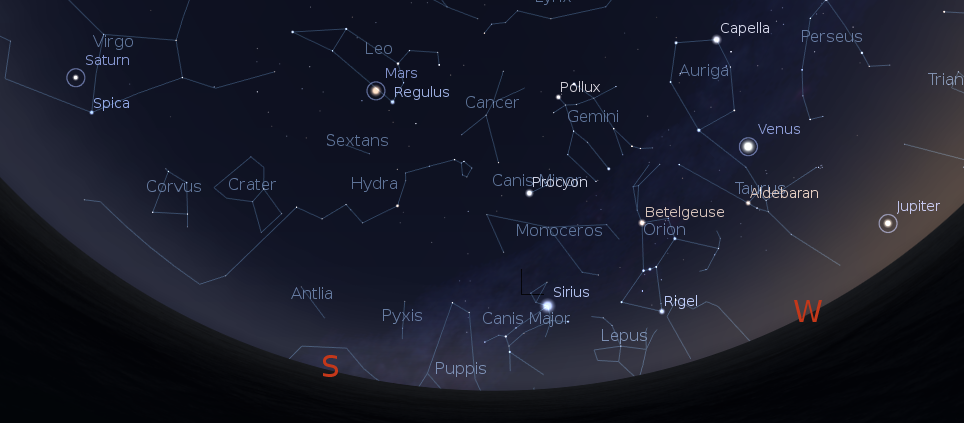
The sky and the evening planets at 9:30 p.m. on April 18, 2012. Created using Stellarium.
 Bob Moler's Ephemeris Blog
Speaking of Venus, I was checking it out the other night with typical binoculars and saw that the sun was shining on only about half of it or less making it look like the moon does at such a shape showing. Never thought of that before how a planet would show only a portion based on how much of it was being shined on by the sun.
Inferior planets (not a function of their quality but of their position inside the earth’s orbit) Venus and Mercury exhibit all the phases as our moon does. Venus, now is in the act of passing between the earth and the sun, and so we see more of its unlit side. On June 5th our time it will be a “new” when it passes directly in front of the sun in the last transit of Venus for the next 105 1/2 years. Venus’ changing sizes and phases were used by Galileo to prove the Copernican system of the world.
Superior planets, those outside the earth’s orbit, also exhibit phases, but only the gibbous phases. Mars shows them best because it’s close to the earth’s orbit.
Neat, I’ll have to look for that regarding Mars. Thanks!