07/11/2012 – Ephemeris – Where are the bright planets this week?
Ephemeris for Wednesday, July 11th. Today the sun will be up for 15 hours and 18 minutes, setting at 9:27. The moon, 1 day past last quarter, will rise at 1:18 tomorrow morning. Tomorrow the sun will rise at 6:09.
Let’s see what’s happening with the bright planets for this week. Mars, with its unmistakable bright reddish color, is in the west southwest in the evening in the constellation of Virgo the virgin. Mars will be setting in the west at 12:34 a.m. It is approaching Saturn and Spica just to its left. Saturn will be in the southwest above the bright star Spica now. It will set at 1:26 a.m. Jupiter, now a morning planet will rise at 3:08 a.m. in the east northeast. Venus, is now seen just below Jupiter after it rises at 3:45 a.m. Tomorrow morning, Venus will appear next to the bright star Aldebaran. The planets are striking in telescopes with Venus as a large thin crescent, and Jupiter with its cloud bands and satellites.
Times are for the Traverse City/Interlochen area of Michigan. They may be different for your location.
Addendum
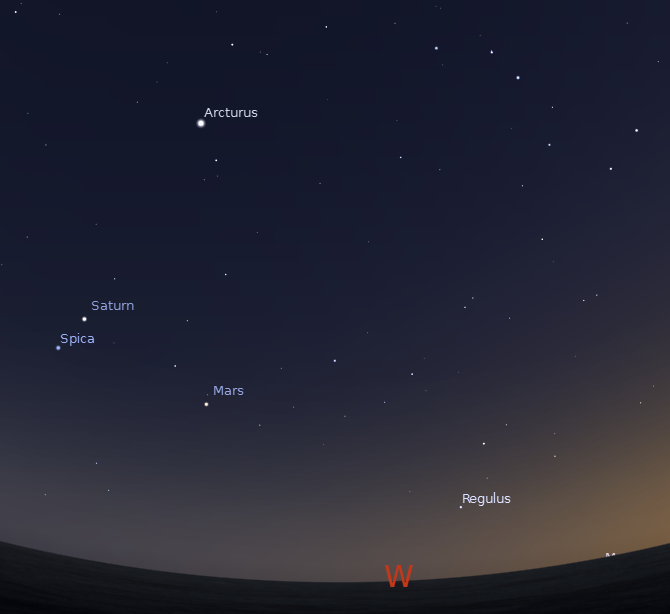
Looking westward at 10:30 p.m. on July 11, 2012. Created using Stellarium.
Click on image to enlarge.
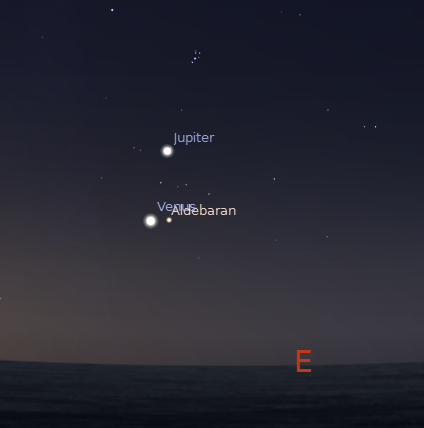
Looking eastward at 5 a.m. on July 12, 2012. Created using Stellarium.
Note Aldebaran near Venus. Aldebaran is the brightest star in the winter constellation Taurus the bull. Note the Pleiades star cluster above Jupiter. Well worth a look with binoculars.
 Bob Moler's Ephemeris Blog
Hi Bob,
I wake up around 3 or 4 in the morning (PDT, northern California) and for the past week or two I’ve seen two planets lined up in the eastern sky. I know the brighter one must be Venus and I assumed the other one was Mars. But from your description I see it’s Jupiter!
I’ve come only recently to stargazing, thanks to a Great Courses offering from Edward Murphy that came with helpful book and planisphere. It’s something I’ve wanted to do all my adult life but this course has given me the tools.
The high point of my evenings lately has been going out on my patio around 10 pm, lying down on my air mattress, and gazing at the summer sky, trying to make out the constellations but also just enjoying the peaceful companionship of the cosmos. I don’t bring the planisphere outside, just study it inside, pick out a couple of constellations and then go out and try to find them. It’s quite exhilarating when a new constellation comes into focus.
So far, in the summer sky I’ve found Lyra, Cygnus, Hercules, Corona Borealis, and I think Aquila (my south sky view is somewhat limited because of light pollution from the town). Perhaps that may account also for my difficulty in locating Sagittarius and Scorpio?
For the past couple of nights I’ve been trying to make out Ophiochus and the two Serpens. Also there’s an elongated 4-star diamond that I thought was part of Cepheus but now think may be the end of Draco. Hoping for a really dark couple of nights to figure it all out–lately visibility has been been only so-so.
I’m delighted to have discovered your blog. I know it will help me and add greatly to my stargazing experience. Thank you!