10/02/2013 – Ephemeris – Where are the bright planets and one dim comet?
Ephemeris for Wednesday, October 2nd. The sun will rise at 7:41. It’ll be up for 11 hours and 38 minutes, setting at 7:20. The moon, 2 days before new, will rise at 6:14 tomorrow morning.
Time again to check out the bright planets. Saturn and Venus will be at the same height above the west southwestern horizon. Dimmer Saturn will be to the right of Venus by one and a half widths of a fist held at arm’s length. Binoculars may be needed to Saturn. Saturn will set at 8:40, while Venus will set at 8:56 p.m.. We are losing Saturn in the sun’s glare for a few months. The rest of the planetary action will be in the morning sky. The giant planet Jupiter will rise at 12:36 a.m. in the east northeast. It’s cruising against the stars of Gemini this viewing season. By 6 a.m it will be high in the southeast, the brightest object in that direction. Mars will rise at 3:30 a.m. also in the east northeast. It’s in the east at 6 a.m.
Times are for the Traverse City/Interlochen area of Michigan. They may be different for your location.
Addendum
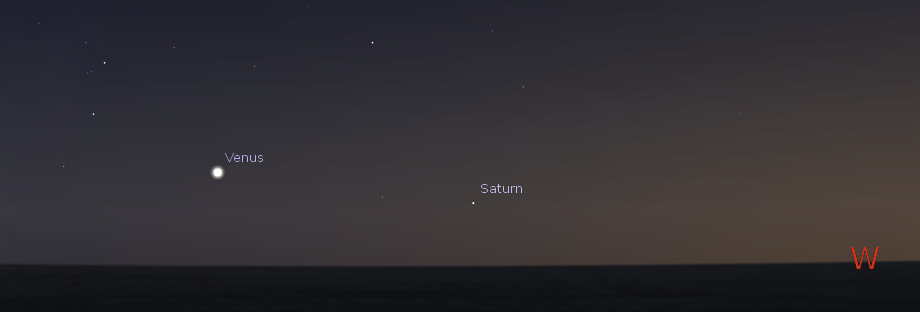
Venus and Saturn low on the west southwestern horizon along with Saturn at 8:15 p.m. on October 2, 2013. Created using Stellarium.
I was out at the Lanphier Observatory of the Leelanau School in Glen Arbor Michigan Monday evening about this time, to show Venus to the audience for Andrea Wulf’s talk about some of her book Chasing Venus. If the book is like her talk, it should be fabulous. It’s about the 18th century expeditions of many nation to view a pair of transits of Venus in order to determine the size of the solar system. Anyway the sky was like this with Venus setting over the low Sleeping Bear Dunes across Sleeping Bear Bay.
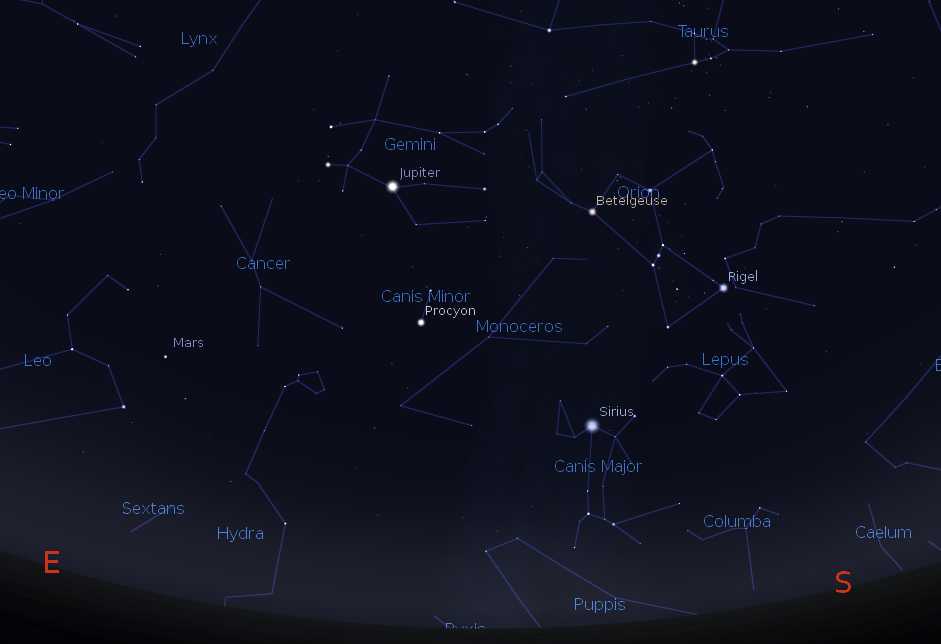
Jupiter, Mars with the winter stars and constellations at 6 a.m. on October 3, 2012. Created using Stellarium.
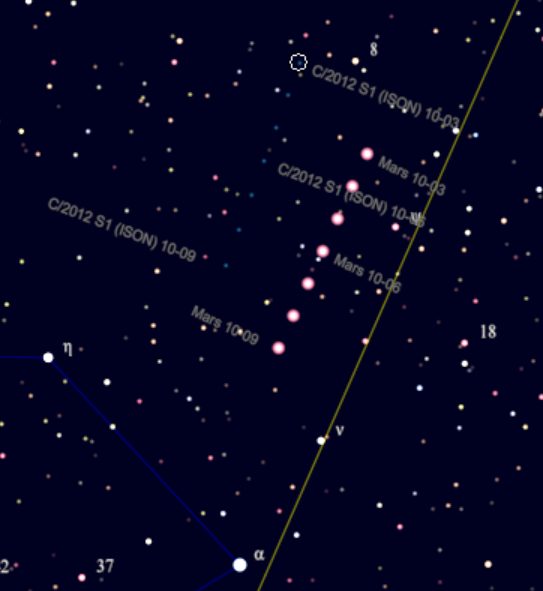
The tracks of Mars and Comet ISON at 6 a.m. from October 3 to 9, 2013. The comet may still be too faint to view in binoculars. Chart created using Cartes duCiel.
The yellow line is the ecliptic. The blue line is the constellations lines for Leo. Comet ISON positions are blue dots. It’s too far away for the software to show a tail.
 Bob Moler's Ephemeris Blog