Archive
10/29/2013 – Ephemeris – Comet ISON 30 days before perihelion
Ephemeris for Tuesday, October 29th. The sun will rise at 8:16. It’ll be up for 10 hours and 18 minutes, setting at 6:35. The moon, 3 days past last quarter, will rise at 3:56 tomorrow morning.
In 30 days Comet ISON will meet its date with the sun. November 28th, Thanksgiving day Comet ISON will whip around the sun, and to us will seem to be sent at a near 90 degree angle from heading eastward to heading nearly due northward. That’s an illusion because we, on the earth will be moving, in effect under it. The closest Comet ISON will get to us is just under 40 million miles on December 26th and 27th. The morning waning crescent is no longer affecting the visibility of the comet, so barring clouds, it should be visible in dark skies in small telescopes. The website gtastro.org now has lots of information on the comet and where you can find more from good sources. I’ll tell you more on Friday.
Times are for the Traverse City/Interlochen area of Michigan. They may be different for your location.
Addendum
This is the major document from the Gtastro website cited above: The article from the GTAS Stellar Sentinel plus extra charts and information for viewing Comet ISON at perihelion (closest approach to the sun) safely online.
10/28/2013 – Ephemeris – The constellation Perseus the hero
Ephemeris for Monday, October 28th. The sun will rise at 8:15. It’ll be up for 10 hours and 21 minutes, setting at 6:36. The moon, 2 days past last quarter, will rise at 2:54 tomorrow morning.
About a third the way from the east northeastern horizon to the zenith at 9 p.m. and below the letter W shaped constellation of Cassiopeia the queen is Perseus the hero. It’s kind of a odd shape for a hero, To me it looks like a chicken running across the road. To those who’s imagination doesn’t run to poultry, its shape is also like the Greek letter pi. It’s two brightest stars are Mirfak and Algol the demon star. Look at the area around Mirfak with binoculars and you will see a large group of stars just below naked eye visibility. It’s called the Alpha Persei association. That because Mirfak is Alpha Persei. The group is about 560 light years away, which means, though close, are farther away than the Pleiades, below and right of them.
Times are for the Traverse City/Interlochen area of Michigan. They may be different for your location.
Addendum
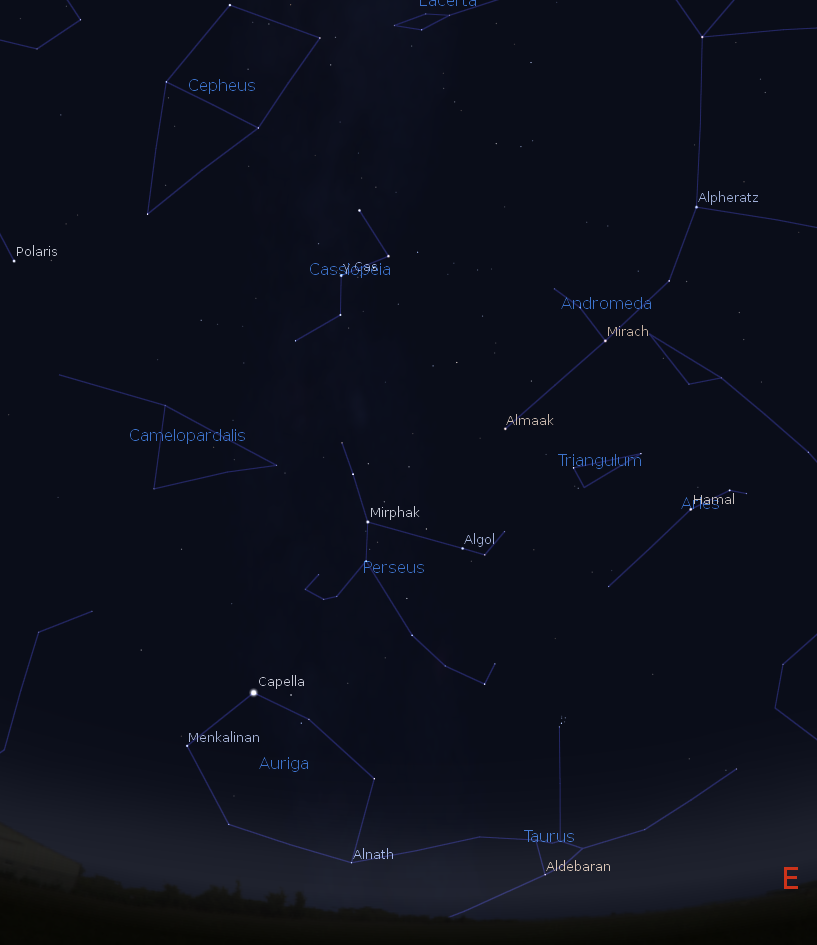
Perseus finder chart. Note the star Mirfak is spelled Mirphak on the chart. Created using Stellarium.
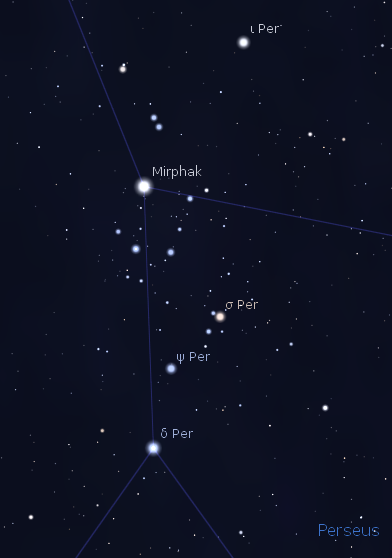
Alpha Persei Association. Created using Stellarium.
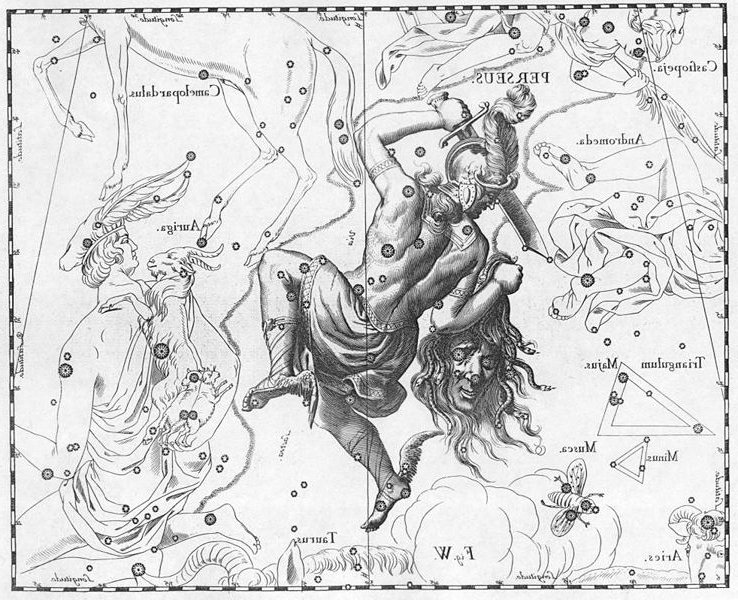
Perseus and the head of Medusa from the 1690 Uranographia by Johannes Hevelius. Image found with the article on Algol in Wikipedia.
 Bob Moler's Ephemeris Blog