Archive
Ephemeris: 09/15/2026 – Two small but interesting constellations in and near the Summer Triangle
This is Ephemeris for Tuesday, September 15th. Today the Sun will be up for 12 hours and 31 minutes, setting at 7:53, and it will rise tomorrow at 7:22. The Moon, 3 days before first quarter, will set at 9:34 this evening.
There are two small constellations in and near the Summer Triangle of bright stars. Both are near Altair the bottom star of the triangle in the south. The first is Delphinus the dolphin to the left of Altair. Delphinus is made-up of a small squished box of stars with another star below. It does look a dolphin leaping out of the water. The legendary Greek poet Arion, according to myth, was rescued by a dolphin. Also the little squished box is an asterism called Job’s Coffin, though no one knows the origin of that name. The second constellation is above Altair, and within the Summer Triangle. It is called Sagitta the arrow. The stars do line up to look like a short arrow. It’s supposed to represent Cupid’s dart.
The astronomical event times given in this blog are for the Traverse City/Interlochen area of Michigan (Lat 44.7° N, Long 85.7° W; EDT, UT – 4 hours) unless stated otherwise. Times will be different for other locations.
Addendum

Ephemeris: 08/13/2026 – The Milky Way seen in two cultures
This is Ephemeris for International Left-Handers Day, Thursday, August 13th. Today the Sun will be up for 14 hours and 8 minutes, setting at 8:51, and it will rise tomorrow at 6:44. The Moon, 1 day past new, will set at 9:22 this evening.
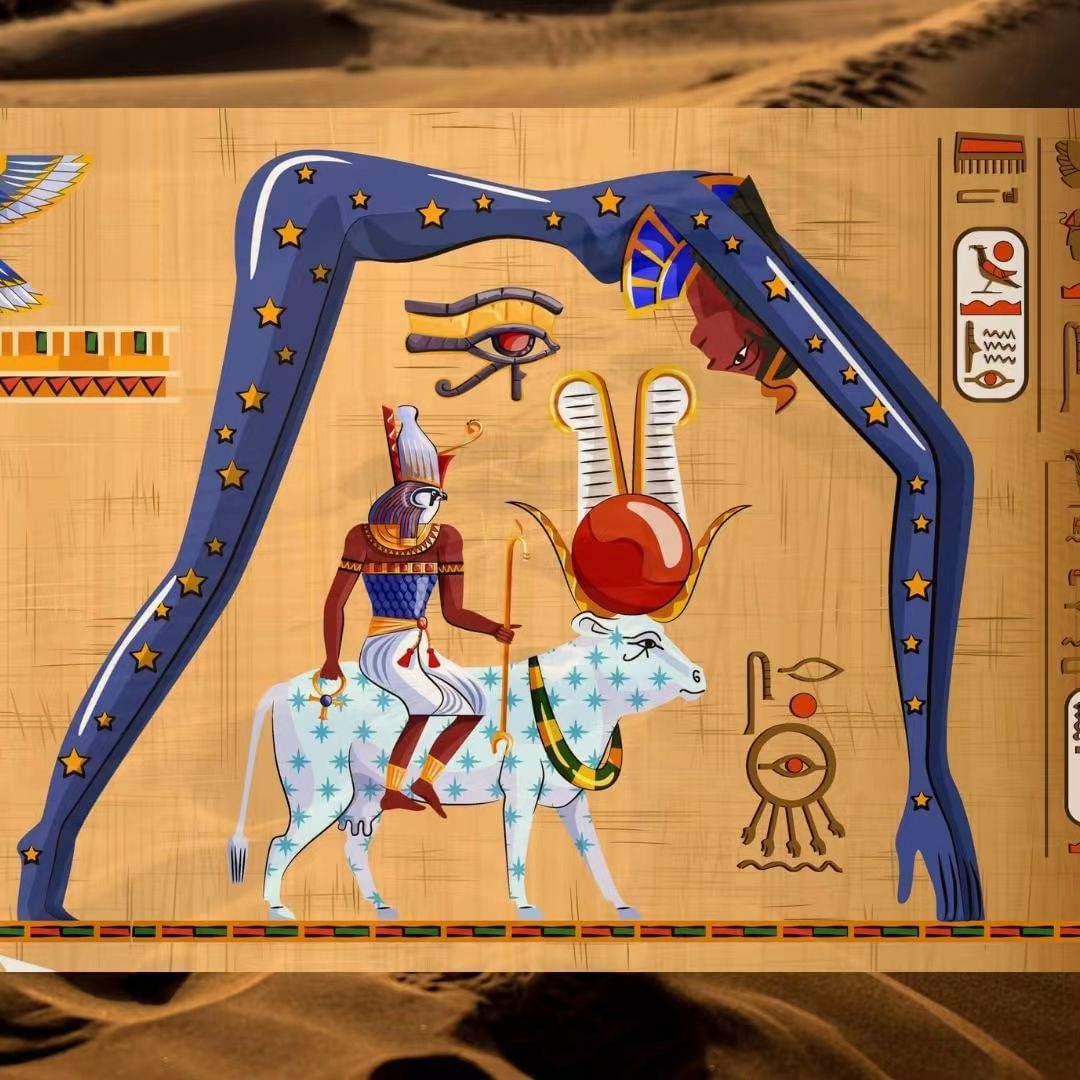
In the folk tales of many lands and cultures the Milky Way has been seen as either a stream or pathway. The term we get for it, the Milky Way, is that it is a stream of milk from the breasts of the Egyptian goddess Nut, the goddess of the sky.
The Anishinaabe native peoples of our area gave it several names: Jiibay-Miikana, The Spirit Road, or Jiibay-ziibi, River of souls, Both for the journey of souls to the afterlife. Or Binesiwi-miikana, Thunderbird’s path. This last is interesting, because in spring as the Milky Way rises from the southeast it beckons migrating birds northward, and in autumn as the Milky Way sinks to the southwest, it bids them to fly southward to warmer climes.
The astronomical event times given in this blog are for the Traverse City/Interlochen area of Michigan (Lat 44.7° N, Long 85.7° W; EDT, UT – 4 hours) unless stated otherwise. Times will be different for other locations.
Addendum
Ephemeris: 07/13/2026 – Finding the celestial eagle, Aquila
This is Ephemeris for Monday, July 13th. Today the Sun will be up for 15 hours and 17 minutes, setting at 9:26, and it will rise tomorrow at 6:10. The Moon, 1 day before new, will rise at 6:04 tomorrow morning.
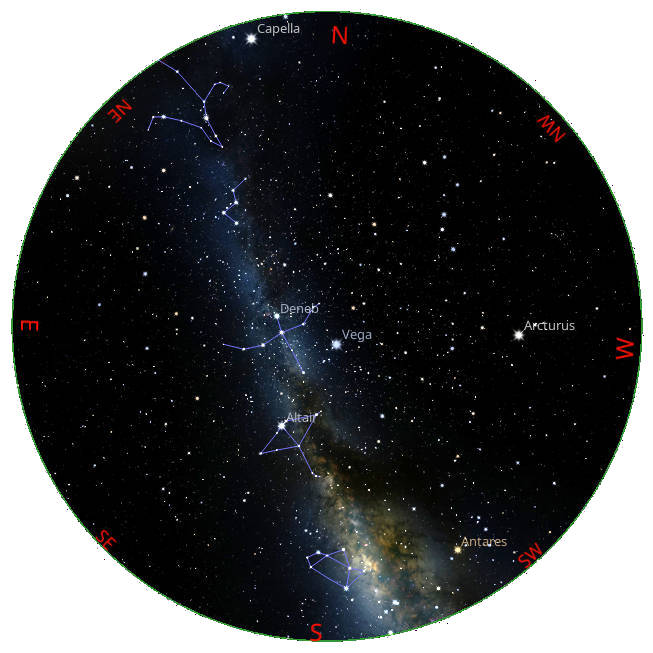
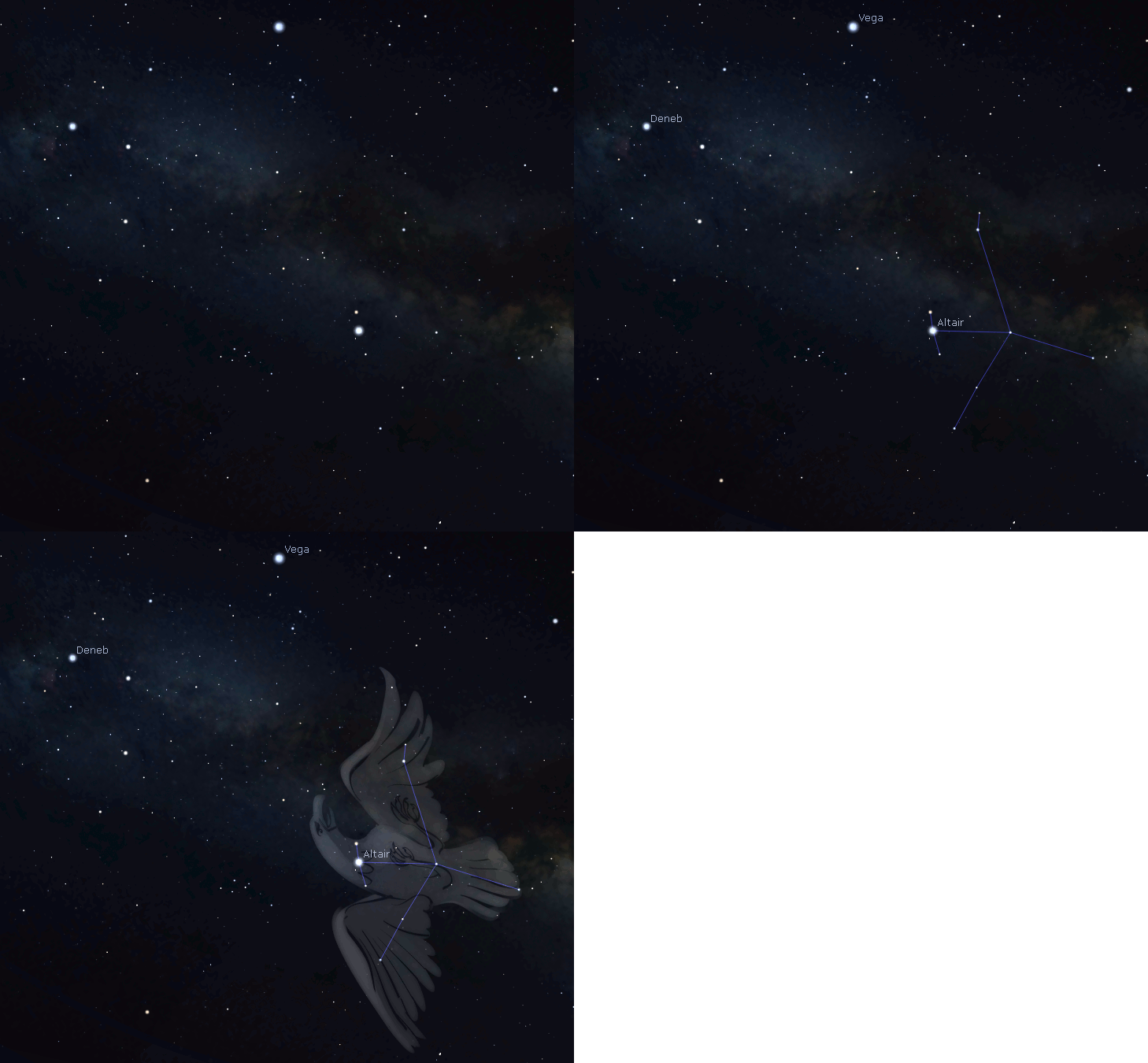
Aquila the eagle is a constellation that lies in the Milky Way. It’s in the southeastern sky as it gets dark. Its brightest star, Altair, is one of the stars of the Summer Triangle, a group of three bright stars dominating the eastern sky in the evening now. Altair, in the head of the eagle, is flanked by two slightly dimmer stars. The eagle is flying northeastward through the Milky Way. Its wings are seen in the wing tip stars. A curved group of stars to the lower right of Altair is its tail. Within Aquila, the Milky Way shows many dark clouds as part of the Great Rift that splits it here. The other summer bird is Cygnus the swan above and left of Aquila, flying in the opposite direction. It was said this was the eagle that attended the god Jupiter.
The astronomical event times given in this blog are for the Traverse City/Interlochen area of Michigan (Lat 44.7° N, Long 85.7° W; EDT, UT – 4 hours) unless stated otherwise. Times will be different for other locations.
Addendum
Ephemeris: 07/02/2026 – Finding Ophiuchus, the celestial snake handler
This is Ephemeris for Thursday, July 2nd. Today the Sun will be up for 15 hours and 30 minutes, setting at 9:31, and it will rise tomorrow at 6:02. The Moon, 3 days past full, will rise at 11:26 this evening.
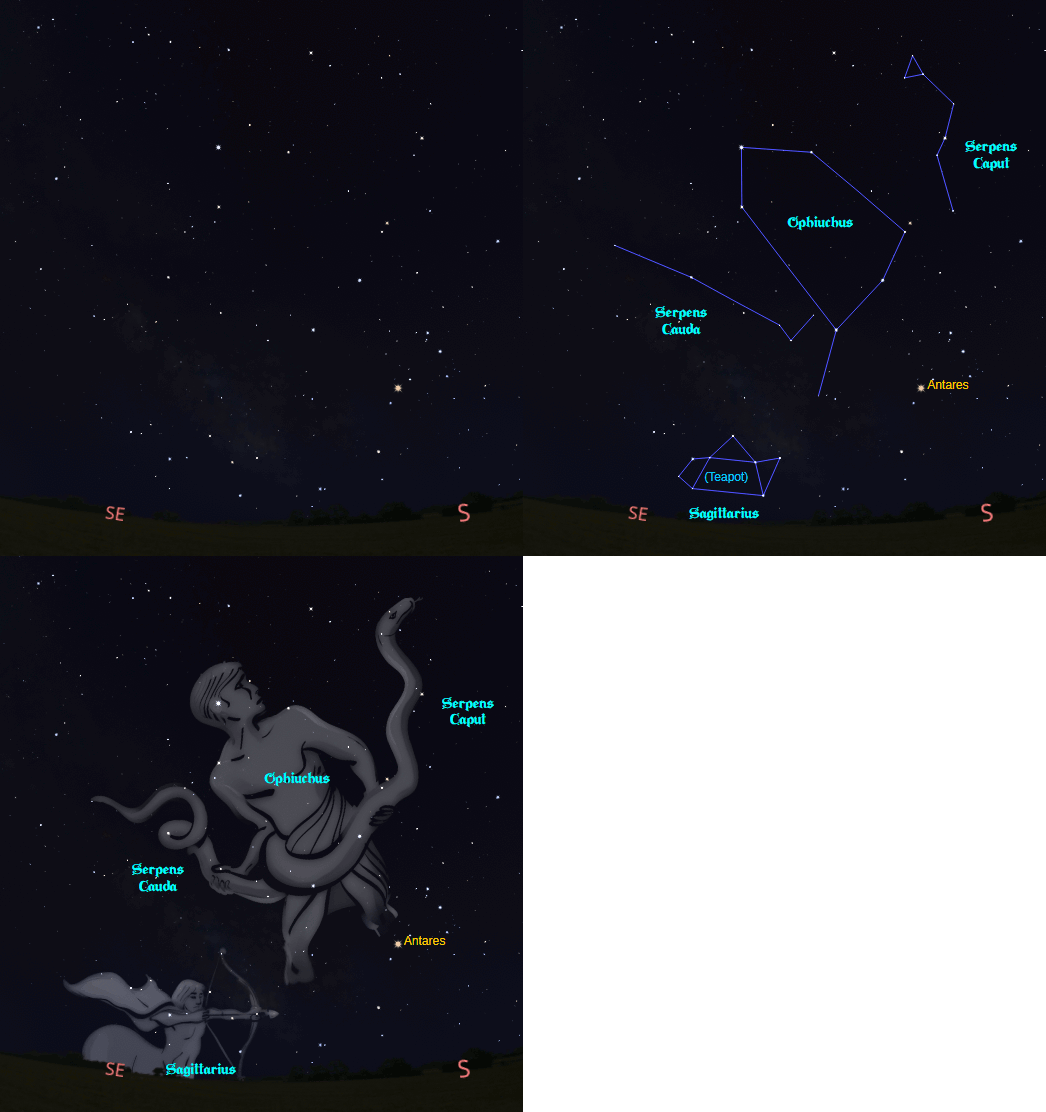
The red star Antares shines in the south at 11 p.m. In the constellation of Scorpius. In the area of sky above and a little to the left lies a large constellation of faint stars called Ophiuchus, the serpent bearer. The constellation shape is like a large bell, which reminds me of the head, shoulders and arms of a fellow that’s holding the large snake across his body, hip high. The serpent he’s holding is Serpens, the only two-part constellation in the heavens. The head rises to Ophiuchus’ right, toward Hercules, and the tail extends up to the left, toward Aquila the eagle. In Greek myth, Ophiuchus represents the great physician Aesculapius, educated by the god Apollo, and the centaur Chiron, who is found in the stars as Sagittarius, now rising below and left of him.
The astronomical event times given in this blog are for the Traverse City/Interlochen area of Michigan (Lat 44.7° N, Long 85.7° W; EDT, UT – 4 hours) unless stated otherwise. Times will be different for other locations.
Addendum
Ephemeris: 06/04/2026 – Finding Lyra the harp
This is Bob Moler with Ephemeris for Thursday, June 4th. Today the Sun will be up for 15 hours and 24 minutes, setting at 9:23, and it will rise tomorrow at 5:58. The Moon, halfway from full to last quarter, will rise at 12:57 tomorrow morning.
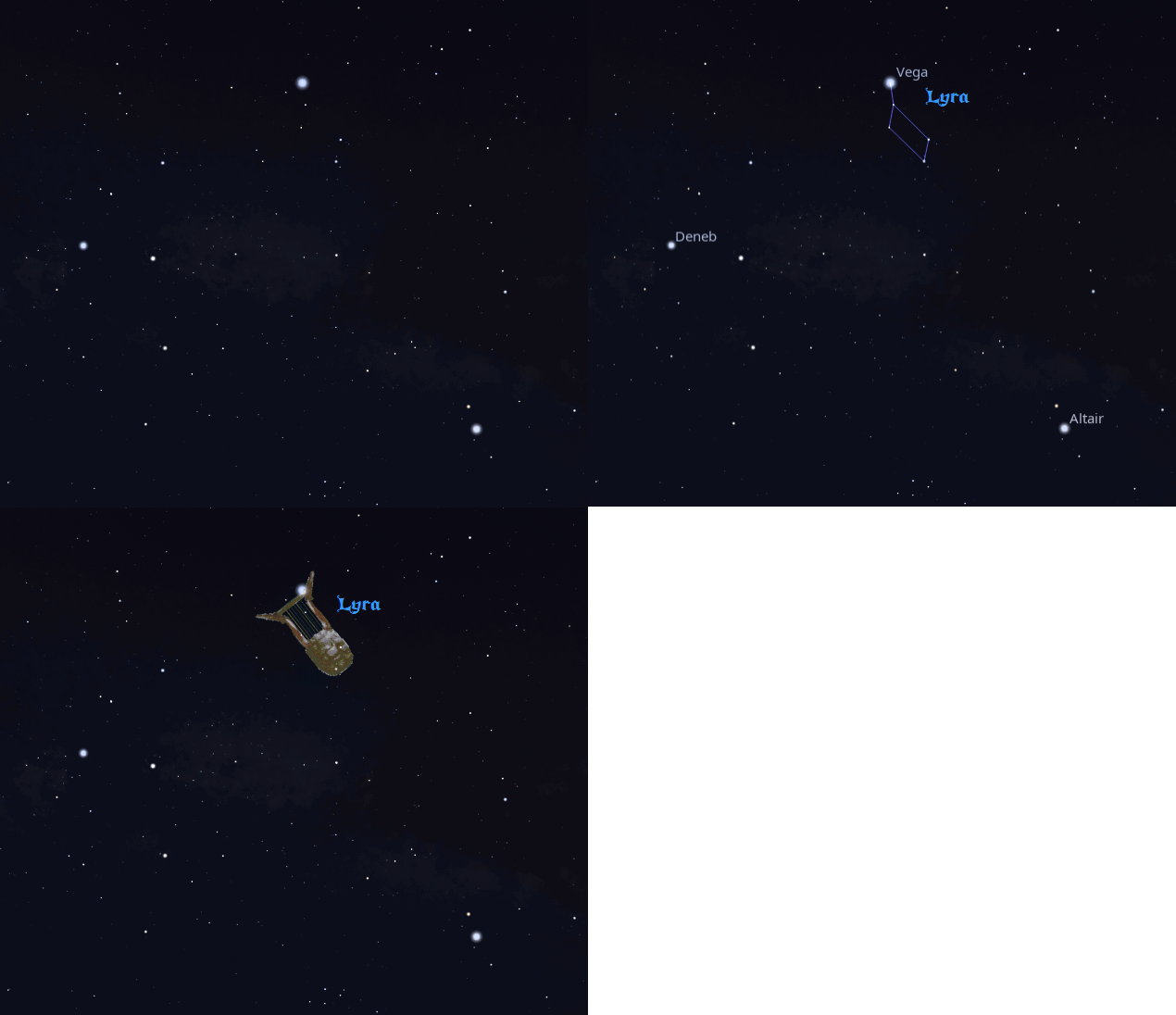
Halfway up the sky in the east at 11 PM, one can find a bright star just above a small, narrow, but very distinctive parallelogram of stars. They are the stars of the constellation Lyra the harp. The bright star is Vega, the 5th brightest nighttime star. To the Romans, the star Vega represented a falling eagle or vulture. Apparently they never made the distinction between the two species. It is a pure white star and serves as a calibration star for color and brightness. In the evening, it is the top-most star of the Summer Triangle. The harp, according to Greek mythology, was invented by the god Hermes. The form of the harp, in the sky, is as he had invented it: by stretching strings across a tortoise shell. Hermes gave it to his half-brother Apollo, who in turn gave it to the legendary musician Orpheus.
The astronomical event times given in this blog are for the Traverse City/Interlochen area of Michigan (Lat 44.7° N, Long 85.7° W; EDT, UT – 4 hours) unless stated otherwise. Times will be different for other locations.
Addendum
Ephemeris: 05/15/2026 – Orion flees the evening sky as Scorpius rises
This is Ephemeris for Friday, May 15th. Today the Sun will be up for 14 hours and 49 minutes, setting at 9:04, and it will rise tomorrow at 6:13. The Moon, 1 day before new, will rise at 5:34 tomorrow morning.
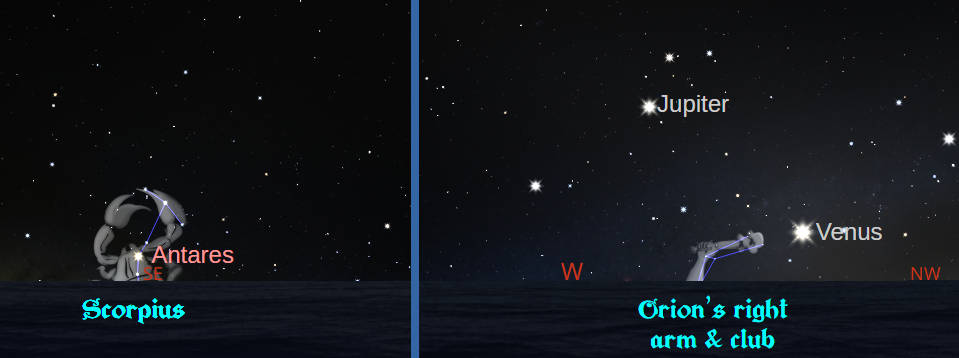
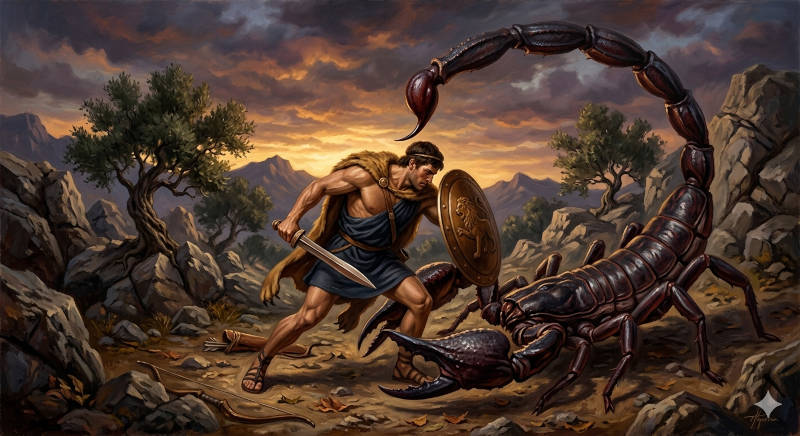
Orion the winter constellation is just about gone from our spring skies. Only the top part of his club is left in the west as evening twilight fades. Rising in the southeast at the same time is his nemesis the constellation Scorpius the scorpion. According to Greek mythology, Orion was killed by a giant scorpion. And that scorpion of course was Scorpius. It was sent by the goddess of the earth Gaia. Orion, the mighty hunter, had boasted that he could kill any creature. So this was his final comeuppance. In that battle he was killed by the sting of that scorpion. And that is why Scorpius and Orion can never be in the sky at the same time. Orion won’t venture into the evening sky until Scorpius is long gone in late autumn.
The astronomical event times given in this blog are for the Traverse City/Interlochen area of Michigan (Lat 44.7° N, Long 85.7° W; EDT, UT – 4 hours) unless stated otherwise. Times will be different for other locations.
Addendum
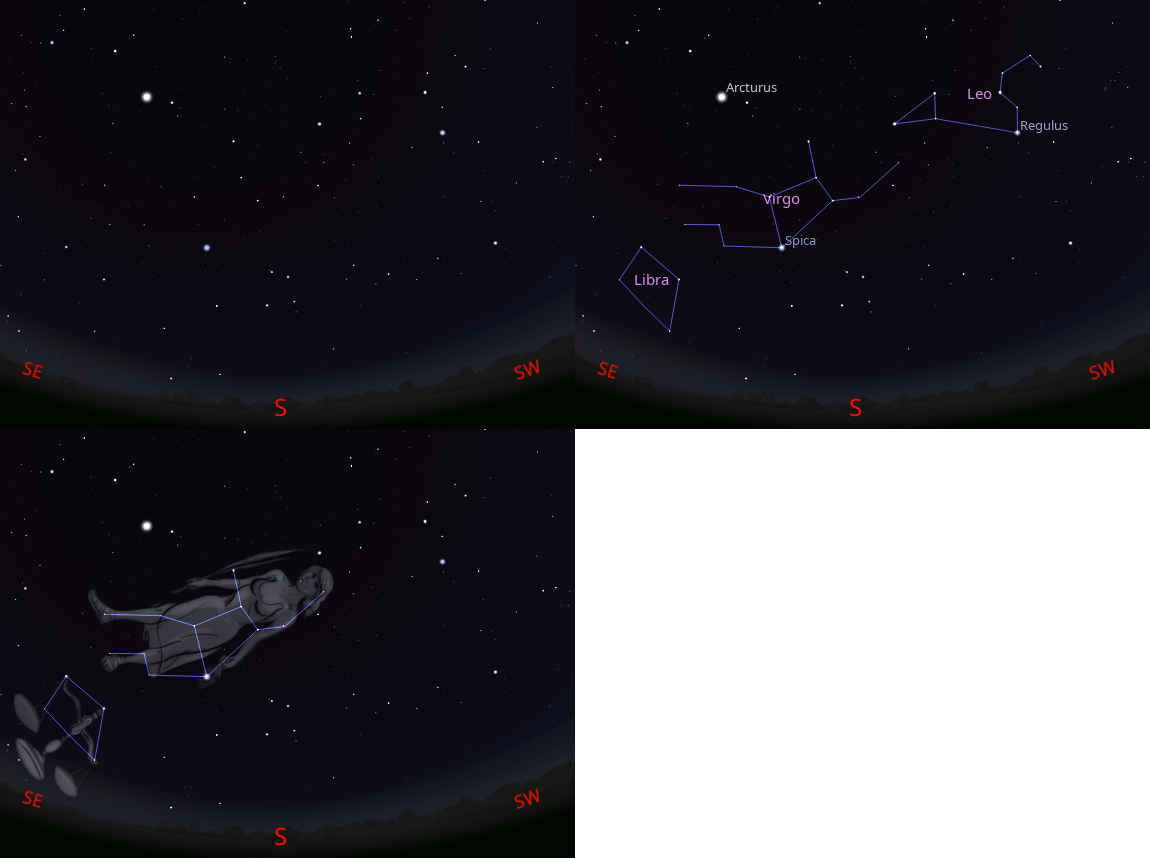
Ephemeris: 05/12/2026 – Finding the constellations of Virgo and Libra
This is Ephemeris for Tuesday, May 12th. Today the Sun will be up for 14 hours and 43 minutes, setting at 9:01, and it will rise tomorrow at 6:16. The Moon, 3 days past last quarter, will rise at 4:16 tomorrow morning.
As skies darken look to the south, below the bright star Arcturus, high in the southeast, and left and below Leo the lion, in the southwest, to the constellation of Virgo the virgin with its bright star Spica in the south. Other than Spica, Virgo contains only dim stars. It’s quite large, extending to the upper right, and to the left of Spica. Virgo represents two goddesses. The Greek harvest goddess Persephone, whose Roman name is Ceres, which is the root of our word cereal, is one. The bright star Spica is the ear of wheat that she’s holding in her hand. Some see her standing at an odd angle, I see her reclining. Virgo also represents Astraea the goddess of Justice, with her scales, the constellation Libra, at her feet low in the southeast.
The astronomical event times given in this blog are for the Traverse City/Interlochen area of Michigan (Lat 44.7° N, Long 85.7° W; EDT, UT – 4 hours) unless stated otherwise. Times will be different for other locations.
Addendum
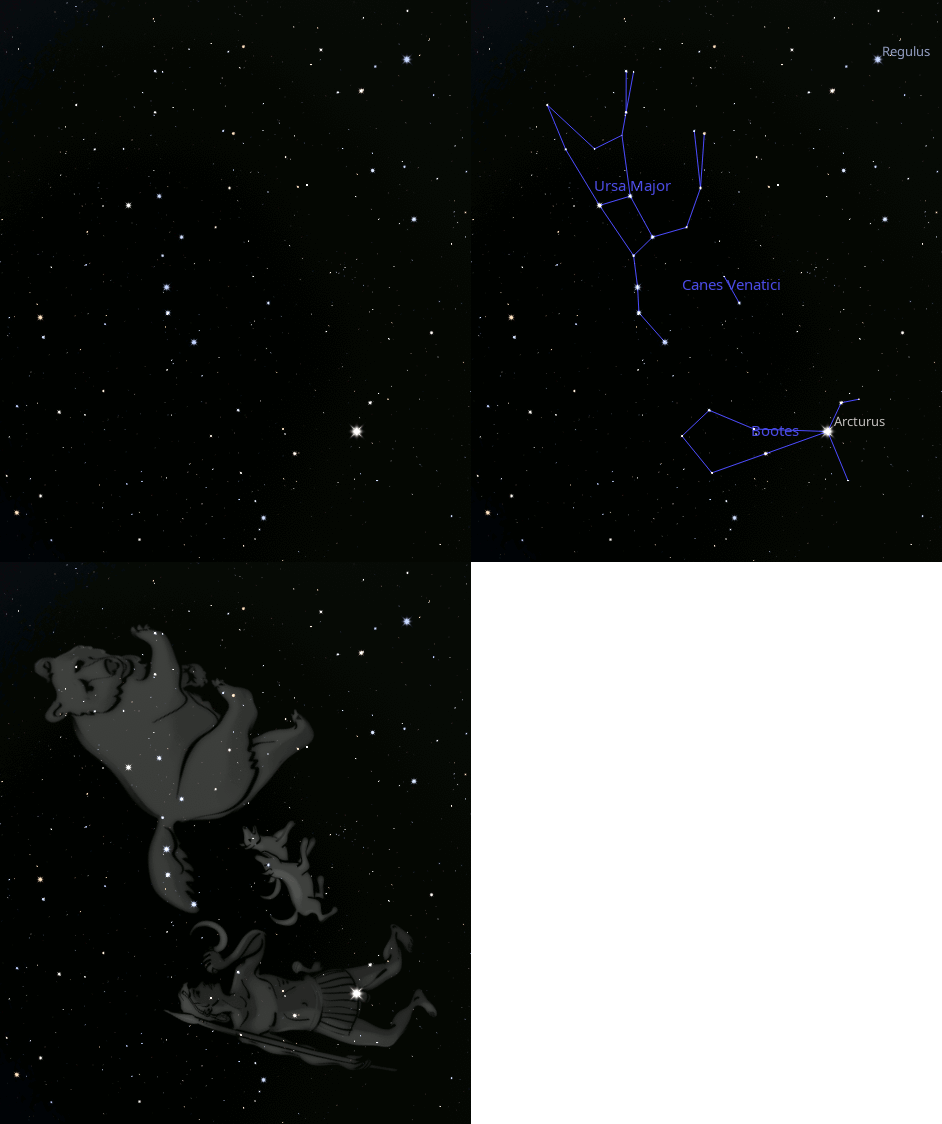
Ephemeris: 05/08/2026 – The story of Boötes and Ursa Major
This is Ephemeris for Friday, May 8th. Today the Sun will be up for 14 hours and 33 minutes, setting at 8:56, and it will rise tomorrow at 6:21. The Moon, 1 day before last quarter, will rise at 2:55 tomorrow morning.
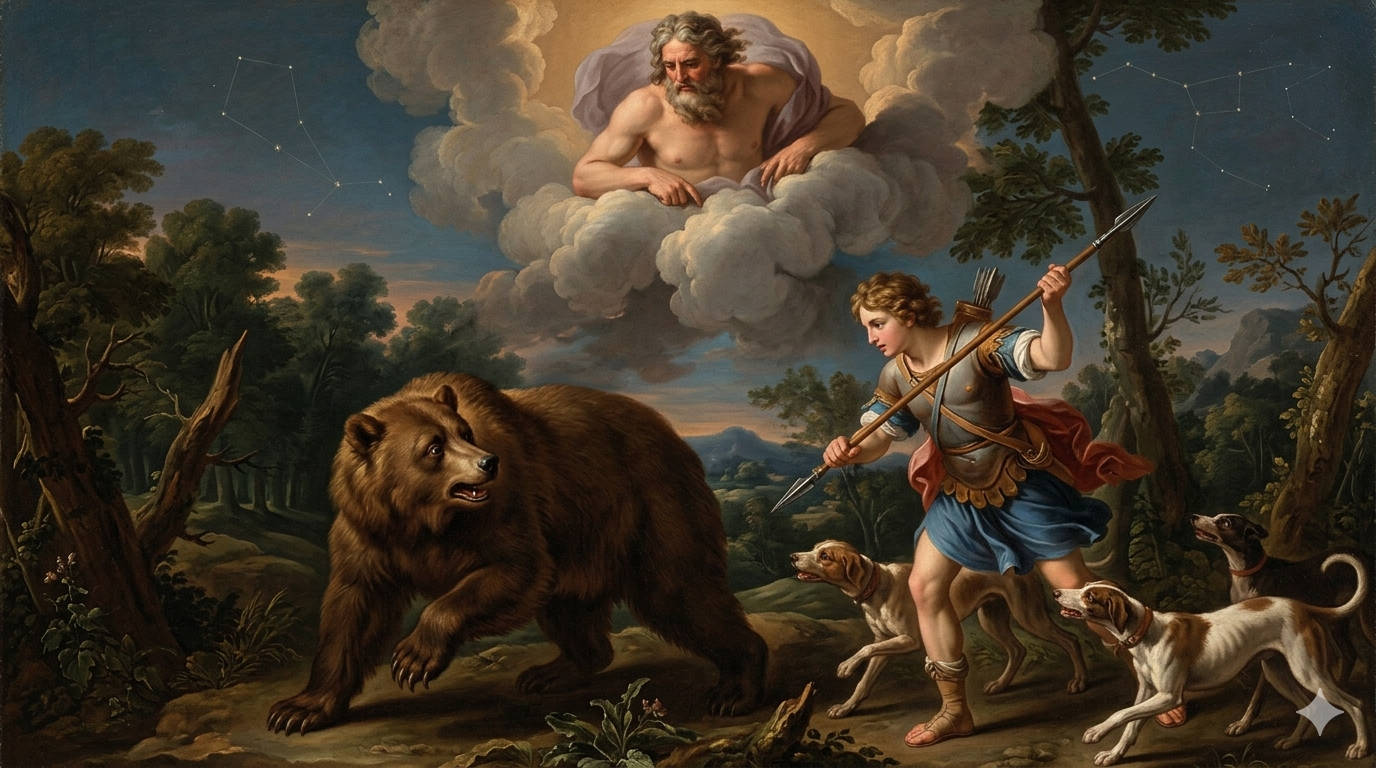
Appearing in the eastern sky at 10 p.m. tonight is the kite shaped constellation of Boötes the herdsman. The bright star Arcturus is at the bottom of the kite which is horizontal to the left, pointed to by the arc of the handle of the Big Dipper, higher in the east. The Big Dipper is the hind end of the constellation Ursa Major, the Great Bear. In one story, Boötes represents a young hunter named Arcas, son of Callisto, a beautiful young woman who had the misfortune of being loved by god Zeus. Zeus’ wife, Hera, found out about the affair, and since she couldn’t punish Zeus, turned the poor woman into a bear. Arcas, many years later, unaware of why his mother disappeared, was about to kill the bear when Zeus intervened and placed them both in the sky, where he continues to chase her across the sky nightly.
The astronomical event times given in this blog are for the Traverse City/Interlochen area of Michigan (Lat 44.7° N, Long 85.7° W; EDT, UT – 4 hours) unless stated otherwise. Times will be different for other locations.
Addendum
Ephemeris: 05/07/2026 – A constellation of a real person: Coma Berenices
This is Ephemeris for Thursday, May 7th. Today the Sun will be up for 14 hours and 30 minutes, setting at 8:55, and it will rise tomorrow at 6:22. The Moon, 2 days before last quarter, will rise at 2:28 tomorrow morning.
High in the south-southeast at 10:30 p.m. is a tiny and faint constellation of Coma Berenices, or Berenice’s Hair. In it are lots of faint stars arrayed to look like several strands of hair to the naked eye. The whole group will fit in the field of a pair of binoculars, which will also show many more stars. Berenice was a real queen, whose husband, the Pharaoh Ptolemy III, was away at war. Those were the days when the Greeks ruled Egypt. She offered her golden tresses to the gods for the king’s safe return. The hair, was placed in a temple. However, the offering disappeared when the king returned. Later, the constellation of Coma Berenices has been made to commemorate the queen’s sacrifice.
The astronomical event times given in this blog are for the Traverse City/Interlochen area of Michigan (Lat 44.7° N, Long 85.7° W; EDT, UT – 4 hours) unless stated otherwise. Times will be different for other locations.
Addendum
Ephemeris: 04/13/2026 – How the Greeks saw the constellation Leo
This is Bob Moler with Ephemeris for Monday, April 13th. Today the Sun will be up for 13 hours and 23 minutes, setting at 8:25, and it will rise tomorrow at 7:00. The Moon, 3 days past last quarter, will rise at 5:35 tomorrow morning.
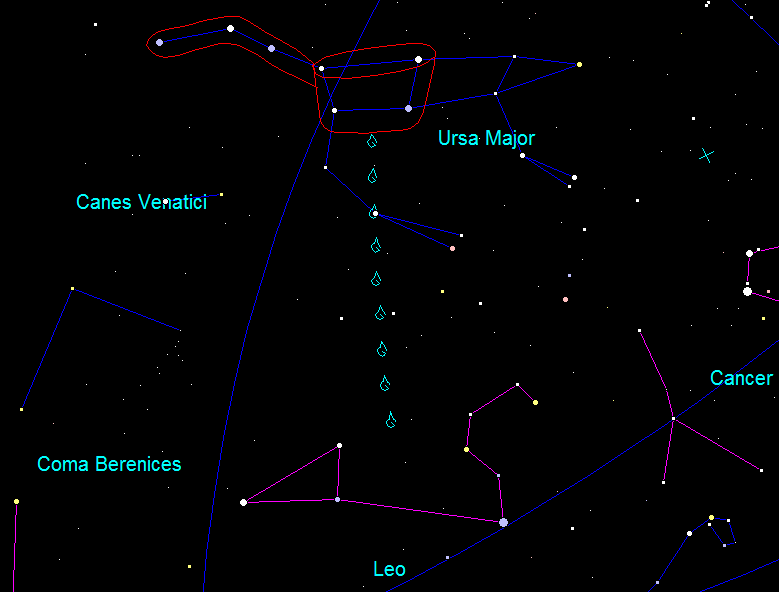
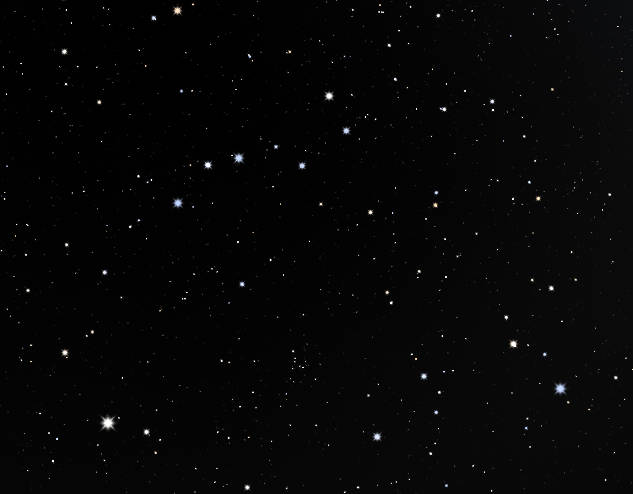
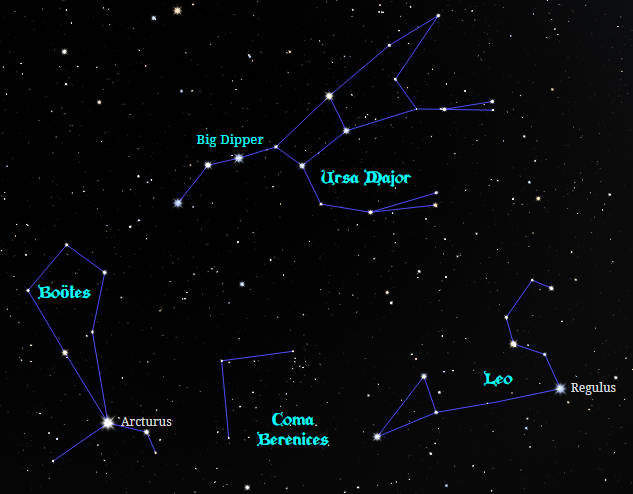
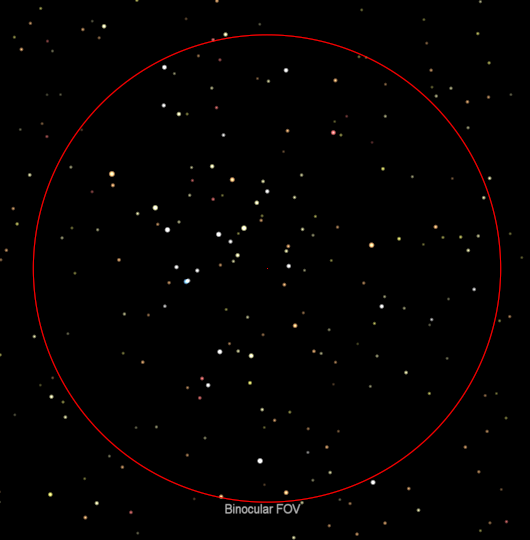
The constellations that we know are mostly those that come from the Sumerians and other civilizations who lived around what is now modern day Iraq. They were adopted and adapted by the ancient Greeks, and to us. Foremost of these was Leo the lion, seen high in the south-southeastern sky at 10 PM. It is easily found by imagining the bottom of the Big Dipper leaks. It will drip on the back of Leo, with its distinctive backward question mark as his front with his head and mane. To the Greeks he was the Nemean Lion, whose coat was impervious to arrows or spears. Heracles (Hercules) was able to kill it by first stunning it with a club then strangling it with his bare hands. It was the first of his Twelve Labors.
The astronomical event times given in this blog are for the Traverse City/Interlochen area of Michigan (Lat 44.7° N, Long 85.7° W; EST, UT – 5 hours) unless stated otherwise. Times will be different for other locations.
Addendum