Archive
02/03/2014 – Ephemeris – Why we don’t see unicorns anymore
Ephemeris for Monday, February 3rd. The sun will rise at 7:58. It’ll be up for 9 hours and 55 minutes, setting at 5:54. The moon, 3 days before first quarter, will set at 10:58 this evening.
Among all the constellations in the sky of animals real and mythical, there is also a unicorn. It’s called Monoceros, and inhabits the southern sky at 9 p.m. bounded by Orion on the right, Canis Major, the great dog below and Canis Minor, the little dog to the left. Unfortunately for observers without optical aid Monoceros, though large, is devoid of any but the faintest stars. Maybe that’s why no one sees unicorns anymore. It has many faint stars because the Milky Way runs through it. To the telescope it is a feast of faint nebulae or clouds of gas and dust, the birth place of stars, including the red rose of the Rosette Nebula, and the strange and tiny Hubble’s Variable Nebula. It contains no bright stars, but a wealth of wonders below the surface so to speak.
Times are for the Traverse City/Interlochen area of Michigan. They may be different for your location.
Addendum
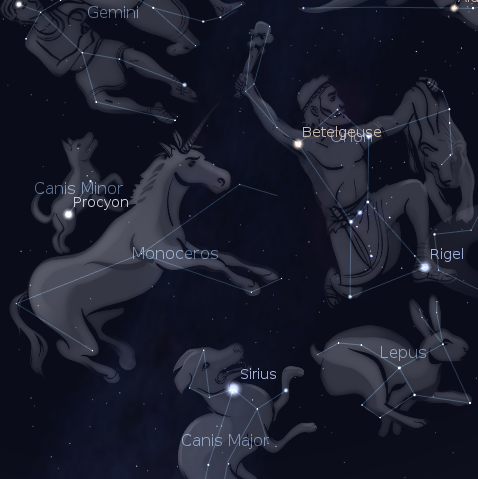
Moniceros the unicorn. See really, really dim stars. Created using Stellarium.
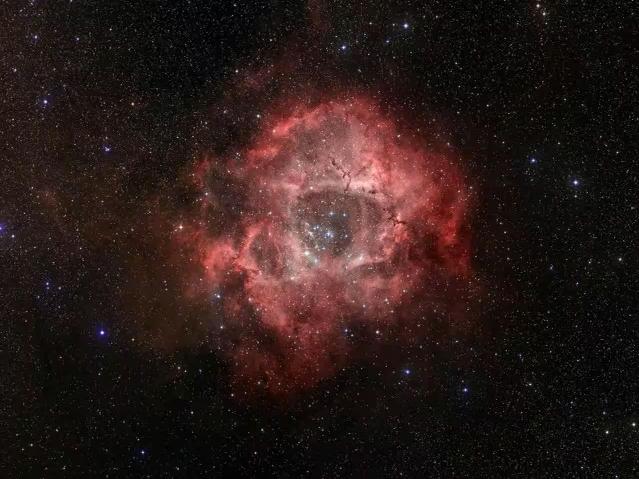
Rosette Nebula in the infrared from the Spitzer Space Telescope. Credit: NASA/JPL/Caltech
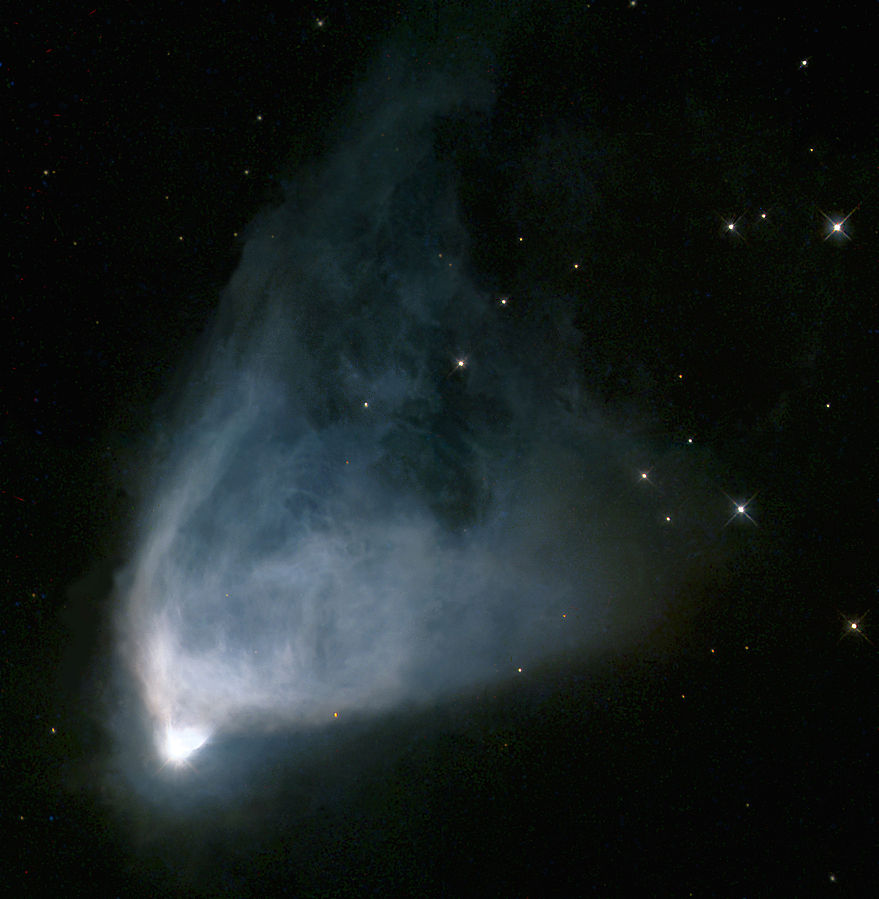
Hubble’s Variable Nebula photographed appropriately enough by the Hubble Space Telescope. Credit: NASA/ESA and The Hubble Heritage Team (AURA/STScI).

Another nebula: The Cone Nebula as seen with the Hubble Space Telescope. Credit ESA/Hubble
 Bob Moler's Ephemeris Blog