Archive
03/19/2014 – Ephemeris – Wednesday is bright planet day
Ephemeris for Wednesday, March 19th. The sun will rise at 7:47. It’ll be up for 12 hours and 6 minutes, setting at 7:53. The moon, 3 days past full, will rise at 11:19 this evening.
Wednesday is bright planet day on Ephemeris. Jupiter will be in the southern sky as darkness falls tonight. It’s cruising against the stars of Gemini now, and moving east after spending a couple of months backtracking to the west. It will pass due south at 8:39 p.m., and will set at 4:22 a.m. in the west-northwest. Reddish Mars is in Virgo now and left and a bit above bright star Spica in the late evening, which it now outshines. Mars will rise at 9:56 p.m. It will pass due south at 3:29 a.m. Saturn will rise at 12:21 a.m. in the east-southeast. It’s seen against the stars of Libra the scales this year. Venus will rise at 5:48 tomorrow morning and shines brightly in the southeast before sunrise. It will reach its greatest angle from the sun on Saturday.
Times are for the Traverse City/Interlochen area of Michigan. They may be different for your location.
Addendum
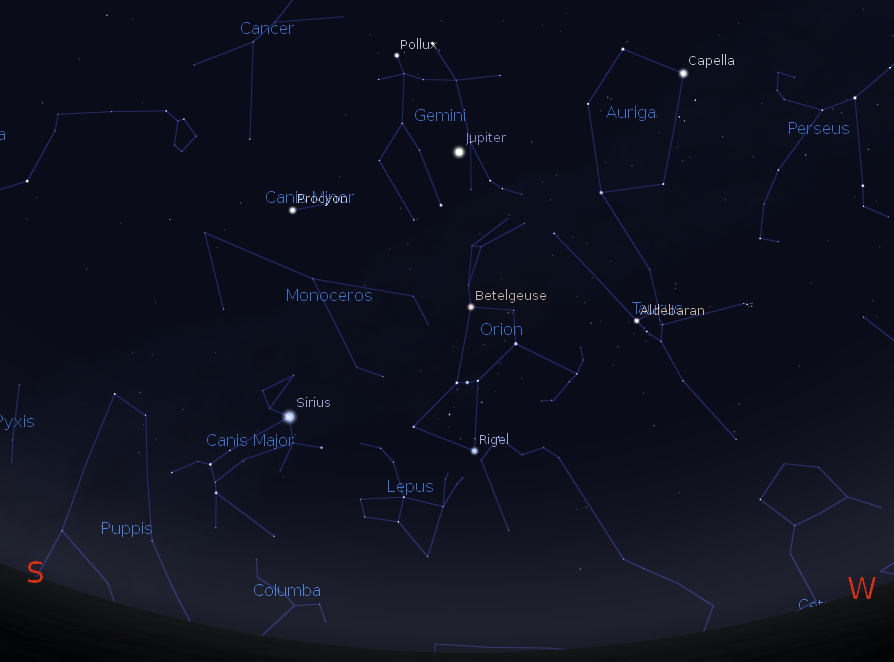
Jupiter and the winter constellations at 10 p.m. on March 19, 2014. Created using Stellarium.
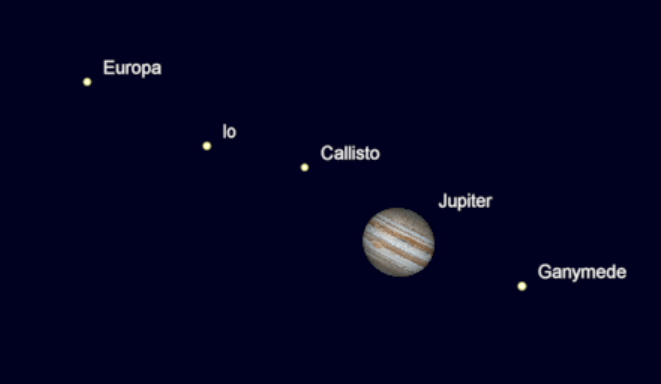
- Jupiter and moons at 10 p.m. on March 19, 2014. Created using Cartes du Ciel.
Note the Great Red Spot. It will transit the disk ( be centered) at 10:48 p.m. Since the 1960’s the Great Red Spot has not been that red. It’s faded quite a bit since then. I tend to think of it a a pastel pink. This is a north is up view, but most telescopes invert the image and/or show a mirror image, so don’t give up too soon.
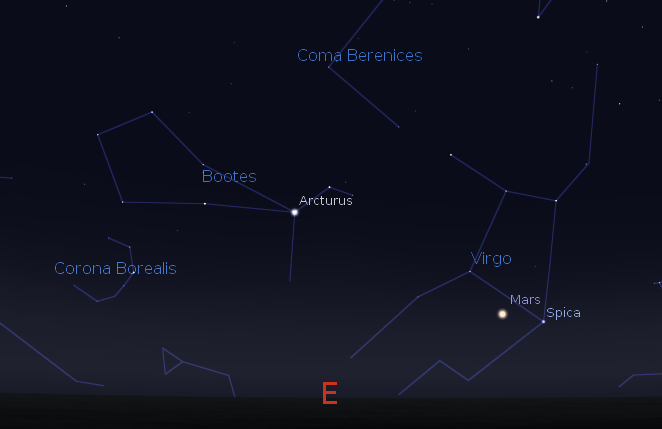
Mars low in the east at 11 p.m. on March 19, 2014. Created using Stellarium.
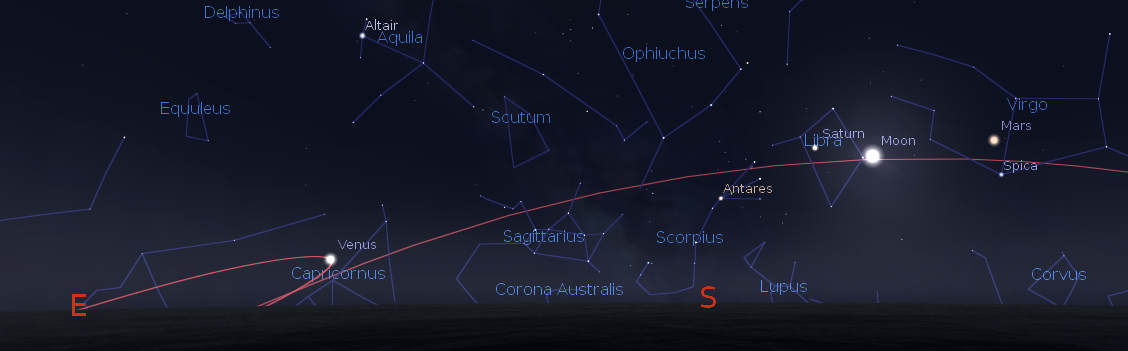
- Mars, Saturn, and Venus with the constellations of summer at 6:30 a.m. on March 20, 2014. I’ve added Venus’ orbit and the ecliptic. Created using Stellarium.
Saturday Venus will be at its greatest western elongation from the sun of 47º. As can be seen it’s about there now. The ecliptic is the plane of the earth’s orbit, and the other planets stick reasonably close to it because the solar system is essentially flat. I’m sure the new Cosmos will cover how the solar system formed and the reason the solar system is flat and also one way.
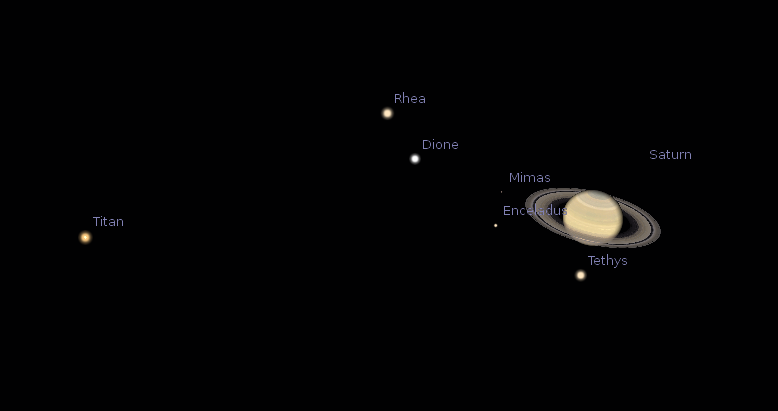
Saturn and its moons at 6:30 a.m., March 20, 2014. Only the moon Titan can be easily seen in small telescopes. Created using Stellarium.
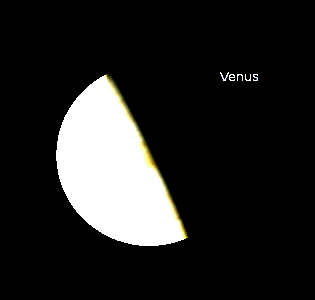
Venus at 6:30 a.m., March 20, 2014. I burned in the image of Venus because that’s what it looks like. Stellarium shows the Venusian clouds as seen in ultraviolet light. In white light Venus is a cue ball. Created using Stellarium.
Spring starts tomorrow!
 Bob Moler's Ephemeris Blog