Archive
06/03/2014 – Ephemeris – Observing Saturn’s rings over the years
Ephemeris for Tuesday, June 3rd. Today the sun will be up for 15 hours and 22 minutes, setting at 9:22. The moon, 2 days before first quarter, will set at 1:11 tomorrow morning. Tomorrow the sun will rise at 5:59.
The planet Saturn is now well placed to see with a telescope. It’s located in the southeast. The brightest star in that direction. It takes a telescope of only 20 power magnification to spot the rings. A bit more power and the planet can be detected apart from the rings. Most of the light reflected by Saturn comes from the rings. The rings are still opening up, and will be for the next 3 years. The rings orbit the planet over its equator, and Saturn has an axial tilt of some 26 degrees. Over Saturn’s nearly 30 year journey around the sun, its seasonal changes go from solstice when the rings are open wide, to equinox where the rings, only about 90 feet [30 meters] thick on average, seem to disappear.
Times are for the Traverse City/Interlochen area of Michigan. They may be different for your location.
Addendum
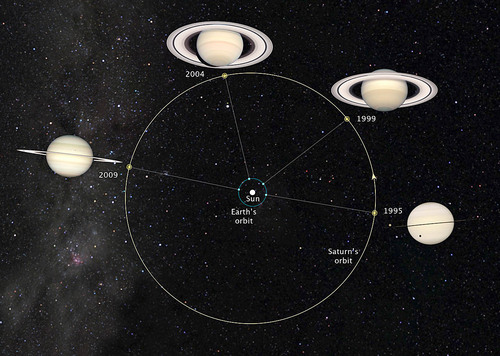
Saturn’s ring appearances over that last Saturnian half-year from the equinox in 1995 through southern hemisphere spring and summer to the equinox 2009. Illustration Credit: NASA, ESA, and Z. Levay (STScI)
06/02/2014 – Ephemeris – The Big Dipper points to other stars and constellations
Ephemeris for Monday, June 2nd. Today the sun will be up for 15 hours and 21 minutes, setting at 9:21. The moon, 3 days before first quarter, will set at 12:41 tomorrow morning. Tomorrow the sun will rise at 5:59.
The Big Dipper points to other stars and constellations. Right now the Big Dipper is nearly overhead. The front bowl stars point to Polaris, the North Star which never seems to move in the sky. The handle can be used to find two stars. First follow the arc of the handle away from the bowl to find the fourth brightest night time star Arcturus in the base of the kite shaped constellation of Boötes. Straighten the arc to a spike and continue to the south and you will come to the bright blue-white star Spica in Virgo the virgin. Don’t confuse it with reddish Mars to the right of it now. You can remember these stars with the phrase “Follow the arc of the handle to Arcturus and then spike to Spica”
Times are for the Traverse City/Interlochen area of Michigan. They may be different for your location.
Addendum
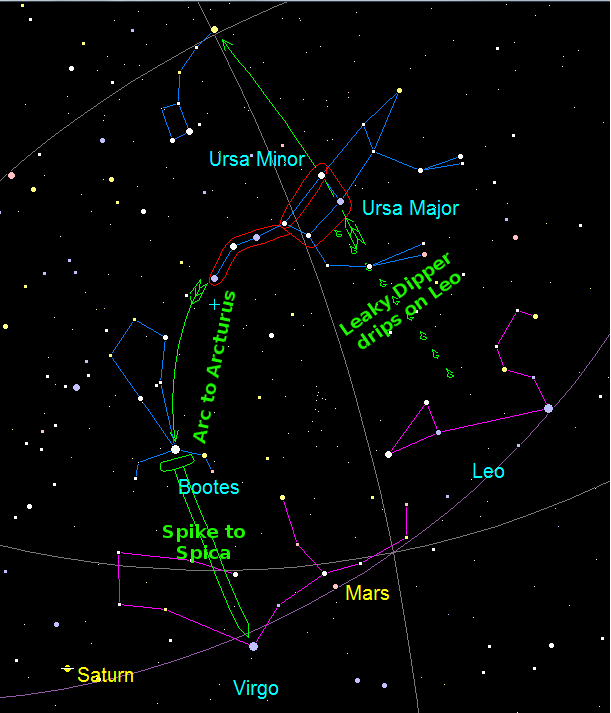
The Big Dipper can be used to point to other stars and constellations in the spring sky. Credit: My LookingUp program.
 Bob Moler's Ephemeris Blog