Archive
09/02/2014 – Ephemeris – Viewing the first quarter Moon
Ephemeris for Tuesday, September 2nd. The sun will rise at 7:06. It’ll be up for 13 hours and 11 minutes, setting at 8:17. The moon, at first quarter today, will set at 12:52 tomorrow morning.
Tonight on the moon there are some very prominent craters on the terminator or sunrise line that’s cutting the moon in half. From the top or north of the moon there’s Plato, which is also called a ringed plain because it has a flat floor. South of there is Eratosthenes, at the end of the arc of the Apennines mountain chain. At the south or bottom end of the moon are two other of my favorite craters. First is the crater Tycho, that doesn’t look spectacular now, but will when the Moon is full with its rays of ejecta crossing a long way across the face of the moon. A little bit farther south, partially entering sunlight is the large crater Clavius. On my blog, bobmoler.wordpress.com, I’ll illustrate what the Moon’s image looks like in different types of telescopes.
Times are for the Traverse City/Interlochen area of Michigan. They may be different for your location.
Addenda
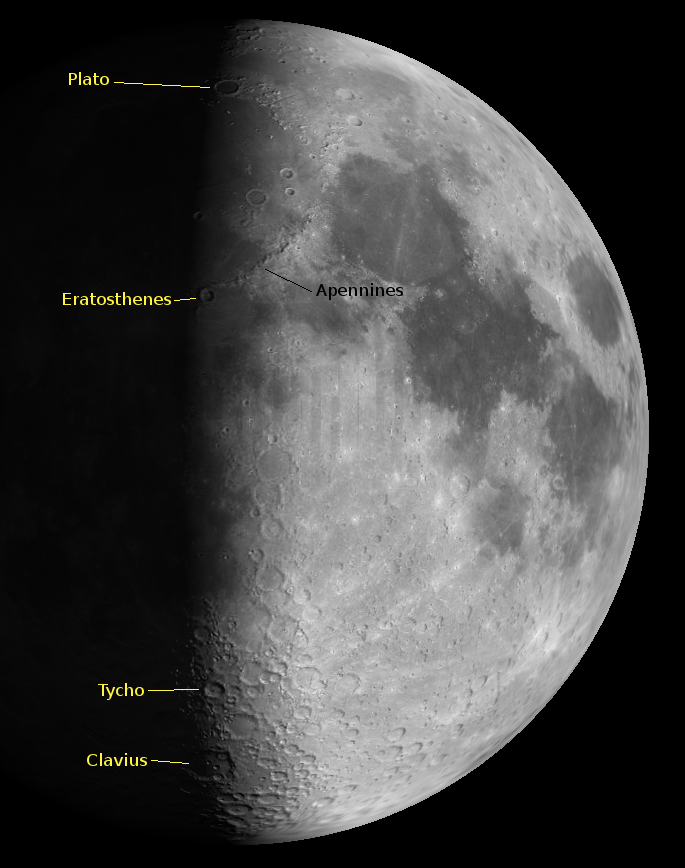
The Moon tonight at 9 p.m. (September, 2, 2014). Created using Virtual Moon Atlas.
Image orientation in telescopes
The orientation of what one sees in an astronomical telescope depends on the type of telescope and the placement of the eyepiece. The orientations shown are for observers in the northern hemisphere. For the images below the moon shown is due south.
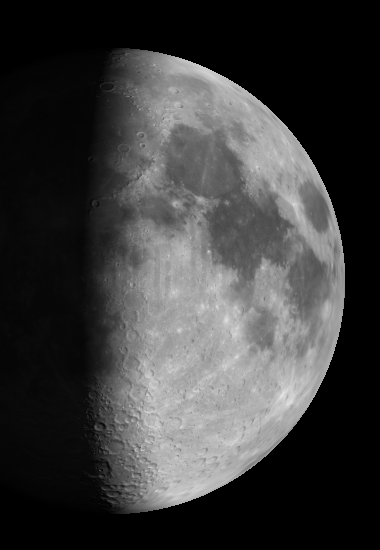
The orientation of the Moon as seen with the naked eye, binoculars, spotting scopes and telescopes with an erecting eyepiece.
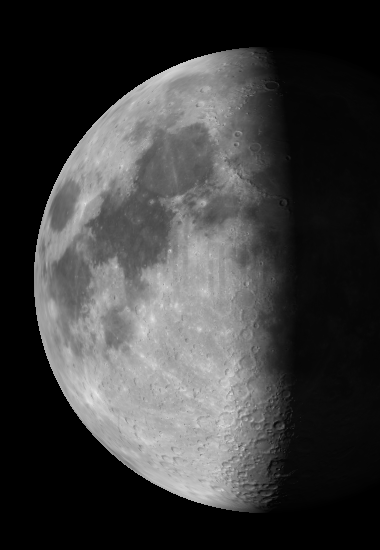
The orientation of the Moon as seen in a refractor or a Schmidt-Cassigrain or similar type reflector with a diagonal at the eyepiece end, and the eyepiece pointing up. This is a mirror image due to an odd number of mirror reflections in the telescope.
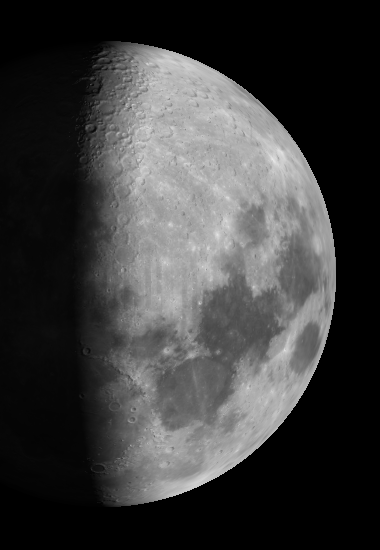
The orientation of the Moon as seen with a refractor or Schmidt-Cassigrain and diagonal with the eyepiece oriented horizontally. It is a n inverted mirror image.
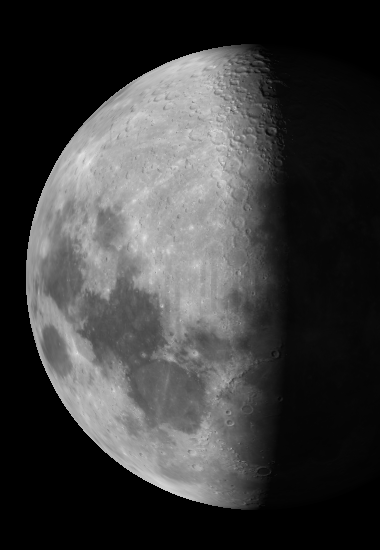
The orientation of the moon through a Newtonian reflector or a refractor without an eyepiece diagonal. It is an inverted image, an image rotated 180 degrees.
For southern hemisphere observers for these images to work the moon would be due north and all the images would have to be upside down.
Correction 09/02/2014 11:07 p.m.
All images created using Virtual Moon Atlas.
09/01/2014 – Ephemeris – Previewing the month of September
Ephemeris for Labor Day, Monday, September 1st. The sun will rise at 7:04. It’ll be up for 13 hours and 14 minutes, setting at 8:19. The moon, 1 day before first quarter, will set at 12:02 tomorrow morning.
Let’s look at the skies for the month of September. The sun will moving at its greatest speed in its retreat to the south. Daylight hours in the Interlochen/Traverse City area and will drop from 13 hours and 14 minutes today to 11 hours 45 minutes on the 30th. The altitude of the sun above the southern horizon at local noon will be 54 degrees today, and will descend to 42 degrees on the 30th. The season of summer is getting short, so enjoy it while you can. Summer ends and autumn begins at 10:30 p.m. on September 22nd. Saturn is retreating toward the sun now. Mars is pushing on eastward. On the 27th Mars will be north of the star Antares. It will be a good time to compare their colors.
Times are for the Traverse City/Interlochen area of Michigan. They may be different for your location.
Addendum
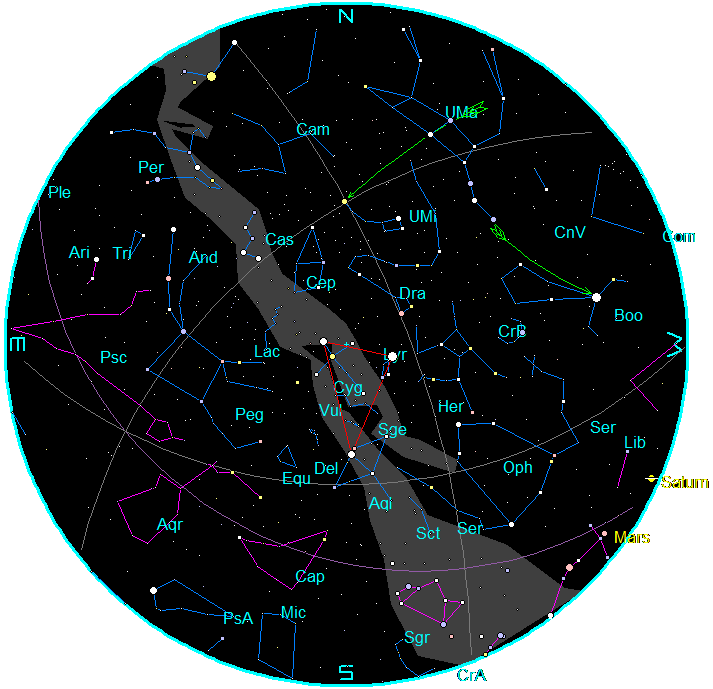
September star chart for 10 p.m. on September 15, 2014. Created by my LookingUp program.
The Moon is not plotted. The planets are plotted for the 15th. Mars will move eastward through the month and will approach Saturn.
Astronomical twilight ends at 10:05 p.m. on September 1st, decreasing to 9:01 on the 30th.
Add a half hour to every week before the 15th and subtract and hour for every week after the 15th.
For a list of constellation names to go with the abbreviations click here.
Also shown is the Summer Triangle in red. Clockwise from the top star is Deneb in Cygnus, Vega in Lyra and Altair in Aquila.
The green pointers from the Big Dipper are:
- Pointer stars at the front of the bowl of the Big Dipper point to Polaris the North Star.
- The arc of the dipper’s handle points to Arcturus.
 Bob Moler's Ephemeris Blog