Archive
03/04/2015 – Ephemeris – Our weekly look at the bright planets
Ephemeris for Wednesday, March 4th. The Sun will rise at 7:15. It’ll be up for 11 hours and 18 minutes, setting at 6:34. The Moon, 1 day before full, will set at 6:59 tomorrow morning.
Lets take a look at the bright planets for this week. Brilliant Venus is in the west by 7:30 p.m. It will set at 9:13 p.m. It’s separating from Mars which appears below and right of it. The Red Planet will set tonight at 8:47 p.m. Jupiter will appear In the southeastern sky in the evening. It will be up just about all night, and will set at 6:16 a.m. It’s near the sickle-shaped head of Leo the lion, and it’s the brightest star-like object in the sky. In telescopes tonight the moon Io will be behind Jupiter and will pop into sunlight a bit away from the planet at 9:39 p.m. Tomorrow night the 5th the moon Europa will duck behind Jupiter at 8:48 p.m. After that only 3 of the moons will be visible, until 12:57 a.m. when Europa will appear on the other side.* Early risers will be able to spot Saturn which will rise in the east-southeast at 1:25 a.m. It’s in the south at 6 a.m.
Times are for the Traverse City/Interlochen area of Michigan. They may be different for your location.
* Due to a date mix up the radio program may be incorrect. The occultation of Europa on the 5th being set on the 4th. The Io occultation is since added.
Addendum
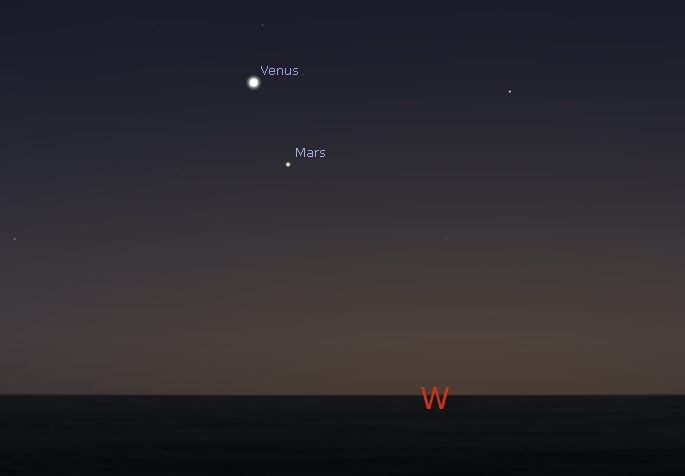
Venus and Mars in the west at 7:30 p.m. on March 4, 2015. Created using Stellarium.
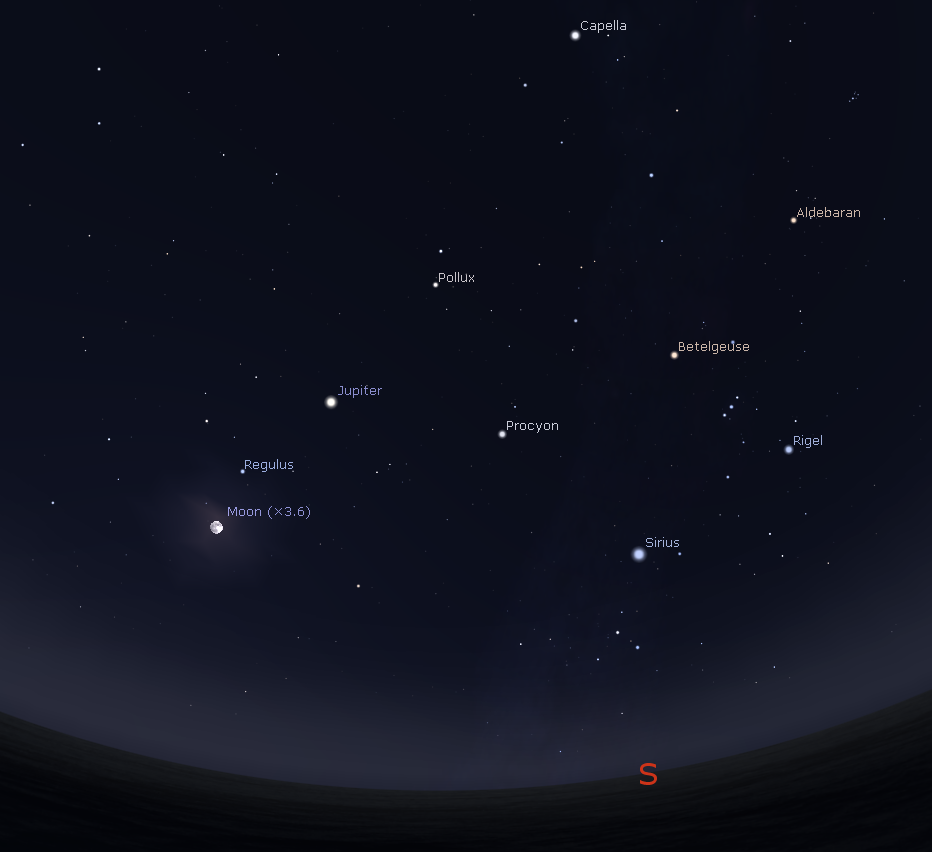
Jupiter, the full Moon and the winter stars at 9 p.m. on March 4, 2014. Created using Stellarium.
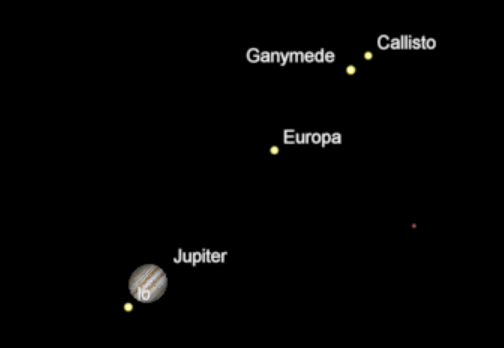
Jupiter and moons at 9:39 p.m., when Io leaves Jupiter’s shadow on March 4, 2015. Created using Cartes du Ceil (Sky Charts).
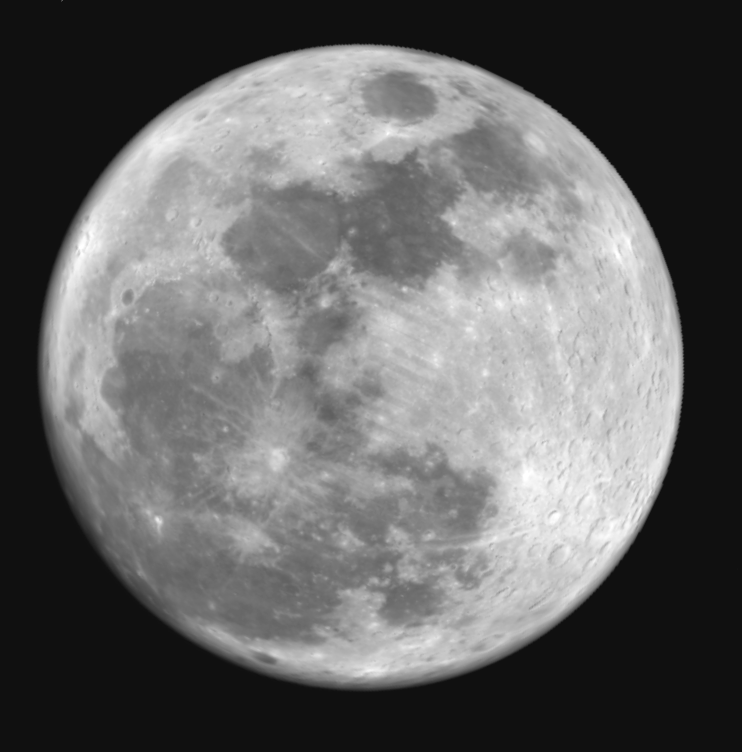
The nearly full moon at 9 p.m. on March 4, 2015. Created using Virtual Moon Atlas.
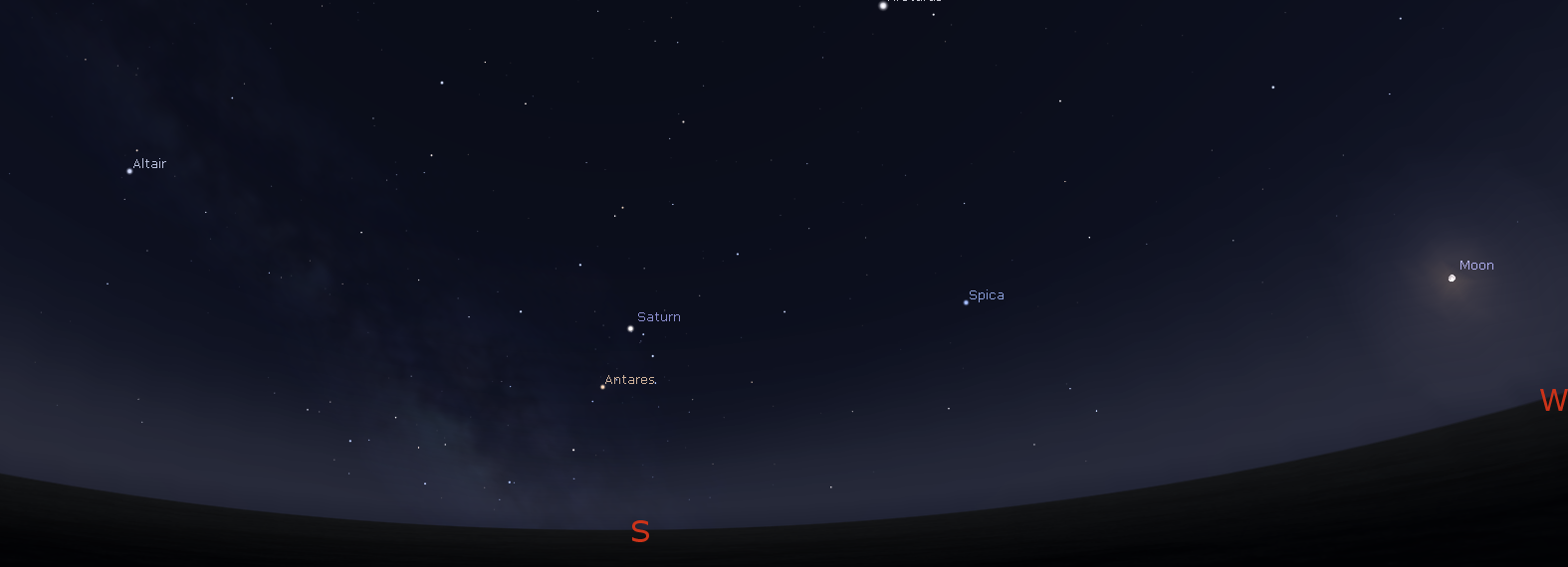
Looking south toward Saturn along with the summer stars and the setting Moon in the west at 6 a.m. March 5, 2015. Created using Stellarium.
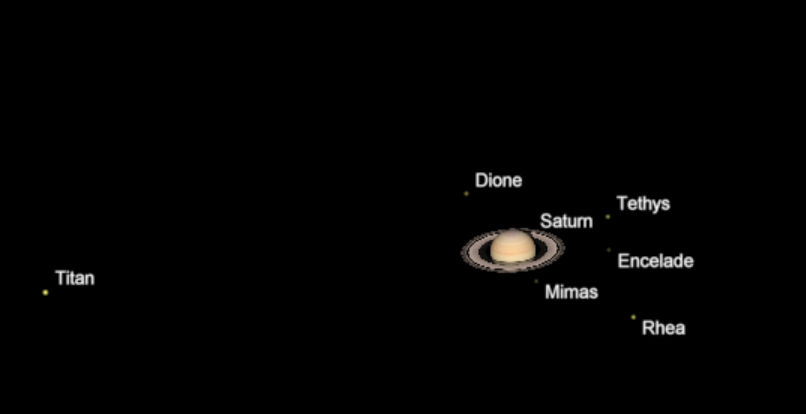
What Saturn and its moons might appear like in a telescope at 6 a.m., March 5, 2015. Small telescopes will show only the moon Titan. Created using Cartes du Ceil (Sky Charts).
03/03/2015 – Ephemeris – The bright spots on Ceres are still a mystery
Ephemeris for Tuesday, March 3rd. The Sun will rise at 7:17. It’ll be up for 11 hours and 15 minutes, setting at 6:32. The Moon, 2 days before full, will set at 6:30 tomorrow morning.
The Dawn spacecraft is approaching the asteroid Ceres. It will be gently captured by Ceres on the 6th. This as an update from the date I gave you yesterday. Then the spacecraft will spiral closer and closer to the asteroid over the next few months. There is a mystery spot on Ceres, a bright spot that was visible by the Hubble Space Telescope orbiting Earth. As Dawn got close enough to resolve Ceres it too saw the bright spot. As the spacecraft got even closer the spot showed to be smaller and smaller. I thought it might be a crater that penetrated into Ceres icy interior. But the latest image, taken February 19th shows that the bright spot has a companion spot, both inside a crater and still too small to resolve. It’s still a mystery.
Times are for the Traverse City/Interlochen area of Michigan. They may be different for your location.
Addendum
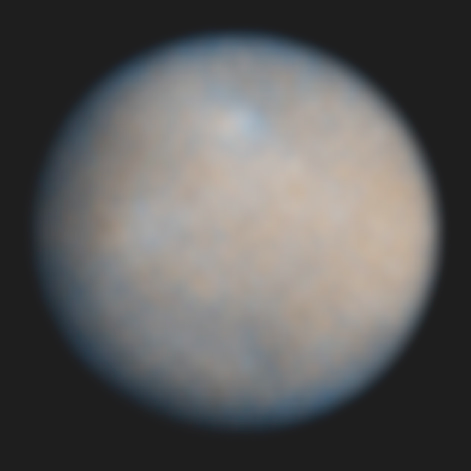
Hubble’s best photo of Ceres. Note the white spot near the top of the image. Image Credit: NASA, ESA, J. Parker (Southwest Research Institute), P. Thomas (Cornell University), L. McFadden (University of Maryland, College Park), and M. Mutchler and Z. Levay (STScI)
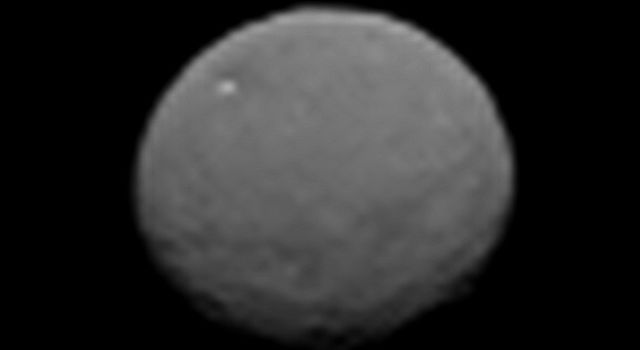
The white spot shows as Dawn approaches Ceres. Credit: NASA/JPL.
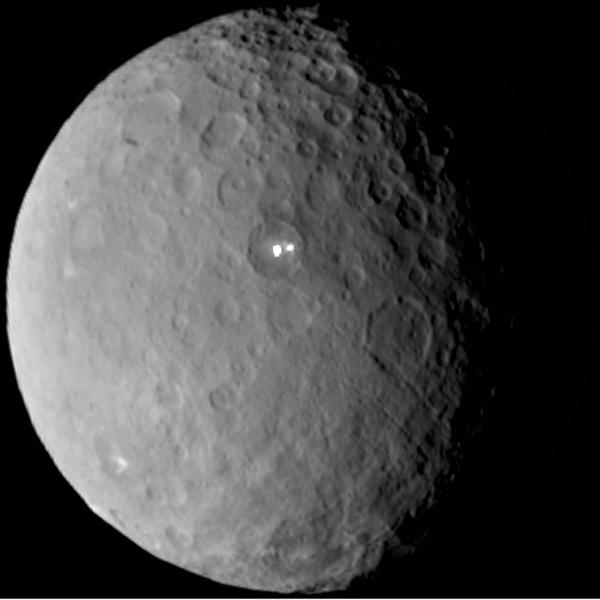
The bright spot is two. Picture taken February 19, 2015 from 29,000 miles (46,700 km). Credit: NASA/JPL-Caltech/UCLA/MPS/DLR/IDA.
This photo will be the best photo of the bright spots until the end of April, an Dawn maneuvers over the night side of Ceres.
On March 2nd NASA held a Dawn Mission Pre- Close Approach News Briefing which can be found on YouTube.
03/02/2015 – Ephemeris – The Dawn spacecraft (The turtle wins the race)
Ephemeris for Monday, March 2nd. The sun will rise at 7:19. It’ll be up for 11 hours and 12 minutes, setting at 6:31. The moon, 3 days before full, will set at 6:00 tomorrow morning.
On Thursday March 5th NASA’s Dawn spacecraft will fall under the gravitational influence of the asteroid, or actually recently promoted dwarf planet Ceres and enter orbit. The journey took 7 years including an intermediate year-long stop at the asteroid Vesta. Dawn uses the latest in ion thrusters, or latest when it was launched. Using power generated by its solar panels it ejects xenon ions from one of its three ion thrusters to produce a thrust comparable to the weight of a piece of paper. It can accelerate the spacecraft from zero to 60 miles per hour in a few days. In the tale of the hare and the tortoise it’s in the tortoise class, at least to start. Ion engines are 10 times as efficient as chemical rockets and they can thrust for years.
Times are for the Traverse City/Interlochen area of Michigan. They may be different for your location.
Addendum
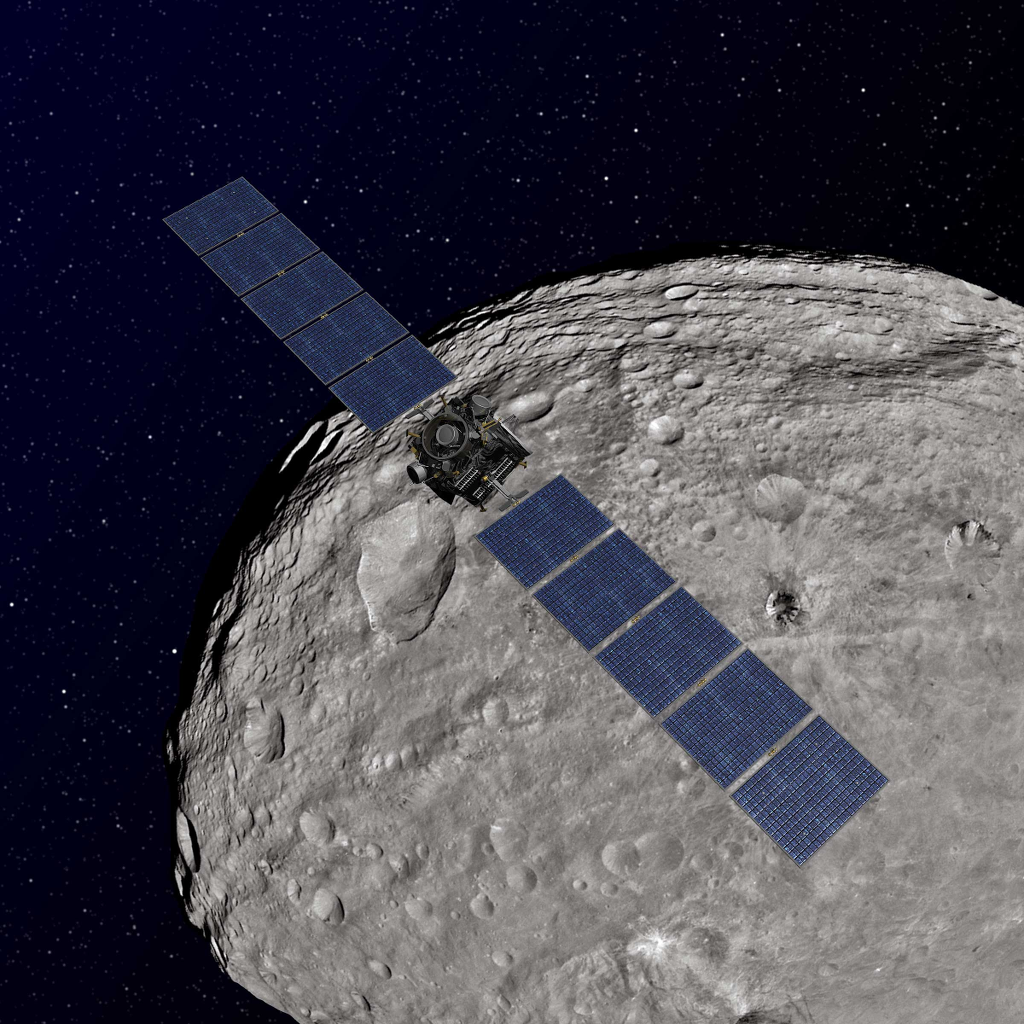
Artist’s rendition of the Dawn spacecraft at Vesta. Credit: NASA/JPL
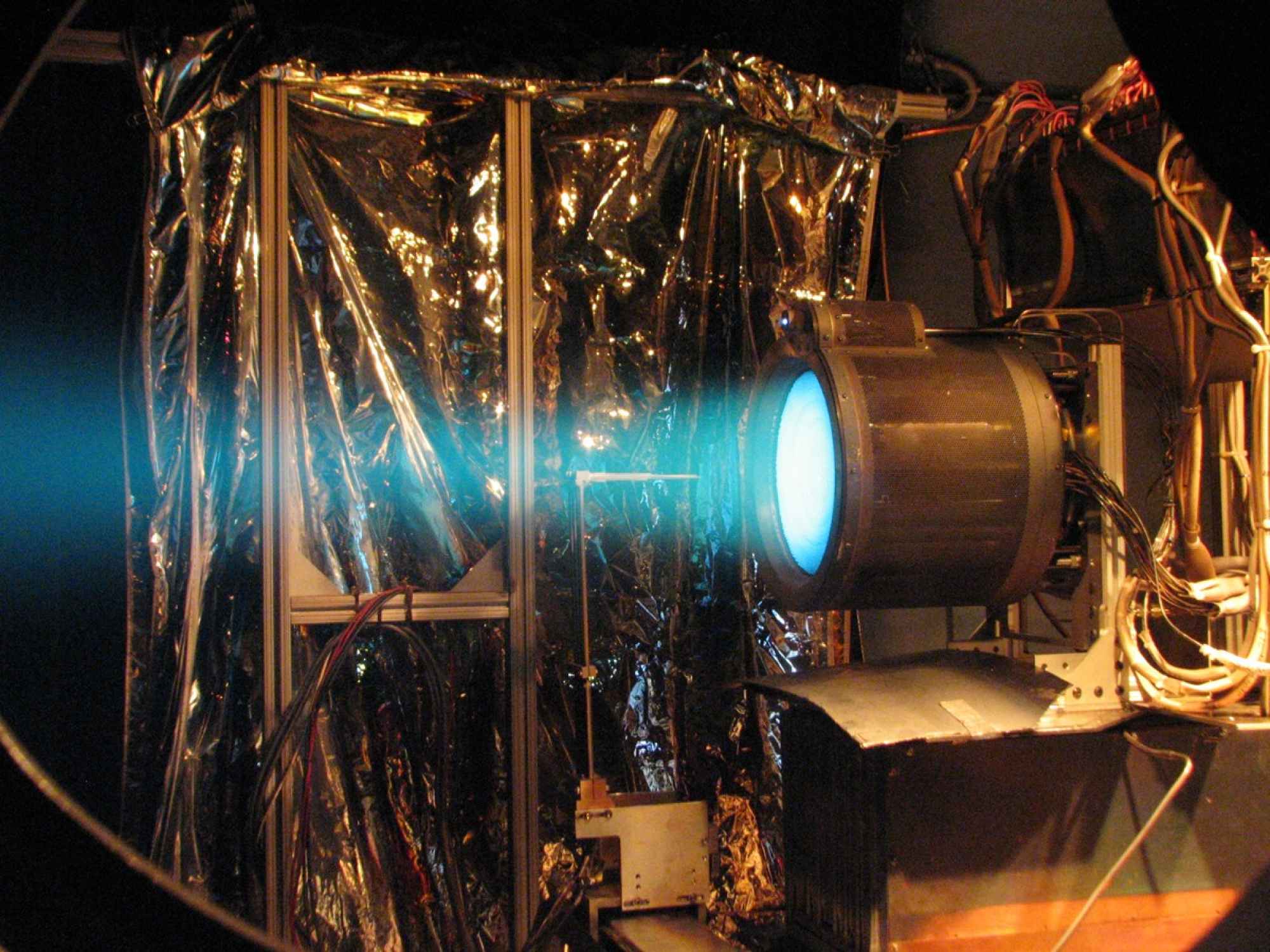
Ion engine test. Xenon ions glow blue. Credit NASA.
 Bob Moler's Ephemeris Blog