Archive
02/01/2016 – Ephemeris – Previewing February
Ephemeris for Monday, February 1st. The Sun will rise at 8:02. It’ll be up for 9 hours and 48 minutes, setting at 5:50. The Moon, 1 day past last quarter, will rise at 2:34 tomorrow morning.
Let’s preview the month of February. It will be a day longer this year because it’s a leap year, the adjustment to keep the calendar in sync with the seasons. The daylight hours throughout February will be getting longer. Daylight hours will increase from 9 hours and 48 minutes today to 11 hours and 8 minutes on the 29th. The altitude of the sun at noon will increase from 28 degrees tomorrow to nearly 38 degrees at month’s end. The straits area will see the sun a degree lower. Local noon, by the way for Interlochen and Traverse City is about 12:56 p.m, which is mainly due to the fact that our standard time meridian happens to run through Philadelphia and the Sun is currently running 13 minutes slow.
Times are for the Traverse City/Interlochen area of Michigan. They may be different for your location.
Addenda
February Star Chart
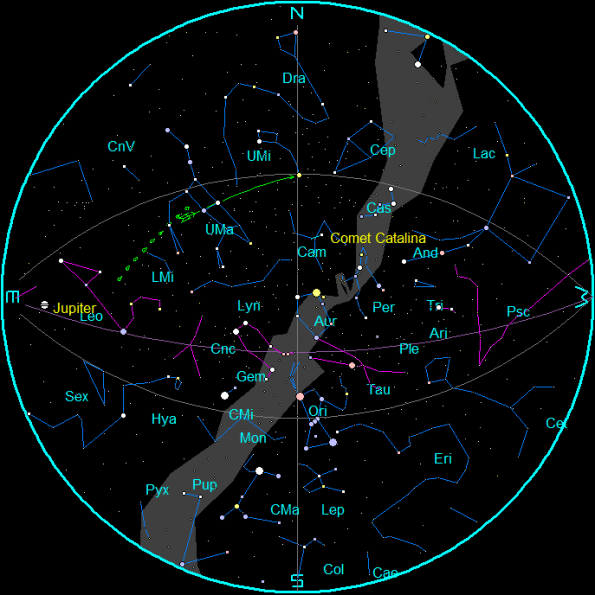
Star Chart for February 2016. Created using my LookingUp program. To enlarge in Firefox Right-click on image then click View image.
The planets and stars are plotted for the 15th at 9 p.m. EST. That is chart time. Note, Traverse City is located 45 minutes behind our time meridian. To duplicate the star positions on a planisphere you may have to set it to 45 minutes earlier than the current time.
Evening astronomical twilight ends at 6:56 p.m. EST on January 1st, increasing to 7:33 p.m. EST on the 29th.
Morning astronomical twilight starts at 6:56 a.m. EST on January 1st, and decreasing to 6:18 a.m. EST on the 29th.
Add a half hour to the chart time every week before the 15th and subtract and hour for every week after the 15th.
For a list of constellation names to go with the abbreviations click here.
- Pointer stars at the front of the bowl of the Big Dipper point to Polaris the North Star
- A leaky Big Dipper drips on Leo
Calendar of Planetary Events
Credit: Sky Events Calendar by Fred Espenak and Sumit Dutta (NASA’s GSFC)
To generate your own calendar go to http://eclipse.gsfc.nasa.gov/SKYCAL/SKYCAL.html
Times are Eastern Time. Some additions made to aid clarity.
     Date   Local    Event
            Time EST
Feb  01  Mo  3:48 am Moon-Mars: 3° S
     01  Mo          Venus: 31.4° W
     03  We  2:05 pm Moon-Saturn: 3.8° S
     04  Th 11:34 pm Moon South Dec.: 18.3° S
     06  Sa  2:32 am Moon-Venus: 4.5° S
     06  Sa 11:47 am Moon-Mercury: 3.9° S
     06  Sa  7:59 pm Mercury Greatest Elongation: 25.6° West
     08  Mo  9:39 am New Moon
     10  We  3:46 pm Moon Descending Node
     10  We  9:42 pm Moon Perigee: 364400 km
     12  Fr  9:32 pm Mercury-Venus: 4° N
     15  Mo  2:46 am First Quarter
     16  Tu  2:41 am Moon-Aldebaran: 0.4° S
     17  We  6:18 pm Moon North Dec.: 18.3° N
     22  Mo  7:48 am Moon-Regulus: 2.7° N
     22  Mo  1:20 pm Full Moon
     23  Tu 10:58 pm Moon-Jupiter: 1.9° N
     24  We  1:10 am Moon Ascending Node
     26  Fr 10:28 pm Moon Apogee: 405400 km
     28  Su 10:17 am Neptune Solar Conjunction
     29  Mo  1:16 pm Moon-Mars: 3.9° S
Mar  01  Tu          Venus: 24.9° W
Comet C/2013 US10 (Catalina)
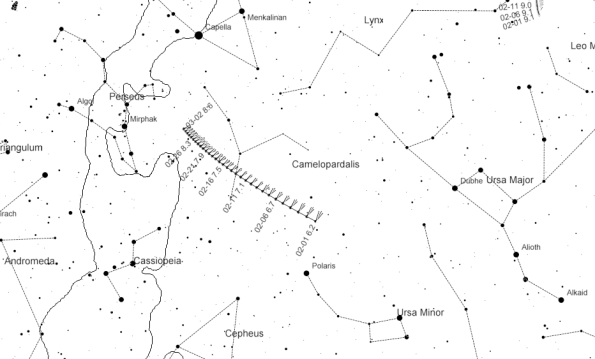
The track of Comet C/2013 US10 (Catalina) for February 2016. Created using Cartes du Ciel (Sky Charts).
The comet magnitudes, given after the date, are now pretty much on track. Comet is plotted every day at 10 p.m. EST (3 hr UT the next day). To monitor the brightness reports from observers go to http://www.aerith.net/comet/catalog/2013US10/2013US10.html.
 Bob Moler's Ephemeris Blog