Archive
05/05/2016 – Ephemeris – Previewing Monday’s transit of Mercury
Ephemeris for Thursday, May 5th. The Sun rises at 6:26. It’ll be up for 14 hours and 26 minutes, setting at 8:53. The Moon, 1 day before new, will rise at 6:38 tomorrow morning.
Next Monday, the 9th, the tiny planet Mercury will be seen to cross that face of the Sun. Astronomers call such an event a transit. The last time a planet crossed the face of it Sun, it was Venus on June 5th, 2012, almost 4 years ago. Very few, who were alive in 2012 will be around to see the next transit of Venus in 2117. Transits of Mercury are more frequent. Mercury will cross the face of the Sun from 7:12 a.m. to 2:42 p.m. on Monday. Mercury is too small to see with eclipse filters or with the naked eye. The latter could cause blindness. Only telescopes with solar filters that fit over the front of the telescope are safe to use. Mercury will be a tiny black dot, smaller than most sunspots. Tomorrow I’ll have information about where to go to see it.
Times are for the Traverse City/Interlochen area of Michigan. They may be different for your location.
Addendum
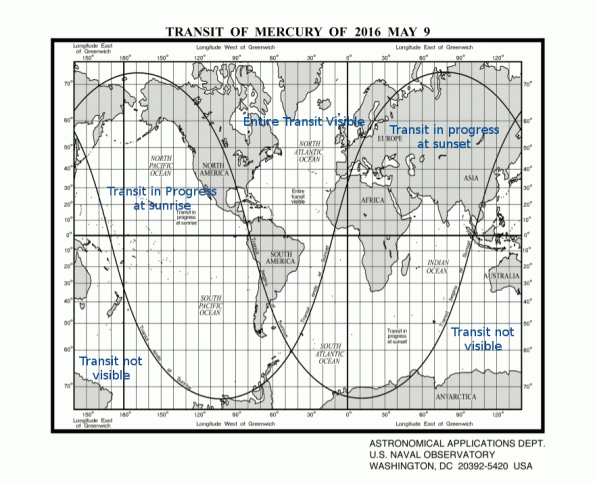
Transit visibility map with added captions to make it more readable. Credit United States Naval Observatory, The Astronomical Almanac Online! 2016
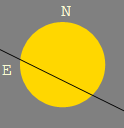
The track of Mercury across the face of the Sun. Mercury will travel from upper left to lower right. Mercury will not be visible until it impinges upon the disk of the Sun. Credit IOTA’s program Occult4.
From IOTA’s Occult4 program
Transit of Mercury on 2016 May 9 (TT)
   {'+' => next day; '-' => previous day }
                                           Overhead at
     Geocentric Event      UTC         P.A.  Long  Lat
                         h  m  s       o      o    o

[1]  Exterior Ingress   11 12 16     83.1     11   17
[2]  Minimum Separation 14 57 38             -45   18
[3]  Exterior Egress    18 42 23    224.4   -102   18

Minimum sepn 318.5";  Radii - Sun 950.4", Mercury 6.0"
delta T =  68.2 secs,  Ephemeris = DE0
Note: These timings are geocentric. Occult4 has timings for various cities of the world. Occult4.0.2 can be downloaded here. They can vary by several minutes for different cities due to parallax.
05/04/2016 – Ephemeris – There are three bright planets out by midnight
Ephemeris for Wednesday, May 4th. The Sun rises at 6:27. It’ll be up for 14 hours and 24 minutes, setting at 8:52. The Moon, 2 days before new, will rise at 5:59 tomorrow morning.
Let’s see what the bright naked eye planets are up to. Mercury is too close to the Sun to be seen. However next Monday it will be so close to the Sun that we’ll see it cross the Sun’s face. Jupiter is in the south in the early evening, and will pass due south at 9:49 p.m., and will set at 4:23 a.m. It’s below the stars of Leo this year. Binoculars can make out some of Jupiter’s moons, but a telescope is required to see all four bright moons and Jupiter’s cloud features. Mars will rise at 10:33 p.m. in the east-southeast. It’s still above its look-a-like star Antares, whose name means Rival of Mars. Mars is getting closer to the Earth now, only 52.2 million miles. 5 and a half million miles to go. Saturn will rise at 11:06 p.m. in the east-southeast. It’s just left of Mars.
Times are for the Traverse City/Interlochen area of Michigan. They may be different for your location.
Addendum
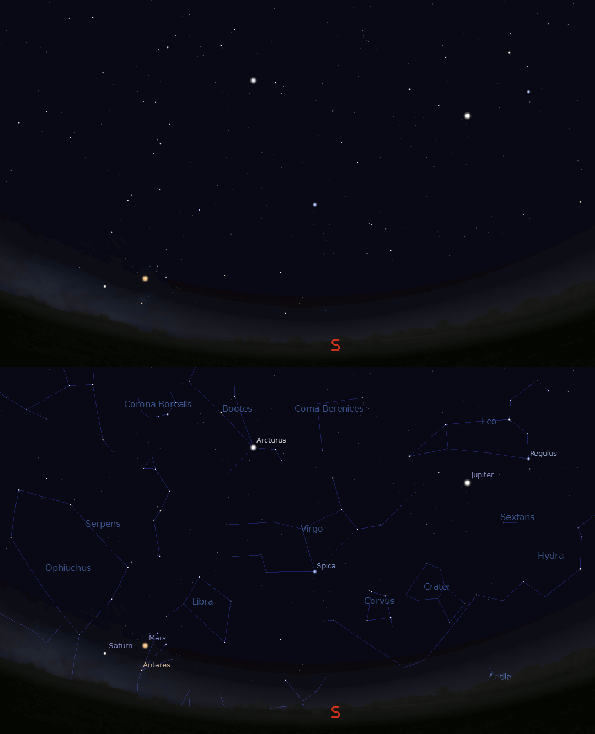
Jupiter, Mars and Saturn at midnight 12:00 a.m. May 5, 2016. Created using Stellarium.
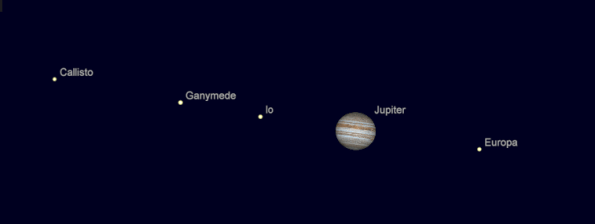
Jupiter and its moons as they might be seen through a telescope at 12 midnight May 5, 2016. It’s 40.3″ in diameter. Created using Cartes du Ciel (Sky Charts).
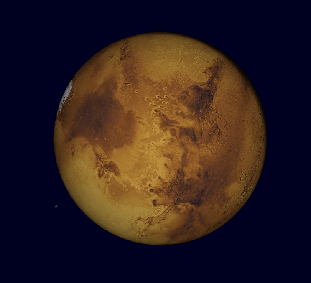
Mars as it might be seen in a large telescope with high power at midnight May 5, 2016. Mars apparent diameter is 16.7″. The central meridian will be 26.77 degrees. Syrtis Major is the large feature in the north near the polar cap. Created using Cartes du Ciel (Sky Charts).
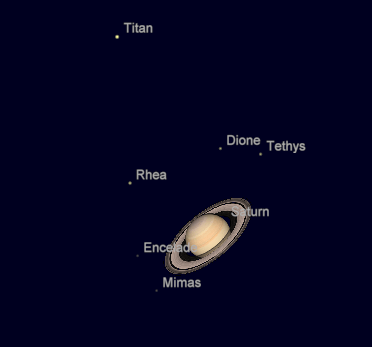
Saturn and its moons at midnight May 5, 2016. The apparent diameter of the planet will be 18.2″. The rings span 42.4″, a bit larger than the apparent diameter of Jupiter. Created using Cartes du Ciel (Sky Charts).
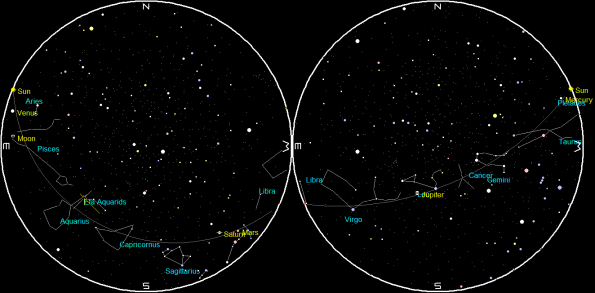
Planets at Sunrise and Sunset of a single night starting with sunset on the right on May 4, 2016. The night ends on the left with sunrise on May 5. I’ve also plotted the Eta Aquariid meteor shower radiant. If using Firefox right-click on the image and select View Image to enlarge the image. That goes for all the large images.
05/03/2016 – Ephemeris – Halley’s Comet is back… In little bitty pieces
Ephemeris for Tuesday, May 3rd. The Sun rises at 6:29. It’ll be up for 14 hours and 21 minutes, setting at 8:50. The Moon, 3 days before new, will rise at 5:23 tomorrow morning.
There’s a meteor shower happening this week that’s a tough one for observers as far north as we are. It’s the Eta Aquariids: seeming to come from the Water Jar asterism of the constellation Aquarius the water bearer. It will reach peak on Thursday the 5th, however the radiant point rises around 3:30 a.m., and twilight starts an hour and a half later. The radiant is also low in the southeastern part of the sky. The meteors are fast-moving and many of them are bright. They are bits shed by Halley’s Comet and left in its orbit. The Earth passes close to Halley’s orbit twice a year: In late October as the particles come in from the outer solar system, and again in early May as they head back out again. We’ll see souvenirs of Halley’s Comet before it returns in 2061.
Times are for the Traverse City/Interlochen area of Michigan. They may be different for your location.
Addendum
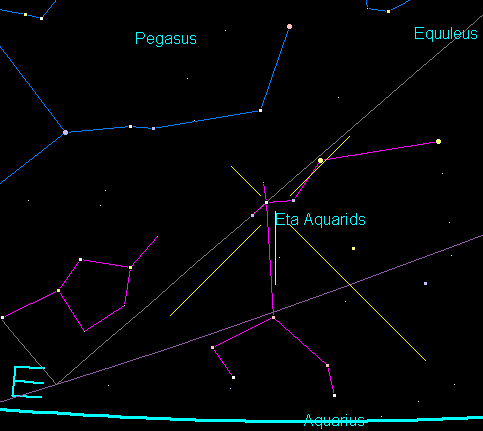
The Eta Aquarid radiant at the peak of the shower. The radiant moves slowly to the east with time. Credit: Bob Moler’s LookingUp program.
This meteor shower is low for us in the Northern Hemisphere, but it will be great for those Down Under. The Moon is even cooperating this year, by getting out of the way. The active dates for the shower are April 19th to May 28th. The velocity of the meteoroids that strike the atmosphere is 66 km/s. Halley’s Comet, and thus its debris is traveling in a retrograde orbit, going the wrong way in a one way solar system, which is why the speed of the particles is so high.
 Bob Moler's Ephemeris Blog