Archive
08/03/2021 – Ephemeris – Centaur or Teapot?
This is Ephemeris for Tuesday, August 3rd. Today the Sun will be up for 14 hours and 33 minutes, setting at 9:05, and it will rise tomorrow at 6:32. The Moon, 3 days past last quarter, will rise at 2:31 tomorrow morning.
In the south and low in the sky at 10:30 p.m. is one of my favorite asterisms the Teapot of the constellation Sagittarius. Sagittarius classically represents a centaur with a bow and arrow aimed at the heart of the constellation Scorpius to its west. I can find the bow and arrow here, but the half man, half horse figure of the centaur eludes me. However, the stout little teapot of the children’s song is quite obvious, with its base, lid on top, handle to the left and the spout to the right. To make things more realistic, the bright Milky Way seems to rise like steam from its spout. As the night goes on, the Teapot slides westward and appears to tilt, pouring its tea on the southwestern horizon. Its appearance in the south is an invitation to explore the milky band with binoculars.
The astronomical event times given are for the Traverse City/Interlochen area of Michigan (EDT, UT – 4 hr). They may be different for your location.
Addendum
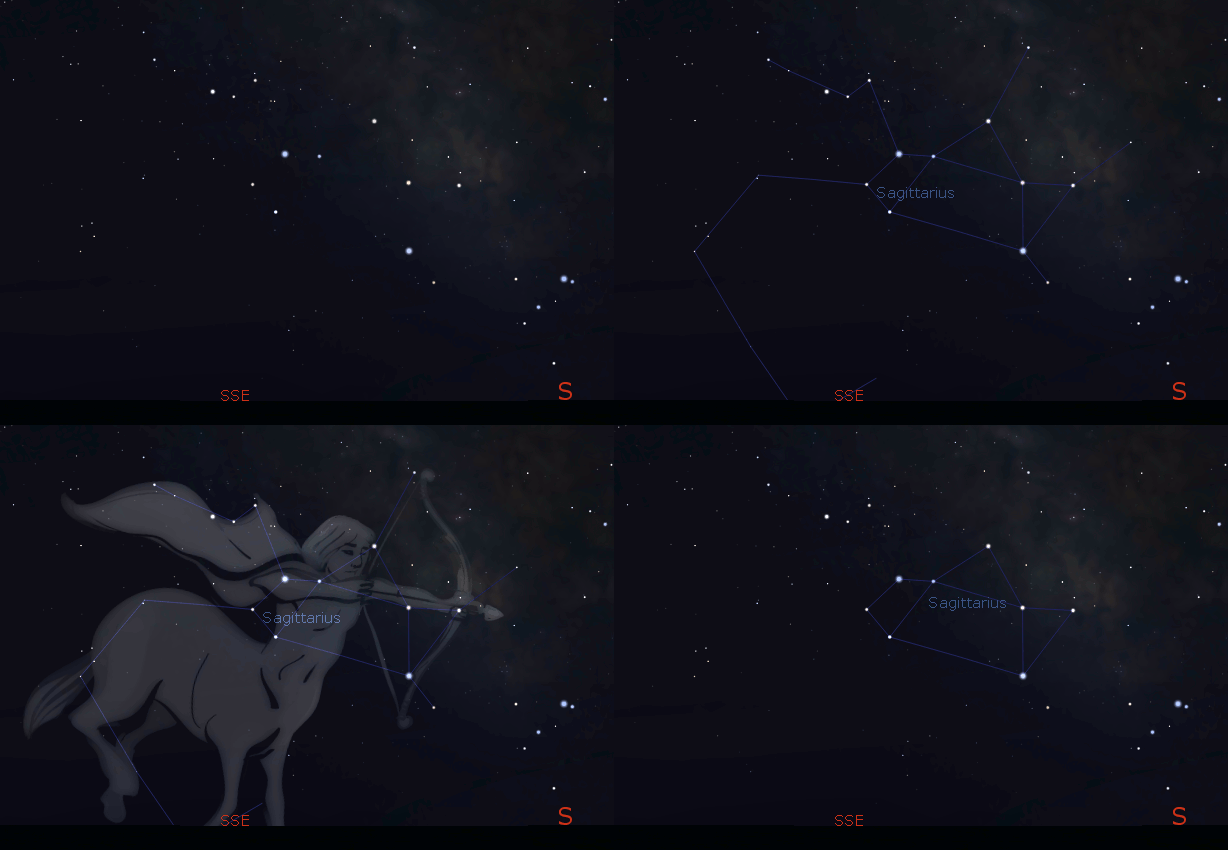
Sagittarius and the Teapot finder animation for tonight, August 3rd. Created using Stellarium.
08/02/2021 – Ephemeris – Saturn is closest to us and enters the evening sky today
This is Bob Moler with Ephemeris for Monday, August 2nd. Today the Sun will be up for 14 hours and 36 minutes, setting at 9:06, and it will rise tomorrow at 6:31. The Moon, 2 days past last quarter, will rise at 1:55 tomorrow morning.
Today the ringed planet Saturn is at opposition, that is, opposite the Sun in our sky, rising at sunset and setting at sunrise. Saturn, then, is as close to us as it can get at 832 million miles (1,339 billion kilometers). Its rings are getting noticeably thinner now. Their narrow dimension is less than the planet’s diameter. Saturn’s axis and rings, which orbit over its equator, keep the same orientation in space as it orbits the Sun, just as the Earth’s axis does, giving us our seasons. Saturn’s seasons last nearly seven and a half of our years. Since about 2017, the rings have been closing, imperceptibly at first, but by March 2025 they will be edge-on, and will disappear, since for their great breadth of 175,000 or so miles (282,000 kilometers), they are less than 100 feet thick.
The astronomical event times given are for the Traverse City/Interlochen area of Michigan (EDT, UT – 4 hr). They may be different for your location.
Addendum
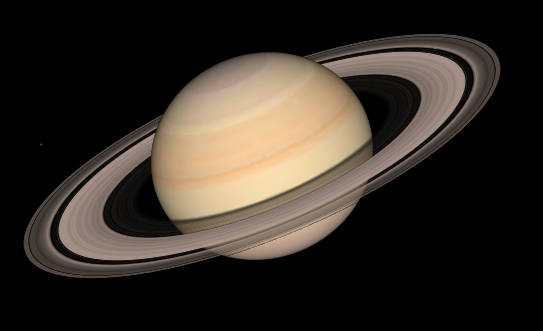
An enlarged view of Saturn and its rings as created by the program Cartes du Ceil (Sky Charts). Note that the globe of Saturn now extends past the narrow dimension of the rings. The rings will continue to narrow until March 23, 2025.
 Bob Moler's Ephemeris Blog