Ephemeris Extra: Taurus and its two bright star clusters
Based on an article published in the November 2023 issue of the Stellar Sentinel the newsletter of the Grand Traverse Astronomical Society.
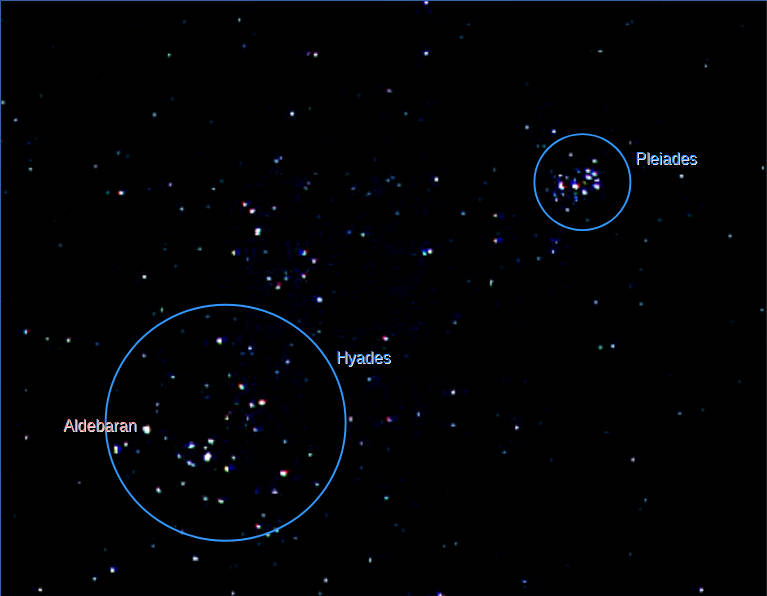
In my October presentation to the society I talked about the stars of autumn, moving generally from the constellations close to summer and ending pretty much against the constellations of winter ending with the constellation of Taurus and with the wonderful Pleiades or Seven Sisters. In this article I’ll take a little bit closer look at the Pleiades and especially the Hyades, the face of Taurus the bull.
On the previous page is a family portrait of the Pleiades and Hyades. Yes, family portrait. In Greek mythology, the Hyades are the half sisters of the Pleiades. The god Atlas is their father, Pleione seems to be the mother of the Pleiades, and Aethra is the mother of the Hyades. In astronomical terms the Hyades would then be the older sisters of the Pleiades.
The Hyades is a star cluster that is 153 light years away. It is the closest star cluster to us and somewhat over 6 times the age of the Pleiades. The younger and splashier Pleiades are around 444 light years away, and only 100 million years old. Whereas the Hyades are over 600 million years old. The Pleiades still contain hot blue-white stars which have died out by the time of the age of the Hyades. The brightest star of the letter V of stars is Aldebaran, Taurus’ angry bloodshot eye. It doesn’t belong to the Hyades, being about half the distance.
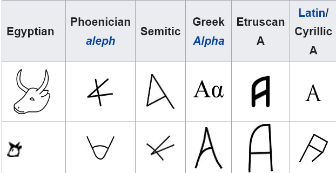
While the Hyades is not as splashy as the Pleiades are and has less of a role in mythology. However, it did play an important part in history when Taurus was the first constellation of the Zodiac some 4,000 years ago, due to precession of the equinoxes. This is because the letter A, the first letter of our alphabet is taken from the stars of the face of Taurus the bull in what looks to us like a V. But it was turned around to be the A we have today. Back then it was called Aleph the first letter of the alphabet for middle eastern cultures.
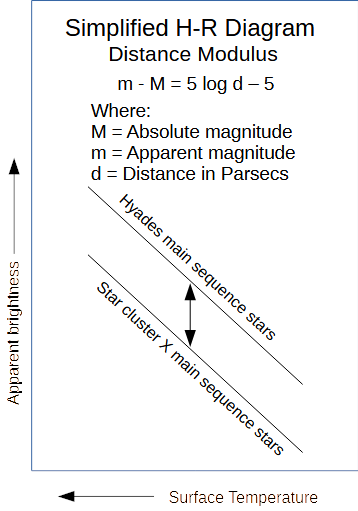
The Hyades is also important in astronomical history in that it helps us measure distances to more distant star clusters. The Hyades was the only star cluster close enough to measure its distance by the parallax method before the advent of the European Space Agency’s Hipparcos and Gaia satellites. If one matches stars on the Hertzsprung-Russell diagram of intrinsic brightness versus surface temperature with other star clusters the stars of the main sequence, where stars spend most of their lives burning hydrogen. The difference in the brightness of the main sequence stars gives the measure of how other star clusters measure up as far as distance since the main sequence is a relatively narrow distribution of stars. This works only with star clusters because there are many stars at the same distance which happen to be about the same age. And enough stars to establish the main sequence since stars at later stages of life may have the same temperature, but vastly different brightnesses.
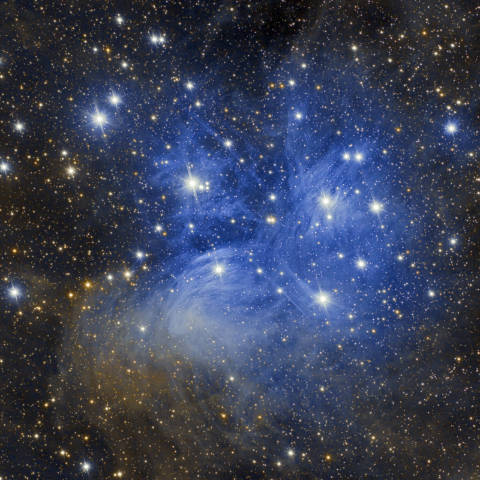
The Pleiades are so large that most telescopes will not allow one to see all the brighter stars at once, so binoculars are the best way to view them. At a dunes star party a few years ago, before COVID, I used my 11-inch (279 mm) Newtonian telescope, which has a 55 inch (1,397 mm) focal length, with a 40 millimeter eyepiece to view the Pleiades. A 40 millimeter eyepiece in that scope gives too low a magnification to use the entire diameter of the primary mirror. All the light doesn’t make it into the eye. That eyepiece gave me about 35 times magnification, so the main stars of the cluster fit into the field of view. The photograph above is nice and all that, but looking with the eye visually at the Pleiades, even with binoculars, you’ll notice something quite different from the photographs. In photographs to make a star brighter you make it bigger. But the eye has a much greater dynamic range. The stars are incredibly brilliant blue white-points of light in the case of the Pleiades. Absolutely beautiful, much more beautiful than any photograph. Not to disparage photographs, but photographs can do what the eye cannot. That is, store light to bring out very faint objects and details. So, let’s take a final look at the Pleiades in a photograph by GTAS member Dan Dall’Olmo.
 Bob Moler's Ephemeris Blog