Ephemeris: 01/11/2024 – Rigel, the star in Orion’s knee or is it his foot?
This is Bob Moler with Ephemeris for Thursday, January 11th. Today the Sun will be up for 9 hours and 4 minutes, setting at 5:23, and it will rise tomorrow at 8:18. The Moon is new today, and won’t be visible.
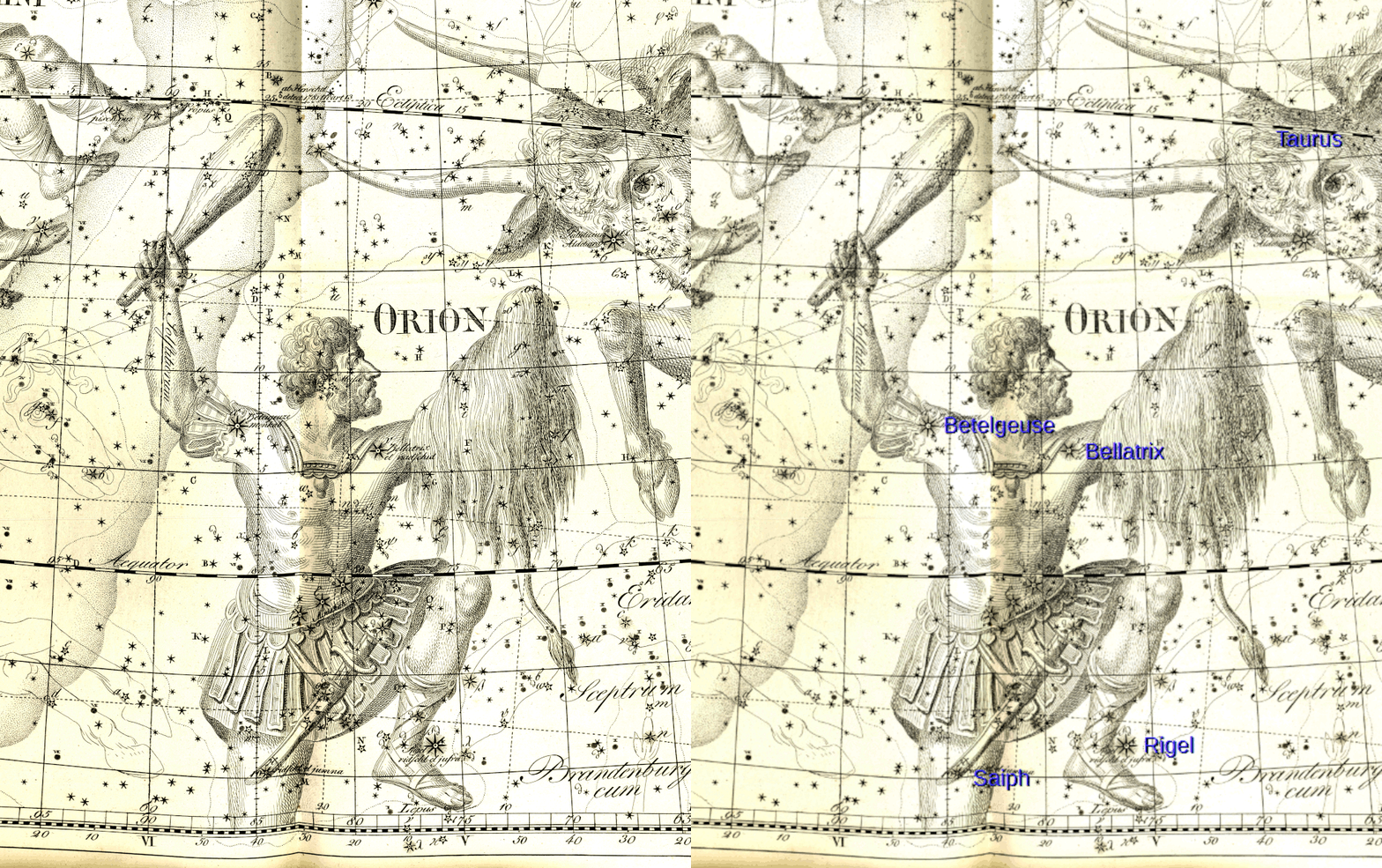
Orion’s second first magnitude star is Rigel in the lower right corner of the constellation this is a blue-white star in contrast to Betelgeuse which is a reddish star. The name Rigel is part of a phrase that means Left foot of Jauzah. Jauzah being the old name of the constellation Orion. It’s where we place Orion’s left knee now. In older drawings of the constellation, Orion has his left foot raised as if charging towards Taurus who’s charging at him. Rigel is about the same mass as Betelgeuse, though it’s nearly twice as far away at nearly 900 light years. Rigel is a quadruple star system. The bright Rigel A itself has what looks like a companion in small telescopes. That companion is actually three stars orbiting each other.
The astronomical event times given are for the Traverse City/Interlochen area of Michigan (EST, UT –5 hours). They may be different for your location.
Addendum
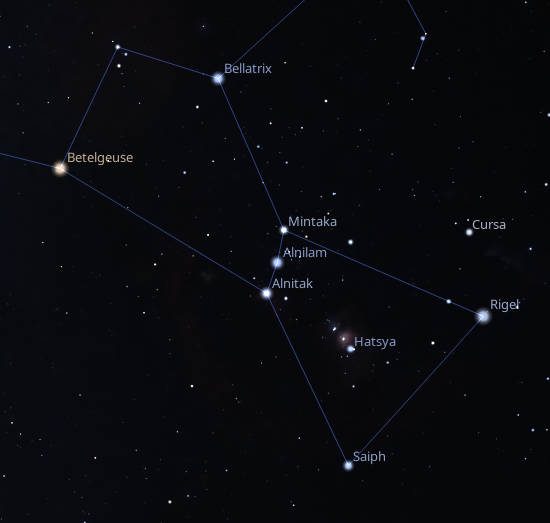
right-most bright star Is Rigel, a bluish white star, in contrast to Betelgeuse which has a ruddy glow. Here it looks like Betelgeuse and Bellatrix are in Orion’s shoulders and Saiph and Rigel are in his knees, with the belt star halfway in between. The word Rigel, however, means foot, and Saiph means sword. Check out the star chart below. Created using Stellarium.

 Bob Moler's Ephemeris Blog