This is Ephemeris for Friday, March 22nd. Today the Sun will be up for 12 hours and 17 minutes, setting at 7:58, and it will rise tomorrow at 7:39. The Moon, 3 days before full, will set at 7:16 tomorrow morning.
We are in an eclipse season. These occur at a bit less than 6 months intervals, and last about 35 days. During this period we will have a solar eclipse and a lunar eclipse. Of course the big eclipse of this eclipse season is the April 8th total solar eclipse, which will be visible from the United States and be visible from here as a very deep partial eclipse. We start off this eclipse season with a lunar eclipse, not a really great lunar eclipse, but a lunar eclipse nonetheless. It is a penumbral eclipse where the Moon enters the Earth’s outer shadow where the Sun is only partially blocked to it. What we will see will be not much. It will reach its maximum at 3:13 am Monday morning, when the bottom part of the Moon will be slightly darker than the top.
The astronomical event times given are for the Traverse City/Interlochen area of Michigan (EDT, UT–4 hours). They may be different for your location.
Addendum
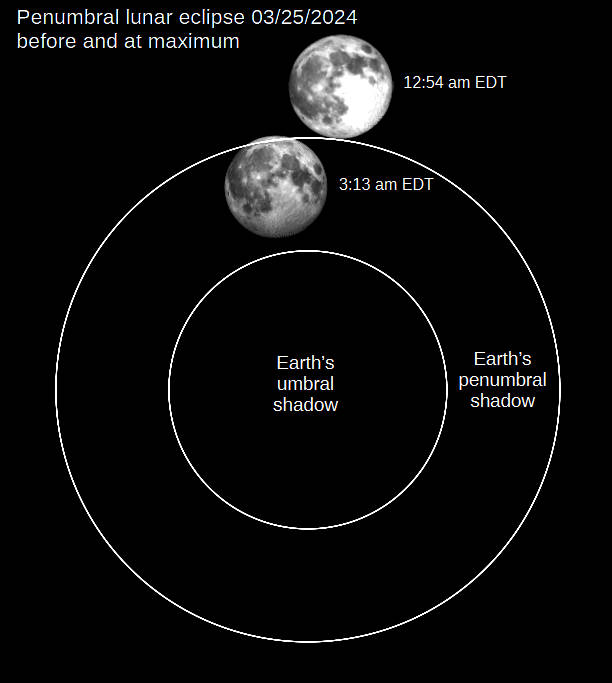
A diagram of the Earth’s shadow and the Moon at the beginning of the and at the maximum of the penumbral eclipse of next Monday morning, March 25th 2024. Created using Cartes du Ciel (Sky Charts). It does give a flavor of what the eclipse kind of looks like. The moon will get a bit dimmer especially the part closest to the umbra, the Earth’s inner shadow. The penumbral shadow is not evenly dark. At the outer edge when the Moon crosses that, nothing will be visible because that bottom edge will go from 100% illuminated by the Sun to maybe 99%, so there’s no visible change at that point. With a penumbral eclipse the only real visible effect is a duskiness on the part of the moon closest to the umbral shadow and it’s usually only within about half an hour in a total or partial eclipse of the moon starting and ending. I’ve found that viewing the moon through sunglasses diminishes the glare of the Moon and allows the penumbral shadow effect to be more easily seen. The image is in alt-azimuth orientation as one would see it from Northern Michigan.
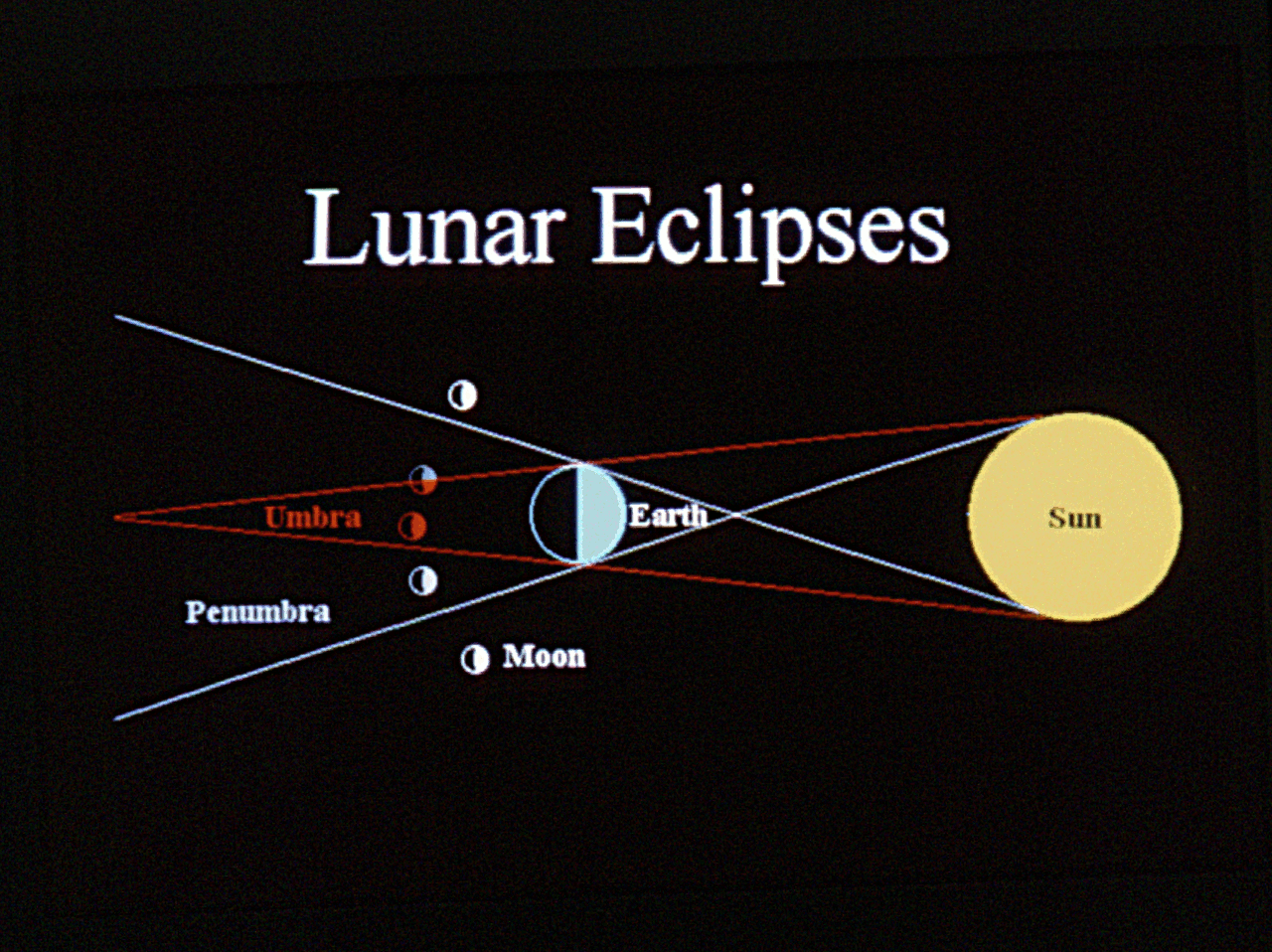
This is a not-to-scale diagram of the motion of the moon through the Earth’s shadow during a lunar eclipse. Assume we are looking down from the north, the motion of the Moon will be counterclockwise. The Moon will enter the shadow from the west or right, so the first “bite” of the shadow will be on the left side of the Moon. The penumbra is a gradually increasing shadow from the outer edge to the umbra, where the Sun is partially blocked by the Earth. In Monday’s eclipse the Moon passes just north of the Earth’s umbral shadow.
 Bob Moler's Ephemeris Blog