Home > Ephemeris Program, Nova, Observing > Ephemeris: 11/11/2024 – Still waiting for the promised nova

Ephemeris: 11/11/2024 – Still waiting for the promised nova

November 11, 2024

This is Ephemeris for Veterans Day, Monday, November 11th. Today the Sun will be up for 9 hours and 43 minutes, setting at 5:18, and it will rise tomorrow at 7:36. The Moon, 2 days past first quarter, will set at 3:19 tomorrow morning.

We’ve been waiting all year so far for the appearance of a nova or Blaze Star, as they called it, in the constellation of Corona Borealis. The astronomical name For it is T Coronae Borealis or T CrB for short. It last erupted in 1946 and the time before that it was 1866 an interval of 80 years. This year would be 78 years since 1946 so we could be waiting another two years. Observations of the star, which is still visible, though faint, between eruptions, were not as comprehensive in the prior 80 years, as they are today. It’s possible that observations of pre-nova activity were missed during war years preceding the 1946 outburst.

The astronomical event times given are for the Traverse City/Interlochen area of Michigan (EST, UT – 5 hours). Times will be different for other locations.

Addendum
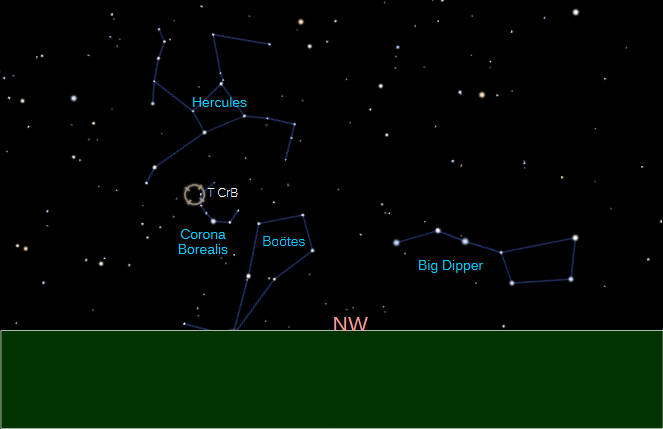
A Finder for the location of the nova, or Blaze Star, T Coronae Borealis or T CrB (when it happens), for the early evening now
A Finder for the location of the nova, or Blaze Star, T Coronae Borealis or T CrB (when it happens), for the early evening now. Corona Borealis is a small horseshoe shaped constellation whose brightest star Alphecca is just above the “n” in Corona. It is a second magnitude star about the same brightness as the nova will get at its peak. After late November the best time to see the nova, if it occurs then, will be in the morning sky just before sunrise. Though the nova is not circumpolar, meaning it rises and sets, it is up in the sky for 16 of the 24 hours of the day, so we will never completely lose it to daylight. When the Nova explosion occurs it will be visible to the naked eye for about a week so it’s easy to miss in time and also, in Northern Michigan due to the winter weather, we could miss it because of clouds. But as I mentioned in the program script above we are currently about two years away from the nominal time between between explosions, so we still have a couple of years to go before 80 years are up. Created using Stellarium, and LibreOffice Draw.