Ephemeris: 06/03/2025 – Looking at the Moon tonight
This is Bob Moler with Ephemeris for Tuesday, June 3rd. Today the Sun will be up for 15 hours and 23 minutes, setting at 9:23, and it will rise tomorrow at 5:58. The Moon, 1 day past first quarter, will set at 2:41 tomorrow morning.
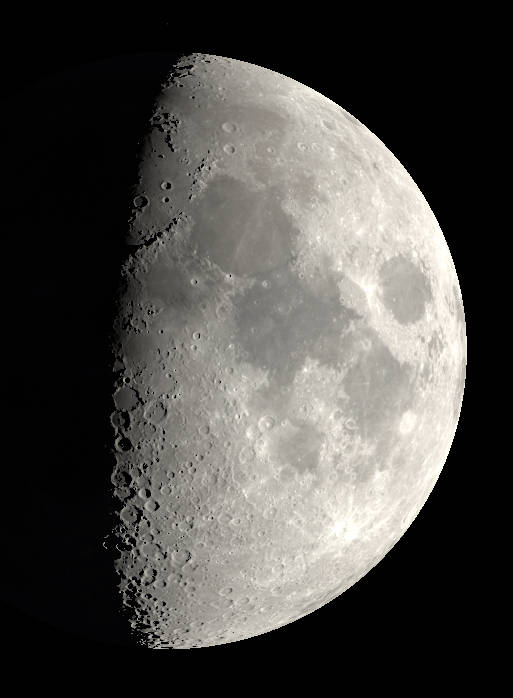
For me, the best time to view the Moon with binoculars or a telescope is around first quarter and tonight’s Moon is just a day past first quarter. At this time we see the maximum amount of shadowing of the craters because the sunrise line which we call the terminator is cutting across, pretty much, the center of the Moon. Since the Moon is a pretty uniformly dark gray with light gray areas, shadows make all the difference in seeing detail. One thing to notice on tonight’s Moon is that the southern or bottom part of the Moon has a lot of craters and is bright gray. This is called the lunar highlands and is brighter than the darker areas to the north and on the western side of the Moon, which are covered by the maria or seas, plains of solidified lava flows.
The astronomical event times given in this blog are for the Traverse City/Interlochen area of Michigan (Lat 44.7° N, Long 85.7° W; EDT, UT – 4 hours) unless stated otherwise. Times will be different for other locations.
Addendum
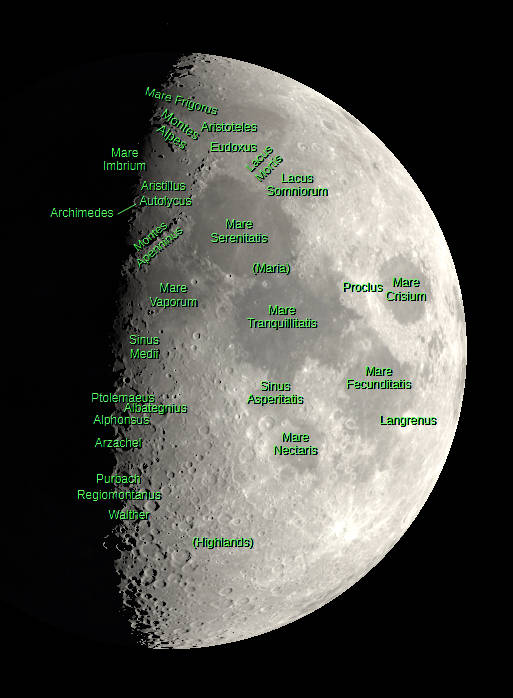
Translations of some lunar feature names according to Virtual Moon Atlas
Lacus Mortis – Lake of Death
Lacus Somniorum – Lake of Dreams
Mare Crisium – Sea of Crises
Mare Fecunditatis – Sea of Fruitfulness
Mare Frigoris – Sea of Cold
Mare Imbrium – Sea of Showers
Mare Nectaris – Sea of Nectar
Mare Serenitatis – Sea of Serenity
Mare Tranquillitatis – Sea of Tranquility
Mare Vaporum – Sea of Vapors
Montes Alpes – Alps Mountains
Montes Apenninus – Apennines Mountains
Sinus Asperitatis – Bay of Roughness
Sinus Medii – Central Bay
Note: Mare is pronounced Mar-e, and Maria is pronounced Mar-e-a.
These features, for the most part, were named by Giovanni Battista Riccioli in 1651, when he produced the first accurate map of the Moon. Craters are named for persons, real or otherwise. Features like Seas, Lakes and Bays were given fanciful names. Labels are centered on their feature where possible.
 Bob Moler's Ephemeris Blog