Ephemeris: 06/12/2025 – Another look at the star Spica
This is Ephemeris for Thursday, June 12th. Today the Sun will be up for 15 hours and 32 minutes, setting at 9:29, and it will rise tomorrow at 5:56. The Moon, 1 day past full, will rise at 11:20 this evening.
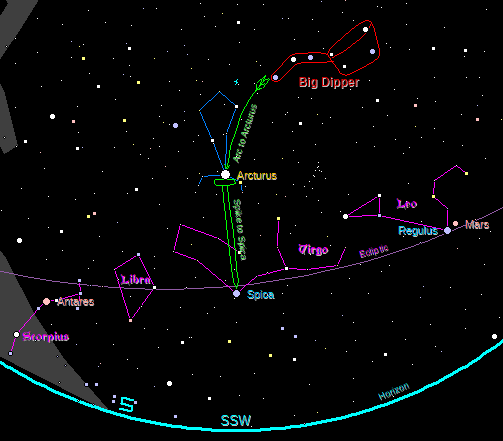
In the south-southwest at 11 PM is the bright star Spica in Virgo the virgin. Arcturus, high in the south, is much brighter than Spica and has an orange tint to Spica’s bluish hue. In fact, Spica is the 15th brightest and the bluest of the 21 first magnitude stars. That means that it has a really hot surface temperature. Spica is actually two stars in a tight 4-day orbit of each other. They are both reasonably matched in mass and brightness. I found that out once photographing a lunar eclipse near Spica, The star came out very blue. The twin stars of Spica are 250 light years away. I’m glad the stars are young now. They will have a very interesting future as they age and interact in the next few million years.
The astronomical event times given in this blog are for the Traverse City/Interlochen area of Michigan (Lat 44.7° N, Long 85.7° W; EDT, UT – 4 hours) unless stated otherwise. Times will be different for other locations.
Addendum


 Bob Moler's Ephemeris Blog