Ephemeris: 08/04/2025 – Mars’ twin
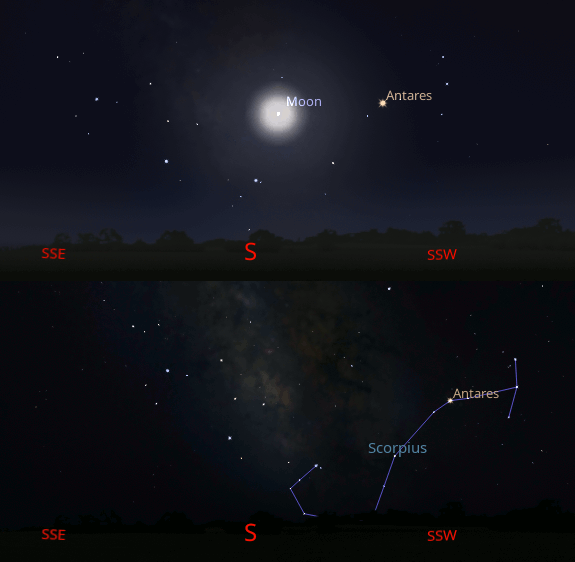
This is Bob Moler with Ephemeris for Monday, August 4th. Today the Sun will be up for 14 hours and 31 minutes, setting at 9:04, and it will rise tomorrow at 6:33. The Moon, 3 days past first quarter, will set at 2:10 tomorrow morning.
Low in the south as it gets dark is the red giant star Antares. It lies at the heart of Scorpius the scorpion. Its name means Rival of Mars, because it has the same hue as the red planet. In Mars case the color comes from iron oxide, rust. In Antares case it has a cool surface temperature, relatively speaking, of 7,000 degrees Fahrenheit (3,660 K). As a red giant star Antares is near the end of its life, though compared to the Sun it is young – possibly 12 million years old. At that age the Sun was just getting started. Antares, with around 13 to 16 times the Sun’s mass, has already run out of fusible hydrogen in its core and has bloated out to double Mars’ orbit in size. Antares is 550 light years away and has a companion star in its system that looks greenish in contrast to Antares red. But, when Antares A, the red giant’s light is blocked, the companion looks bluish.
The astronomical event times given in this blog are for the Traverse City/Interlochen area of Michigan (Lat 44.7° N, Long 85.7° W; EDT, UT – 4 hours) unless stated otherwise. Times will be different for other locations.
Addendum

 Bob Moler's Ephemeris Blog