Archive

Archive for August 21, 2025

Ephemeris: 08/21/2025 – The Milky Way’s Great Rift

August 21, 2025 Comments off

This is Ephemeris for Thursday, August 21st. Today the Sun will be up for 13 hours and 45 minutes, setting at 8:38, and it will rise tomorrow at 6:53. The Moon, 2 days before new, will rise at 5:57 tomorrow morning.

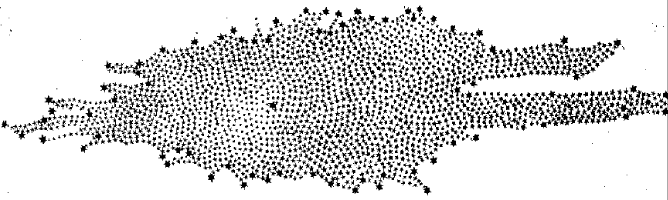
Once one finds the Milky Way which is pretty hard to miss this month, it becomes obvious that the Milky Way is split lengthwise starting near Deneb, the northernmost star of the Summer Triangle, almost all the way to the Teapot of Sagittarius low in the south. That dark split is called the Great Rift. Galileo first discovered that the hazy clouds of the Milky Way were actually made of faint stars, so it was thought the dark areas were due to a lack of stars. The great 18th century astronomer William Herschel did star counts all over the sky with his telescope. A map his sister drew of the flattened shape of his universe shows the lack of distant stars in one direction. It’s not really fewer stars, but interstellar clouds of dust blocking the light of the stars behind them.

The astronomical event times given in this blog are for the Traverse City/Interlochen area of Michigan (Lat 44.7° N, Long 85.7° W; EDT, UT – 4 hours) unless stated otherwise. Times will be different for other locations.

Addendum
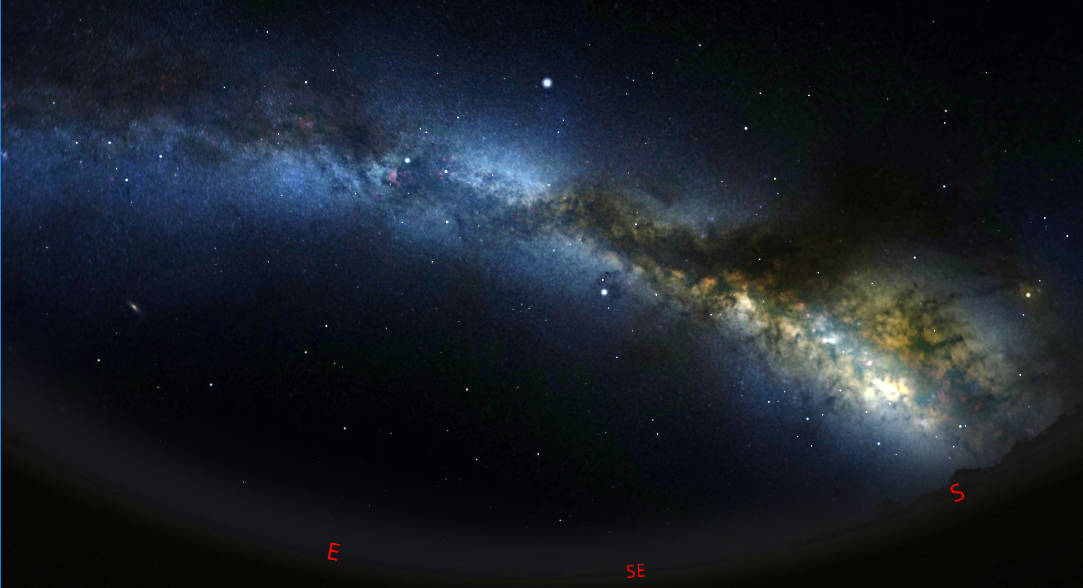
The span of the Milky Way across the summer sky as seen in the free Stellarium app. Specifically August 15th at 10 pm from Northern Michigan. The Milky Way has been set to its maximum brightness to show as much detail as possible. It really isn’t that bright. The horizon is only delineated by the compass points. The dark clouds of the Great Rift are also visible. The Milky Way, in Stellarium, is photo-realistic. The triangle of three bright stars above center is the Summer Triangle, Specifically, clockwise from the top star: Vega, Altair and Deneb. Large images can be truncated on the right. Click or tap on the image to enlarge and display the complete image.
The span of the Milky Way across the summer sky as seen in the free Stellarium app. The Milky Way has been set to its maximum brightness to show as much detail as possible. It really isn’t that bright. The horizon is only delineated by the compass points. The dark clouds of the Great Rift are also visible. The Milky Way, in Stellarium, is photo-realistic. The triangle of three bright stars above center is the Summer Triangle, Specifically, clockwise from the top star: Vega, Altair and Deneb. Large images can be truncated on the right. Click or tap on the image to enlarge and display the complete image.
Herschel's Universe
The shape of the universe (Milky Way) as measured by William Herschel by counting stars in the eyepiece fields of his telescope pointed in various directions. The large indent on the right is caused by the Great Rift, clouds of gas and dust the block the light of the stars behind it, not the lack of stars in that direction. The Great Rift is easily seen in the summer sky running through the Milky Way. Drawing by Caroline Herschel.