Ephemeris: 11/10/2025 – Waiting on a stellar explosion
This is Ephemeris for Monday, November 10th. Today the Sun will be up for 9 hours and 46 minutes, setting at 5:19, and it will rise tomorrow at 7:34. The Moon, 2 days before last quarter, will rise at 10:22 this evening.
According to one astronomer, that I mentioned last Thursday, today is about the day he expects a star to erupt as a nova in the constellation Corona Borealis, the Northern Crown. In the early evening, it will appear low in the west northwest. The star is designated T Coronae Borealis (T CrB). Its appearance should make the normal news outlets, because it will be the brightest stellar outburst in a very long time. It will appear just left of the constellation Corona Borealis and be about as bright as its brightest normal star. However, it will soon fade and to be less the naked eye brightness in about a week. So we’re hoping for clear skies, if it happens. If it’s not this time, the next predicted time is June 25th, next year. Or he could be wrong, and it could go off at any time. Spaceweather.com has more information.
The astronomical event times given in this blog are for the Traverse City/Interlochen area of Michigan (Lat 44.7° N, Long 85.7° W; EDT, UT – 4 hours) unless stated otherwise. Times will be different for other locations.
Addendum
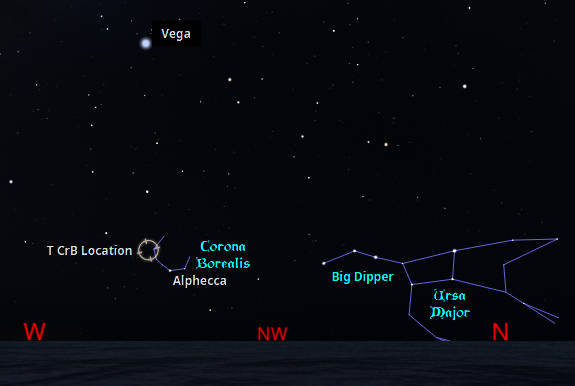
According to a paper in the Research Notes of the American Astronomical Society, Jean Schneider with the Paris Observatory predicted that the next eruption of T Coronae Borealis would be somewhere around November 10th 2025, or June 25th 2026. The first prediction of the 27th of March earlier this year turned out to not have occurred. These were tentative predictions based on the orbit around each other, of the two stars involved. The period of 80 years between eruptions is an approximation. There is an additional periodicity due to the fact that the two stars involved, a red giant and a white dwarf, have an orbital period of about 228 days which is why the predictions are 228 days apart. There have been four previous eruptions of the star observed. The first was in 1217, the next in 1787, then in 1866 and then finally in 1946. The reason for the big gap between 1217 and 1787 is unknown. Either the star didn’t erupt, or more likely, nobody observed and recorded it. The times of the first two eruptions weren’t accurately reports, but fell within what the 228-day periodicity would explain.
T Coronae Borealis is far enough north in the sky so that it is visible sometime during the night, year round. Currently, it would be best seen at the end of twilight in the west northwest. This will shift over to the morning sky, before morning twilight, after about the 25th of November, only 15 days from now in the east northeast. This star like any other star that rises and sets does so approximately 4 minutes earlier each night, or 28 minutes per week. So after the 25th the best observing opportunity will be before dawn in the morning until much later in the late winter, when it will be available also in the evening sky again.
 Bob Moler's Ephemeris Blog