Archive
03/30/2015 – Ephemeris – The importance of meteorites and asteroids
Ephemeris for Monday, March 30th. The Sun will rise at 7:27. It’ll be up for 12 hours and 39 minutes, setting at 8:07. The Moon, 3 days past first quarter, will set at 5:33 tomorrow morning.
On Friday the 3rd Joe Brooks will be giving a talk at the Grand Traverse Astronomical Society on meteorites. That will be at 8 p.m. at Northwestern Michigan College’s Rogers Observatory. NASA has the Dawn spacecraft now settling into orbit of the largest asteroid Ceres. It is the asteroid belt that is the source of meteorites. Meteorites are either pieces of destroyed protoplanets due to collisions in the asteroid belt or primitive objects like carbonaceous chondrites pristine that date back to 4.567 billion years ago, the formation of the solar system. Meteorites tend to be contaminated by the environment. That’s why samples of asteroids will be so valuable for planetary defense and understanding the origin of the solar system.
Times are for the Traverse City/Interlochen area of Michigan. They may be different for your location.
Addendum
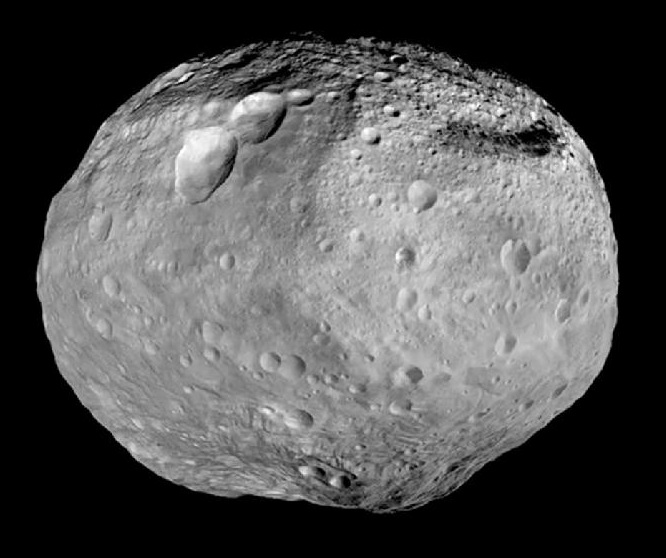
Looking back at Vesta as Dawn headed off to Ceres. Credit: NASA/JPL-Caltech/UCAL/MPS/DLR/IDA
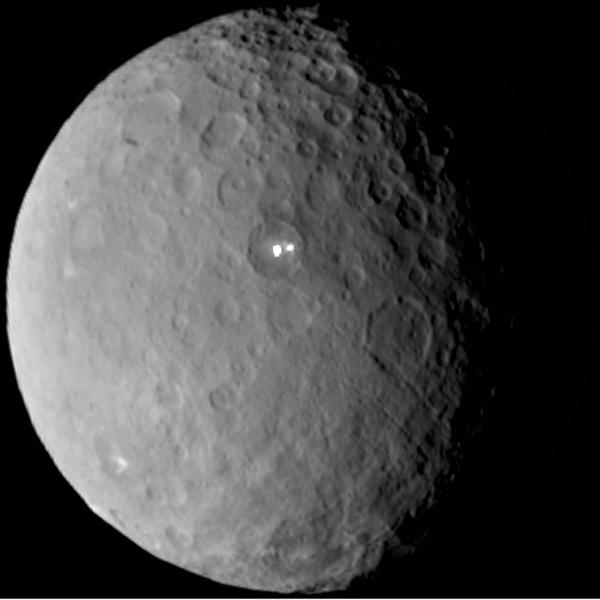
The bright spot is two. Picture taken February 19, 2015 from 29,000 miles (46,700 km). Credit: NASA/JPL-Caltech/UCLA/MPS/DLR/IDA.
03/06/2015 – Ephemeris – Learn about this year’s adventures in exploring the soiar system tonight
Ephemeris for Friday, March 6th. The Sun will rise at 7:12. It’ll be up for 11 hours and 24 minutes, setting at 6:36. The Moon, 1 day past full, will rise at 7:47 this evening.
This evening yours truly will be giving a program at the monthly meeting of the Grand Traverse Astronomical Society at 8 p.m. at Northwestern Michigan College’s Rogers Observatory. It’s entitled Asteroids and Dwarf Planets and Comets, oh my! It’s about the three solar system bodies being visited this year by spacecraft from NASA and the European Space Agency. The asteroid is Ceres, which the Dawn spacecraft entered orbit of today. The dwarf planet is Pluto which is the target of a summer flyby by the New Horizon spacecraft. The comet is 67P/Churyumov–Gerasimenko orbited by ESA’s Rosetta spacecraft. There will be a star party at 9 p.m. following the meeting.
Times are for the Traverse City/Interlochen area of Michigan. They may be different for your location.
Addendum
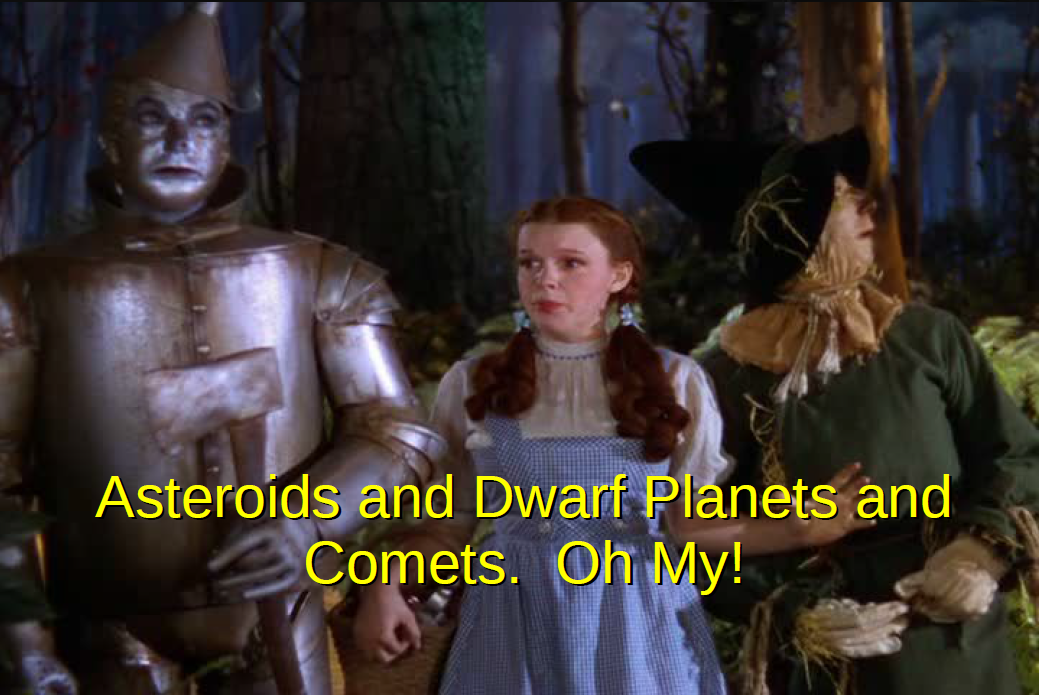
Apologies to MGM.
Looking back at Vesta as Dawn headed off to Ceres. Credit: NASA/JPL-Caltech/UCAL/MPS/DLR/IDA
The bright spot is two. Picture taken February 19, 2015 from 29,000 miles (46,700 km). Credit: NASA/JPL-Caltech/UCLA/MPS/DLR/IDA.
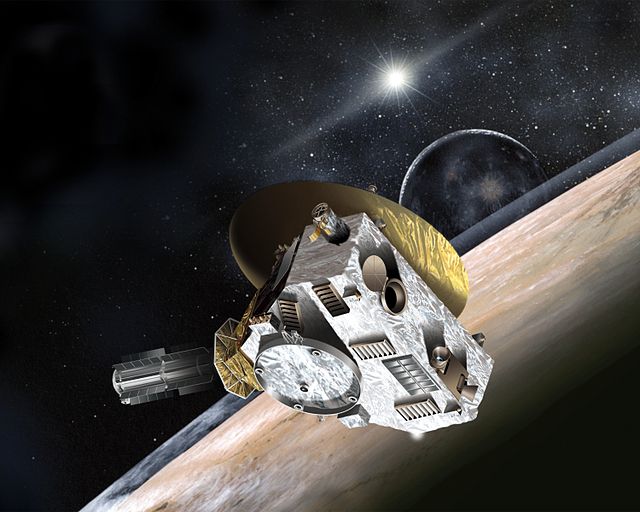
Artist conception of the New Horizons spacecraft at Pluto. Credit: NASA/Johns Hopkins University Applied Physics Laboratory/Southwest Research Institute
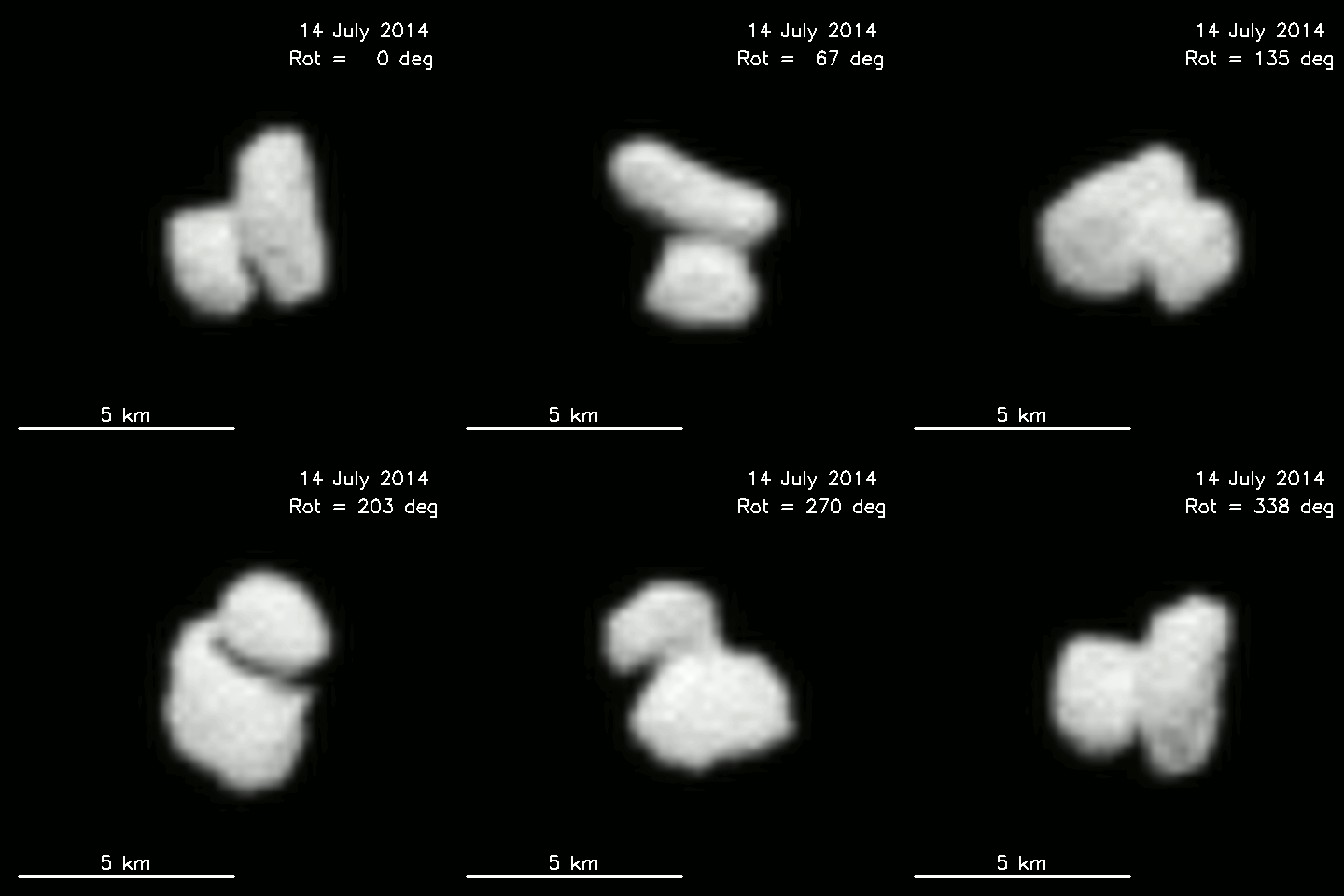
An animation of Comet 67p/Churyumov–Gerasimenko rotation on July 14, 2014. The 30 pixel wide image has been smoothed. The Rotation rate is 1 rotation every 12.4 hours. Credits: ESA/Rosetta/MPS for OSIRIS Team MPS/UPD/LAM/IAA/SSO/INTA/UPM/DASP/IDA
03/03/2015 – Ephemeris – The bright spots on Ceres are still a mystery
Ephemeris for Tuesday, March 3rd. The Sun will rise at 7:17. It’ll be up for 11 hours and 15 minutes, setting at 6:32. The Moon, 2 days before full, will set at 6:30 tomorrow morning.
The Dawn spacecraft is approaching the asteroid Ceres. It will be gently captured by Ceres on the 6th. This as an update from the date I gave you yesterday. Then the spacecraft will spiral closer and closer to the asteroid over the next few months. There is a mystery spot on Ceres, a bright spot that was visible by the Hubble Space Telescope orbiting Earth. As Dawn got close enough to resolve Ceres it too saw the bright spot. As the spacecraft got even closer the spot showed to be smaller and smaller. I thought it might be a crater that penetrated into Ceres icy interior. But the latest image, taken February 19th shows that the bright spot has a companion spot, both inside a crater and still too small to resolve. It’s still a mystery.
Times are for the Traverse City/Interlochen area of Michigan. They may be different for your location.
Addendum
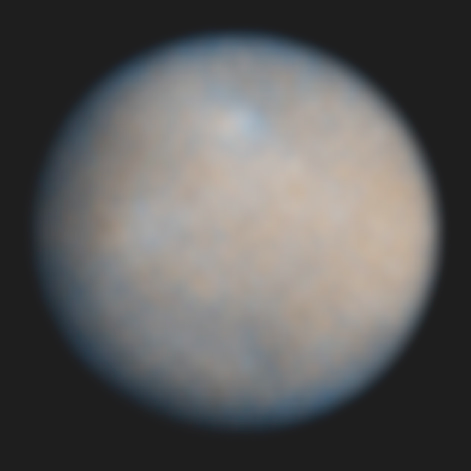
Hubble’s best photo of Ceres. Note the white spot near the top of the image. Image Credit: NASA, ESA, J. Parker (Southwest Research Institute), P. Thomas (Cornell University), L. McFadden (University of Maryland, College Park), and M. Mutchler and Z. Levay (STScI)
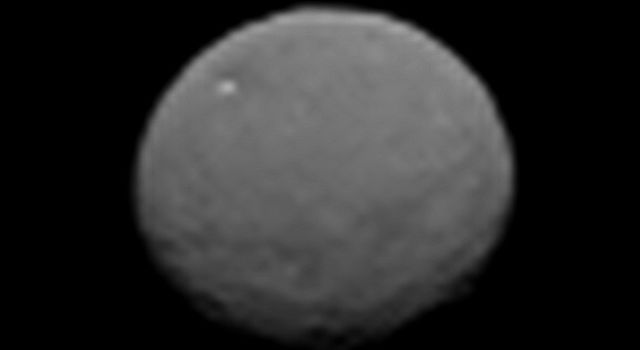
The white spot shows as Dawn approaches Ceres. Credit: NASA/JPL.
The bright spot is two. Picture taken February 19, 2015 from 29,000 miles (46,700 km). Credit: NASA/JPL-Caltech/UCLA/MPS/DLR/IDA.
This photo will be the best photo of the bright spots until the end of April, an Dawn maneuvers over the night side of Ceres.
On March 2nd NASA held a Dawn Mission Pre- Close Approach News Briefing which can be found on YouTube.
01/26/2015 – Ephemeris – First quarter Moon, a telescopic asteroid misses the Earth tonight and a Jupiter shadow recap
Note: Ephemeris program generally features objects in the sky that are visible to the naked eye or binoculars. However in the blog, with the ability to expand in both content and illustrations I can add information for telescopic observers and expand postings.
Ephemeris for Monday, January 26th. The sun will rise at 8:08. It’ll be up for 9 hours and 34 minutes, setting at 5:42. The moon, at first quarter today, will set at 1:30 tomorrow morning.
The Moon will be perfectly half illuminated by the sun at 11:48 p.m. The gray patches that appear on the Moon’s surface were called by early telescopic astronomers: seas; because they thought they were bodies of water. The Moon is pretty much bone dry, except for some eternally shadowed craters at the poles, which still aren’t wet because the water is frozen. Anyway the seas or maria on the moon are indeed low spots. The seas, from the top center of the moon down to the lower right are Serenity, Tranquility, Nectar and Fertility. To the upper right all by itself is the Sea of Crises. From Serenity to Fertility some can imagine an upside down rabbit, with ears of unequal sizes. In a few more days we’ll see the face of the man in the Moon.
Times are for the Traverse City/Interlochen area of Michigan. They may be different for your location.
Addenda
First Quarter Moon
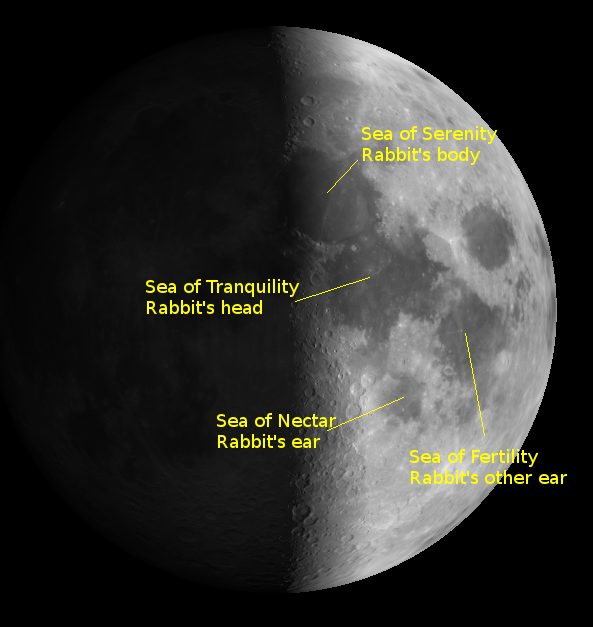
Rabbit in the first quarter Moon. Created using Virtual Moon Atlas.
Tonight Asteroid 2004 BL86 will pass three times the Moon’s distance from the Earth
This evening a rather large asteroid for a Near Earth Object or NEO will pass three-quarters of a million miles from the Earth. The asteroid has the designation 2004 BL86. The cool thing is that this asteroid is half a kilometer or so meters across, that’s 5 soccer or football fields in diameter. Radar from this close passage should nail down the size and shape. Between Goldstone Tracking Station and Arecibo Observatory in Puerto Rico the asteroid should be mapped down to 2 to 4 meters. It would be definitely not cool if this asteroid ever hit the Earth. It will be 9th magnitude, and so will be visible in small telescopes, and it will cross the east or left side of the Beehive star cluster also designated M44 starting about midnight tonight.
If you want to observe the event and don’t have the equipment head on over to www.slooh.com. This is the site for Slooh (pronounced “slew”) Community Observatory which has observatories in the Canary Islands and Chile, and partners with others. Besides these events, members can schedule time and use the telescopes via the internet. Check the above link for more information.
The chart below is from NASA/JPL’s Near Earth Object Program: Updated Charts for Asteroid 2004 BL86 Earth Flyby on Jan 26, 2015
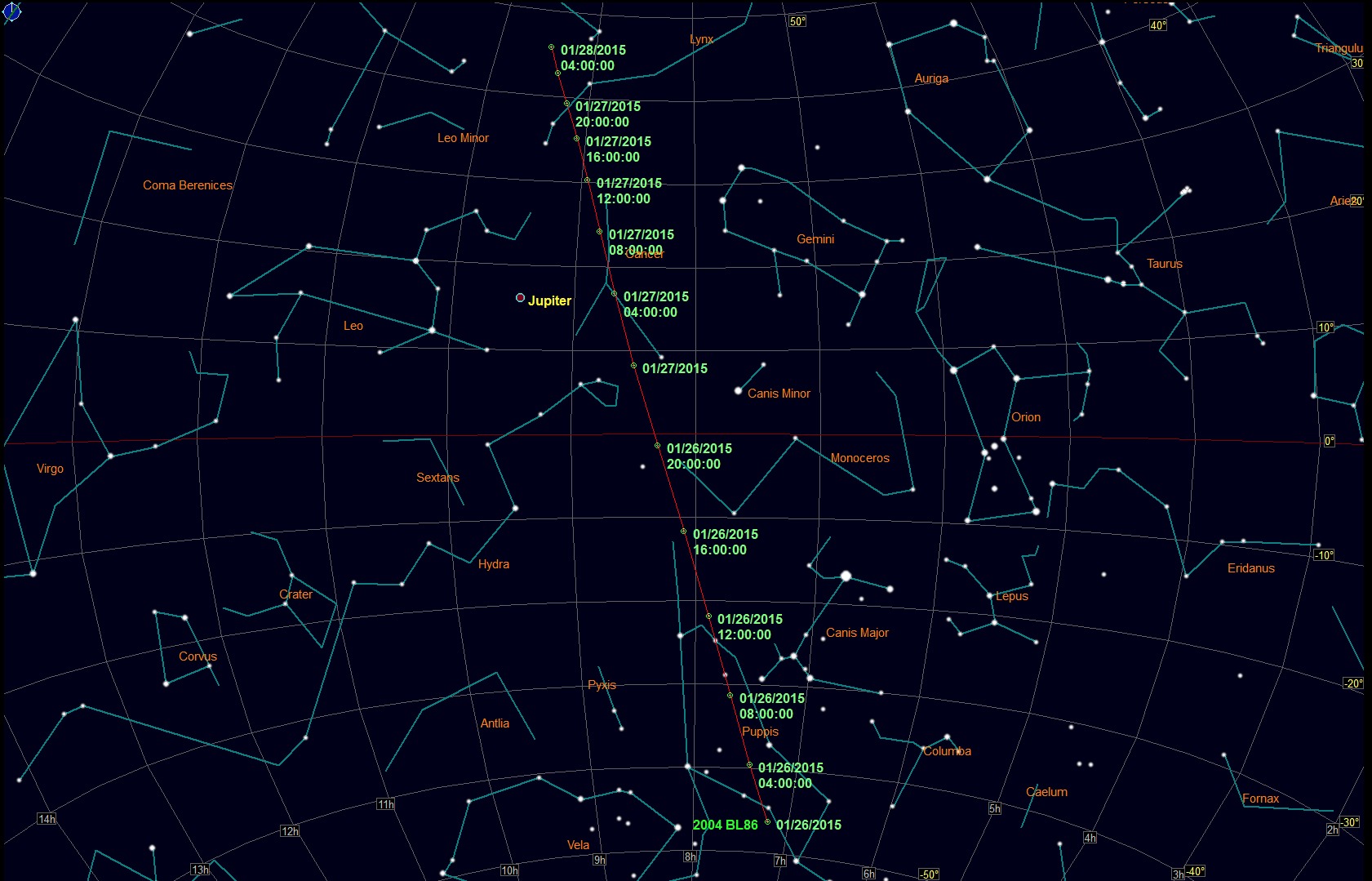
The track of asteroid 2004 BL86 as viewed from the Earth, plotted on a star chart with an equatorial coordinate grid. The asteroid location is shown at four-hour intervals from January 26 to 28. The indicated times are Universal Time; subtract 5 hours for Eastern Standard Time (EST), 6 hours for CST, and 8 hours for PST. On January 26, the asteroid will pass within 11 degrees of Jupiter, now shining brightly in the east in the evening sky. Image and caption credit: NASA/JPL-Caltech. JPL orbit solution #43, with star chart graphics produced using C2A. Click to enlarge.
Below is a chart from Universe Today. Here’s a link to their web page.
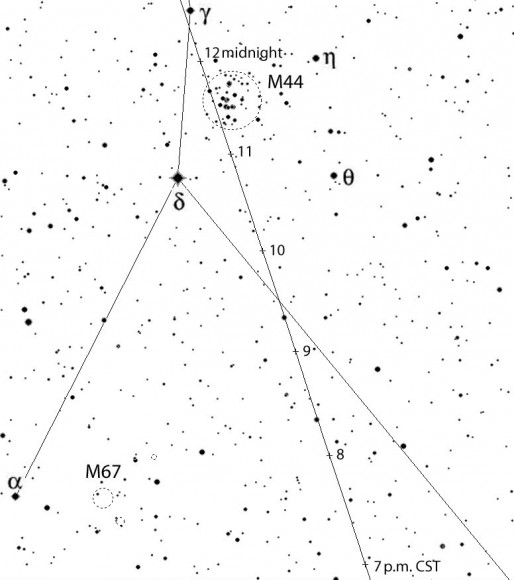
A Black on white chart of asteroid 2004 BL86 crossing to the right of M44. Note that the actual path depends on your location since the chart is based on the center of the Earth. The closer to your horizon the greatest deviation from the path shown. Time Ticks are for CST. Add one hour to them for EST. The Midnight tick mark is 0 h UT or GMT the 27th. Credit Universe Today and created with Chris Marriott’s SkyMap software.
Sky and Telescope has charts that have BL86’s track plotted about 15 minutes ahead of the track above. It is a newer chart, so the asteroid’s position may have been updated. The Sky and Telescope narrative and charts are here.
Results from Jupiter’s early Saturday satellite shadow play
The video live feed from the Griffith Planetarium in Los Angeles was a bust. It suffered from what astronomers call bad seeing. I mean really horrible seeing. Astronomers ascribe at least two qualities to the sky, other than brightness due to the moon or light pollution. That is transparency and seeing. Seeing is the steadiness of the sky. What Jupiter looked like was looking at a small disk at the bottom of a swimming pool while the kids are still playing in it. At first I ascribed it to Jupiter being low in the LA sky, being 3 hours west of here. But it didn’t get better as the night progressed. I could occasionally make out Callisto’s shadow, just because I knew where it’s supposed to be. But that’s it.
However my friend from the Detroit area, Scott Anttila, blessed at least for a while with clearer and calmer skies got some wonderful pictures of the first part of the multiple shadow event.
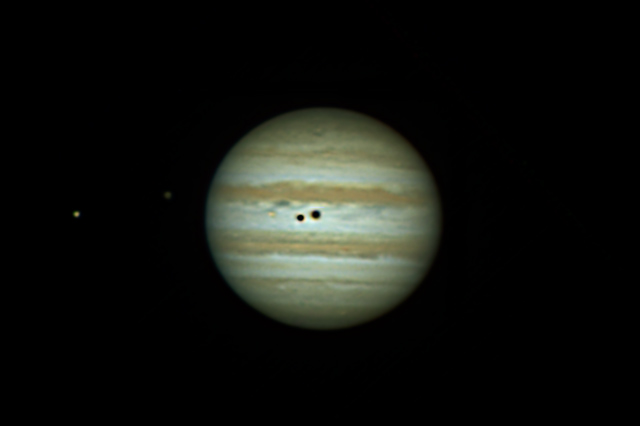
Left to right the shadows of Io and Callisto crossing the face of Jupiter at 12:52 a.m. January 24, 2015. Credit Scott Anttila.
Note that Callisto has a larger shadow than Io. That’s mainly due to it’s greater distance from Jupiter that makes its shadow larger and fuzzier than the closer Io.
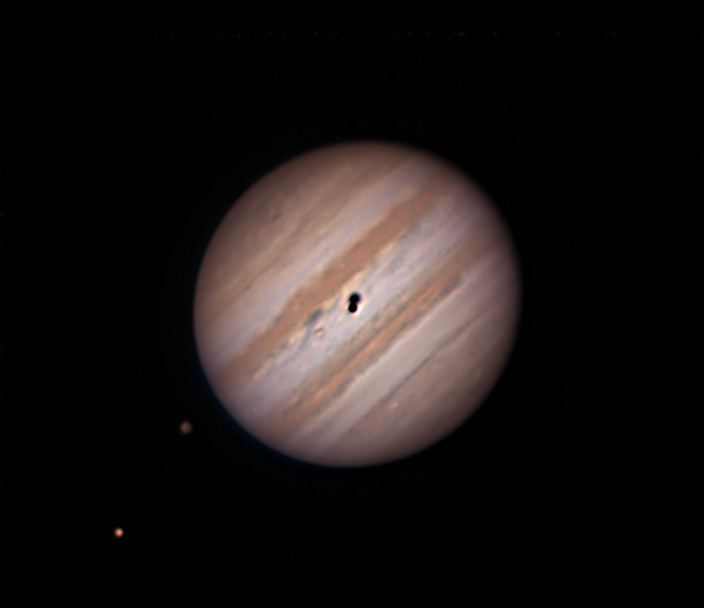
In this picture Io’s shadow has just caught up with Callisto’s shadow. Credit: Scott Anttila.
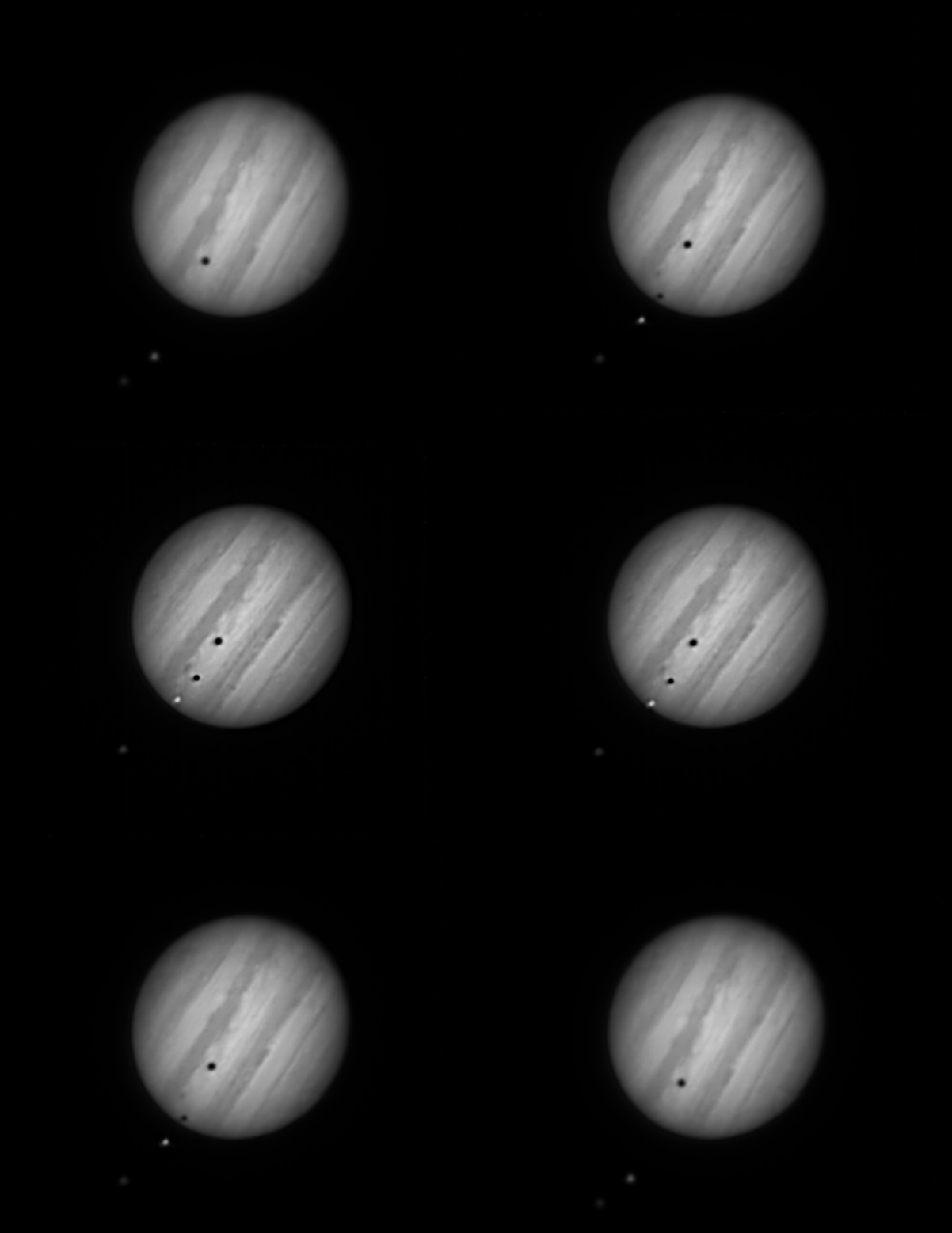
Rocking animation of the early stages of the shadow show on Jupiter. Callisto’s shadow already on the planet while Io’s shadow is just entering. Also Io’s transit is starting, following its shadow on the planet. Credit: Scott Anttila
05/12/2014 – Ephemeris – NASA’s OSIRIS-REx mission to an asteroid
Ephemeris for Monday, May 12th. Today the sun will be up for 14 hours and 42 minutes, setting at 9:00. The moon, 2 days before full, will set at 5:37 tomorrow morning. Tomorrow the sun will rise at 6:16.
Construction is beginning on a spacecraft called OSIRIS-REx, which is slated to be launched in September of 2016 to reach asteroid Bennu in 2018 and retrieve a 2 or so ounce sample and return it in 2023. It is important to discover the physical features of near earth asteroids or NEOs, and so learn how best to deflect them, or even mine them for resources. If you’d like your name to ride along on the spacecraft to orbit the Sun forever, well for several billion years; and be apart of the return capsule, which will probably reside at the Smithsonian at the end of its travels, go to the Planetary Society website at http://www.planetary.org/get-involved/messages/bennu/, and sign up yourself and your family. Be part of space history.
Times are for the Traverse City/Interlochen area of Michigan. They may be different for your location.
Addendum
Mission webpage: http://www.asteroidmission.org/
NASA mission page: http://www.nasa.gov/mission_pages/osiris-rex/#.U3Br1HbDuBw
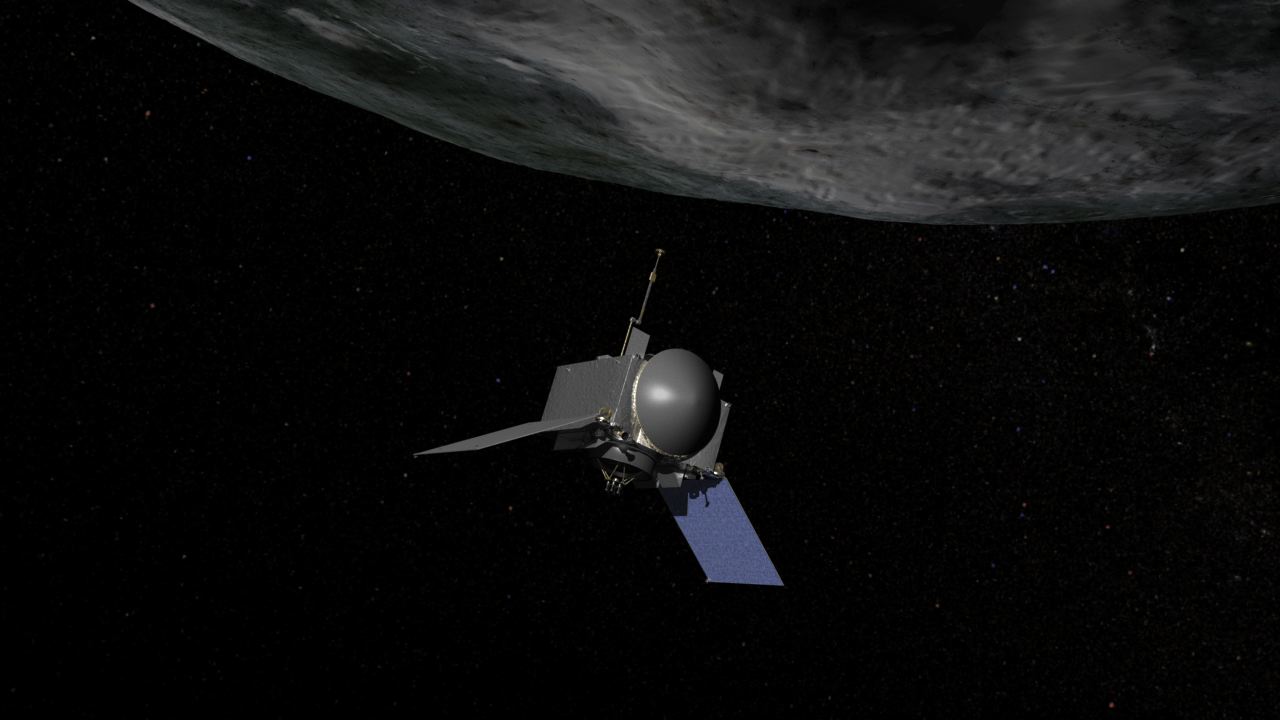
Artist’s conception of OSIRIS-REx about to collect a sample from asteroid Bennu. Image Credit:
NASA/Goddard/Chris Meaney
03/18/2014 – Ephemeris – Thursday a.m. many folks including New Yorkers will see a bright star wink out
Ephemeris for Tuesday, March 18th. The sun will rise at 7:49. It’ll be up for 12 hours and 3 minutes, setting at 7:52. The moon, 2 days past full, will rise at 10:15 this evening.
On Thursday morning the 20th around 2 a.m. the star Regulus, the brightest star in the constellation Leo the lion will wink out for up to 14 seconds for observers in New York City. That will be exceptionally cool, because Regulus is one of the few stars actually bright enough to be visible from that metropolis. Regulus will not be at fault, but for a narrow band of the earth running northwest of there the asteroid 163 Erigone will pass in front of Regulus in an extremely rare occultation of a bright star. This will allow observers on the ground to time the duration of the event and put together the silhouette of the asteroid, which is thought to be 45 miles wide. Observers have in the past spotted secondary occultations of another asteroid and discovered an asteroid satellite.
Times are for the Traverse City/Interlochen area of Michigan. They may be different for your location.
Addendum
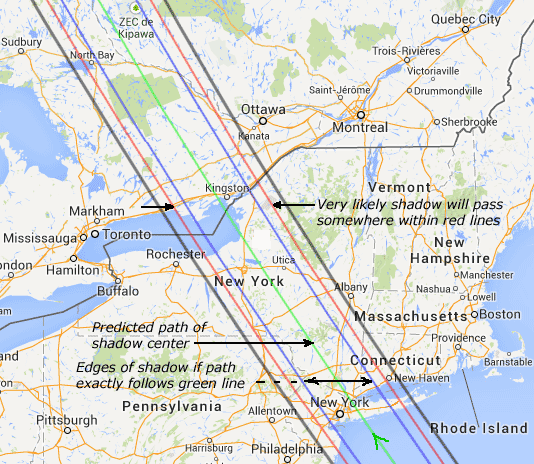
Part of the occultation path of Regulus. See link below. Credit: Geoff Hitchcox / IOTA and Sky & Telescope magazine
Here’s a link to the Sky and Telescope site with lots more information. Clicking on their map will bring up an interactive Google earth map.
03/13/2014 – Ephemeris – An asteroid self destructs
Ephemeris for Thursday, March 13th. The sun will rise at 7:58. It’ll be up for 11 hours and 47 minutes, setting at 7:46. The moon, 3 days before full, will set at 6:40 tomorrow morning.
The solar system is getting weirder and weirder. Last week came the announcement from the Hubble Space Telescope folks, that they have been watching an asteroid in the main asteroid belt falling apart. The object was picked up last year by two sky survey groups and communicated to the Keck Telescope and Hubble telescope folks for further study. Both found that it was an asteroid slowly breaking up into smaller pieces, and watched it over several months breaking into smaller and smaller pieces. It’s thought that this asteroid is or was a rubble pile and the pressure of sunlight caused it to rotate fast enough to break it apart. The speeds of the dispersing particles is a mere earthly walking speed, ruling out a collision.
Addendum
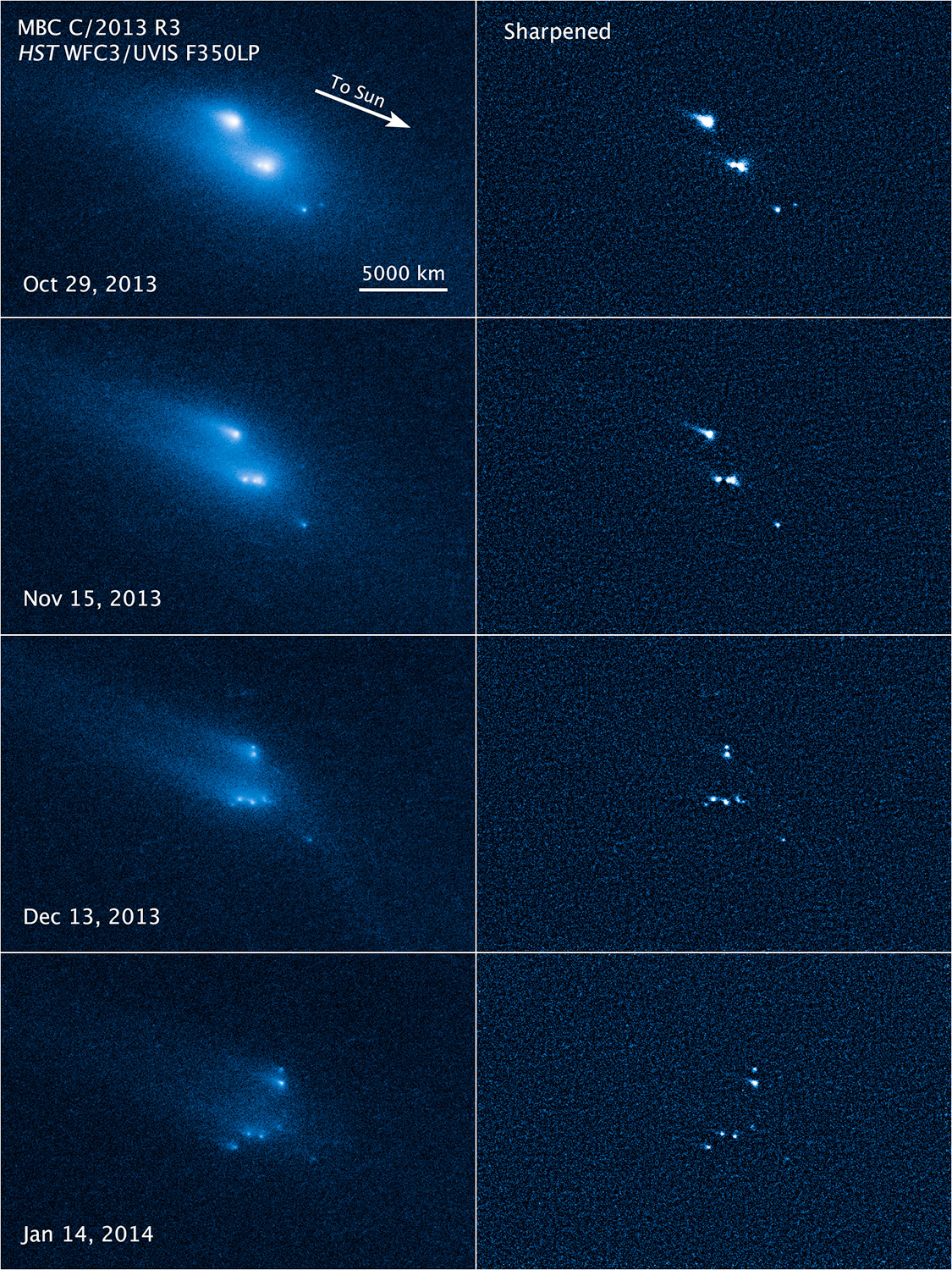
Four images of an asteroid breaking up over 3 months. The largest piece is perhaps the size of 4 football fields. Image Credit: NASA, ESA, D. Jewitt (UCLA).
Click here for the NASA page with more information.
02/13/2014 – Ephemeris – Dwarf planet Ceres is the next stop for the Dawn spacecraft.
Ephemeris for Thursday, February 13th. The sun will rise at 7:45. It’ll be up for 10 hours and 22 minutes, setting at 6:08. The Moon, 1 day before full, will set at 7:10 tomorrow morning.
The Dawn spacecraft is in the asteroid belt. After spending a year orbiting the asteroid Vesta two years ago, it has set its sights on Ceres, the largest asteroid, which was promoted by the same reasoning that Pluto was demoted, as a dwarf planet. Recently it was announced that Ceres is out-gassing water molecules. Dawn, with its ion engine is slowly approaching Ceres and will enter orbit of the body in April next year, a few months before the new Horizons spacecraft will fly by the dwarf planet Pluto on Bastille Day 2015. Dawn will stay in orbit of Ceres for a year at least. It will take at least several months to download all the images and data from the Pluto encounter from New Horizons, so we will have a very eventful 2015.
Times are for the Traverse City/Interlochen area of Michigan. They may be different for your location.
Addendum
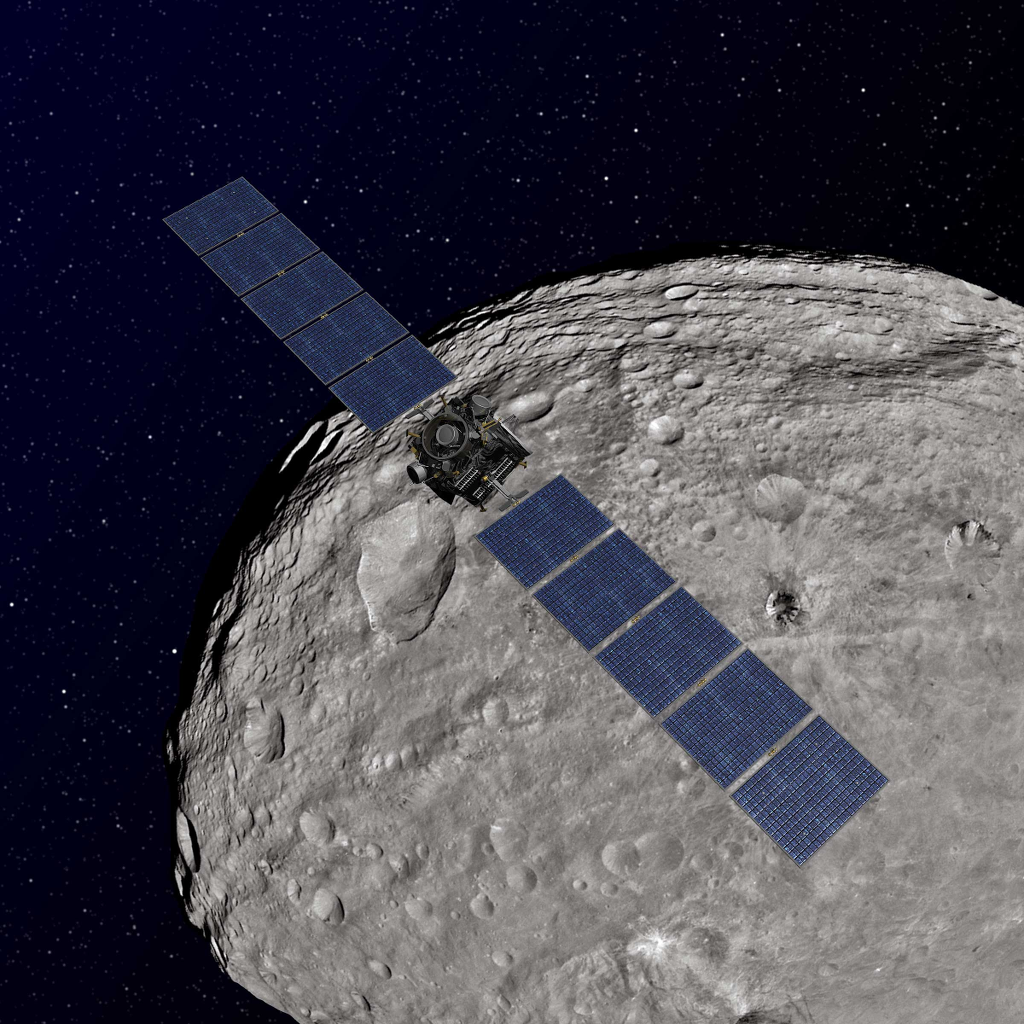
Artist’s rendition of the Dawn spacecraft at Vesta. Credit: NASA/JPL.
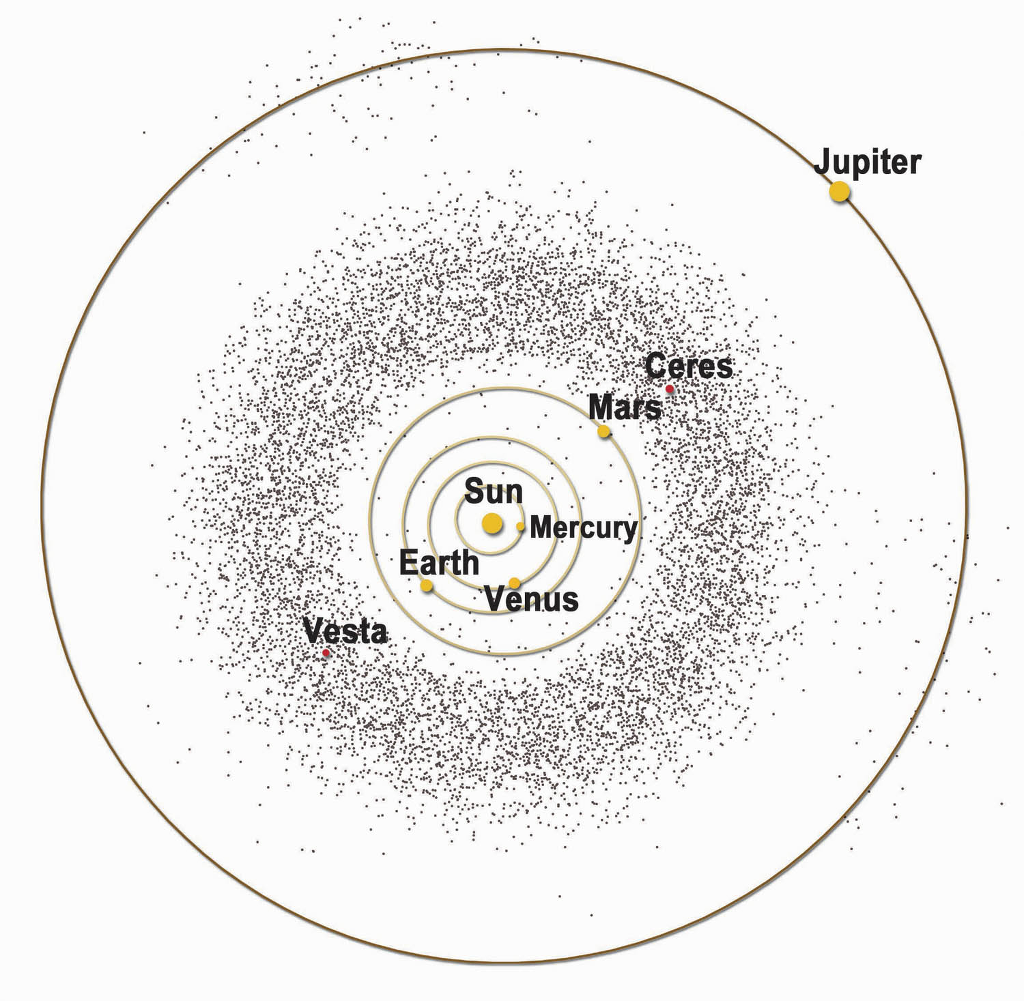
The asteroid belt n the inner solar system. Credit: NASA/JPL.
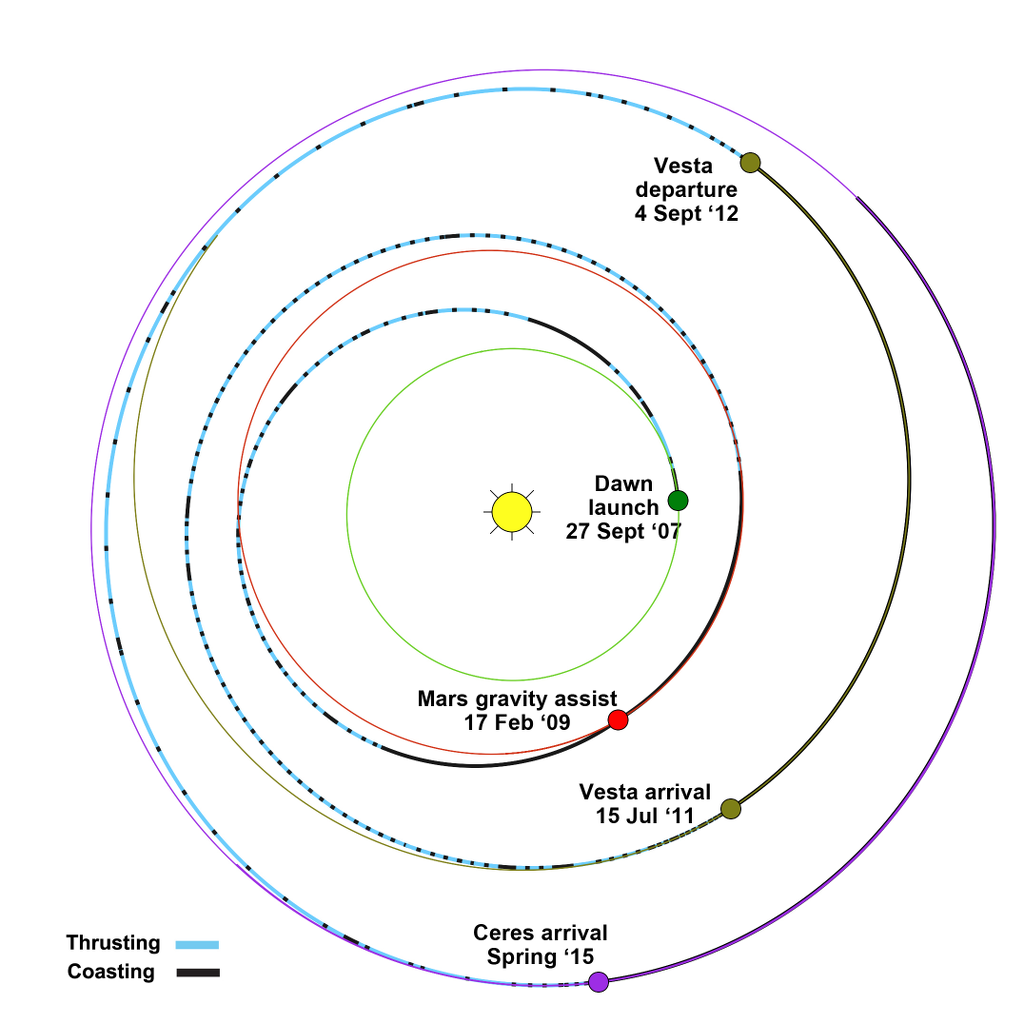
Dawn orbital track past Mars, stopping at Vesta and continuing to Ceres. Credit: NASA/JPL.
The Dawn spacecraft uses ion propulsion, which though 10 times more efficient than chemical fuels, has the thrust comparable to that of the weight of a piece of a piece of paper. Consequently the spacecraft spends most of its time thrusting. Since it’s antenna is bolted on the spacecraft, it cannot thrust and communicate with the earth at the same time, so it has to stop thrusting and turn toward the earth to report back at scheduled intervals before resuming thrusting again.
11/14/2013 – Ephemeris – An asteroid with 6 tails.
Ephemeris for Thursday, November 14th. The sun will rise at 7:38. It’ll be up for 9 hours and 37 minutes, setting at 5:15. The moon, 3 days before full, will set at 5:31 tomorrow morning.
Ready for something weird in the sky? Back in August the Pan-STARRS telescope on Mount Haleakala in Hawaii discovered an asteroid with 6 tails. This was confirmed in September by the Hubble Telescope. The tails weren’t directed away from the sun like cometary tails, bur were set off in a range of directions from the asteroid. This was a main belt asteroid orbiting the sun between Mars and Jupiter. It may be that the asteroid was in a collision some time ago which sent it spinning rapidly, so the speed of rotation at its equator is at or above the asteroid’s escape velocity, and dust migrating to the equator is flung off to make the tails. Looks like the hunt for near earth asteroids is picking up some interesting objects.
Times are for the Traverse City/Interlochen area of Michigan. They may be different for your location.
Addendum
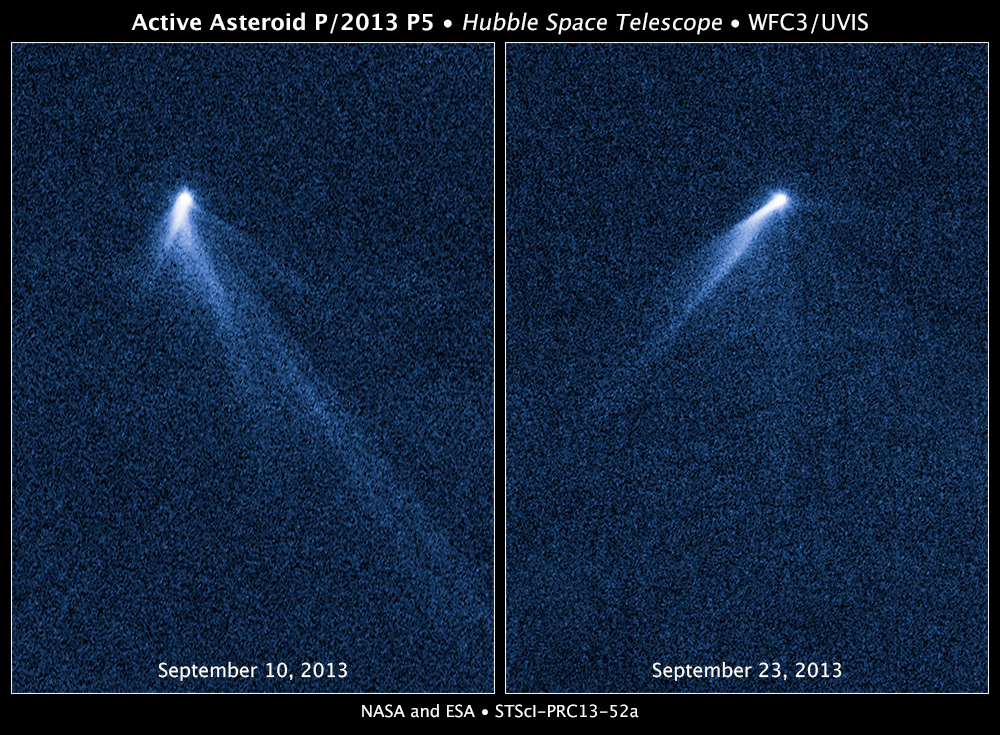
Hubble Space Telescope images of Asteroid P/2013 P5. Hat tip to Universe Today.
02/15/2013 – Ephemeris – Old grumpy astronomer to asteroid 2012 DA14: “Get off my lawn”!
Ephemeris for Friday, February 15th. The sun will rise at 7:42. It’ll be up for 10 hours and 29 minutes, setting at 6:11. The moon, 2 days before first quarter, will set at 12:29 tomorrow morning.
The asteroid 2012 DA14 will zip inside the ring of geosynchronous communication and weather satellites this afternoon around 2:30. We’re on the wrong side of the earth to see it. But many astronomers with optical and radio telescopes will be watching. The asteroid, perhaps half the size of a football field in diameter will whiz by 18,000 miles above the earth’s surface and from our point of view will appear to move from south to north. The asteroid was found by Spanish amateur astronomers in a program to refine the orbits of other near earth objects. They use mostly their own funds and whatever they receive in donations. The asteroid was discovered with a CCD camera that they received with a grant from the Planetary Society.
Times are for the Traverse City/Interlochen area of Michigan. They may be different for your location.
Addendum
The Bad Astronomer, Phil Plait, has a lot to say about today’s close encounter.
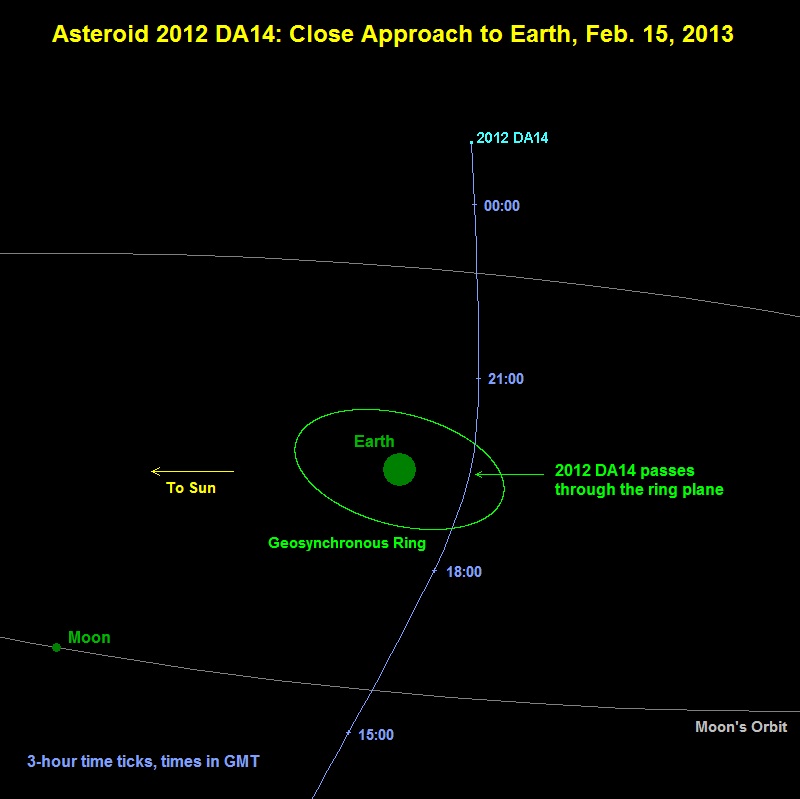
The orbit of asteroid 2012 DA14 as it passes the earth on February 15, 2013. Credit NASA.
As it passes the earth the asteroid 2012 DA14 will appear to travel just about directly south to north. This because we are orbiting the sun too. Until the encounter the asteroid has a slightly slower orbit of the sun. The encounter will cause the orbital period of the asteroid to shorten. The asteroid will cross this point in the solar system again, and someday the asteroid and the earth will cross each other’s path again on or around February 15th in a distant year.
 Bob Moler's Ephemeris Blog