Archive
05/29/2015 – Ephemeris completes 40 years on the air
Ephemeris for Monday, June 1st. Today the Sun will be up for 15 hours and 20 minutes, setting at 9:21. The Moon, 1 day before full, will set at 6:17 tomorrow morning and tomorrow the Sun will rise at 6:00.
We’ll start Ephemeris’ 41st orbit of the Sun by looking at the skies of June. There’ will be a lot of sun in June and very little night. The daylight hours will increase a bit from 15 hours and 20 minutes today to 15 hours and 34 minutes on the 21st, retreating back to 15 hours 31 minutes at month’s end. At this time of the year the sunset times for Ludington, Interlochen, Petoskey and Mackinaw City are very nearly the same. However the sunrise times are at their most divergent. With Ludington’s sunrise being 14 minutes later than Mackinaw City’s. The altitude of the sun above the southern horizon at local noon will hover around 68 to 69 degrees. Local noon, when the sun is actually due south will occur at about 1:43 p.m. Here’s what we’ve been waiting for: Summer will start on the 21st at 12:38 p.m.
Times are for the Traverse City/Interlochen area of Michigan. They may be different for your location.
Addendum
This is my article in the June Stellar Sentinel, the monthly newsletter of the Grand Traverse Astronomical Society
At the end of May I will have completed 40 years of the short program on Interlochen Public Radio (IPR) I call Ephemeris. The first airing was June 1st 1975. It currently airs twice each week day at 6:49 a.m.** on their news stations, and at 6:59 a.m.** on their classical music stations. This article isn’t about Ephemeris, but what has transpired in the last 40 years. It’s kind of sobering to realize that 40 years is approximately 10% of the span of 406 years since Galileo first turned his crude telescope to the night sky. Over the next year I’ll look at what has been happening in astronomy and space in those 40 years. This time I’ll look at some telescope advances in that time.
In 1975 the largest optical telescope in the world was the Hale 200 inch (5 meter) telescope* on Mount Palomar, today the Keck I telescope and its twin Keck II on Mauna Kea in Hawai’i are among the largest in the world with 10 meter diameter mirrors. Keck I saw first light in 1990, while Keck II saw its first light in 1996. They share the peak with two 8 meter telescopes: Gemini North and Subaru, among other large scopes. The Thirty Meter Telescope (TMT) is about to be built up there pending the clearing up of a dispute with native Hawaiians who consider the mountain sacred.
Actually the Kecks have been edged out by the Gran Telescopio Canarias, in the Canary Islands with a 10.4 meter mirror, which saw first light a few years ago. Not to be outdone, the European Southern Observatory, a consortium of 13 European nations have established a beachhead in the Chilean Andes and are building the European Extremely Large Telescope (E-ELT). Its segmented mirror will span 39.3 meters (1,550 inches), nearly eight times the diameter of the Hale telescope, and is expected to see first light in 2024. If Ephemeris and I will be around another 10 years, we’ll see that too.
Many of the existing large telescopes have been shown up by NASA’s most popular satellite, the Hubble Space Telescope (HST) which has only a 2.4 meter (94.5 inch) mirror. Telescope placement is like real estate: Location, location, location. The higher the better to beat the bane of telescope viewing atmospheric turbulence. Nearly 400 miles altitude in orbit solves that problem nicely. The next generation space telescope is to be launched in three years. It’s the James Webb Space Telescope (JWST), named for an Apollo era NASA administrator. It will be launched by an ESA Ariane 5 rocket to the Earth-Sun L2 point a million miles opposite the direction of the Sun. It will operate in the infrared.
Not to be outdone by Hubble, ground based astronomers have found a way to combat atmospheric turbulence, or “bad seeing” as we term it: It’s called adaptive optics. Ever see those time-lapse videos of the Keck and other observatories shine lasers skyward. These are tuned to the wavelength that excites sodium atoms in the atmosphere above 50 kilometers to produce an artificial star. By deforming the telescope mirror or mirror segments to straighten out the artificial star’s light the atmospheric seeing can be improved by a factor of 16 or better. This technique works better in the infrared whose wavelengths are longer than visible light.
Our atmosphere is relatively transparent at wavelengths that happen to be at the Sun’s peak output. That is where evolution has given us the ability to see in. However to use an acoustic analogy, we are doomed to hear the cosmic symphony by listening to a single octave on a piano that stretches in a mile in either direction from middle C.
In 1975 radio astronomy was beginning to work with multiple telescopes to produce radio interferometers that spanned the continent to produce the effect of a single telescope of the width of the array of many telescopes. These arrays have now spanned oceans, and even into space. These interferometers rival and surpass the resolution of optical telescopes. A prime goal is to resolve the black hole in the center of the Milky Way, something that can’t be seen invisible light, which can’t penetrate the gas and dust along the 26,000 light year path to the center of our galaxy.
Today there are neutrino telescopes underground, X-ray telescopes and Gamma Ray telescopes orbiting the Earth, an armada of spacecraft orbiting and studying the Sun. Also techniques and instruments have been refined, so that when once the idea of detecting planets around other stars was thought to be a dream for the future, we’ve been discovering them by the thousands over the last 20 years. Even amateur astronomers can do it now.
In the 45 seconds I have to devote to astronomical topics after the sunrise, sunset and lunar phase information in an Ephemeris program I cannot delve deeply into the wonders that modern astronomy brings. But I can give a taste, and provide the key to the heavens to just go out and experience the wonder of the universe that is the night sky as seen from our own back yards.
* I forgot about BTA-6 in the Caucasus Mountains in the then Soviet Union, a 6 meter telescope that saw first light in late 1975, so I guess I was still correct on the Ephemeris launch date. It has a history of problems and was never really able to fulfill its promise for a number of reasons. It beat out the Hale telescope by 38 inches. It did pioneer the alt-azimuth mount that all large telescopes now use.
** Correction (June 4): These are the corrected times. I was an hour too late. Thanx and a tip of the old observers cap to Emmett Holmes for the heads up.
10/13/2014 – Ephemeris – Columbus uses knowledge of eclipses to get supplies from the natives
Ephemeris for Columbus Day, Monday, October 13th. The sun will rise at 7:55. It’ll be up for 11 hours and 6 minutes, setting at 7:01. The moon, 2 days before last quarter, will rise at 11:04 this evening.
On Columbus’ 4th voyage to the Caribbean he was stranded on Jamaica. For a while the natives of the island fed Columbus and his men. However due to the thievery of some of his crew, these people no longer trusted Columbus any refused them any more supplies. Columbus consulted a table of eclipses and found that a lunar eclipse was to occur on February 29th that year (1504), and that at his location the moon would rise in eclipse. He went to the leader of the people and said that they had displeased their god by refusing his crew food, and that the god would turn the Moon red in anger. The native peoples saw the red moon rising and promptly gave Columbus the supplies he wanted.
Times are for the Traverse City/Interlochen area of Michigan. They may be different for your location.
Addendum
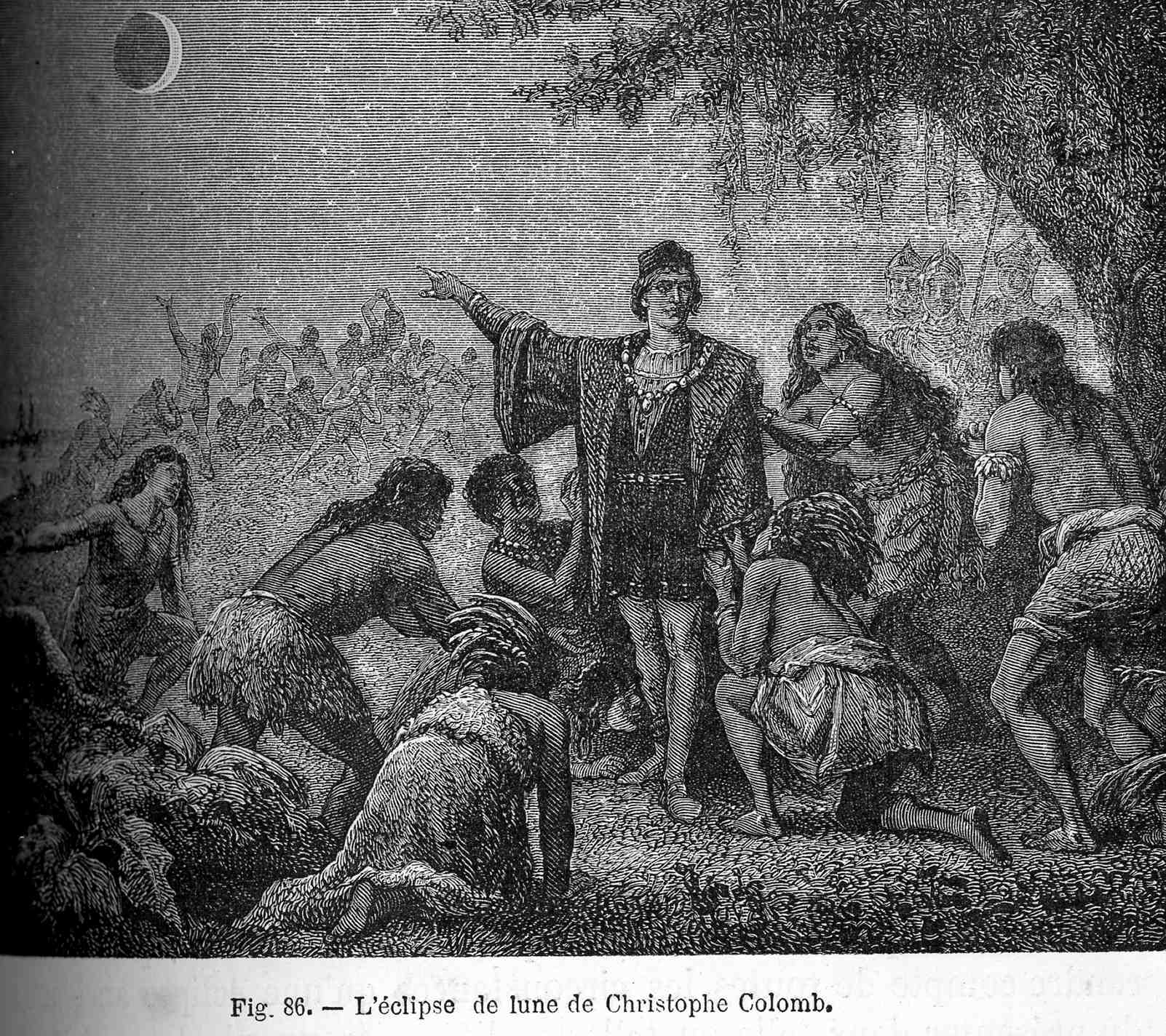
Christopher Columbus showing the lunar eclipse. From Camille Flammarion – Astronomie Populaire 1879, p231.
For more information in the Internet – search for Columbus lunar eclipse
05/26/2014 – Ephemeris – In memory of the fallen Space Shuttle Astronauts
Ephemeris for Memorial Day, Monday, May 26th. Today the sun will be up for 15 hours and 10 minutes, setting at 9:15. The moon, 2 days before new, will rise at 5:29 tomorrow morning. Tomorrow the sun will rise at 6:03.
Memorial day is a day of remembrance for those who paid the ultimate price for our freedom. When astronomers name craters or other features on planets or moons, they are names of those who have gone before. For instance craters near the moon’s north and south poles are named for explorers of the corresponding earthly pole. The Challenger astronauts have craters named for them in the moon system of Uranus, from discovery pictures relayed to the earth by Voyager 2 a few days before the Challenger accident. The Mars Rover Spirit is a memorial and located in the Columbia Hills, its features named for the astronauts who died 11 months before Spirit landed.
Times are for the Traverse City/Interlochen area of Michigan. They may be different for your location.
Addendum
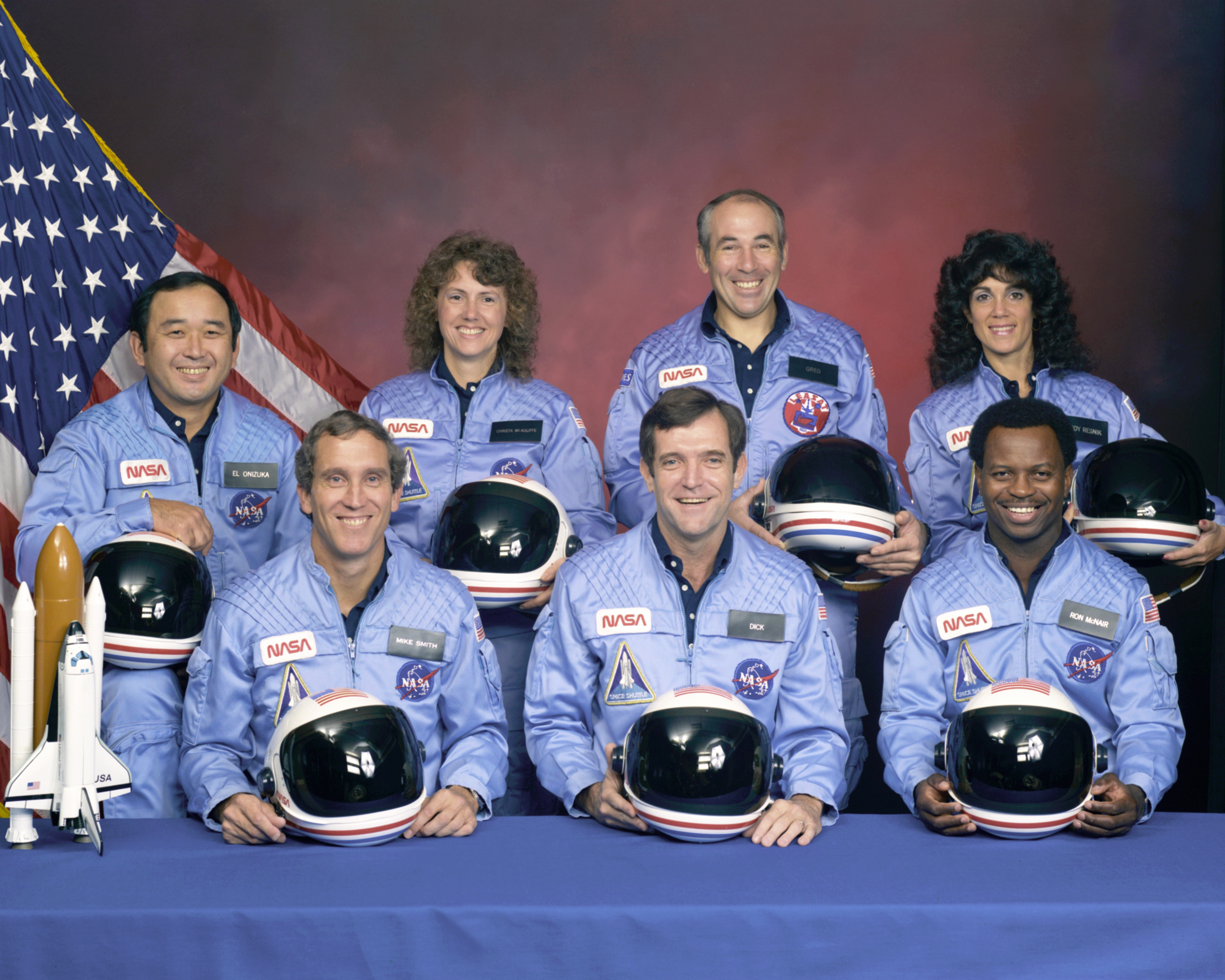
The Challenger crew. From the left: Ellison Onizuka, Michael Smith, Christa McAuliffe, Dick Scobee, Gregory Jarvis, Judith Resnick, and Ronald McNair. Credit: NASA
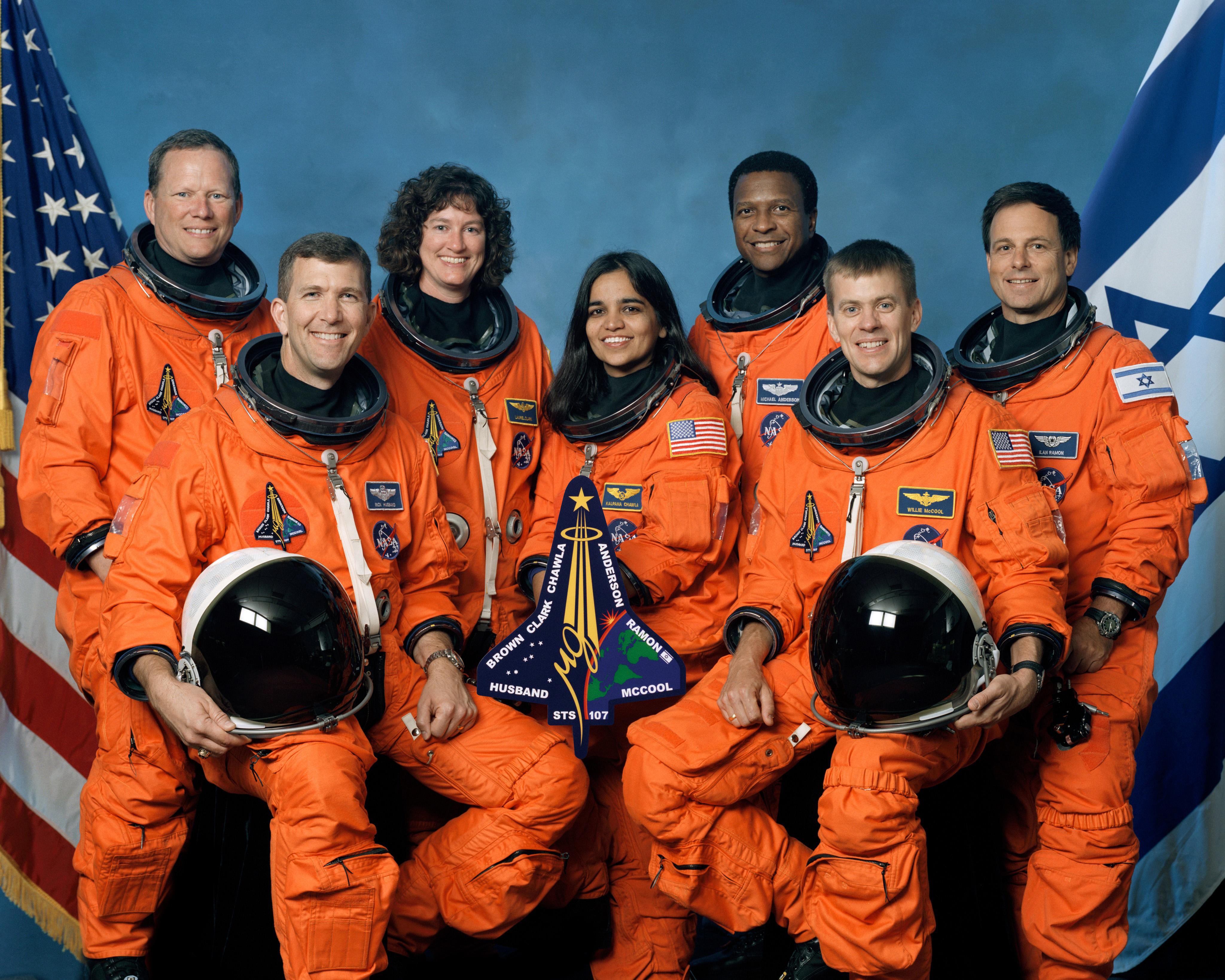
The Columbia crew. From the left: Mission Specialist David Brown, Commander Rick Husband, Mission Specialists Laurel Clark, Kalpana Chawla and Michael Anderson, Pilot William McCool and Payload Specialist Ilan Ramon. Credit: NASA.
I was remiss in my program to omit the Apollo 1 crew.
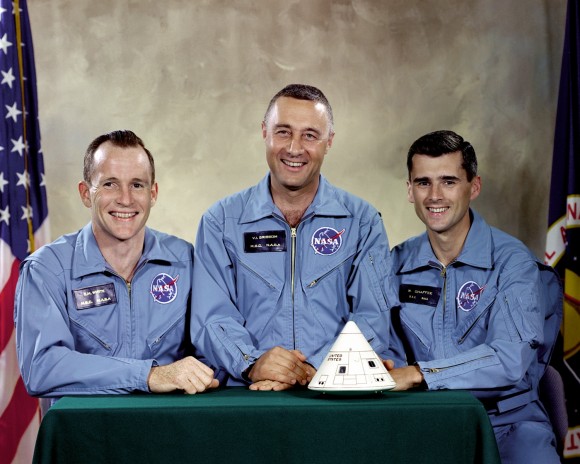
The Apollo 1 crew. From the left: Ed White, Gus Grissom, and Roger Chaffee. Credit: NASA
Apollo 1 never flew. A spark and the faulty design of the spacecraft doomed the men during a test on the pad. Roger Chaffee, from my home town of Grand Rapids, MI was the rookie and had never flown in space. They are immortalized with craters on the far side of the moon.
For more information check out Amy Shira Teitel’s excellent article in Universe Today.
05/22/2014 – Ephemeris – Meteor storms past and maybe this Saturday morning
Ephemeris for Thursday, May 22nd. Today the sun will be up for 15 hours and 3 minutes, setting at 9:11. The moon, 1 day past last quarter, will rise at 3:14 tomorrow morning. Tomorrow the sun will rise at 6:06.
The meteors from Comet 209P/LINEAR have not been completely unseen in the past, but their occurrence had never piqued the interest of meteor observers before. So the comet has left debris in its orbit. Some astronomers have been doing calculations on the orbital dynamics of a hypothetical meteor sward that may have developed near the comet. These swarms are not unprecedented. There’s the Leonid meteor storms that come every 33 years around November 17th that occur when its comet is near the Earth. Another is the less dramatic Draconids of early October, when its comet Giacobini-Zinner is in the neighborhood. The meteor storm is expected to peak around 3 a.m. this Saturday morning the 24th.
Times are for the Traverse City/Interlochen area of Michigan. They may be different for your location.
Addendum
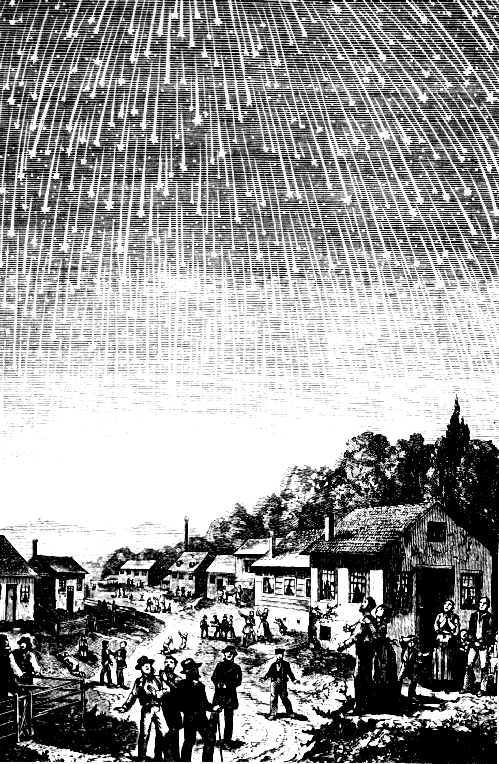
A famous woodcut of the 1833 Leonid meteor storm.
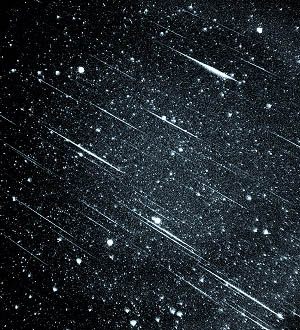
A photograph of the 1966 Leonid meteor storm by A. Scott Murrell. 40 meteors can be counted in the 10-12 minute exposure. Credit: P. Jenniskens/NASA-ARC http://leonid.arc.nasa.gov/.
RIP John Dobson
I just learned that John Dobson passed away today. He was 98 years old. Dobson was the inventor of the Dobsonian Mount for Newtonian telescopes that revolutionized the mounting of large reflector telescopes, thus greatly reducing their price. He was also a co-founder of San Francisco’s Sidewalk Astronomers, an idea that got our society out of the NMC Observatory and on the road.
For new members of the Grand Traverse Astronomical Society he was invited here (Traverse City, MI) to give a talk at Northwestern Michigan College’s Hagarty Center in February 2007 when we were trying to raise money for our own Dobsonian telescope. That was a Saturday night, On Sunday night he came out to Northwestern Michigan College’s Joseph H. Rogers Observatory for a free get together, where he autographed some of our Dobsonian mounts. On Monday I took him out to the Leelanau School in Glen Arbor for a presentation, and he sat in on an astronomy class and an English class taught by Norm Wheeler at the school’s Lanphier Observatory.
Here are some photos from that visit.

John Dobson talking with an audience member after his talk.

John Dobson answering a question at Rogers Observatory
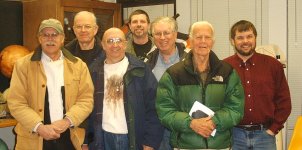
John Dobson with some members of the GTAS at the Rogers Observatory.
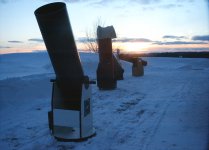
Members brought their Dobsonian telescopes to the Rogers Observatory for the event.
Update: John’s visit was 2007. I originally posted his visit was in 2008. Time flies when you’re not paying attention.
12/19/2013 – Ephemeris – The mystery of the Star of Bethlehem
Ephemeris for Thursday, December 19th. The sun will rise at 8:15. It’ll be up for 8 hours and 49 minutes, setting at 5:04. The moon, 2 days past full, will rise at 7:34 this evening.
The Star of Bethlehem is one of the great mysteries of Christmas. The Chinese of that time were the only ones that recorded the happenings in the heavens. There were no bright stars that appeared near the time of Christ’s birth. That leads us to the Magi themselves, if that’s who they were. Magi were astrologer priests of the Zoroastrian religion in Persia. They saw signs in the positions of the planets that would go unnoticed to the Jews to which astrology was forbidden. Conjunctions where two or more planets gathered together were the most powerful of these configurations. There was a triple conjunction of Jupiter and Saturn in seven BC, and two extremely close conjunctions between Jupiter and Venus in 3 and 2 BC. Could one of those be it?
Times are for the Traverse City/Interlochen area of Michigan. They may be different for your location.
Addendum
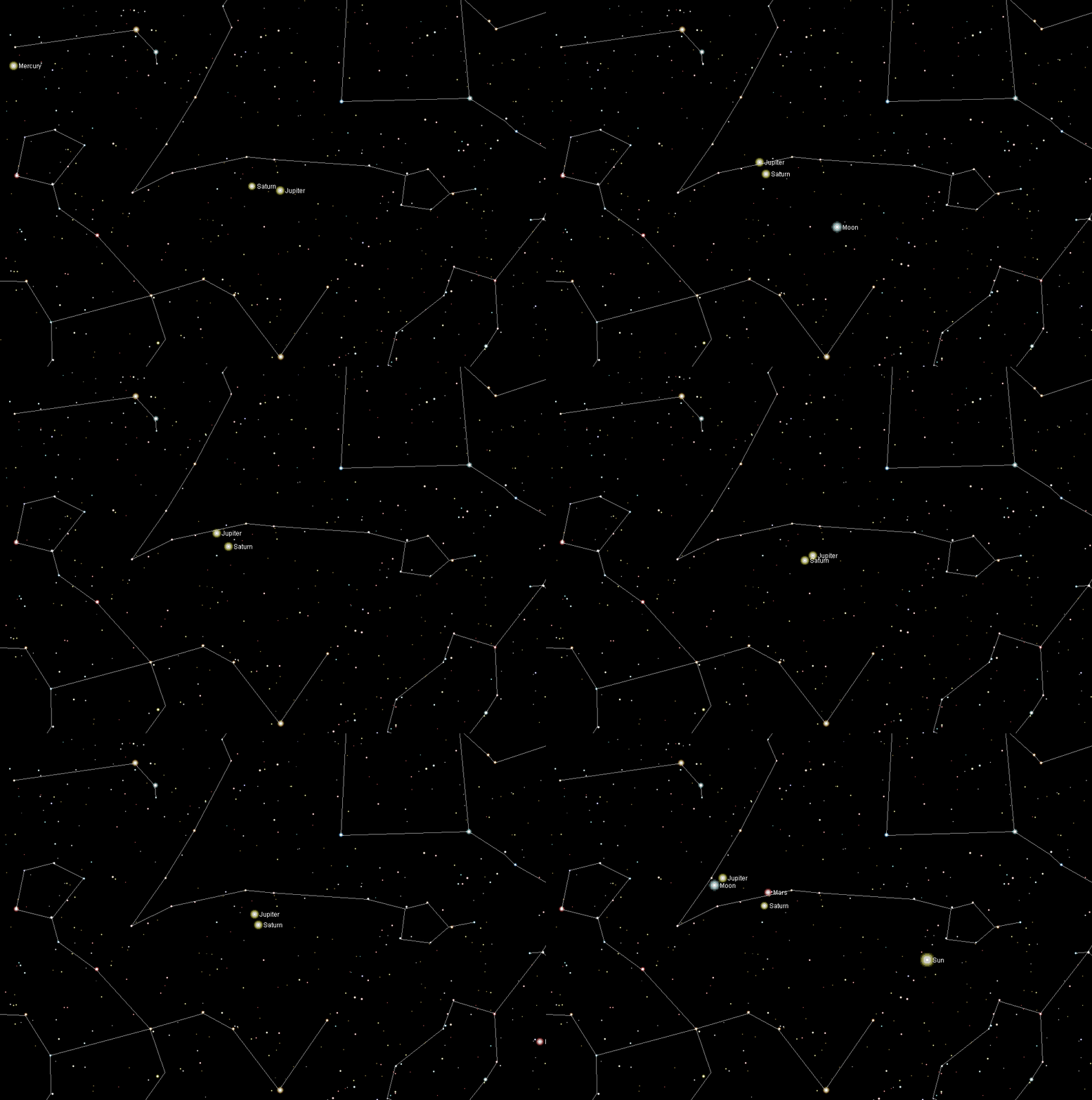
The Jupiter-Saturn triple conjunction of 7 BC. Click on the image to enlarge and animate. Created using Cartes du Ciel.
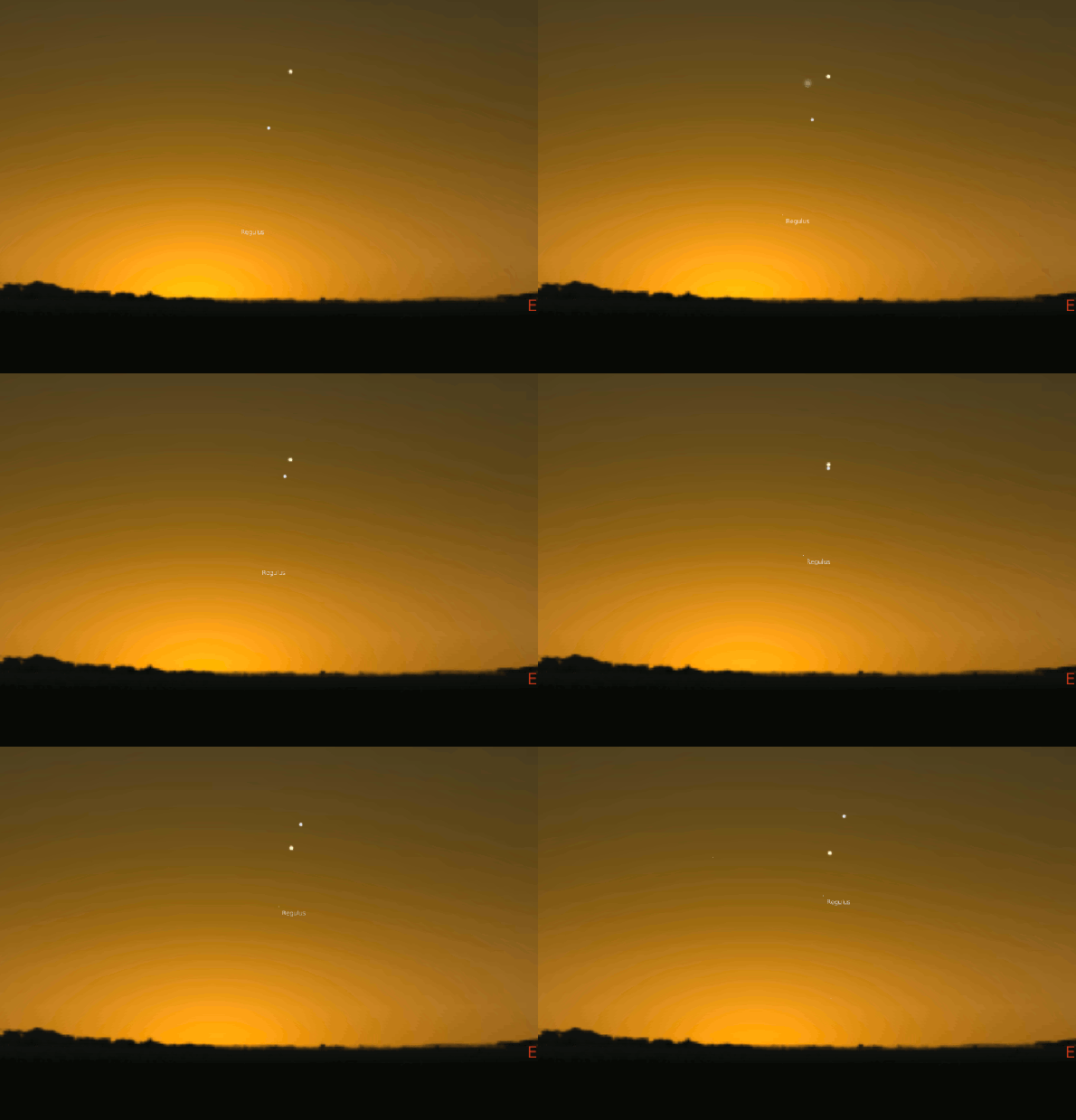
Animation of the Jupiter-Venus conjunction of August 3, 3 BC. in the morning twilight. Created using Stellarium.
Click on the image to enlarge and show the animation. Jupiter is rising while Venus, the brighter one, is heading back to the sun. Jupiter will seem to mate with Venus. 9 months later, the human gestation period their paths seem to cross again.
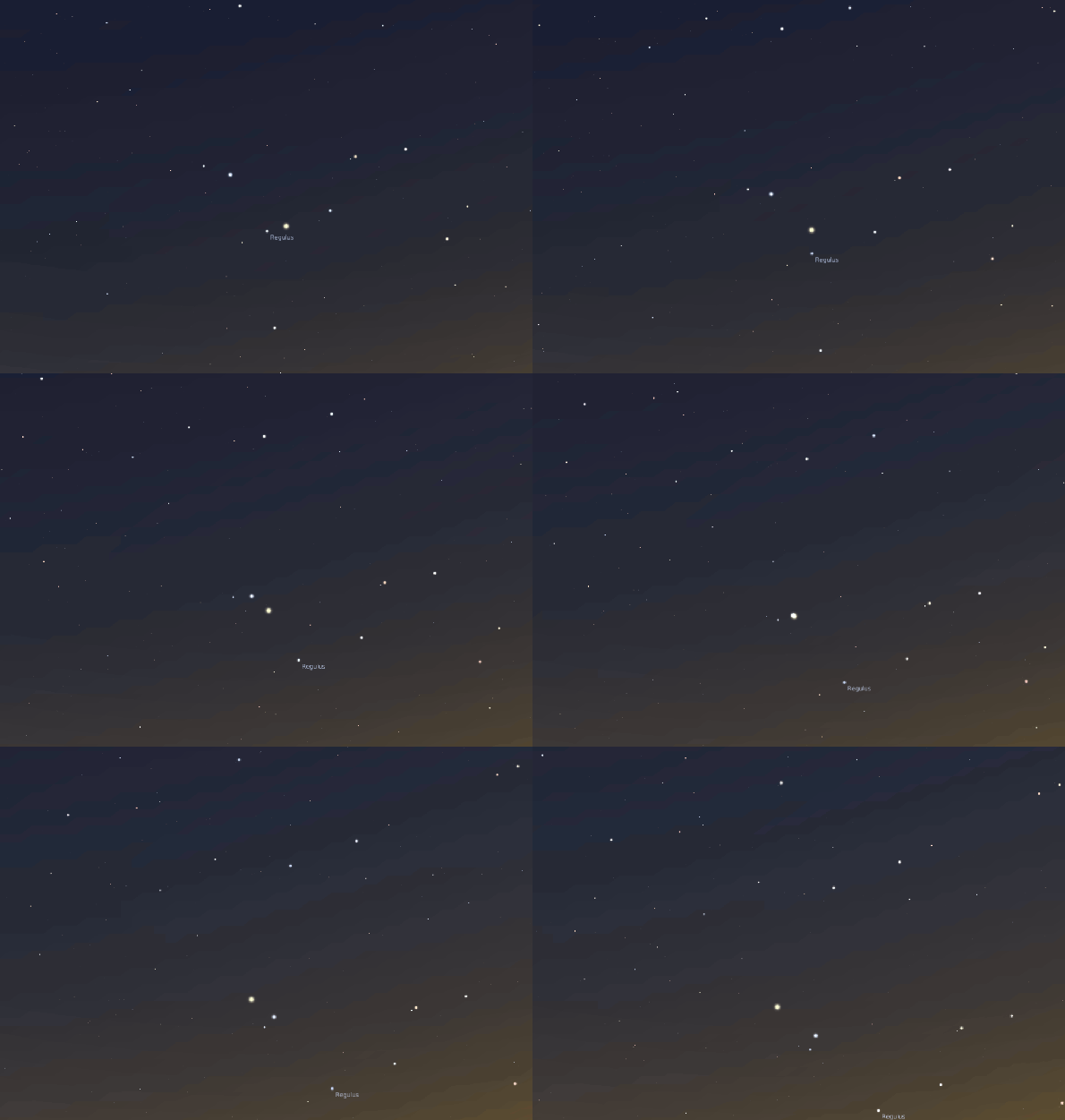
June of 2 BC just after sunset Jupiter and Venus again cross paths. Created using Stellarium.
Click on the image to enlarge and show the animation.
12/06/2013 – Ephemeris – I’ll talk about ancient cosmologies tonight
Ephemeris for Friday, December 6th. The sun will rise at 8:04. It’ll be up for 8 hours and 57 minutes, setting at 5:02. The moon, 3 days before first quarter, will set at 9:40 this evening.
This evening’s meeting of the Grand Traverse Astronomical Society starting at 8 p.m. at Northwestern Michigan College’s Rogers Observatory will be a new December program. In the past yours truly alternated between a program on the Star of Bethlehem and the cosmology of the Bible. This year I’m presenting Ancient Cosmologies, a look at the cosmologies of many mostly pre-scientific cultures, including how the Biblical world view was influenced by one of them. Then we’ll see the beginnings of Greek scientific thought that codified by Ptolemy in the second century AD, held sway for 1,500 years. At 9 p.m. there will be a star party at the observatory, and another program if it’s cloudy. All are welcome.
Times are for the Traverse City/Interlochen area of Michigan. They may be different for your location.
11/11/2013 – Ephemeris – D-Day and the moon
Ephemeris for Veteran’s Day, Monday, November 11th. The sun will rise at 7:34. It’ll be up for 9 hours and 44 minutes, setting at 5:18. The moon, 1 day past first quarter, will set at 2:12 tomorrow morning.
Veterans’ day used to be called Armistice Day, celebrating the end of War to End All Wars. There was, of course a great war after that, and its greatest battle was the invasion on D-Day, a date governed by the position of the Moon. The full moon on June the 6th, 1944 gave light for the gliders and paratroopers light to carry out their operations at midnight. Plus the high tides were near noon and midnight and the low tides near dawn. The idea was to hit the beach at low tide to enable the landing craft to operate without hitting the obstacles the Germans planted in the tidal zone. It was great for the landing craft, but the troops had a lot of open beach to cover to get to some sort of shelter.
Times are for the Traverse City/Interlochen area of Michigan. They may be different for your location.
10/14/2013 – Ephemeris – Columbus greatest and luckiest mistake
Ephemeris for Columbus Day, Monday, October 14th. The sun will rise at 7:56. It’ll be up for 11 hours and 2 minutes, setting at 6:59. The moon, 3 days past first quarter, will set at 4:12 tomorrow morning.
Today we celebrate Christopher Columbus’ big mistake. Mistake? Yes, mistake. Back in 1492 anyone with any education at all knew the earth was round. It was known since the Greek mathematician and geographer Eratosthenes calculated the circumference in the 3rd century BC. Columbus error was in misjudging its size. Columbus though the earth was only 18 thousand miles in circumference, which would put the east coast of Asia 3,000 miles west of the Spanish coast. Most academics held the circumference was nearer 25,000 miles, the correct value, putting Asia some 10,000 miles out. Columbus was very lucky that there was a continent in between. The native peoples, however, were not so lucky.
Times are for the Traverse City/Interlochen area of Michigan. They may be different for your location.
12/17/2012 – Ephemeris – Were the planetary conjunctions of 3 and 2 BC the Star of Bethlehem?
Ephemeris for Tuesday, December 18th. The sun will rise at 8:14. It’ll be up for 8 hours and 49 minutes, setting at 5:03. The moon, 2 days before first quarter, will set at 11:43 this evening. | For over 400 years astronomers have wondered and looked through ancient Chinese records, ran the positions of planets back 2000 years, and still no one knows for sure what the Star of Bethlehem really was, but here’s my favorite scenario. On August 13th of 3 BC Jupiter and Venus briefly merged in the pre-dawn skies against the constellation of Leo the lion. A month later Jupiter was in conjunction with Regulus the bright star in Leo, the little king star. Then 9 months later, after sunset on June 16th of 2 BC the two planets again joined as one in Leo. The king of the planets twice mating with Venus as Ishtar, the Babylonian goddess of fertility, against the constellation of the lion signifying Judah from Genesis? The Magi not being Jewish might have found meaning in all that.
Times are for the Traverse City/Interlochen area of Michigan. They may be different for your location.
Addendum
Animation of the Jupiter-Venus conjunction of August 3, 3 BC. in the morning twilight. Created using Stellarium.
Click on the image to enlarge and show the animation. Jupiter is rising while Venus, the brighter one, is heading back to the sun. Jupiter will seem to mate with Venus. 9 months later, the human gestation period their paths seem to cross again.
June of 2 BC just after sunset Jupiter and Venus again cross paths. Created using Stellarium.
Click on the image to enlarge and show the animation.
 Bob Moler's Ephemeris Blog