Archive
12/29/2016 – Ephemeris – Astronomical milestones of 2016
Ephemeris for Thursday, December 29th. The Sun will rise at 8:19. It’ll be up for 8 hours and 50 minutes, setting at 5:10. The Moon is new today, and won’t be visible.
Looking back at 2016 the biggest astronomical news was the detection of gravitational waves coming from two separate collisions of black holes far beyond our Milky Way galaxy. The two detectors in Washington state and in Louisiana recorded these events in September and December 2015, but the first announcement was made in February this year after the signals were cleaned up and studied. The year saw the end of the European Space Agency’s Rosetta Mission to the comet we’ve come to call 67P after orbiting it for over two years. The Opportunity and Curiosity rovers continued their exploration of Mars along with a fleet of satellites. On a sad note, we lost pioneering Mercury astronaut John Glenn at the age of 95.
Times are for the Traverse City/Interlochen area of Michigan. They may be different for your location.
Addendum
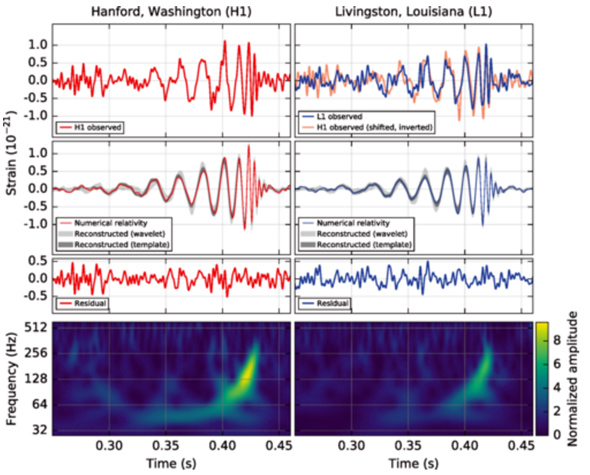
The chirp heard ’round the world and indeed the universe. Credit: LIGO/Abbot et al. 2016. Hat tip: Phil Plait, the Bad Astronomer.
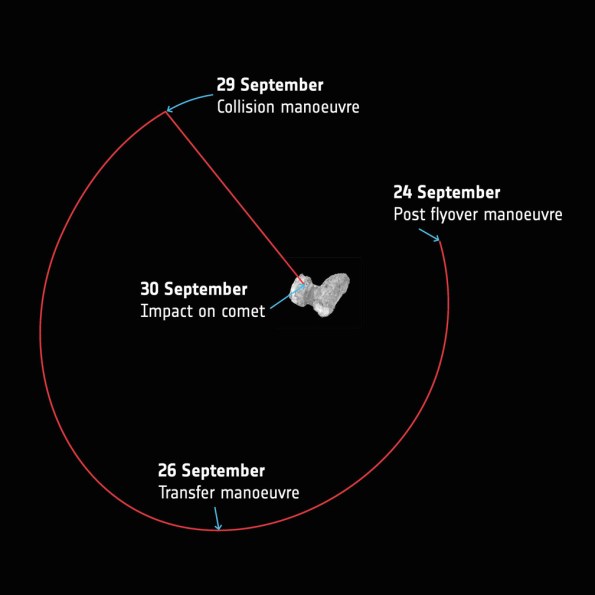
Rosetta, Final orbit. Credit & copyright European Space Agency (ESA)
12/23/2016 – Ephemeris – Another possible set of events that could have been the Star of Bethlehem
Ephemeris for Friday, December 23rd. The Sun will rise at 8:18. It’ll be up for 8 hours and 48 minutes, setting at 5:06. The Moon, 3 days past last quarter, will rise at 3:43 tomorrow morning.
The brilliant planet Venus is out evening star now, and one could say that’s its our Christmas Star. And perhaps it was, or was part of the Star of Bethlehem. Back in August of 3 BC the planet Jupiter and Venus appeared to come very close to one another. The term for such an apparent close approach is called a conjunction. Astrologers make a big deal out of such a chance alignment. It’s like a trick photo of someone in the foreground appearing to hold up or leaning on a more distant object. Anyway, 10 months later in June of 2 BC Jupiter again appeared to join Venus, this time so close they could not be separated by the human eye. This all occurred against the constellation of Leo the lion which in Genesis is the symbol of Judah.
Times are for the Traverse City/Interlochen area of Michigan. They may be different for your location.
Addendum
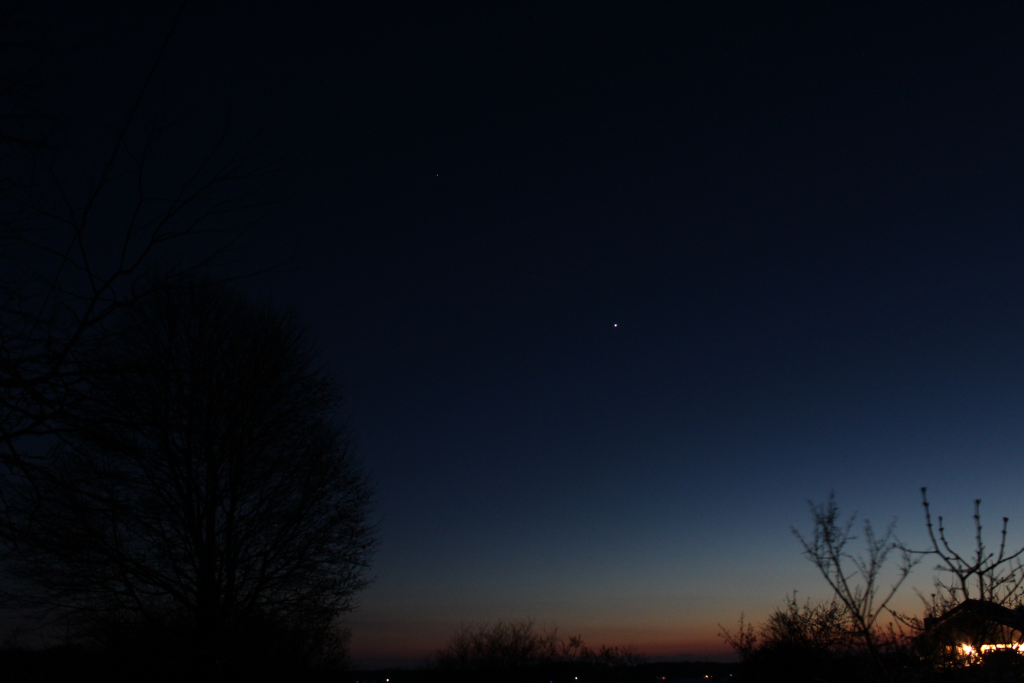
Venus and Mars in the twilight last night at 6 p.m., December 22, 2016. Photograph by Bob Moler. Click on the image to enlarge.
I have more information on this set of conjunctions in my December 2 post announcing my program on the Star of Bethlehem: https://bobmoler.wordpress.com/2016/12/02/12022016-ephemeris-my-talk-about-the-star-of-bethlehem-is-tonight/
12/22/2016 – Ephemeris – Could Jupiter and Saturn have combined to be the Star of Bethlehem?
Ephemeris for Thursday, December 22nd. The Sun will rise at 8:17. It’ll be up for 8 hours and 48 minutes, setting at 5:05. The Moon, 2 days past last quarter, will rise at 2:45 tomorrow morning.
This morning the planet Jupiter is seen right below the waning crescent Moon. It reminds me of one of the possible answers to the questions to what the Star of Bethlehem was. Back in 7 BC Jupiter passed Saturn three times in that year. This is a reasonably rare occurrence especially against a particular constellation, which in this case was Pisces the fish, which would occur every 800 plus years. Early in the run of this program there was another so-called triple conjunction of Jupiter and Saturn. This time it was against the constellation of Virgo the virgin in 1980 and 81. Jupiter passes Saturn every 20 years, but only when it does so when they are opposite the Sun in the sky is there a chance for a triple conjunction. Tomorrow I’ll look at two really close conjunctions of Jupiter and Venus that also could have been seen by the Magi as the Star of Bethlehem.
Times are for the Traverse City/Interlochen area of Michigan. They may be different for your location.
Addendum
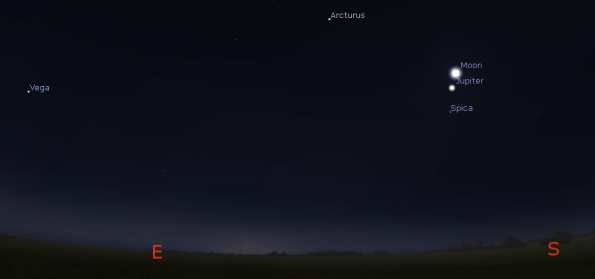
Jupiter and the Moon at 7 a.m. this morning, December 22, 2016. Created using Stellarium.
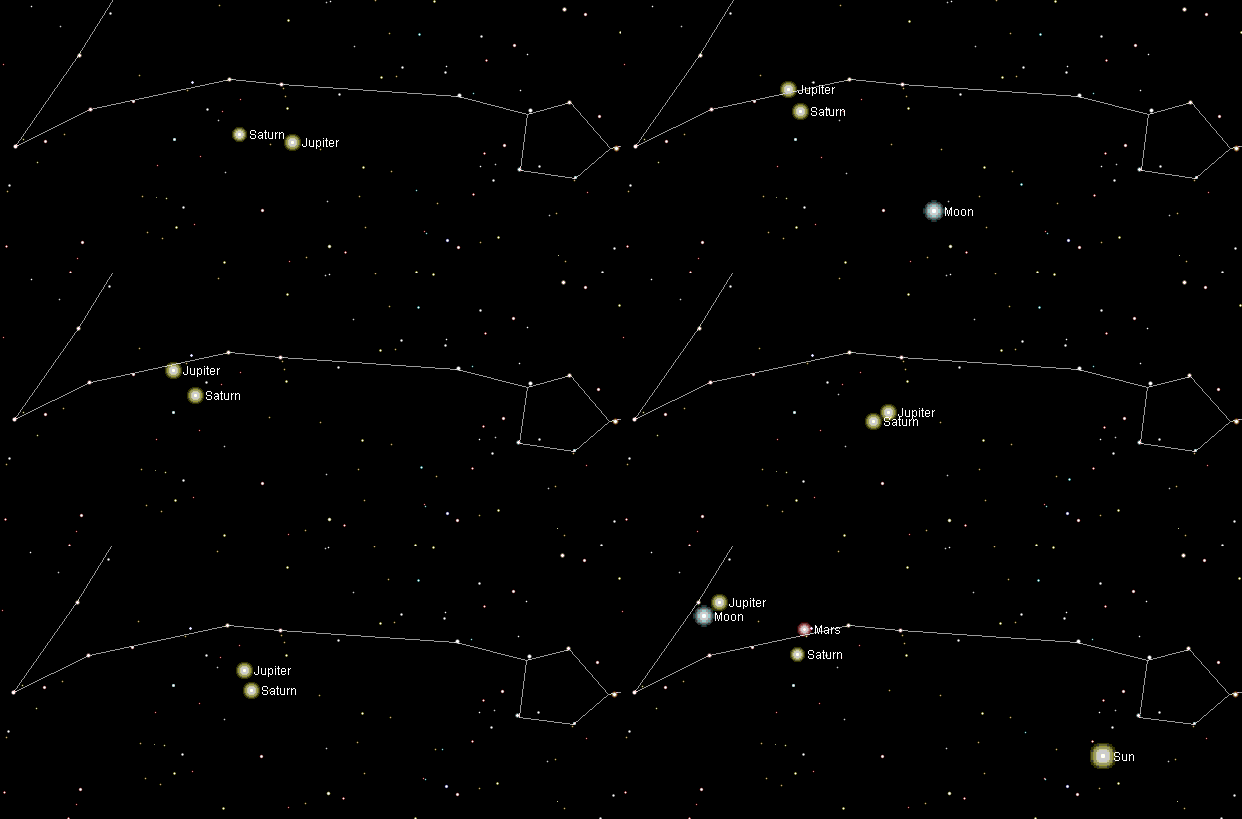
Jupiter and Saturn pass each other three times from May to December in 7 BC. Created using Cartes du Ciel (Sky Charts) and GIMP. Click image to enlarge.
12/02/2016 – Ephemeris – My talk about the Star of Bethlehem is tonight
Ephemeris for Friday, December 2nd. The Sun will rise at 8:01. It’ll be up for 9 hours and 1 minute, setting at 5:03. The Moon, 3 days past new, will set at 8:02 this evening.
This evening at 8 p.m. I will be giving a talk investigating the origin of the Star of Bethlehem. This will be during the monthly meeting of the Grand Traverse Astronomical Society, at Northwestern Michigan College’s Rogers Observatory located south of Traverse City on Birmley Road. The talk is a scientific treatment of the subject, rather than a religious one. We’ll look at what the Gospel writers got right and possibly got wrong. We’ll look at historical writings and oriental observations of the heavens around that time. This will be augmented by computer simulations of what might be important celestial events visible around that time. There is no admission charge. There will be viewing of the skies afterward if it’s clear.
Times are for the Traverse City/Interlochen area of Michigan. They may be different for your location.
Addendum
The Star of Bethlehem: The case for a 2 BC Nativity date
By Bob Moler
This is a 2016 rewriting of a Stellar Sentinel article from December 1997 as an introduction to my talk this month: In Search of the Star of Bethlehem.
At this month’s meeting of the society I will present again the two thousand 2,000 year old search for the Star of Bethlehem. After studying and dismissing, for a variety of reasons, other phenomena, the quest centers on two rare sets of conjunctions of planets. The first, the favorite of the last 400 years, involves a rare triple conjunction of Jupiter and Saturn over 6 months in 7 BC. It’s 2,000th anniversary was in 1994.
The triple conjunction fits if King Herod the Great died in 4 BC. Remember according to Matthew the Magi visited Herod in Jerusalem, and were directed to Bethlehem. According to the Jewish Historian Flavius Josephusi, a contemporary of the Gospel writers, Herod died between an eclipse of the Moon and the following Passover. Pretty much the accepted eclipse was a slight partial eclipse on the early morning of March 13, 4 BC. Passover followed the next lunar month later. It turns out that Josephus was a busy boy in his last dayes after the eclipse. A much better eclipse was that of January 10, 1 BC which was total and visible in the evening, and which allowed a span of 3 months for Herod to accomplish the requisite wickedness of his final days. It is this eclipse, and Herod’s death in 1 BC that the events of the 2 BC Nativity date was based.
The second solution involves the planets Jupiter and Venus, which had two nearly stellar conjunctions 10 month’s apart in 3 and 2 BC, 2,000 years ago from 1998 and 1999. If you’re a bit confused about the mathematics of the 2,000 year subtraction, remember there was no year zero, 1 BC was the year prior to AD 1. So mathematically year -1 was 2 BC. Of course the AD/BC calendar numbering wasn’t used back then. Our calendar wasn’t determined for another 500 plus years later. Back then, the Roman calendar (AUC) was in use in the that part of the world.
Adding to the information on the second solution I talked about 20 years ago are more ideas that were graciously sent me by George Petritz. It was an issue of Imprimis, a publication of Hillsdale College. In the December 1996 issue was an article The Star of Bethlehem by Dr. Craig Chesterii, who suggests the 1 BC date for Herod’s death.
It looks like the Star of Bethlehem was not the spectacular apparition we celebrate today in images and song. The importance of the apparition was definitely in the eye of the beholder. And the beholders were the Magi, astrologer priests of the Zoroastrian religion based in Persia. They have worked out the meaning of every planet, position and constellation in the visible heavens, and they were aware of the writings and religions of the nations that surrounded them. So let’s try to see what the Magi might have read into two planetary conjunctions occurring 10 months apart in 3 and 2 BC.
On August 12th of 3 BC. just before dawn. The two brightest planets Jupiter and Venus merge into a single dazzling star in the dawn twilight. This even occurred below the chin of the constellation of Leo the lion. In the twilight, on the lion’s bright star Regulus was visible.
So here’s the cast of characters. Jupiter then as now was the king of the gods. In Hebrew, it was Sedeq, which meant Righteousness. The Jews worshiped one God, the only God, who created everything, so they didn’t need to see Jupiter as a god.. Venus was the fertility goddess to all except the Jews. To the Babylonians it was Ishtar. However the in Second Kings and Jeremiah the prophets were distresses to find many Jews were indeed worshiping Ishtar. The lion was the king of beasts, and in Genesis 49:9 Jacob associated his son Judah with a young lion. King David was of the tribe of Judah, and so was the Messiah to be. The reference is again repeated in Revelation 5:5, which reveals the power of the association in the early Christian era. Regulus’ name means little king star, an allusion to its location in heart of the king of beasts. The ancients thought that this star ruled the affairs of the heavens.
Beside the conjunctions of Jupiter and Venus, each planet has their own conjunctions of Regulus. Chester also suggests a solution to the problem of the verse in Matthew 2:9, where the star came to a standstill over place where the child was. This seems to be impossible for an astronomical object. Chester’s explanation was that this is when Jupiter reached its stationary points at the beginning and end of its retrograde or westward motion. Well, let’s see the chronology of all these events, as modeled with the free app Cartes du Ciel:
- August 12, 3 BC. – Venus and Jupiter are in their first conjunction, visible low in the eastern twilight before sunrise. Both are moving eastward against the stars.
- August 17, 3 BC. – Venus and Regulus are in conjunction.
- August 24, 3 BC – Venus and Mercury are in conjunction
- September 14, 3 BC. – Jupiter and Regulus are in conjunction.
- November 27, 3 BC. – Jupiter is stationary, and will begin to move in retrograde with respect to the stars, or to the west.
- February 16, 2 BC. – Jupiter and Regulus are in conjunction for the second time, as Jupiter continues the retrograde motion.
- March 29, 2 BC. – Jupiter is stationary, ending retrograde motion, and resuming its prograde or eastward motion.
- May 9, 2 BC. – Jupiter and Regulus are in conjunction for the third time.
- June 10, 2 BC. – Venus and Regulus are in conjunction.
- June 17, 2 BC. – Venus and Jupiter are in conjunction. They appear to merge into a single star low in the west at sunset.
The first conjunction, on August 12th, 3 BC., apparently set the Magi on their journey. This is the first appearance of the star as recorded in Matthew 2:2. I expect that the knowledge of planetary motions allowed the Magi to predict the second conjunction 10 months later. They may have timed their journey to arrive around that second conjunction.
The Magi expecting a king, went to the capitol city of Judea, Jerusalem. It is a reading from the scriptures that sends them to King David’s birthplace, Bethlehem. As they left Jerusalem the Magi saw the star again. Was this the second conjunction on June 17th, 2 BC?
The problem of the star standing still over where the child was is still there. If the stationary point of Jupiter is that phenomenon, Jupiter would have reached its stationary or standstill point for the last time a month before the Magi ever got to Jerusalem. The stationary position of Jupiter, will be lost on all but keen watchers of the heavens. Jupiter would still share the stars daily motion through the sky. Another point: Jupiter isn’t the star but the combination of Jupiter and Venus is. I’m afraid the standstill problem is still unsolved.
Recently we have had a repeat of the above celestial events in our skies beginning with a close Venus-Jupiter conjunction on August 18, 2014 with a second conjunction on June 30, 2015. These were close conjunctions, though not as close as the ones in 3 and 2 BC, plus they were also seen against the stars of Leo.
Whether this is the Star, or not, we know it was the light of the star that drew the Magi. Today both Christians and Jews celebrate, in this season of darkness and the longest nights, holidays of light with Christmas and Hanukkah.
i Antiquities of the Jews – Book XVII Chapters 6-8
ii A condensed copy can be found on the Internet at http://www.theosophy-nw.org/theosnw/world/christ/xt-star.htm
09/19/2016 – Ephemeris – How did the pirates of long ago navigate?
Aye matey, Barnacle Bob here with Ephemeris for Talk Like a Pirate Day, Monday, September 19th. The Sun will rise at 7:26. It’ll be up for 12 hours and 17 minutes, setting at 7:44. The Moon, 3 days past full, will rise at 9:47 this evening.
We tend to romanticize things of the past like the Pirates of the 16th, 17th and 18th century, not so much the Somali pirates of today. The problems of getting around and finding your way around were difficult in the seas and oceans before the use of the Harrison Chronometer made the precise determination of longitude possible in the late 18th century. It did require an almanac of star and planet positions plus the chronometer must be set to some time standard of a particular place of known longitude. Among the Islands of the Caribbean I imagine, though don’t know for certain, that one could dead recon between the islands and crudely navigate that way. Latitude determination was easy using the Sun.
Times are for the Traverse City/Interlochen area of Michigan. They may be different for your location.
Addendum
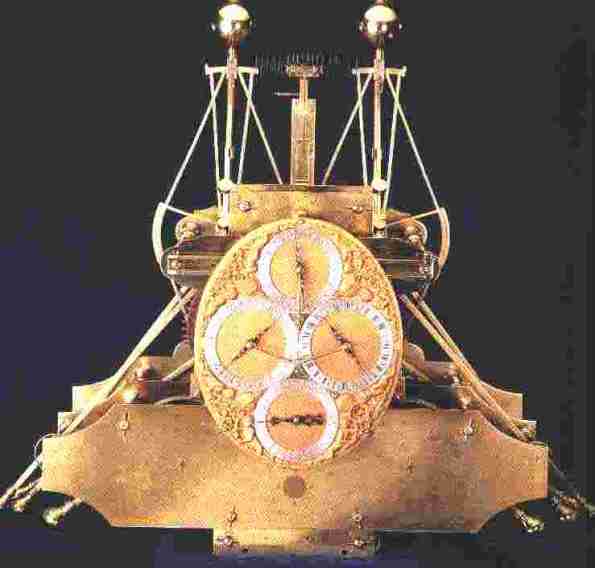
John Harrison’s (1693-1776) First attempt at a chronometer (1735), which he called H1. Credit: Solarnavigator.net.

John Harrison’s (1693-1776) fourth attempt at a chronometer (1759), which he called H4. It passed its sea trials. It’s not much bigger than a pocket watch. Credit: Solarnavigator.net.
03/31/2016 – Ephemeris – Tomorrow night’s Astronomy Society meeting
Ephemeris for Thursday, March 31st. The Sun will rise at 7:24. It’ll be up for 12 hours and 45 minutes, setting at 8:09. The Moon, at last quarter today, will rise at 3:39 tomorrow morning.
Tomorrow night the Grand Traverse Astronomical Society will hold it’s monthly meeting with a program featuring a graduate from Northwestern Michigan College and the astronomy program: Becky Shaw who will present a talk on Women in Astronomy. This is a third presentation of female astronomers, who have made important breakthroughs in astronomy. I especially recommend this for girls interested in the STEM fields, that is Science, Technology, Engineering and Math to find out the wonderful contributions these women have made. Astronomy, by the way encompasses all the STEM fields. The meeting starts at 8 p.m. and the observatory is located on Birmley Road, south of Traverse City. At 9 p.m. there will also be star party if it’s clear, viewing the planet Jupiter, the Great Orion Nebula, and other wonders of the heavens.
Times are for the Traverse City/Interlochen area of Michigan. They may be different for your location.
02/15/2016 – Ephemeris – President Lincoln’s visit to the Naval Observatory
Ephemeris for President’s Day, Monday, February 15th. The Sun will rise at 7:43. It’ll be up for 10 hours and 26 minutes, setting at 6:10. The Moon, at first quarter today, will set at 2:44 tomorrow morning.
In August of 1863, during the height of the Civil War, President Abraham Lincoln and his secretary John Hay rode out to the Naval Observatory where it was back then in Foggy Bottom. The astronomer there Asaph Hall showed them the moon and the star Arcturus through the observatory’s telescope. A couple of nights later Lincoln came out alone to ask the astronomer some questions about what he saw, in including why the Moon was upside down in the observatory telescope while the telescope he used gave a right side up image. Fourteen years later Asaph Hall, still at the Naval Observatory, discovered the two satellites of Mars through the observatory’s then larger telescope.
Times are for the Traverse City/Interlochen area of Michigan. They may be different for your location.
Addendum
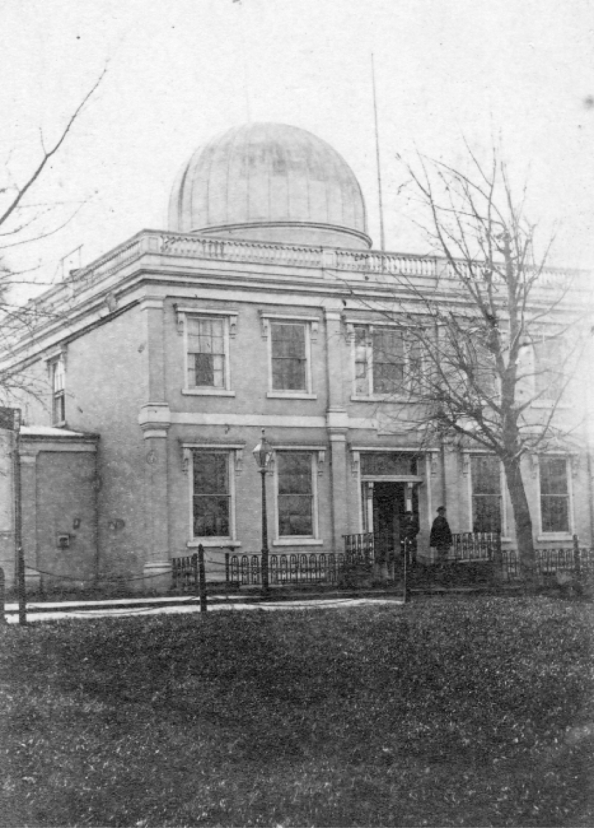
The old Naval Observatory. From the Astronomy.com web site.
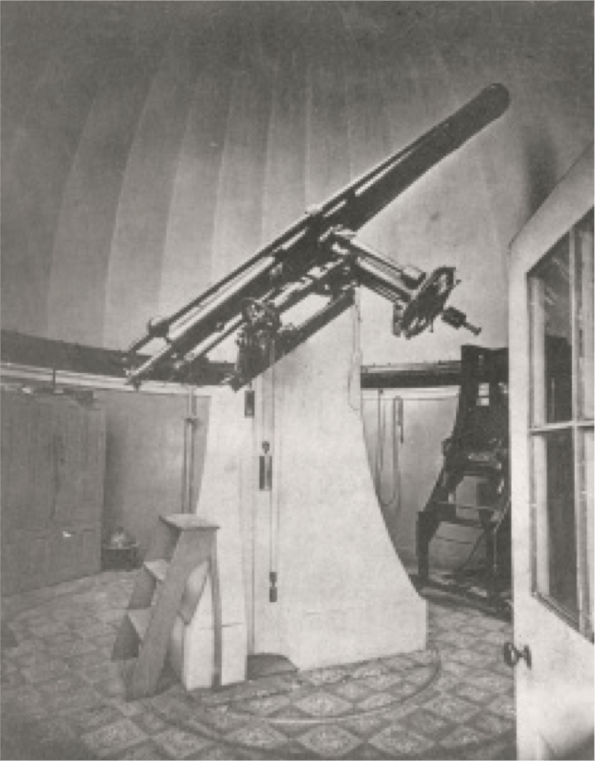
The 9.6 inch telescope through which Lincoln viewed the Moon and Arcturus on the night of August 22, 1863. From the Astronomy.com website.
The above images are from the excellent post Lincoln and the cosmos by Kirk R. Benson, USN Ret. on the Astronomy Magazine website.
02/05/2016 – Ephemeris – Women in astronomy night at the GTAS tonight
Ephemeris for Friday, February 5th. The Sun will rise at 7:57. It’ll be up for 9 hours and 58 minutes, setting at 5:56. The Moon, 3 days before new, will rise at 6:12 tomorrow morning.
Tonight there will be a meeting of the Grand Traverse Astronomical Society at Northwestern Michigan College’s Rogers Observatory, featuring a graduate from NMC and the astronomy program: Becky Shaw who will present a talk Women in Astronomy. This is a second presentation of more female astronomers, the last was in November I especially recommend this for girls in school interested in the STEM fields, that is Science, Technology, Engineering and Math to find out the wonderful contributions these women have made. Astronomy, by the way encompasses all the STEM fields. The meeting starts at 8 p.m. and the observatory is located on Birmley Road, south of Traverse City. At 9 p.m. the will also be star party if it’s clear.
Times are for the Traverse City/Interlochen area of Michigan. They may be different for your location.
Addendum
Appropriate to our speaker’s topic: In the news now is Smith’s Cloud, discovered by Gail Smith (now Gail Bieger-Smith) in 1963 as an astronomy student at Leiden University in the Netherlands. In new studies with the Green Bank (Radio) Telescope and the Hubble Space Telescope the velocity and composition of the cloud has been measured. It somehow was ejected from the Milky Way some 70 million years ago, but it’s coming back! In 30 million years it will crash back in, hitting the Milky Way’s other gas clouds and will probably cause a burst of star formation of maybe 2 million new stars.
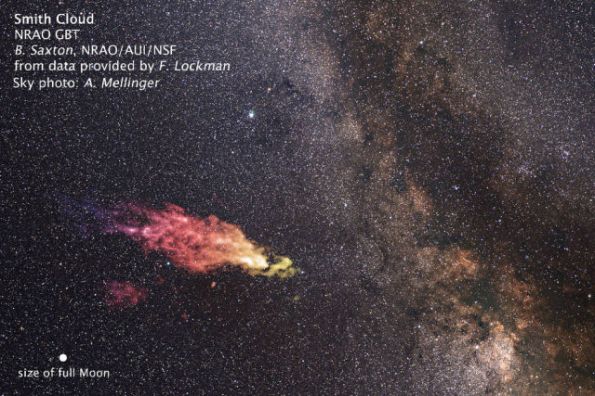
Smith’s cloud superimposed on the Milky Way. Smith’s Cloud is only visible at radio wavelengths, while the Milky Way shown is a visible photograph. Credit: Saxton/Lockman/NRAO/AUI/NSF/Mellinger.
01/25/2016 – Ephemeris – Sirius the Dog Star
Ephemeris for Monday, January 25th. The Sun will rise at 8:09. It’ll be up for 9 hours and 31 minutes, setting at 5:41. The Moon, 2 days past full, will rise at 7:43 this evening.
While we’re waiting for the bright Moon to leave the evening sky, let’s look at another bright star. This one is the brightest of all, Sirius the Dog Star. The Dog Star name comes from its position at the heart of the constellation Canis Major, the great dog of Orion the hunter. The three stars of Orion’s belt tilt to the southeast and point to Sirius. The name Sirius means ‘Dazzling One’, a reference to its great brilliance and twinkling. The Romans thought Sirius added its heat to that of the Sun in summer to bring on the scorching Dog Days of July and August. Its ancient Egyptian name was Sothis, and its first appearance in the morning twilight in late June signaled the flooding of the Nile, and the beginning of the Egyptian agricultural year.
Times are for the Traverse City/Interlochen area of Michigan. They may be different for your location.
Addendum
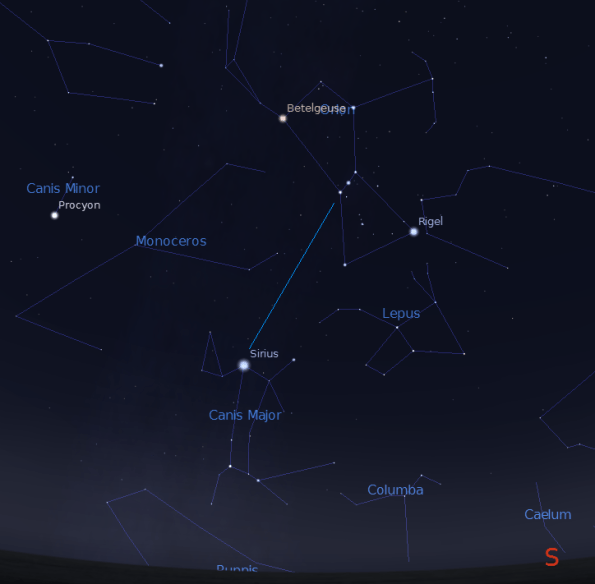
Orion’s Belt points to Sirius. Created using Stellarium.
12/24/2015 – Ephemeris – Jupiter and Venus the “Star” of Bethlehem?
Ephemeris for Christmas Eve, Thursday, December 24th. The Sun will rise at 8:18. It’ll be up for 8 hours and 48 minutes, setting at 5:06. The Moon, 1 day before full, will set at 8:02 tomorrow morning.
Last year August and earlier this year in June we had a near repeat of two very close conjunctions of Jupiter and Venus that occurred in 3 and 2 BC. These two conjunctions spaced by a month more than the human gestation period and seen against the constellation of Leo the lion, symbol of Judah could have brought the Magi, who were Persian astrologer-priests to Jerusalem, capital of Judea. The events could have signified the them the birth of a king of Judea. It was the interpretation of the scriptures by the scribes that actually sent them to Bethlehem. This version of the Star of Bethlehem seems to be the one that’s being accepted more and more by those who believe the Star has a physical reality.
Times are for the Traverse City/Interlochen area of Michigan. They may be different for your location.
Addendum
Jupiter and Venus Conjunctions August 2014 and June 2015
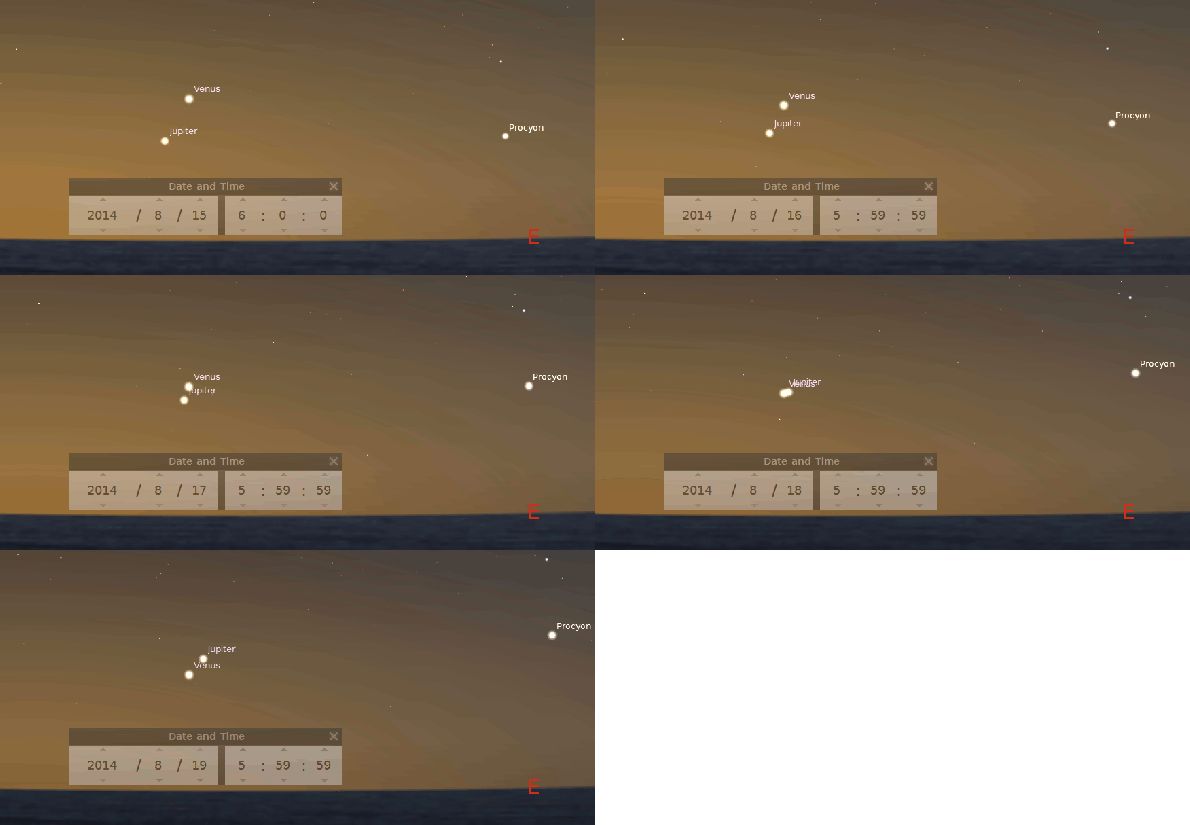
Watch Jupiter and Venus approach each other and separate. From August 15 to August 19, 2018. Created using Stellarium and GIMP.
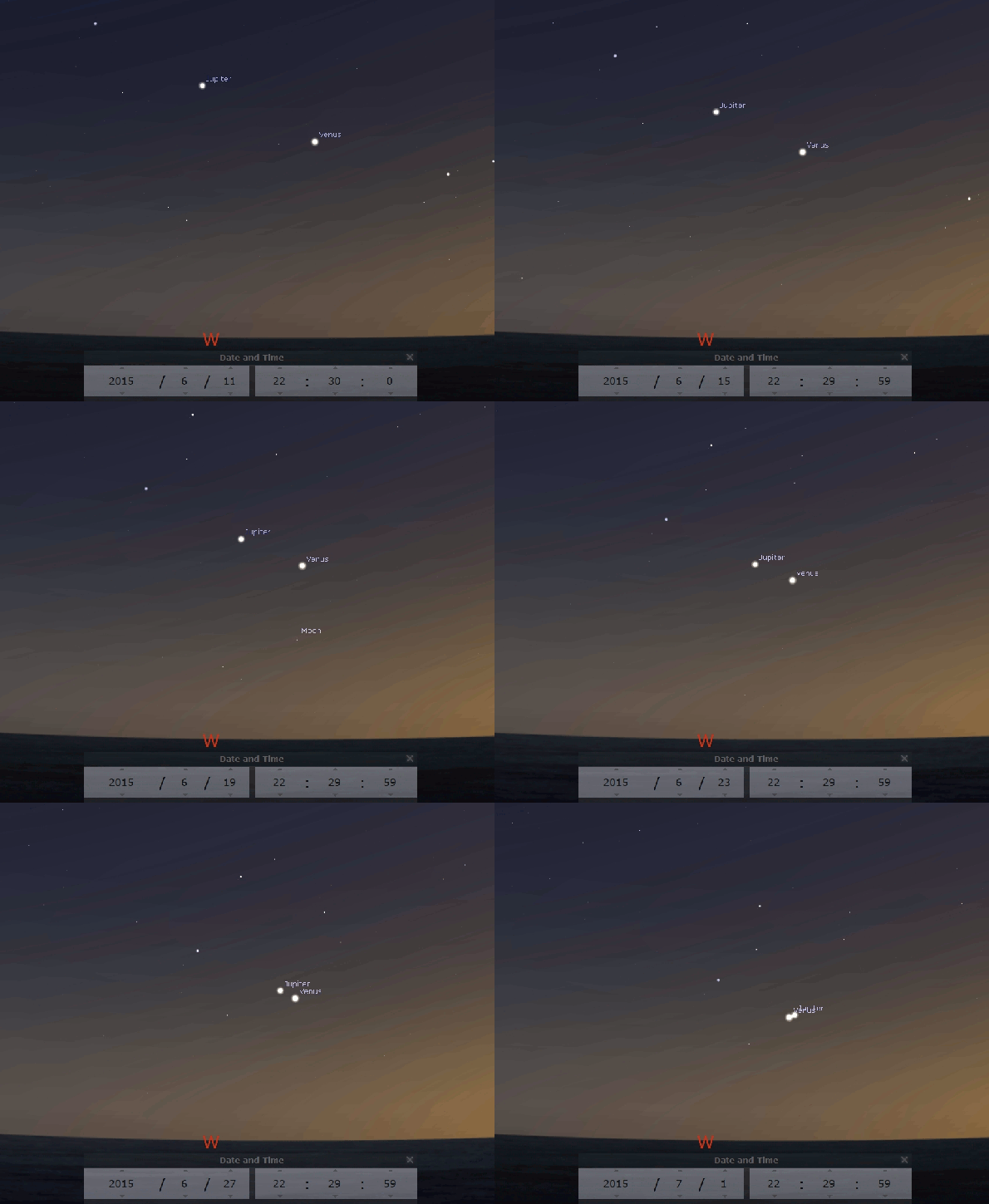
Jupiter-Venus approach animation June 11 to July 1, 2015 at 10:30 p.m. Created using Stellarium and GIMP. Click on image to enlarge.
Jupiter and Venus Conjunctions August 3 BC and June 2 BC
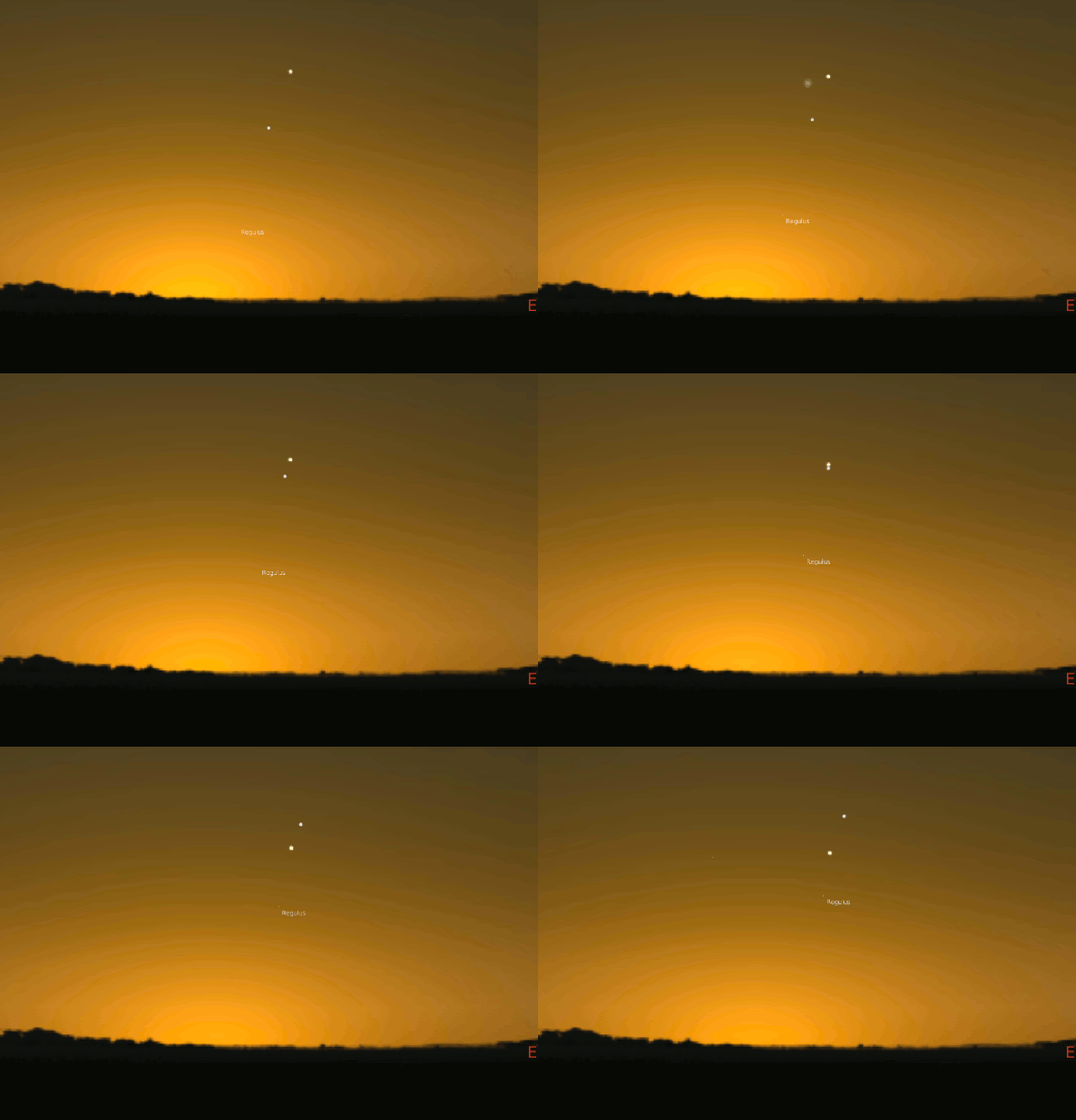
Animation of the Jupiter-Venus conjunction of August 3, 3 BC. in the morning twilight. Created using Stellarium.
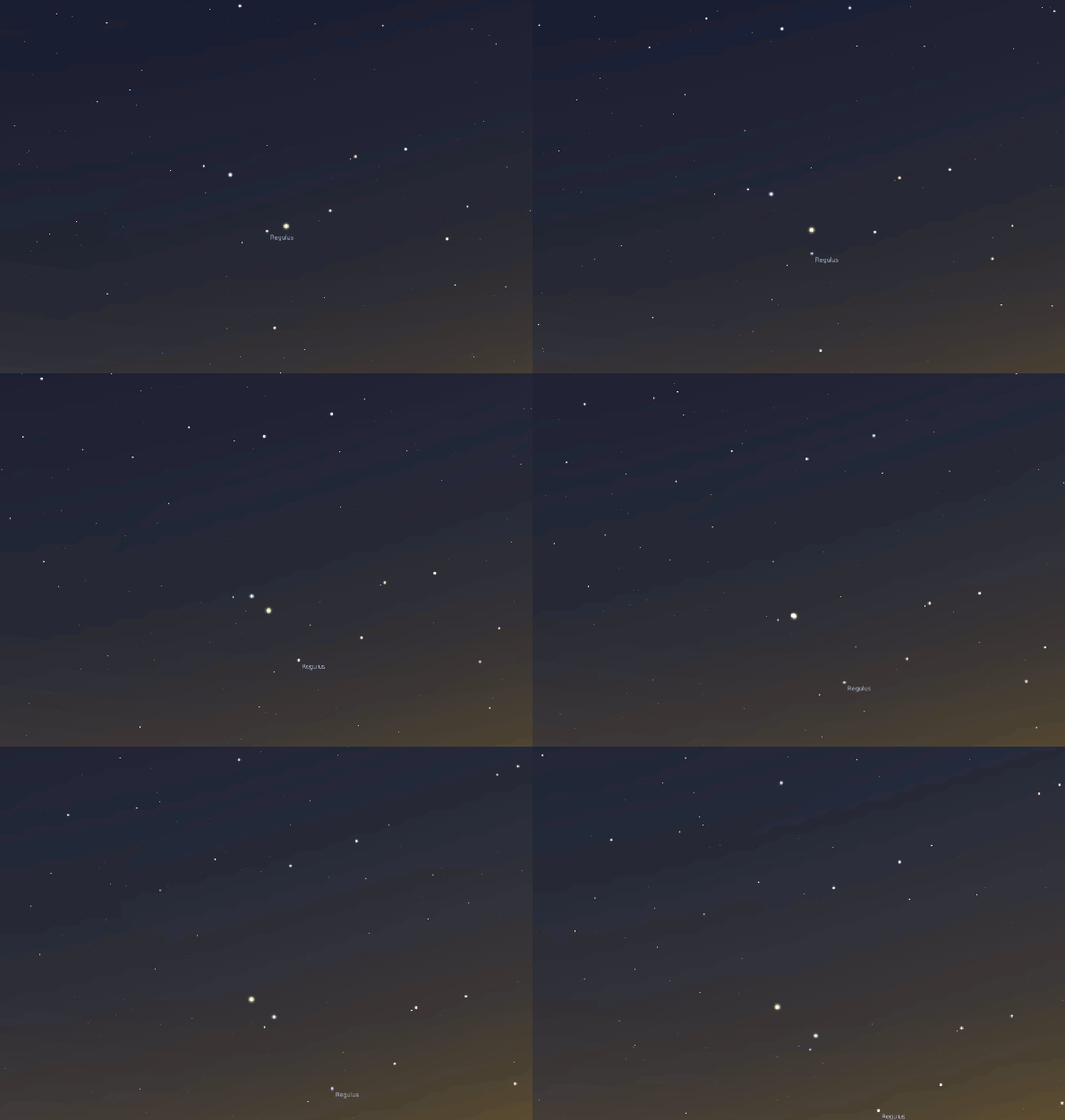
June of 2 BC just after sunset Jupiter and Venus again cross paths. Created using Stellarium.
 Bob Moler's Ephemeris Blog