Archive
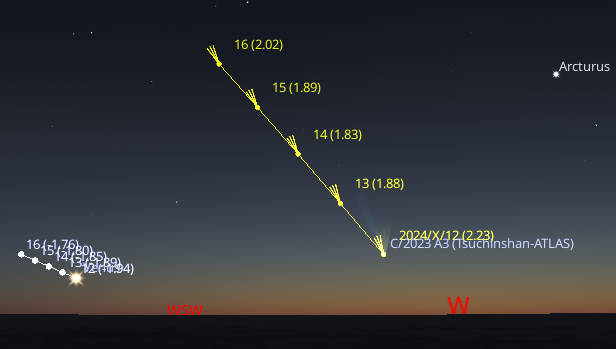
Ephemeris: 10/08/2024 – Comet Tsuchinshan-ATLAS may be brighter than expected
This is Ephemeris for Tuesday, October 8th. Today the Sun will be up for 11 hours and 19 minutes, setting at 7:09, and it will rise tomorrow at 7:51. The Moon, 2 days before first quarter, will set at 10:00 this evening.
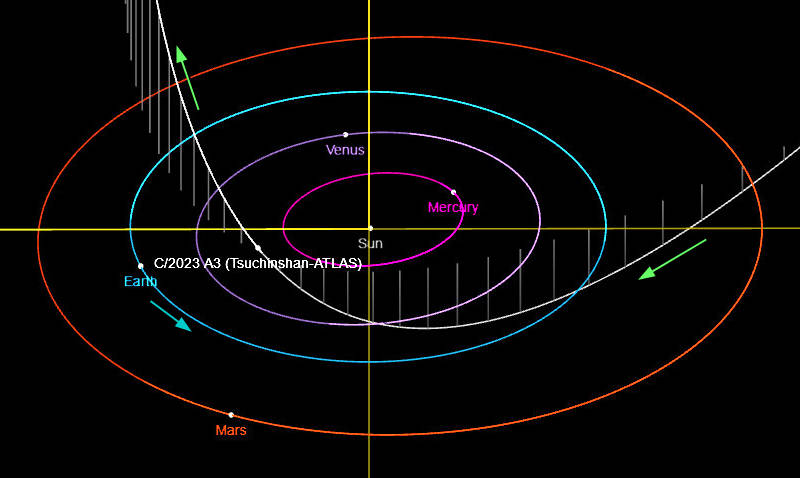
You are going to hear a lot about a bright comet visible in the evening starting this weekend. The comet with a long name Tsuchinshan-ATLAS will begin to be visible in the evening sky, and it will be very bright. It will be the brightest comet we’ve had in some time visible in the Northern Hemisphere since Comet Hale-Bopp in 1997. The reason for this comet’s great brightness is that the comet is passing between the Earth and the Sun. This comet is very dusty with an extensive dust tail. Since the comet is passing between the Earth and Sun the dust scatters sunlight in a forward direction like seeing sunbeams through holes in the clouds near sunset. This is making the comet brighter than originally predicted.
The astronomical event times given are for the Traverse City/Interlochen area of Michigan (EDT, UT – 4 hours). Times will be different for other locations.
Addendum
Ephemeris: 05/20/2024 – Sunspots
This is Ephemeris for Monday, May 20th. Today the Sun will be up for 15 hours and 1 minute, setting at 9:10, and it will rise tomorrow at 6:07. The Moon, 3 days before full, will set at 4:52 tomorrow morning.
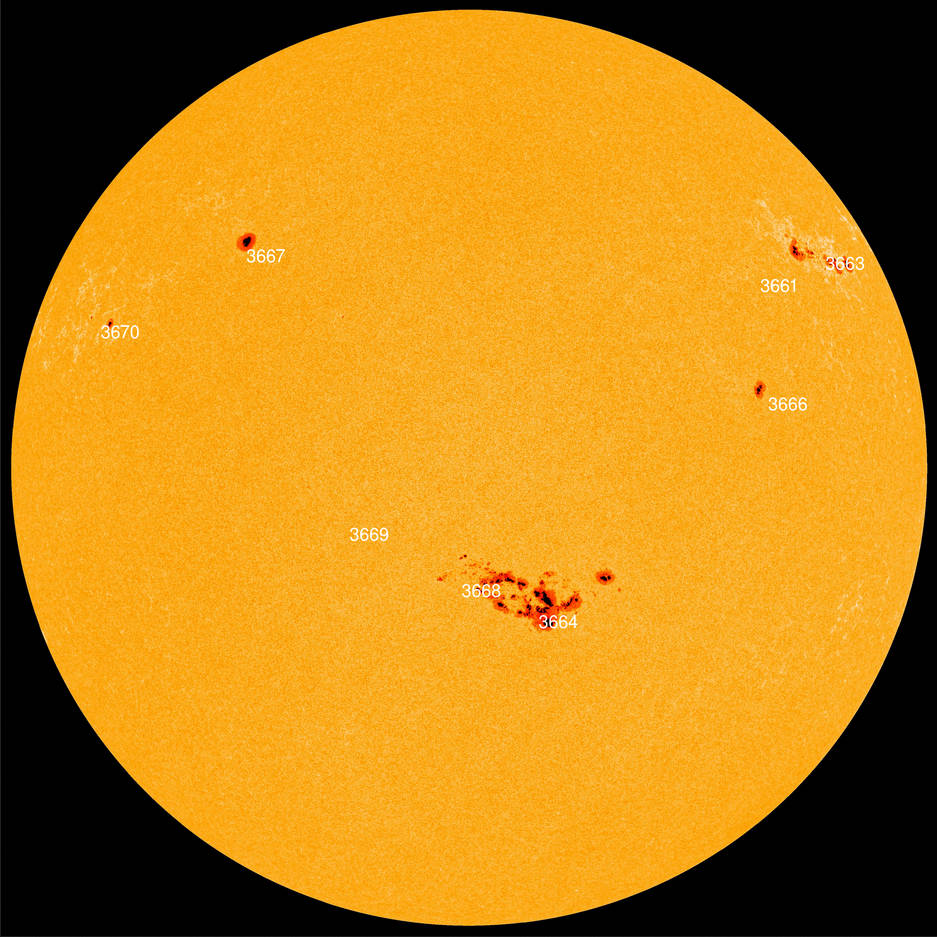
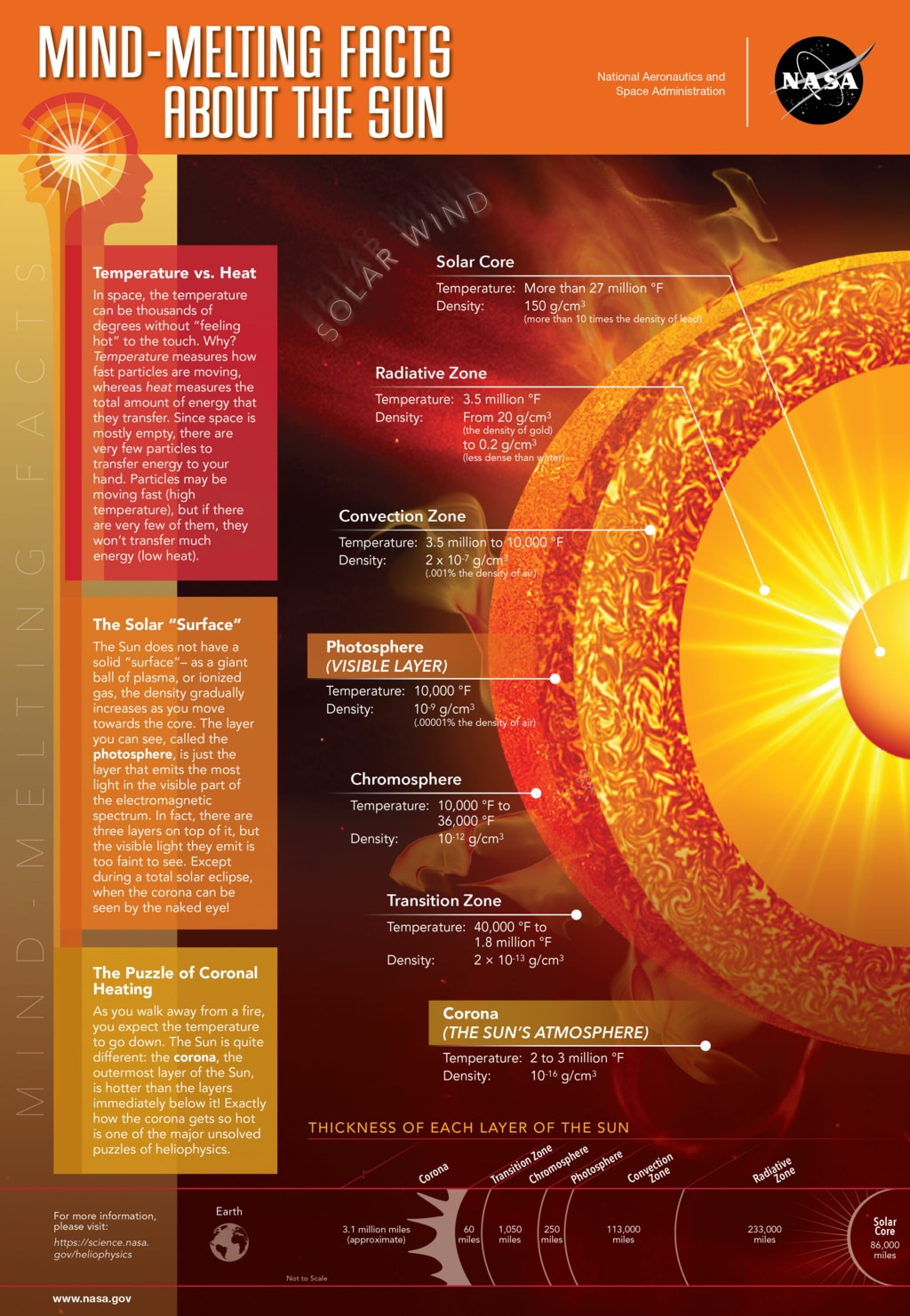
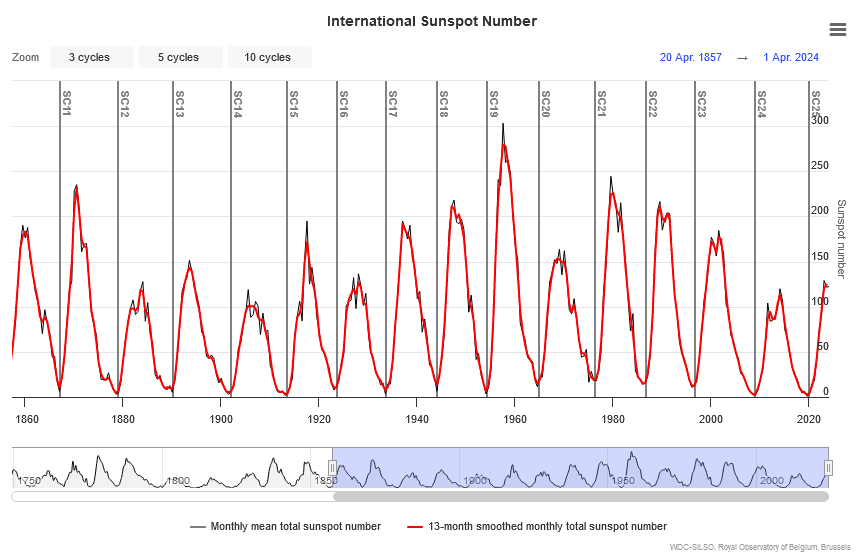
As can be seen with the northern light display more than a week ago that the Sun is becoming more active. It’s because particles, mostly protons, from the Sun in the form of the solar wind and enhancements in the solar wind called coronal mass ejections, tangle with the Earth’s magnetic field and stream through the upper atmosphere. The activity on the Sun is signaled by the ebb and flow of the number of dark spots called sunspots. Individual sunspots or sunspot groups only last for, maybe, a couple of weeks. They’re caused by the magnetic fields being generated in the Sun causing the gas to cool a bit and making them darker. Sunspot numbers ebb flow in a period of about 11 years, called a sunspot cycle. This sunspot cycle is reaching a higher peak than expected.
The astronomical event times given are for the Traverse City/Interlochen area of Michigan (EDT, UT–4 hours). They may be different for your location.
Addendum
02/23/2015 – Ephemeris – The Launch of the DSCOVR satellite
Ephemeris for Monday, February 23rd. The sun will rise at 7:30. It’ll be up for 10 hours and 51 minutes, setting at 6:22. The moon, 2 days before first quarter, will set at 12:24 tomorrow morning.
On Wednesday the 11th the DSCOVR satellite was launched to a special point between the Earth and the Sun called the Lagrangian point 1 or the Earth-Sun L1 point. It’s a point of gravitational equilibrium between the Earth and the Sun, about a million miles sun-ward of the Earth, or four times the distance of the Moon. It will take the craft over 100 days to get there, which it will slowly orbit. It will act as an early warning sentinel, replacing the aging ACE spacecraft. It will give us about an hour’s warning of incoming coronal mass ejections or CMEs erupting from the Sun. It also has an earth pointing camera with various filters pointed to the full earth and occasionally the far side of the new Moon.
Times are for the Traverse City/Interlochen area of Michigan. They may be different for your location.
Addendum
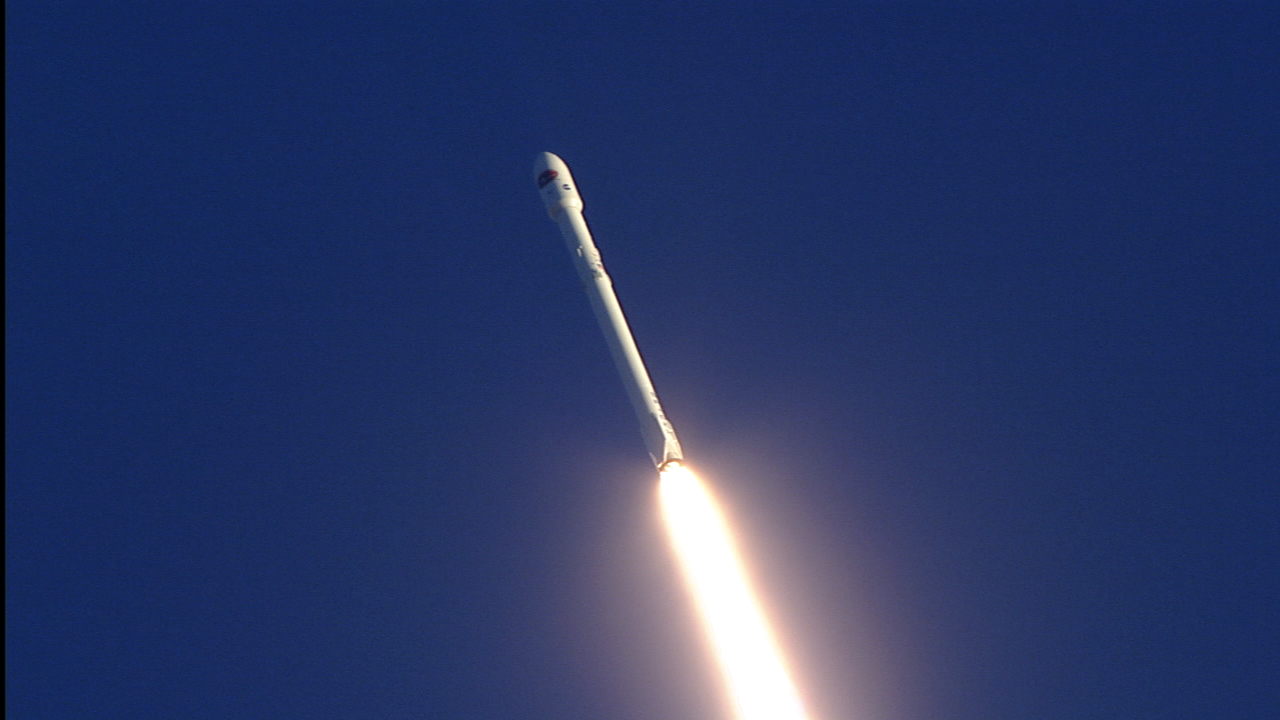
SpaceX Falcon 9 V1.1 first stage burns to launch DSCOVR to the Earth-Sun L1 point. Credit: NASA. Click to enlarge.
Click to enlarge
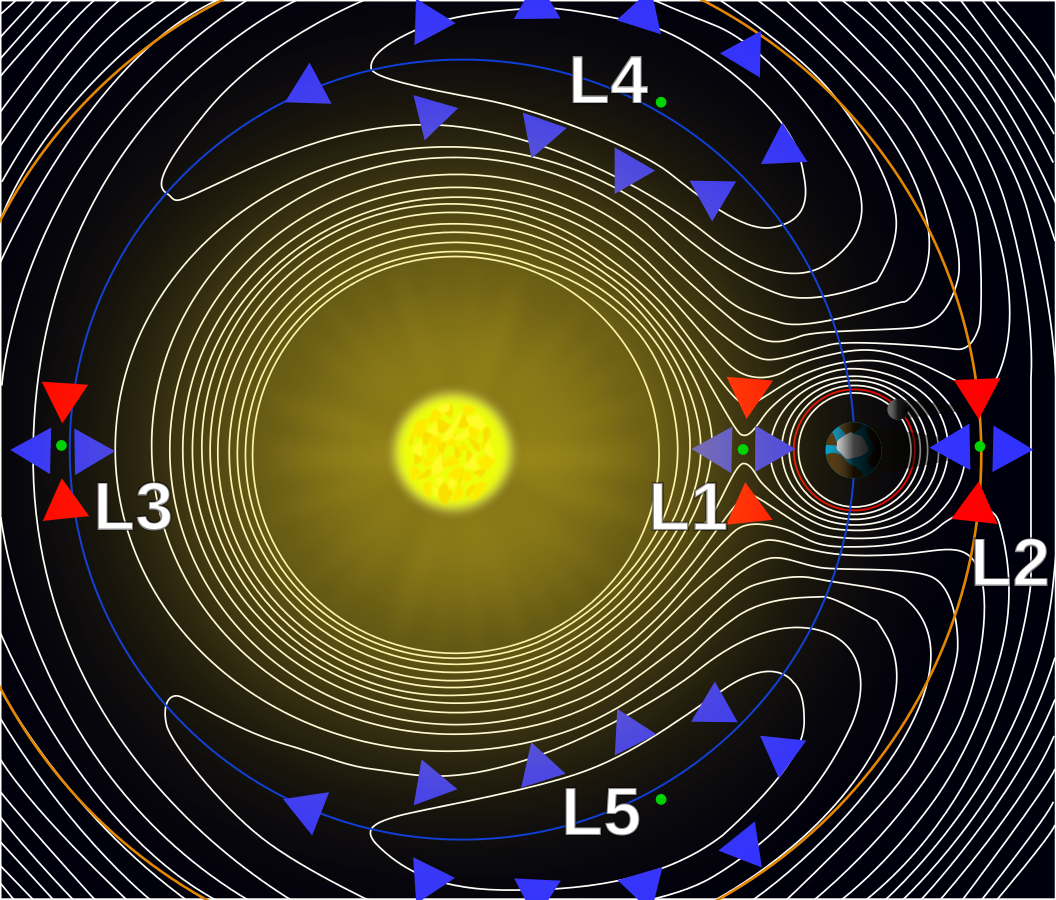
Earth-Sun Lagrangian Points. Source: Wikimedia Commons, Xander89. Click to enlarge.
05/14/2013 – She’ll be coming ’round the sun when she comes
AR 1748 is near the sun’s eastern limb. Already it has caused three radio blackouts. AR means active region, read sunspot group. It’s been kicking up quite a ruckus as it’s poised to rotate onto the earth facing side of the sun. this afternoon spaceweather.com‘s servers appear to be overloaded. I was able to get into the governments NOAA spaceweather website for the latest information.
We could be in for a week of so of northern lights. More later.
 Bob Moler's Ephemeris Blog