Archive
Lovejoy Lives!
Barely.
The Solar Dynamics Observer (SDO) detected Comet Lovejoy (C/2011W3) leaving the sun, but thousands of times fainter than it went in. the LASCO C3 and C2 images that I’ve seen for 9:30 UT show the ghost of Lovejoy’s tail. See Below:
Ghost of Comet Not So Past
Sorry, couldn’t help it. It’s the season I guess. However reports of Lovejoy’s death may have been exaggerated. Sorry Mr. Twain.
Update 8:38 a.m.
I dashed off the above as soon as I got up this morning. It wasn’t until later looking at spaceweather.com’s animation of the LASCO C3 images that I found that the over bright star to the lower left of the sun was what’s left of Comet Lovejoy. I took a quick look at Stellarium and saw no planets in that position, so I thought it may have been an artifact. So it appears Lovejoy lost all its volatile components and is probably a bare nucleus like the progenitor of the Geminid meteor shower 3200 Phaethon. I wonder if the brightness of it will change its size estimates?
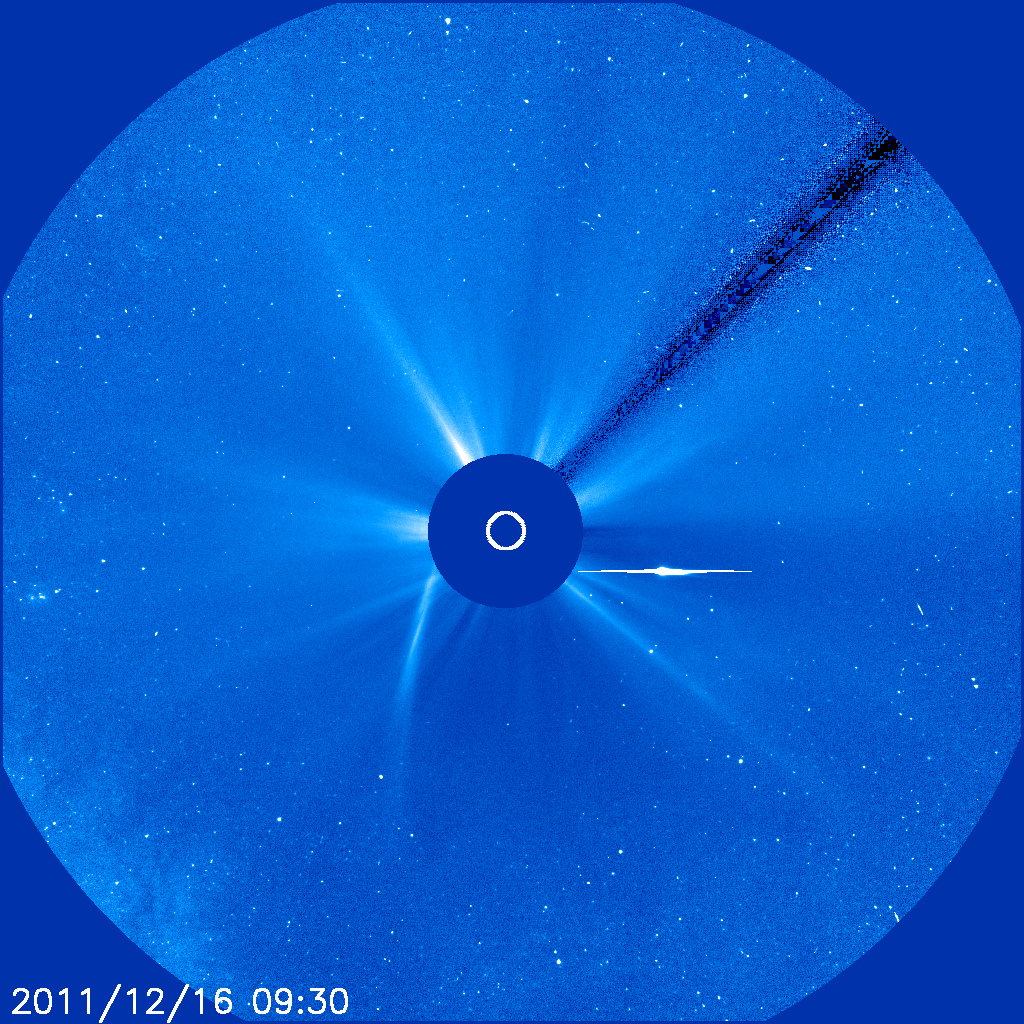
Ghost tail of Comet Lovejoy. Courtesy of ESO, NASA and the LASCO team.
12/15/11 – Ephemeris – Comet Lovejoy will skim past the sun today
Thursday, December 15th. The sun will rise at 8:12. It’ll be up for 8 hours and 50 minutes, setting at 5:02. The moon, 2 days before last quarter, will rise at 10:39 this evening.
Today Comet Lovejoy will pass 100,000 miles above the surface of the sun. The sun is 865,000 miles in diameter, so that’s very close. Will the comet survive? Will it break into multiple pieces? Or will it evaporate in the sun’s intense heat? To get the latest news on the internet go to Spaceweather,com or space.com. For first hand information google SOHO NASA. Look for real time images. LASCO C3 and C2 are the views you want. These are near white light views with the sun’s face blocked out so the solar corona is visible. The C2 view is closer in than the C3 view. The comet will move from the lower left to upper right. And will go behind the occulting disk that hides the sun. The comet’s tail should be quite long.
* Times, as always are for the Traverse City/Interlochen area of Michigan.
Update 6:09 a.m.
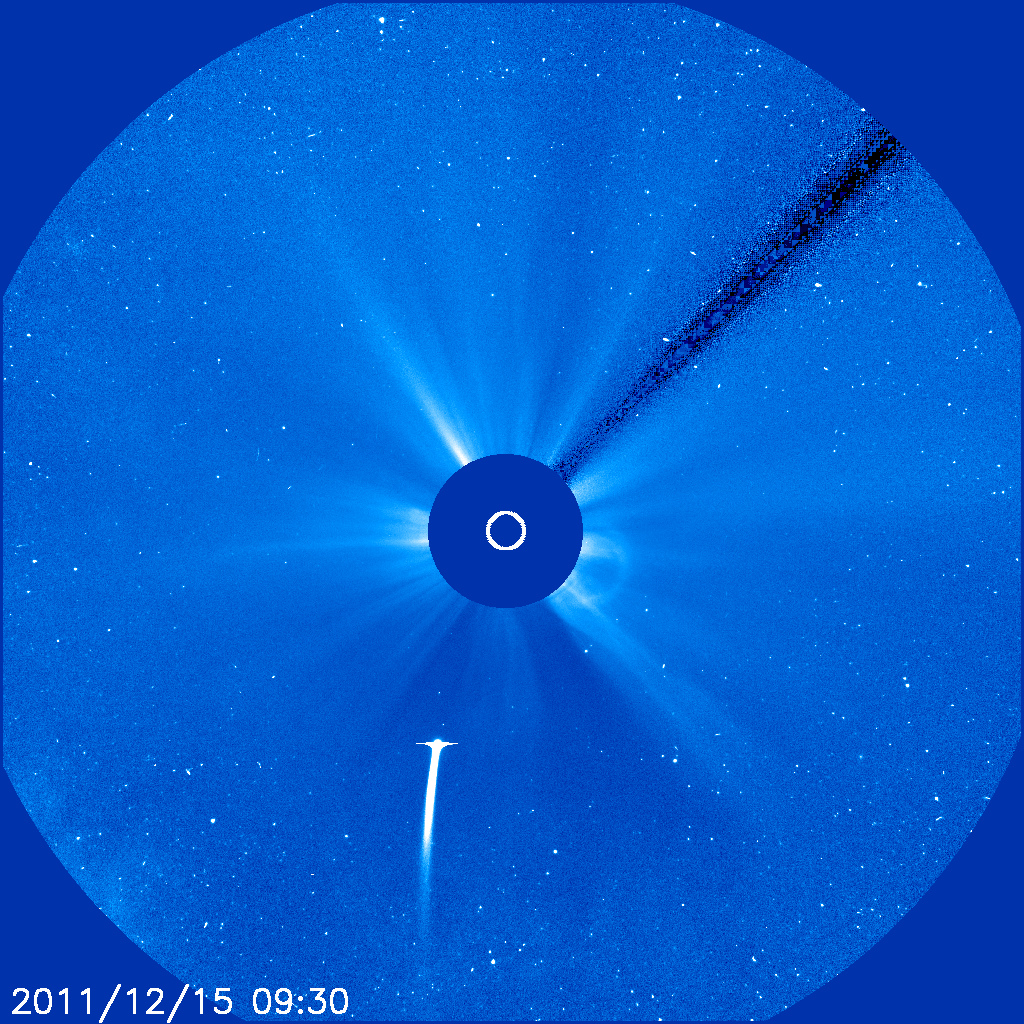
Comet Lovejoy at 9:30 UT or 2:23 a.m. EST. Courtesy of ESA, NASA, LASCO Team.
Click image to enlarge.
Planetary Society Blog has animation of Comet Lovejoy (C/2011W3) entering SOHO’s LASCO C3 field.
Emily Lakdawalla has the scoop. http://www.planetary.org/blog/article/00003301/
The comet should be closest to the sun (100,000 miles from the surface) tomorrow about 7 p.m. EST (0h U.T. December 16th). Supposedly about 600 feet in diameter. Do you think it’s got a snowball’s chance in hell of surviving? The sun’s surface (photosphere) is about 10,000 degrees F.
—
Bob Moler
12/13/11 – Ephemeris – Comet Lovejoy and Kreutz sungrazing comets
Tuesday, December 13th. The sun will rise at 8:10. It’ll be up for 8 hours and 51 minutes, setting at 5:02. The moon, 3 days past full, will rise at 8:21 this evening.
Comet Lovejoy which will pass close to the sun Thursday is not alone. It belongs to the Kreutz sungrazing group of comets. They are named after Heinrich Kreutz the 19th century astronomer who discovered some of the great comets of history were sungrazers and had similar orbits. Astronomers , trying to backtrack the comets, think the original comet broke up maybe in the 4th century AD into two unequal fragments, that have continued to fragment during close approached to the sun. The SOHO spacecraft can detect these comets toward the sun. Over 1,500 Kreutz sungrazer comets have been found on SOHO photographs. Comet Lovejoy should enter SOHO’s LASCO C3 image frame starting tomorrow morning. Google SOHO and NASA to locate the site on the internet.
http://sohowww.nascom.nasa.gov/data/realtime-images.html
* Times, as always are for the Traverse City/Interlochen area of Michigan.
Addendum
Here’s something like what we’ll see in the next two days.

A Kreutz Sungrazer in 1996 seen by SOHO. Credit: LASCO, SOHO Consortium, NRL, ESA, NASA
12/05/12 – Ephemeris – Comet C/2011W3 (Lovejoy)
Monday, December 5th. The sun will rise at 8:03. It’ll be up for 8 hours and 59 minutes, setting at 5:02. The moon, 3 days past first quarter, will set at 4:16 tomorrow morning.
Four days ago an amateur astronomer discovered a new comet. These discoveries by amateur astronomers are getting rarer these days with all the near earth asteroid searches going on now. This comet was discovered by Australian Terry Lovejoy. It turns out that Comet Lovejoy is a sun-grazing comet which will come only 110,000 miles from the sun’s surface on the 16th of this month. At that distance it’s a good bet that the comet will be vaporized. There have been over 2,000 comets discovered by observers studying the SOHO satellite’s images of the vicinity of the sun, Lovejoy. found the comet when it was just inside Venus’ orbit Looks like SOHO’s LASCO C3 images will be the place to view the passage of the comet by the sun. Google SOHO and NASA to locate the site on the internet.
* Times, as always are for the Traverse City/Interlochen area of Michigan.
Bad Astronomy Link to the story: http://blogs.discovermagazine.com/badastronomy/2011/12/04/amateur-astronomer-discovers-sungrazing-comet/
Update 9:27 p.m.
More from NASA: http://sohowww.nascom.nasa.gov/pickoftheweek/old/03dec2011/. It contains the expected path of the comet as seen from the earth and SOHO
The comet should enter the field of SOHO’s LASCO C3 imager early on December 14th!
Latest (Real time L)ASCO C3 images are here: http://sohowww.nascom.nasa.gov/data/realtime/c3/512/
In the LASCO C2 and C3 images the face of the sun is covered by an occulting disk. The white circle in the center is the actual size of the sun.
09/06/11 – Ephemeris – Comet Elenin self-destructs
Tuesday, September 6th. The sun will rise at 7:10. It’ll be up for 12 hours and 59 minutes, setting at 8:10. The moon, 2 days past first quarter, will set at 2:17 tomorrow morning.
When Comet Elenin was discovered by Russian astronomer Leonid Elenin using a remotely controlled telescope in New Mexico on December 10th of last year, it was hoped that it would become a bright comet in our skies next month. It would pass between the earth and the sun this month and move ahead of the earth to be briefly a bright comet in the morning sky. Last week astronomers from the southern hemisphere saw its nucleus suddenly elongate and the comet dropped in brightness. It appears that the small solid part of the comet is breaking up. Comets do this on occasion. About 10 years ago or so one of the many Comet Linears simply exploded sending out hundreds of pieces of its nucleus, which evaporated and disappeared.
* Times are for the Traverse City/Interlochen area of Michigan. They may be different for your location.
Smile! – Comet Tempel 1 gets its retakes
Wow! I was tipped off by Emily Lackdawalla‘s Planetary Society Blog. She found the image of the Deep Impact site. I pulled the image from the JPL site, enlarged it, tweaked the brightness levels, and sharpened it a bit.
I got the impact site wrong, since it hadn’t been pointed out yet. I thought it was that bright spot, definitely not visible in the 2005 images. In perusing the press conference images several hours later I saw the real impact. A low crater that blends with the color and terrain around it. It goes to show how fast the dust liberated by the comet’s out gassing covers the surface of the comet. I’d bet it we ever pass the comet next time around the fresh impact would be covered too.
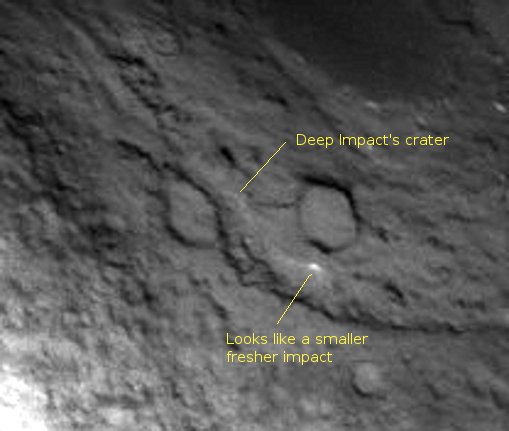
Impact crater on Comet Tempel 1. Credit: NASA/JPL-Caltech/Cornell. Image enhanced and annotated by Bob Moler
01/11/11 – Ephemeris – Stardust spacecraft flyby of Comet Tempel 1 in 34 days
Tuesday, January 11th. The sun will rise at 8:17. It’ll be up for 9 hours and 5 minutes, setting at 5:23. The moon, 1 day before first quarter, will set at 1:08 tomorrow morning.
The Stardust spacecraft is 34 days from its flyby of the comet Tempel 1 on Valentine’s day. This is the comet visited and impacted by the spacecraft Deep Impact five and a half years ago, on the 4th of July 2005. The purpose of this flyby is to study the impact crater created by Deep Impact, and the changes in the comet’s nucleus since the last encounter. Comet’s undergo wear and tear as they approach the sun sublimating their ices and liberating dust that forms their head and tail. The Stardust spacecraft is having some problems. It hasn’t imaged the comet for fine guidance yet, and apparently it has less maneuvering fuel than initially thought. In order to image the impact crater the rotation period of the comet must be known to a great precision. I’m not sure they do.
* Times are for the Traverse City/Interlochen area of Michigan. They may be different for your location.
11/22/10 – Ephemeris – Some Comet Hartley 2 results
Monday, November 22nd. The sun will rise at 7:48. It’ll be up for 9 hours and 20 minutes, setting at 5:08. The moon, 1 day past full, will rise at 5:46 this evening.
NASA held a news conference last Thursday, two weeks after the Deep Impact spacecraft’s encounter with Comet Hartley 2 on November 4th. The comet didn’t disappoint. It was the most active nucleus found by any spacecraft, and its most active jets were powered by dry ice, something not seen before. The jets also disgorged bits of ice that looked like a snow storm in the spacecraft’s high resolution imagers. This was another first. The chicken drumstick shape of the nucleus was expected by beforehand. But the difference in the surface between the lobes which was smooth and the lobes themselves which were rough and actively spewing jets of CO2 and snow was a surprise. Looks like astronomers will be chewing on this drumstick for years to come.
* Times, as always are for the Traverse City/Interlochen area of Michigan.
The biggest dog bone I’ve ever seen.
On November 4th the Deep Impact spacecraft passed inside of 500 miles from the nucleus of Comet Hartley 2. The image below is the first of 5 images released by NASA after the close pass. There are more images to come including some high resolution images. Thanks to Arecibo radio telescope radar images last week we knew this comet had a nucleus with an odd shape. That wasn’t the half of it.
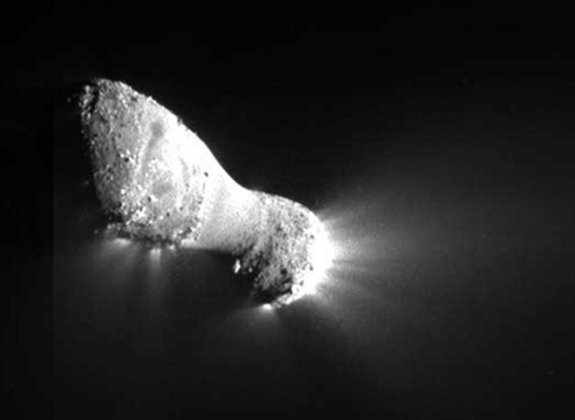
Comet Hartley 2 Medium resolution image. Image credit: NASA/JPL-Caltech/UMD
Emily Lakdawalla of the Planetary Society Blog has some more images and some thoughts on the origin of this celestial “dog bone” Here, here and here.
 Bob Moler's Ephemeris Blog