Archive
04/25/11 – Ephemeris – The constellation of Corvus the crow
Monday, April 25th. The sun rises at 6:42. It’ll be up for 13 hours and 57 minutes, setting at 8:39. The moon, 1 day past last quarter, will rise at 3:32 tomorrow morning.
The small constellation of Corvus the crow is located low in the south southeast at 10 this evening. It’s made of 5 dim stars, but the pattern is a distinctive distorted box with two stars at the upper left marking that corner. To the right is a fainter constellation of a thick stemmed goblet called Crater. Both appear above the long constellation of Hydra the water snake who is slithering just above the southern horizon.. In Greek mythology Corvus, then white, was the god Apollo’s pet. Apollo once bid Corvus to take a cup and fetch him some water. Corvus however dallied and waited for an unripe fig to ripen. Corvus grabbed a snake and returned with a story as to how the snake had delayed him. The angry Apollo turned the crow and all crows to this day black.
* Times are for the Traverse City/Interlochen area of Michigan. They may be different for your location.
Addendum
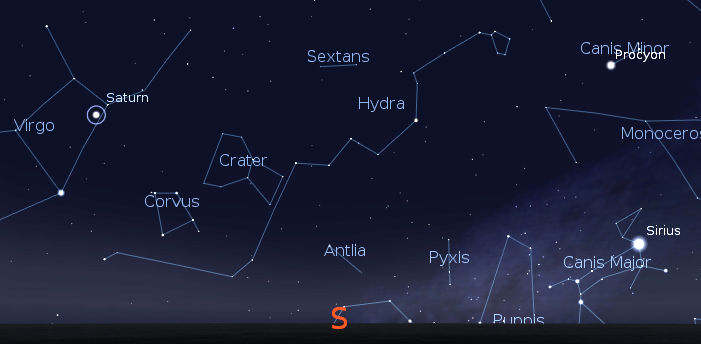
Corvus, Crater and Hydra via Stellarium for April 25, 2011 near 10 p.m.
04/21/11 – Ephemeris – Queen Berenice’s hair
Thursday, April 21st. The sun rises at 6:48. It’ll be up for 13 hours and 45 minutes, setting at 8:34. The moon, 3 days before last quarter, will rise at 1:10 tomorrow morning.
High in the southeast at 10 p.m. is a tiny and faint constellation of Coma Berenices, or Berenice’s hair. In it are lots of faint stars arrayed to look like several strands of hair. The whole group will fit in the field of a pair of binoculars, which will also show many more stars. The story behind it was that Berenice was the Queen of Egypt, whose husband was away at war. This was in the days when the Greeks ruled Egypt after Alexander conquered it. She offered her golden tresses to the gods for the king’s safe return. The hair, was placed in a temple. However the offering disappeared when the king returned. Ever since then the constellation of Coma Berenices has been seen to commemorate the queen’s sacrifice.
* Times are for the Traverse City/Interlochen area of Michigan. They may be different for your location.
Addendum

Coma Berenices via Stellarium
Only one of the three stars that mark the constellation belong to the Coma Berenices star cluster near the top of this image. The cluster is about 270 light years away, making it one of the closest star clusters to us.
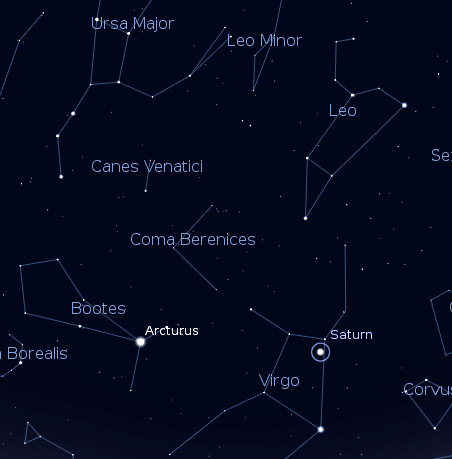
Coma Berenice Finder Chart via Stellarium
Here’s a star chart based on this evening at 10 p.m. on locating Coma Berenices in the southeastern sky.
Note: Stellarium is a free program. See the right column for a link.
04/19/11 – Ephemeris – How the Great Bear got its long tail
Tuesday, April 19th. The sun rises at 6:52. It’ll be up for 13 hours and 39 minutes, setting at 8:32. The moon, 2 days past full, will rise at 11:05 this evening.
The Greeks and Romans who saw the Great Bear, the constellation we call Ursa Major, they also saw it having a long tail. We’re more likely to see the Big Dipper. The bowl of the Big Dipper is the bear’s rump, while the handle is that notorious tail. The Big Dipper is overhead at 10 p.m. this evening. Now, to how did the ancient Romans explained the long tail. According to one story a god threw the bear into the sky. I don’t care if you’re immortal or not, you wouldn’t grab the end of the bear with the teeth. However grabbing the tail apparently caused the tail to stretch, giving the long tail we see in our skies. While the skies are dark before moonrise, check out the bear. He’s all there from the tip of his nose to the end of his claws.
* Times are for the Traverse City/Interlochen area of Michigan. They may be different for your location.
Addendum
Here’s a quotation from Star Names Their Lore and Meaning by Richard Hinckley Allen:
The long tail of the Bear, a queer appendage to a comparitively taillessanimal, is thus accounted for by old Thomas Hood in his didactic style:
Scholar.
I marvell why (seeing she hath the forme of a beare) her tail should be so long.
Master.
Imagine that Jupiter, fearing to come too nigh unto her teeth, layde hold of her tayle, and thereby drew her up into heaven; so that she of herself being very weightie, and the distance from the earth to the heavens very great, there was a great likelihood that her taile must stretch. Other reason I know none.
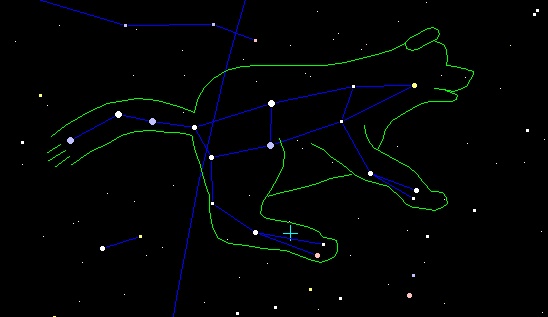
My rather crude drawing of Ursa Major, the Great Bear
 Bob Moler's Ephemeris Blog