Archive
Ephemeris Extra: Star Party Tomorrow night, 10/21/2023, if it’s clear
Update: 10/21/2023 The Star Party has been canceled due to weather (clouds)
This was the last planned star party at the Sleeping Bear Dunes this year. Look for star parties in 2024. Also, there will be a star party after the Grand Traverse Astronomical Society meetings, November 3rd and December 1st, of course weather permitting, at Northwestern Michigan College’s Joseph H. Rogers Observatory. The observatory is located south of Traverse City on Birmley Road. Meetings start at 8 pm, and are not weather dependent, with observing after (approximately 9 pm) if it’s clear. Topic of the meeting programs: November: A documentary video Jack Newton’s Journey to the Stars. Jack Newton (1942-) is a Canadian amateur astronomer and pioneering astrophotographer. December: Ancient Greek astronomy.
Original Post Below
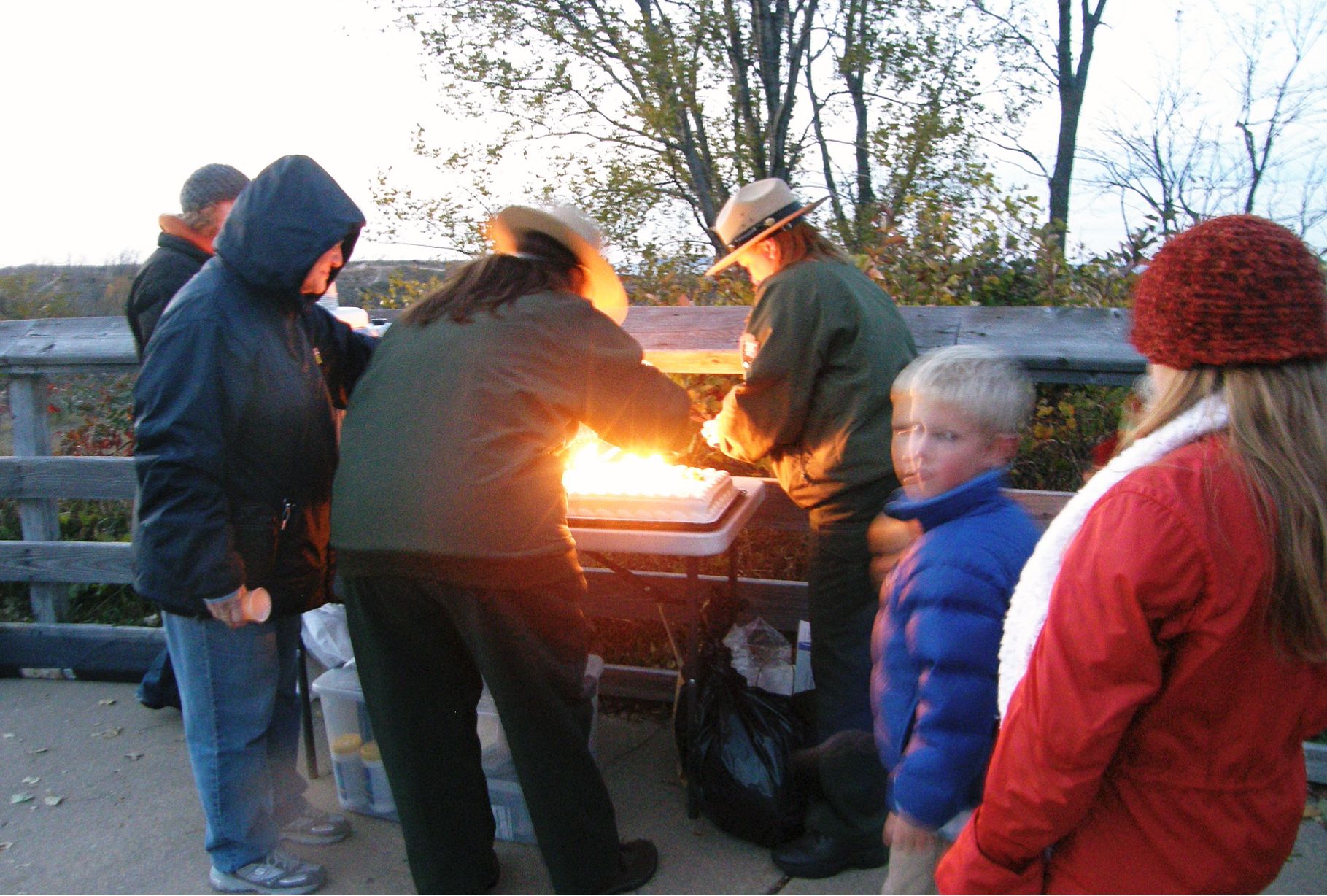
Members of the Grand Traverse Astronomical Society will team up with the park rangers of the Sleeping Bear Dunes National Lakeshore for the last star party of the year celebrating the park’s 53rd anniversary. It will take place at the Dune Climb. Of course, it will only occur if it is clear or partly cloudy. It starts at 4 pm with solar observing using personal and the society’s solar telescopes. Starting at 7 pm it will be dark enough to view the first quarter Moon, followed a bit later with Saturn, and still later with Jupiter. The brighter wonders beyond the solar system will be also be visible later.
07/10/2023 – Ephemeris – Presentation about the James Webb Space Telescope in Traverse City!
This is Bob Moler with Ephemeris for Monday, July 10th. Today the Sun will be up for 15 hours and 21 minutes, setting at 9:28, and it will rise tomorrow at 6:07. The Moon, 1 day past last quarter, will rise at 1:39 tomorrow morning.
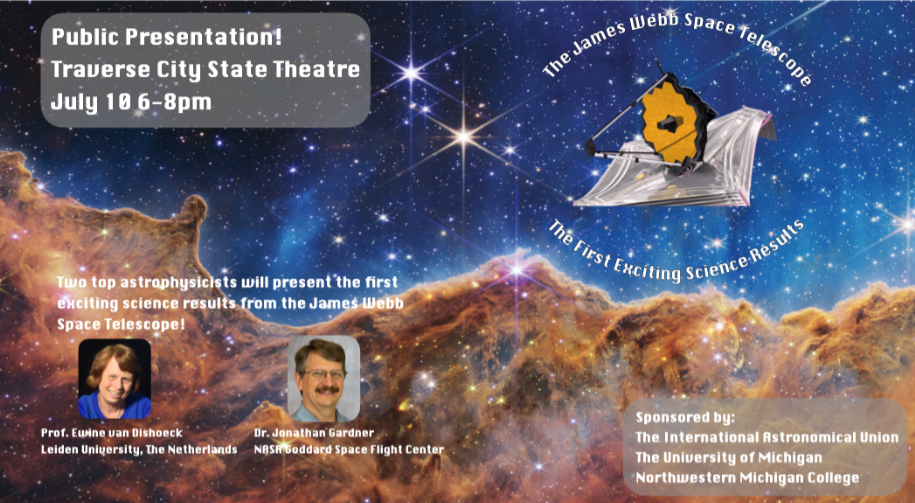
The International Astronomical Union, or IAU, is holding a symposium in Traverse City this week, a meeting of some of the world’s astronomers on the general topic of astrochemistry: From the First Galaxies to the Formation of Habitable Worlds, at the Park Place Hotel & Conference Center. As part of the meeting, there will be a presentation at the State Theater on East Front Street at 6 pm Monday, July 10, 2023 by Professor Ewine van Dishoeck and Dr. Jonathan Gardner on The James Webb Space Telescope – The First Exciting Results. There may still be some free tickets that can be obtained from the State Theater website: https://stateandbijou.org. The program is sponsored by the IAU, University of Michigan, Northwestern Michigan College and the Grand Traverse Astronomical Society.
The astronomical event times given are for the Traverse City/Interlochen area of Michigan (EDT, UT –4 hours). They may be different for your location.
Addendum
This was provided to us about the presentation and the presenters:
Title: The James Webb Space Telescope: a new exploration of the cosmos
Speakers: Jonathan Gardner and Ewine van Dishoeck
Abstract:
The James Webb Space Telescope was launched on Christmas Day 2021 after 25 years of planning, design, development, integration, and testing. Following a six-month deployment and commissioning period, the first science results from Webb have engaged the public and surprised the scientists. Webb’s science goals address our origins and the history of the universe: the first stars and galaxies that formed after the Big Bang; the morphological and dynamical buildup of galaxies; the formation of stars and planetary systems; and exoplanets, our Solar System, and the conditions for life. Webb has already found the most distant galaxies ever seen, made the first detection of carbon dioxide in the atmosphere of an exoplanet, and has examined the interactions between giant stars and the planets that are forming near them.
Jonathan Gardner will review Webb’s construction, launch, and deployments, and discuss the commissioning of the telescope and its instruments. He will describe what scientists have learned in the first year of science results from the telescope on the deep universe. Ewine van Dishoeck will focus on the new insights that Webb has provided us on the formation of new stars and planets and the habitability of other worlds. She will highlight chemical richness of the Webb data, with water and other molecules seen throughout the universe.
Bio:
Jonathan Gardner is the Deputy Senior Project Scientist for the James Webb Space Telescope, a position he has held since 2002 at NASA’s Goddard Space Flight Center. Gardner received an AB degree from Harvard and MS and PhD from the University of Hawaii. As a NATO Fellow, he did postdoctoral research at the University of Durham in the UK. He came to NASA-Goddard in 1996 to work with the Hubble Space Telescope, but soon got involved in early studies of Webb. His scientific research involves using deep infrared observations to study the statistical evolution of galaxies. On the Webb project, he works with the other scientists to ensure the scientific success of the mission, now coming to fruition with Webb’s scientific results.
Ewine van Dishoeck is professor of molecular astrophysics at Leiden University, the
Netherlands. Graduated from Leiden in 1984, she held positions at Harvard, Princeton and
Caltech before returning to Leiden in 1990. The work of her group unites the world of
chemistry with that of physics and astronomy. She has been heavily involved in planning
major new telescopes, including being co-PI on the JWST-MIRI instrument for more than 20
years. She has been fortunate to receive many awards, including the 2018 Kavli Prize for
Astrophysics, as well as membership of the Netherlands, US, German and Norwegian
academies. From 2018-2021, Ewine served as the President of the International
Astronomical Union (IAU).
06/23/2023 – Ephemeris – Sun and Star Party scheduled for tomorrow at the Sleeping Bear Dunes
This is Ephemeris for Friday, June 23rd. Today the Sun will be up for 15 hours and 34 minutes, setting at 9:32, and it will rise tomorrow at 5:57. The Moon, 3 days before first quarter, will set at 1:11 tomorrow morning.
Tomorrow the Sleeping Bear Dunes National Lakeshore and the Grand Traverse Astronomical Society will host a Sun and Star Party at the Dune Climb area of the park. There will be a solar viewing period from 6 pm to 8 pm. The society has two hydrogen alpha solar telescopes to view the Sun’s chromosphere and prominences. Plus some members also have solar scopes also white light filtered telescopes to view sunspots on the face of the Sun. Night viewing will start at 10 pm with the Moon and Venus featured, along with the brighter telescopic wonders of early summer. The park rangers will leave at midnight, but society members can stay later to view the fainter wonders in the darkened sky. All this will happen only if clouds permit.
The astronomical event times given are for the Traverse City/Interlochen area of Michigan (EDT, UT –4 hours). They may be different for your location.
Addendum
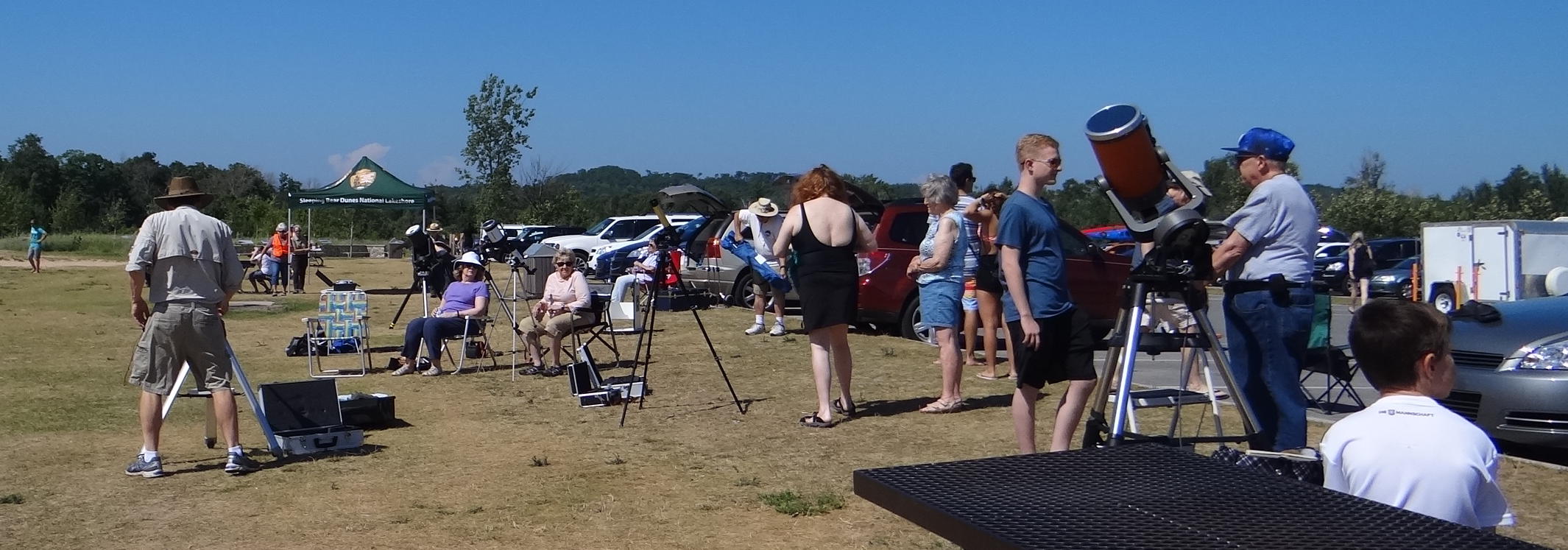
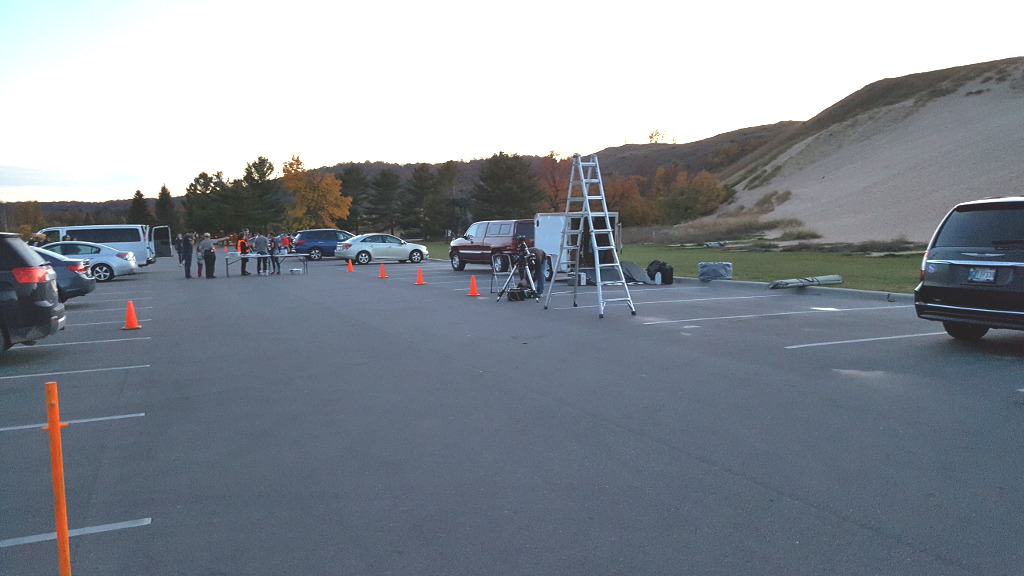
The Dune Climb is not the place to view the spectacular sunset. The best place is from the Lake Michigan Overlook stop on Pierce Stocking Scenic Drive.
10/14/2022 – Ephemeris – The loneliest star in the sky isn’t so lonely this year, and more
This is Ephemeris for Friday, October 14th. Today the Sun will be up for 11 hours and 2 minutes, setting at 6:59, and it will rise tomorrow at 7:58. The Moon, 3 days before last quarter, will rise at 9:37 this evening.
There’s a bright star that appears for only seven and a half hours on autumn evenings. It’s appearance, low in the south-southeast at 9 p.m., is a clear indication of the autumn season. The star’s name is Fomalhaut, which means fish’s mouth. That’s fitting because it’s in the constellation of Piscis Austrinus, the southern fish. At our latitude it’s kind of the fish that got away, because Fomalhaut appears to be quite alone low in the sky. The other stars of its constellation are dim, and being low in the sky makes them even dimmer. However, this year Fomalhaut has visitors. Above and left of it is the brilliant planet Jupiter. And above and right of it is the bright planet Saturn. Both planets, while not very close to Fomalhaut, will keep it company this year.
The astronomical event times given are for the Traverse City/Interlochen area of Michigan (EDT, UT – 4 hours). They may be different for your location.
Addenda
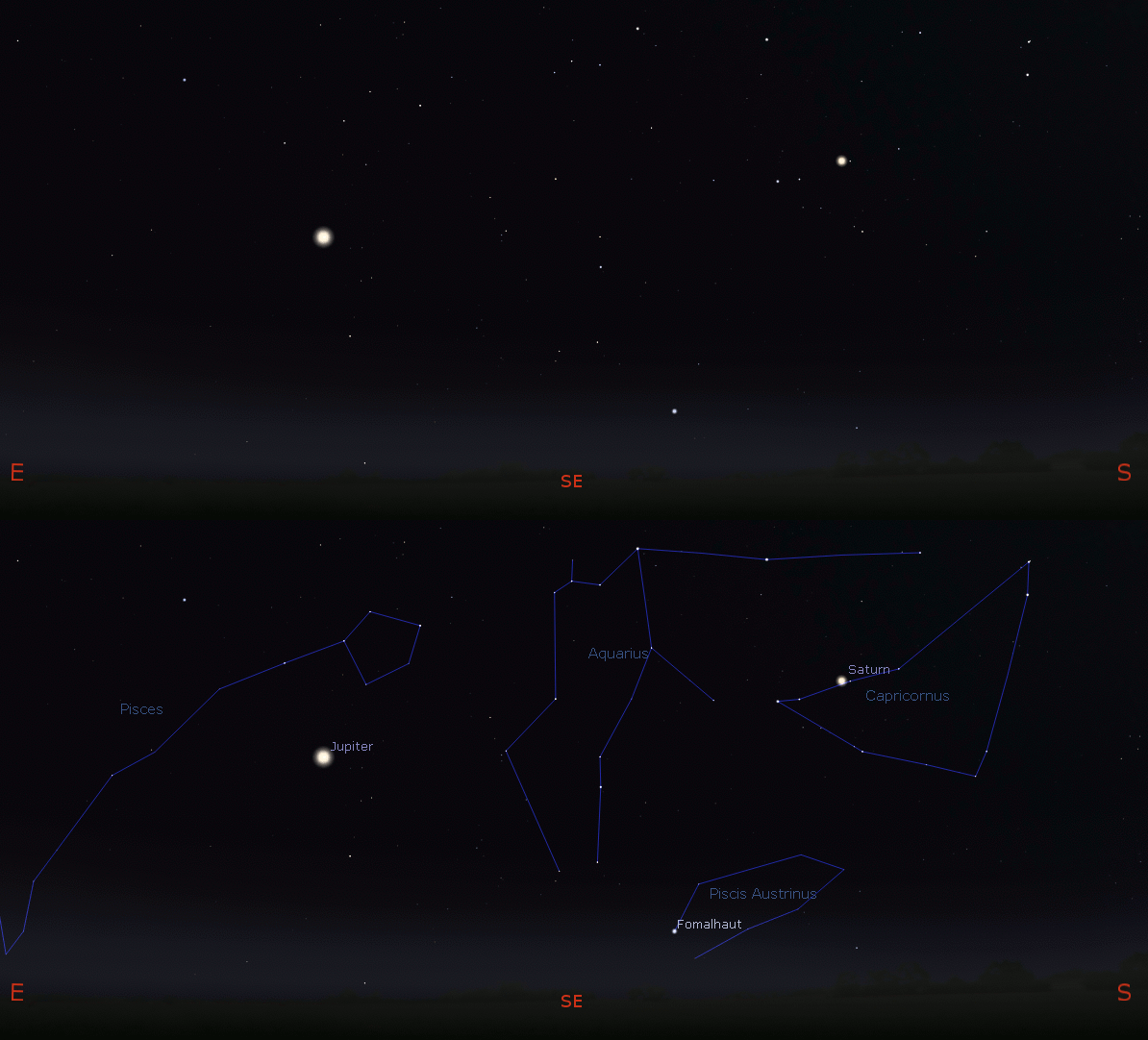
Fomalhaut and friends (Jupiter and Saturn) finder animation for 9 pm tonight, Friday, October 14, 2022. Click on the image to enlarge it. Created using Stellarium and GIMP.
Also at Corson Auditorium on the Interlochen Center for the Arts Campus…
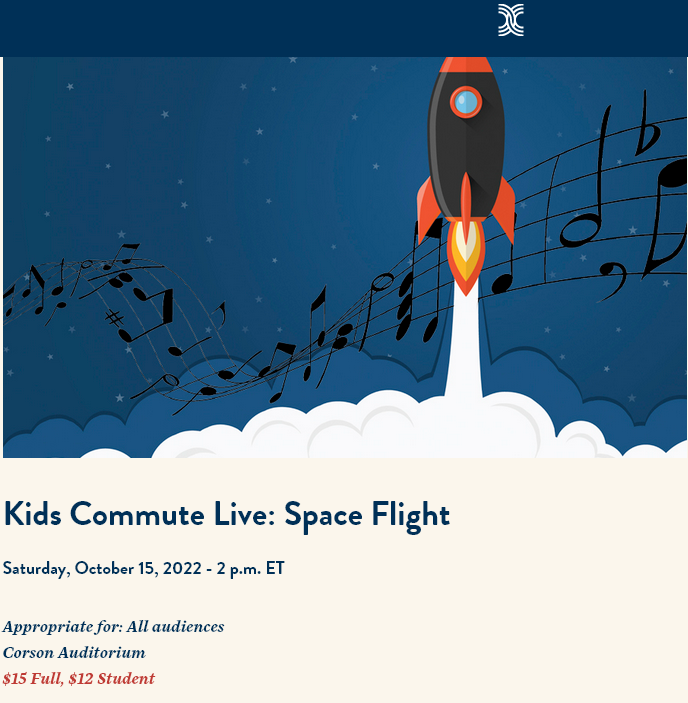
Join Interlochen Public Radio for Kids Commute Live! This family-friendly matinee is brought to you by the Interlochen Arts Academy Wind Symphony and features Interlochen theatre and singer-songwriter students, TCAPS middle school musicians, and special guests from NASA, the Coast Guard, and the International Dark Sky Park. Conductor Matthew Schlomer and Kids Commute host Kate Botello will lead this multi-sensory experience centered on the theme “Space Flight.”
The program will include Gustav Holst’s “Jupiter,” Michael Mogenson’s “Aerial Fantasy,” John Williams’ “Fantasy of Flight,” and more!
Come early for pre-concert activities for kids of all ages, including drone demonstrations and paper airplane contests. Space-themed food will be available for purchase.
I will be there from 12 to 1 pm, having the kids help me make COMETS! I’ll also be part of the program.
For more information and tickets: https://www.interlochen.org/events/kids-commute-live-space-flight-2022-10-15
07/12/2022 – Ephemeris – The rest of the first images and data from the James Webb Space Telescope to be released tomorrow
This is Bob Moler with Ephemeris for Tuesday, July 12th. Today the Sun will be up for 15 hours and 18 minutes, setting at 9:27, and it will rise tomorrow at 6:09. The Moon, 1 day before full, will set at 5:26 tomorrow morning.
Later today at 10:30 am, NASA and the Space Telescope Science Institute will present the first results from the James Webb Space Telescope. These will be, I believe, four multi-spectral images rendered in full color, and other data. The wavelength coverage of Webb in the infrared is greater than Hubble Space Telescope, which is mostly visible light, by several factors. The test images we’ve seen released so far are monochromatic and rendered in white, yellow, orange and red to depict a wide brightness range. There will be a Webb image release with explanations at the Milliken Auditorium of the Dennos Museum at 10:30, with doors opening at 10 am; and also at the Main Library in Traverse City. I’ll endeavor to be at the library.
The astronomical event times given are for the Traverse City/Interlochen area of Michigan (EDT, UT – 4 hours). They may be different for your location.
Addendum
Not known by me last Sunday night when I wrote and recorded today’s program was that President Biden was going to preview one of the images Monday evening. If I were the general public, I would have been underwhelmed. It wasn’t enlarged, or particularly colorful. Here it is below. Click on it for an even larger view:
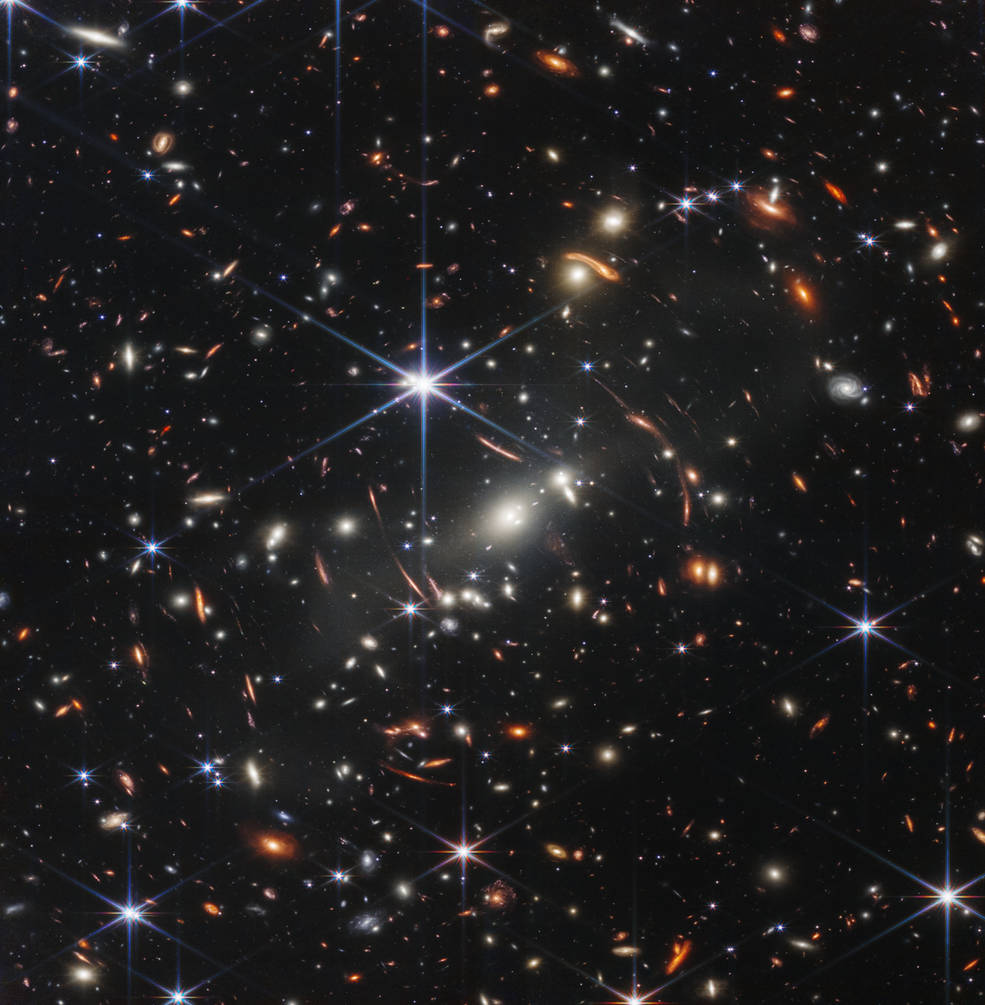
The teaser deep field image from President Biden’s July 11th presentation. Click on the image to fill your screen with it. Credit: NASA, ESA, CSA, JWST, STScI.
In the image above, anything with diffraction spikes is a star in our galaxy. Everything else is a galaxy, like the Milky Way, with billions of stars. This is a tiny piece of sky. As a rule of thumb, the redder the galaxy, the farther away it is. The light emitted by these galaxies are starlight in mostly visible wavelengths, but shifted to the infrared by their great speed of recession caused by the expansion of space between us and them. Also note that many of these galaxies are distorted into short arcs. They seem curved as if being part of a circle around the large, bright galaxy in the center. This is caused by the gravitational lensing caused by the mass of that galaxy, dark matter, and other galaxies in its cluster. This is an effect predicted by Einstein’s theory of General Relativity. I have a feeling that we are going to see a lot more gravitational lensing as the JWST probes into deeper and deeper fields.
One thing to remember about deep fields, is that because of the speed of light being finite, that the farther we look out, the farther back in time we see into an evolving universe. The farthest back we can see with electromagnetic radiation (that is gamma rays, x-rays, ultraviolet, visible, and infrared light, microwaves and radio waves) is the era of the cosmic microwave background, when the universe became transparent, about 380 thousand years after the Big Bang. After that came a period called the dark ages before galaxies formed and the first stars ignited, called the dark ages. At least that’s what I hear-tell. There are lots of questions, like the chicken and egg question: Which came first, supermassive black holes or galaxies?
We will find answers to some of our questions, I’m sure. Even more intriguing, we will be able to ask even more and deeper questions to probe the mystery and beauty of the universe.
07/11/2022 – Ephemeris – First color images from the James Webb Space Telescope will be released tomorrow
This is Ephemeris for Monday, July 11th. Today the Sun will be up for 15 hours and 20 minutes, setting at 9:28, and it will rise tomorrow at 6:08. The Moon, 2 days before full, will set at 4:19 tomorrow morning.
Tomorrow at 10:30 am, NASA and the Space Telescope Science Institute will present the first results from the James Webb Space Telescope. These will be, I believe, four multi-spectral images rendered in full color, and other data. The spectral range of Webb in the infrared is greater than Hubble Space Telescope by several factors. Hubble operates mostly in visible light and plus a bit in the ultraviolet and the near infrared. The current alignment images released are monochromatic and rendered in orange for aesthetic reasons, and to hint that these are from the long wavelength part of the spectrum. I expect the new images to look as great or better than anything the Hubble has produced. There will be a Webb image release and celebration at the Milliken Auditorium of the Dennos Museum at 10:30, with doors opening at 10 am; and also at the Main Library in Traverse City.
The astronomical event times given are for the Traverse City/Interlochen area of Michigan (EDT, UT – 4 hours). They may be different for your location.
Addendum
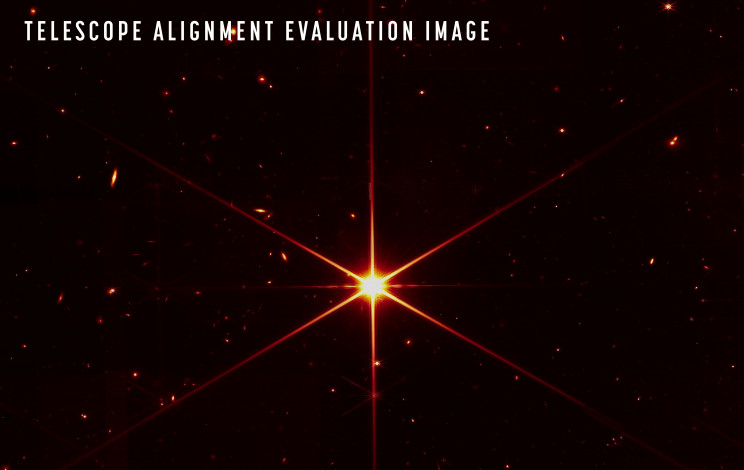
The alignment image of the James Webb Space Telescope after the 18 primary mirror segments have been aligned to act as a single mirror. Beside the alignment star showing its overexposed diffraction spikes, many faint galaxies can be seen. The alignment star, near the Big Dipper, is almost too faint to be seen in binoculars. Credit: NASA, Space Telescope Science Institute (STScI).
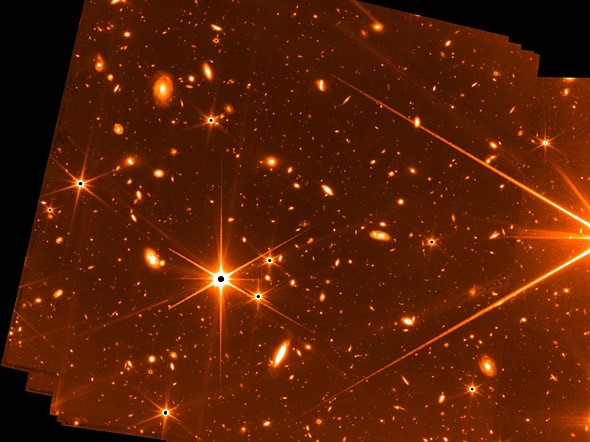
Webb Fine Guidance Sensor (FGC) test image guiding on a star for 72 exposures totaling 32 hours over 8 days. The color key to brightness is white, yellow, orange, red for bright to dim. The black cores to the stars, and at least one galaxy is due to saturating the pixels due to brightness, and are not black holes. Credits: Canadian Space Agency, NASA, FGS team. The Fine Guidance Sensor is a contribution to the James Webb Space Telescope by the Canadian Space Agency.
04/15/2022 – Ephemeris – How the date of Easter is determined
This is Ephemeris for Good Friday, April 15th. Today the Sun will be up for 13 hours and 29 minutes, setting at 8:27, and it will rise tomorrow at 6:56. The Moon, 1 day before full, will set at 7:04 tomorrow morning.
Easter will be celebrated by Western Christian churches this Sunday. Easter is a movable feast in that it falls on a different date each year following the first full moon of spring. It’s an attempt to follow the Jewish Passover, which starts on the 15th of the month of Nisan. The Jewish calendar being a lunar calendar, the 15th is generally the night of the full moon. And since the Last Supper was a Seder, according to at least one Gospel, the Christian church wanted to link Easter with Passover as closely as possible using the Roman solar based (Julian) calendar. The months didn’t follow the cycle of the Moon anymore and where the year was 365.25 days long. Passover starts at sunset tonight. The western churches adopted the Gregorian calendar to keep in sync with the seasons. The Orthodox churches didn’t, so their Easter is a week later this year. They kept the old Julian Calendar and other considerations to calculate the date of Easter.
The astronomical event times given are for the Traverse City/Interlochen area of Michigan (EDT, UT – 4 hours). They may be different for your location.
Addendum
If you’re wondering about what all this has to do with astronomy? The answer is: Everything! Astronomy in ancient times wasn’t about the nature of planets, and stars, but about the cycles about the Sun and Moon. These cycles announced the seasons, and festival times. This is how the date of Passover is set. The Jews, at least in the Bible, only referenced the constellations of Orion and the Great Bear plus the star cluster Pleiades, that scholars have pinned down. There are two more possible references to constellations that don’t translate. These are all in the Book of Job. The only planet mentioned is Saturn, because it was thought to be closest to the firmament, the starry sphere.
07/28/2020 – Ephemeris – The Mars Endurance Rover may launch to Mars on Thursday
This is Ephemeris for Tuesday, July 28th. Today the Sun will be up for 14 hours and 47 minutes, setting at 9:12, and it will rise tomorrow at 6:26. The Moon, 1 day past first quarter, will set at 1:49 tomorrow morning.
This Thursday at 7:50 am is the first opportunity to launch the Mars 2020 or Perseverance Rover to Mars to arrive on February 18th 2021. The rover will be launched on a United Launch Alliance Atlas 5/Centaur rocket with 4 solid boosters. To send a payload to Mars one must launch within a specific window of time called a launch period. This was originally from July17 to August 11th. Some issues with testing caused a delay to July 30th. The launch period was extended to August 15th. Miss that and it’s a wait of 26 months until Earth and Mars are in the same relative position to try again. The landing area or ellipse is less than 6 miles long on the long axis and partially overlaps an ancient dried river delta that flowed into Jezero crater.
The event times given are for the Traverse City/Interlochen area of Michigan. They may be different for your location.
Addendum
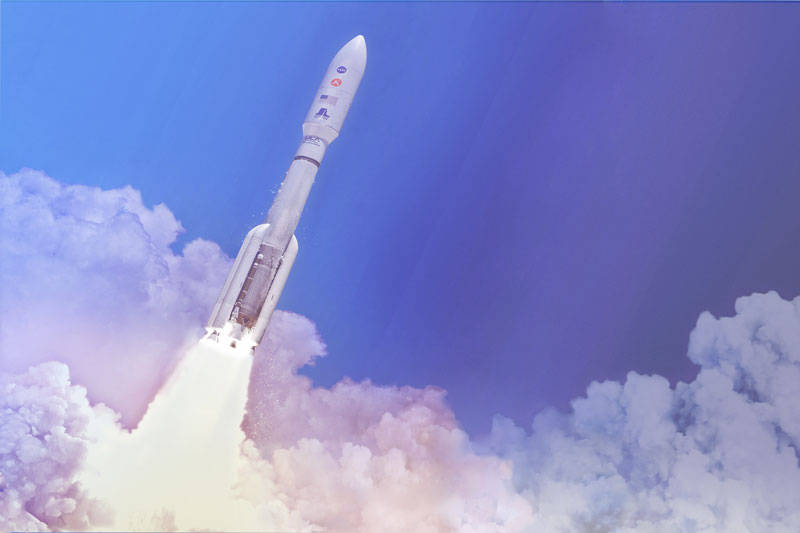
An artist’s concept of the Mars 2020 Rover launch. The rocket is an Atlas V with 4 solid boosters and a Centaur upper stage. Credit NASA.
11/11/2019 – Ephemeris – Mercury is passing across the face of the Sun today
Ephemeris for Veteran’s Day, Monday, November 11th. Today the Sun will be up for 9 hours and 45 minutes, setting at 5:19, and it will rise tomorrow at 7:35. The Moon, 1 day before full, will set at 7:24 tomorrow morning.
Today we are bring treated by a rare event. The planet Mercury is crossing the face of the Sun. It’s called the transit of Mercury. The last one visible from around here was 3 ½ years ago, and the next one will be visible here in 2049. The transit starts at sunrise when Mercury starts to cross the Sun from the lower left from sunrise and will cross the Sun until 1:04 p.m. where it will leave the Sun at the upper right. The best way to see it will be to project the Sun’s image on a white card using binoculars or a telescope. Do not look through them at the Sun. Solar eclipse glasses will not work because Mercury is too small. Do not use eclipse glasses with binoculars. The Sun’s heat will melt the filters and cause blindness.
The times given are for the Traverse City/Interlochen area of Michigan. They may be different for your location.
Addendum
One or more members of the Grand Traverse Astronomical Society mayl be out in the parking lot of Mari Vineyards 8175 Center Road on Old Mission Peninsula, but only if it’s clear. Be advised that there is a winter storm warning for the Grand Traverse Area from 1 a.m. to 6 p.m. today. That means that chances are slim that we’ll have a big enough clear spot to observe through. But I’ll be on the look out., and am a half an hour away.
I found a source for streaming video fo the transit from Griffith Observatory in Los Angeles: https://www.youtube.com/watch?v=rYZKNhTJmOI.
Being on the west coast they will miss part of the transit. They’ll go live at 9:15 a.m. our time. Sunrise over there is at 9:22 our time. There’s more information on: http://www.griffithobservatory.org/events/Transit_of_Mercury_2019.html.
More information about viewing the transit is on: https://spaceweather.com/
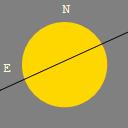
Path of Mercury across the Sun. The planet will move from lower left to upper right. The passage will be from lower left to upper right. Credit: Occult 4.
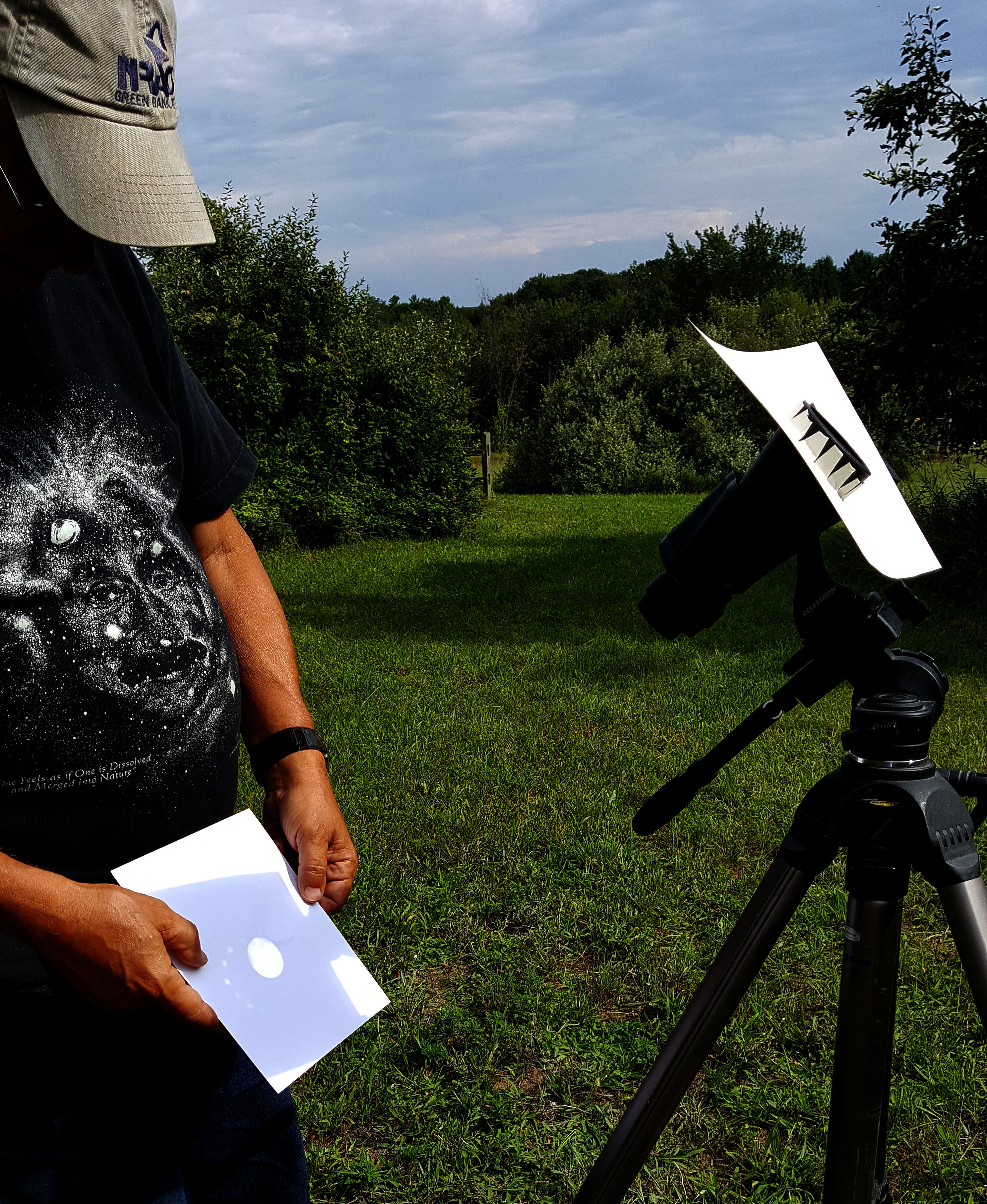
I’m demonstrating using binoculars to project the Sun. Photo by Bea Farrell (granddaughter).
Mercury Inferior Conj.  (Transit)
Transit of Mercury on 2019 Nov 11 (TT)
     Geocentric Event      UTC          EST          P.A.
                           h  m  s                      o
[1]  Exterior Ingress      12 35 27    7:35.27 a.m.  110.0
[2]  Minimum Separation    15 19 48   10:19:48 a.m.
[3]  Exterior Egress       18  4 14    1:04:14 a.m.  298.6

Minimum sepn 75.9";  Radii - Sun 969.3", Mercury 5.0"
delta T =  70.2 secs,  Ephemeris = DE0
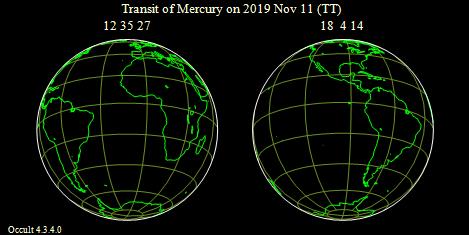
The Sun facing side of the Earth at the start and end of the transit. If you can see your location on either of these maps the transit or part of it will be visible from your location. Credit Occult 4.
09/29/2016 – Ephemeris – The Rosetta spacecraft starts its fatal dive today
Ephemeris for Thursday, September 29th. The Sun will rise at 7:38. It’ll be up for 11 hours and 47 minutes, setting at 7:26. The Moon, 1 day before new, will rise at 7:09 tomorrow morning.
Tomorrow morning at 6:40 a.m. give or take 20 minutes the European Space Agency’s Rosetta spacecraft will slowly crash into Comet 67P/Churyumov-Gerasimenko after orbiting it for a bit over 2 years. The comet is carrying Rosette out toward Jupiter’s orbit where the spacecraft cannot receive enough sunlight to power it. Today the controllers will command the spacecraft to perform the collision maneuver to cancel Rosetta’s complete orbital velocity and let it fall straight down to hit the head of the rubber ducky shaped comet. It’s antenna will be facing Earth and it will be taking pictures all the way down for immediate transmission because Rosetta will turn off its transmitter forever when it impacts the comet.
Times are for the Traverse City/Interlochen area of Michigan. They may be different for your location.
Addendum
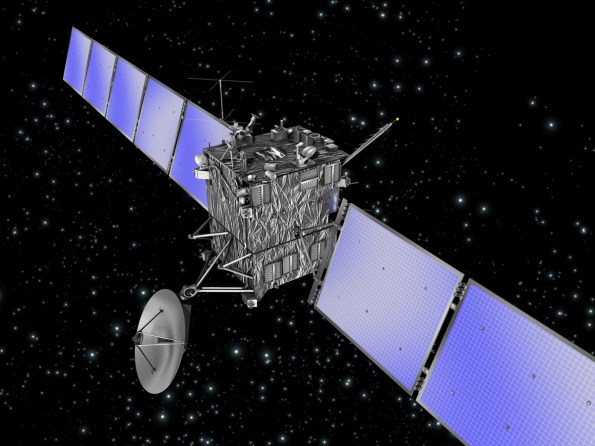
An artist’s illustration of the European Space Agency’s comet-chasing Rosetta spacecraft. Credit: ESA – C. Carreau
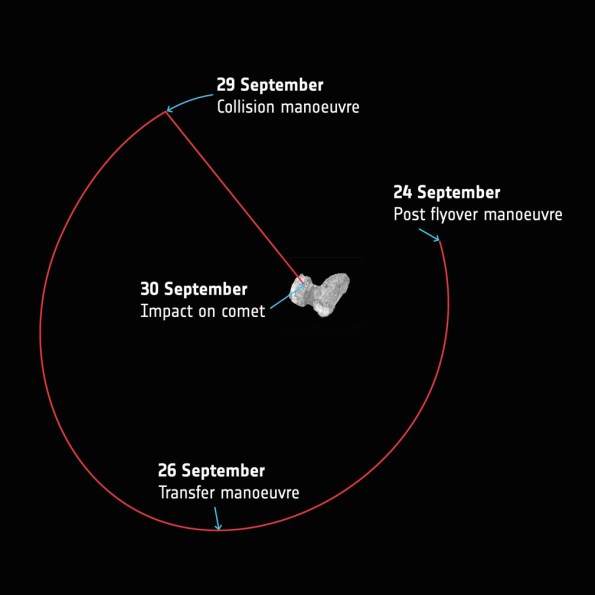
Rosetta, Final orbit. Credit & copyright European Space Agency (ESA)
 Bob Moler's Ephemeris Blog