Archive
04/07/2017 – Ephemeris – Learn about light pollution tonight
Ephemeris for Friday, April 7th. The Sun will rise at 7:12. It’ll be up for 13 hours and 5 minutes, setting at 8:17. The Moon, half way from first quarter to full, will set at 6:11 tomorrow morning.
This evening at 8 p.m. the Grand Traverse Astronomical Society will hold its monthly meeting at Northwestern Michigan College’s Rogers Observatory featuring a talk by observatory director Jerry Dobek about light pollution and what can be done about it to help preserve our dark night skies. I expect he will give us a progress report on the effort to make the Sleeping Bear Dunes National Lakeshore a Dark Sky Park. Special emphasis will be LEDs, now that they are proliferating, the good the bad and the ugly. At 9 p.m. there will be a star party with the gibbous Moon and Jupiter at opposition from the Sun and about at its closest to us at 414 million miles (666 million km) away.
Times are for the Traverse City/Interlochen area of Michigan. They may be different for your location.
Addendum
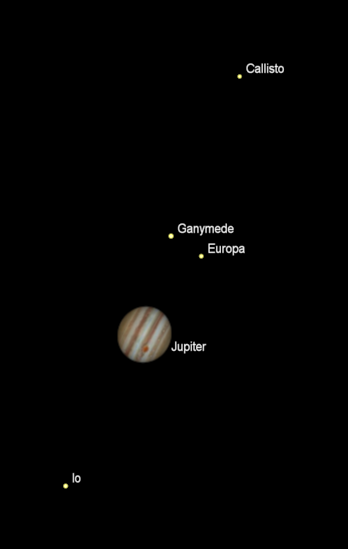
Jupiter and its moons as it should appear tonight at 10 p.m. April 7, 2017 (2 hr UT April 8). Note also the Great Red Spot, which may be paler than it appears here. I double checked the transit time of the red spot across Jupiter’s central meridian, which is predicted for 10:42 p.m. (2:42 UT, April 8) across Jupiter’s central meridian. The position of the Red Spot is correct for 10 p.m.
Times are from Project Pluto: https://www.projectpluto.com/jeve_grs.htm
04/06/2017 – Ephemeris – Jupiter will be opposite the Sun in the sky tomorrow
Ephemeris for Thursday, April 6th. The Sun will rise at 7:13. It’ll be up for 13 hours and 2 minutes, setting at 8:16. The Moon, 3 days past first quarter, will set at 5:39 tomorrow morning.
The planet Jupiter now rises around sunset. Tomorrow at 4:58 p.m. it will be officially in opposition from the Sun. This isn’t some conflict, but the simple fact that Jupiter will be opposite the Sun in our sky. It then will become an evening planet and in the next month or so will become a dazzling fixture in our evening sky, that it is now later in the evening. Jupiter is the second brightest planet after Venus, which is now emerging from the morning Sun’s twilight glare. Watch for it in next Wednesday’s planet report. Though the second brightest planet Jupiter by far is the largest planet. It’s mass exceeds the combines masses of all the other planets times two. Currently NASA’s Juno spacecraft is orbiting it.
Times are for the Traverse City/Interlochen area of Michigan. They may be different for your location.
Addendum
In a telescope the Jupiter system is quite dynamic. It’s four largest moons change position from night to night, and sometimes while you watch. The satellites sometimes duck behind Jupiter or through its shadow, or pass in front of the planet, casting their shadow on it. Close observation of Jupiter reveals details in its clouds. It rotates in less than 10 hours, over twice as fast as the Earth, which apparently whips the clouds into alternate light colored zones and darker brownish belts. There’s the Great Red Spot, which last I spotted it has faded to a pale pink, and located in the south edge of the south equatorial belt. The clouds rotate faster at the equator than at higher latitudes.
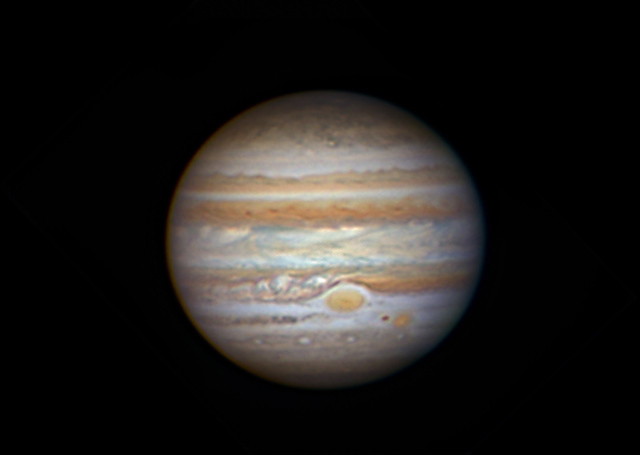
Jupiter with its Great Red Spot November 18, 2012 by Scott Anttila.
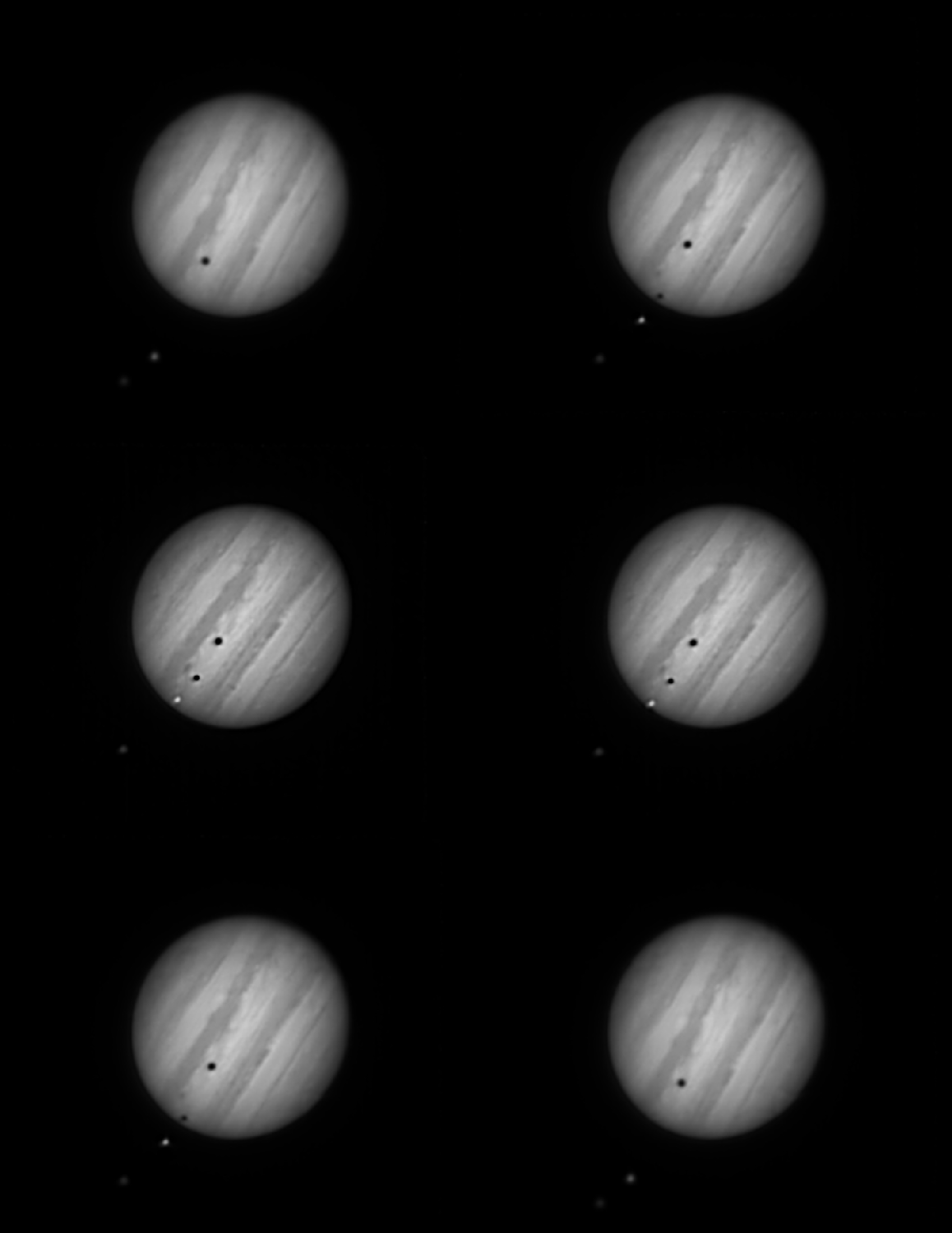
Rocking animation of the early stages of the shadow show on Jupiter. Callisto’s shadow already on the planet while Io’s shadow is just entering. Also Io’s transit is starting., following it’s shadow on the planet. Credit: Scott Anttila
10/28/2016 – Ephemeris – The Moon will hang by Jupiter this morning
Ephemeris for Friday, October 28th. The Sun will rise at 8:16. It’ll be up for 10 hours and 20 minutes, setting at 6:36. The Moon, 2 days before new, rose this morning at 6:02 and will rise at 7:01 tomorrow morning.
This morning the planet Jupiter and the Moon will appear close together in the morning sky. Jupiter rose at 6:03 a.m. After that until twilight becomes too bright both will appear together with Jupiter to the right of the thin waning crescent Moon. They passed each other at 4:18 (8:18 UT) this morning. Jupiter will appear to move farther from the Sun in the coming months, more the Sun moving away from it caused by the Earth’s motion around the Sun. Jupiter will enter the evening sky in April next year, passing in front of the zodiacal constellation of Virgo. By then we will have lost Venus as our Evening Star, so Jupiter will have no competition when it arrives from the east.
Times are for the Traverse City/Interlochen area of Michigan. They may be different for your location.
Addendum
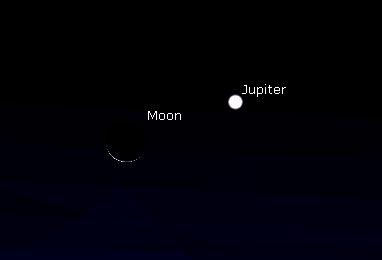
The Moon and Jupiter at 7 a.m. EDT (11:00 UT) this morning October 28, 2016. Stellarium and any other planetarium program cannot display the dynamic range of he sky. The sliver of the moon should be a lot brighter, including earthshine on its night side. I had to delete a star that was showing way too bright when it should be barely visible. Created using Stellarium and GIMP.
For observers in the UK and Europe the Moon will appear above Jupiter. As a rule of thumb, the Moon moves its own diameter in an hour against the stars. In the sky in the east just before sunrise the Moon will be moving down and to the left in relation to Jupiter.
07/04/2016 – Ephemeris – NASA’s going to light off fireworks at Jupiter tonight
Ephemeris for Independence Day, Monday, July 4th. Today the Sun will be up for 15 hours and 27 minutes, setting at 9:31, and it will rise tomorrow at 6:03. The Moon is new today, and won’t be visible.
There are two astronomical highlights for your Independence Day enjoyment. The first comes at 11:59 this morning (15:59 UT) when the Earth is at its very farthest from the Sun this year. Some 1.7% farther than average. You’re still gonna need your sun screen anyway. Later this evening, a half billion miles from Earth NASA’s Juno spacecraft will fire it’s rocket engine for 35 minutes to begin to decelerate over the north pole of Jupiter to drop into a long elliptical orbit of that planet. NASA TV will begin broadcasting the event at 10:30 p.m. (2:30 UT, July 5) The 35 minute engine burn will start at 11:18 p.m. (3:18 UT, July 5) What we’ll see is a real-time graph of the Doppler signal from the spacecraft as it slows down to drop into orbit of Jupiter.
Times are for the Traverse City/Interlochen area of Michigan. They may be different for your location.
Addendum
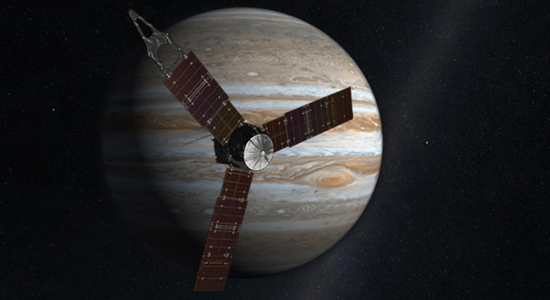
The Juno spacecraft. Credit: NASA.
The Planetary Society’s Emily Lakdawalla has more information on How to watch Juno’s orbit insertion at http://www.planetary.org/blogs/emily-lakdawalla/2016/07011514-how-to-watch-junos-orbit.html.
NASA also has an application in which you can see simulations of Juno’s orbital insertion. It’s called NASA’s Eyes and can be downloaded from http://eyes.nasa.gov/.
04/22/2016 – Ephemeris – Hitting on Jupiter
Ephemeris for Earth Day, Friday, April 22nd. The Sun rises at 6:45. It’ll be up for 13 hours and 51 minutes, setting at 8:37. The Moon, at full today, will rise at 9:08 this evening.
The first time anyone had spotted anything hitting Jupiter was in 1994, when over 20 pieces of Comet Shoemaker-Levy 9 hit the planet over an exciting week in July. Jupiter gets hit maybe once a year by a small asteroid making a flash or a scar visible from the Earth. Except for Shoemaker-Levy 9, all the rest of the impacts have been discovered by amateur astronomers who create videos of Jupiter through their modest, by professional standards, telescopes. Generally the reason for the videos is to stack the images to produce super detailed images of the planet, like my friend Scott Anttila, whose images I occasional post with these program transcripts on my blog bobmoler.wordpress.com. Amateurs have even discovered exoplanets.
Times are for the Traverse City/Interlochen area of Michigan. They may be different for your location.
Addendum
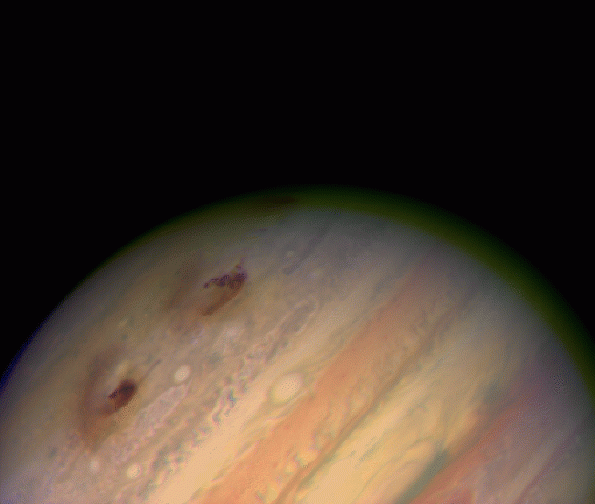
Two of the impact sites of the over 20 bits of Comet Shoemaker-Levy 9 photographed on July 18, 1994. Credit NASA/ESA Hubble Space Telescope.
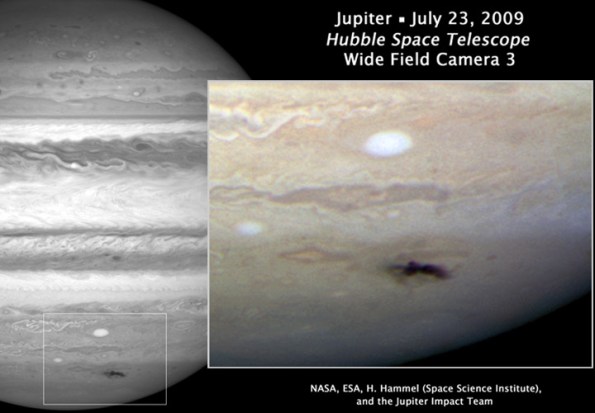
Blemish from an impact discovered by amateur astronomer Anthony Wesley on July 17, 2009. Credit NASA/ESA Hubble Space Telescope.
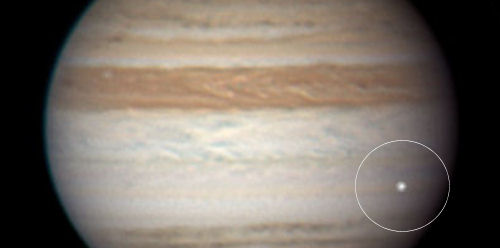
Impact June 3, 2010 photographed by Anthony Wesley. Credit Anthony Wesley.
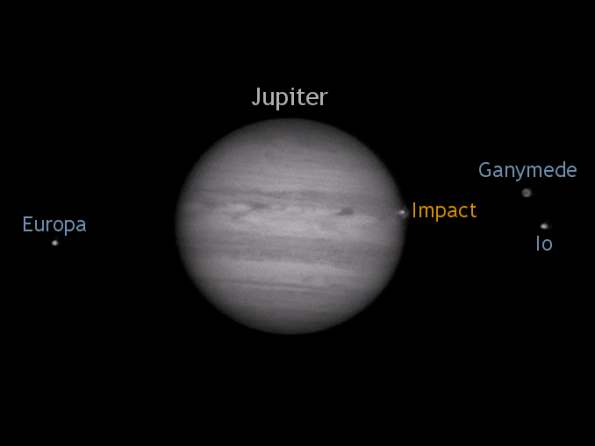
Processed image by John McKeon of the impact of March 17, 2017. The impact was first noticed by Gerrit Kernbauer. Both were amateur astronomers.
Universe Today and more information and videos of the most recent event.
04/14/2016 – Ephemeris – It’s always a cloudy day on Jupiter, worse than Traverse City in winter.
Ephemeris for Thursday, April 14th. The Sun will rise at 6:59. It’ll be up for 13 hours and 27 minutes, setting at 8:27. The Moon, 1 day past first quarter, will set at 3:50 tomorrow morning.
If one has a large enough telescope, possibly 100 millimeters diameter or larger Jupiter’s cloud detail can be studied. At first appearance the clouds appear simple light and dark stripes. They are caused by Jupiter’s rapid rotation of a bit less than 10 hours. The dark stripes are called belts. The darkest and broadest of these is the North Equatorial Belt. The next darkest belt is the South Equatorial Belt, which actually disappeared for a time in 2010. On the belt’s south side is found the Great Red Spot an anticyclone. The white stripes are called zones. There are more belts and zones at higher latitudes. The Great Red Spot is kinda pink now. In my youth in the 1950s it could be easily spotted in a small telescope and it was brick-red!
Times are for the Traverse City/Interlochen area of Michigan. They may be different for your location.
Addendum
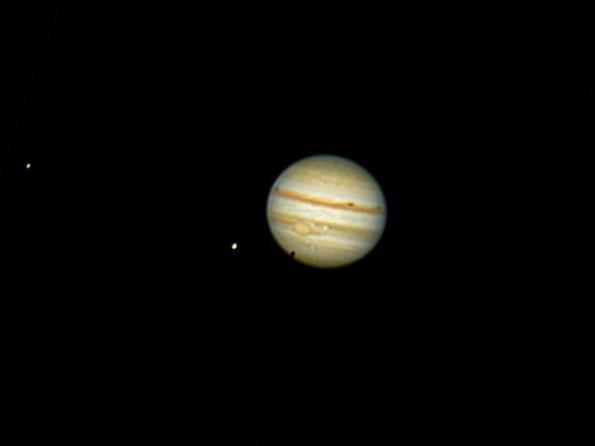
Scott Anttila image of Jupiter from November 14, 2011.
Note how faded the Great Red Spot was.
04/12/2016 – Ephemeris – Can you tell the Jovian moons apart without a program?
Ephemeris for Yuri’s Night, Tuesday, April 12th. The Sun will rise at 7:02. It’ll be up for 13 hours and 21 minutes, setting at 8:24. The Moon, 1 day before first quarter, will set at 2:22 tomorrow morning.
It’s the 55th anniversary of Yuri Gagarin’s flight as first human to orbit the Earth. Speaking of orbits, we can see Jupiter’s 4 largest moons orbit that planet in small telescopes. Their orbits are nearly edge on to us, so they seem to move back and forth from one side to the other of the planet in pretty much a straight line. So how can you tell them apart without a reference? The four moons from Jupiter in order are Io, Europa, Ganymede, and Callisto. They are not normally arranged like that. Ganymede is the brightest and Callisto the dimmest, and is usually the farthest away. Io is usually the closest appearing and has a slight reddish hue due to its sulfurous volcanic surface, and Europa is the dimmer moon close in to Jupiter. Io also can be seen to noticeably move in an hour.
Times are for the Traverse City/Interlochen area of Michigan. They may be different for your location.
Addendum
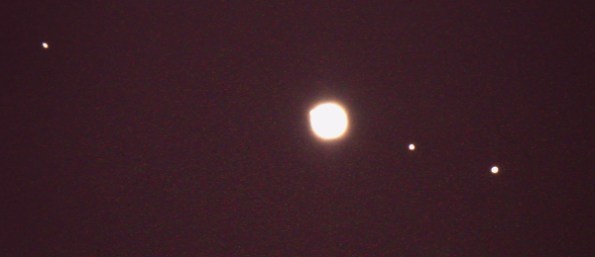
One of my old pictures of Jupiter. Callisto is obvious from its far left position and dimmer brightness. On the right, the farthest is Ganymede due to its brightness and position. Inside of it is Europa, again, dimmer than Ganymede and inside position is probably Europa. That leaves Io, which may be trying to duck behind Jupiter, as a bump in the left edge of the planet.
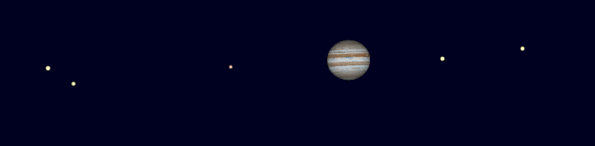
Jupiter and its moons as simulated by Cartes du Ciel for tonight, 10 p.m. April 12, 2016. The bodies, from let to right are Ganymede, Callisto. a background star, Jupiter, Io, and Europa.
3.1416 – 03/14/2016 – Ephemeris – When Jupiter hits your eye like a big pizza Pi
Ephemeris for Pi Day 3/14, Monday, March 14th. The Sun will rise at 7:56. It’ll be up for 11 hours and 52 minutes, setting at 7:48. The Moon, 1 day before first quarter, will set at 2:39 tomorrow morning.
We turn again to the giant planet Jupiter which is shining brightly in the southeastern part of the sky in the early evening. The first thing one notices in a small telescope are it’s four moons, generally in a straight line, which move back and forth each night. Notice their plane. It’s the same direction as the cloud bands are aligned. Jupiter has a very small axial tilt, and its large satellites orbit pretty much over Jupiter’s equator. Our Moon doesn’t behave that way, but that’s another story. Jupiter rotates on its axis in a bit less than 10 hours, which whips its clouds into alternating bands of reddish-brown and cream color. Also the rotation rate of these clouds lessens with increasing latitude.
Times are for the Traverse City/Interlochen area of Michigan. They may be different for your location.
Addenda
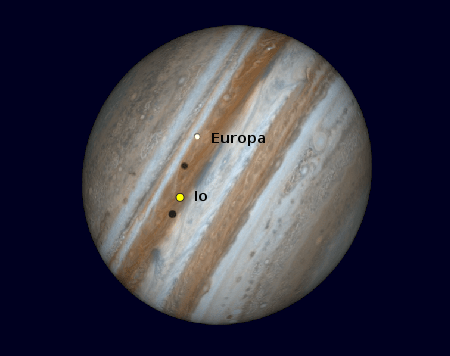
Transits of Europa and Io across the face of Jupiter at 11 p.m. EDT March 14, 2016. The shadows of the moons are hard to see, but the satellites are even harder. Jupiter’s current cloud bands may not be as shown. Image created using Cartes du Ciel (Sky Charts).
| Event | EDT | Universal Time | ||
| Date | Time | Date | Time | |
| Europa Transit Start | March 14 | 09:26 PM | March 15 | 01:26 AM |
| Europa Shadow Start | March 14 | 09:45 PM | March 15 | 01:45 AM |
| Io Shadow Start | March 14 | 10:12 PM | March 15 | 02:12 AM |
| Io Shadow Start | March 14 | 10:21 PM | March 15 | 02:21 AM |
| Europa Transit End | March 15 | 12:12 AM | March 15 | 04:12 AM |
| Io Transit End | March 15 | 12:26 AM | March 15 | 04:26 AM |
| Europa Shadow End | March 15 | 12:33 AM | March 15 | 04:33 AM |
| Io Shadow End | March 15 | 12:36 AM | March 15 | 04:36 AM |
Jovian satellite data from Project Pluto.
Pi Day
Check this out: Pi Day the NASA Way.
Answer to Friday’s Moon phase poser
Of the two representations of the Moon’s terminator last Friday, the Virtual Moon Atlas was the correct representation.
03/07/2016 – Ephemeris – Jupiter officially becomes an evening planet tomorrow, celebrating with a double transit of its moons.
Ephemeris for Monday, March 7th. The Sun will rise at 7:08. It’ll be up for 11 hours and 30 minutes, setting at 6:39. The Moon, 1 day before new, will rise at 6:49 tomorrow morning.
Tomorrow is a busy day astronomically speaking, Tomorrow night our time there will be a solar eclipse on the other side of the Earth that will be covered by NASA-TV. I’ll talk more about it tomorrow. However in the early morning hours Jupiter will reach opposition from the Sun tomorrow at 4:58 a.m. At opposition the Earth is placed almost directly between the Sun and Jupiter. It is the time the planet is closest to the Earth in its orbit. For Jupiter that distance will be 412 million miles (664 million km) away. It’s apparent diameter will be 44.5 seconds of arc. One second of arc is one 3,600th of a degree. The Moon and Sun are about a half a degree or 1800 seconds in diameter. Even so Jupiter appears as a tiny disk in binoculars, but a very tiny disc. A few of its 4 large Galilean moons can also be spotted in binoculars. Jupiter is over 11 times the Earth’s diameter and is twice as massive as all the other planets, asteroids and satellites combined.
Times are for the Traverse City/Interlochen area of Michigan. They may be different for your location.
Addendum
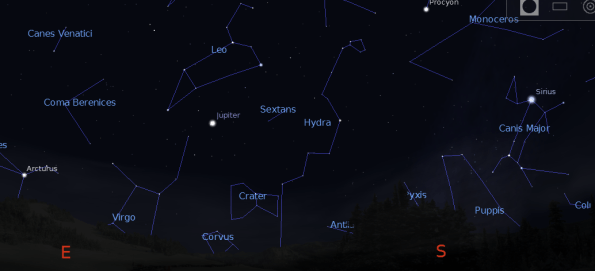
Jupiter at 10 p.m. March 8, 2016 with some of the spring constellations and Canis Major. Created using Stellarium.
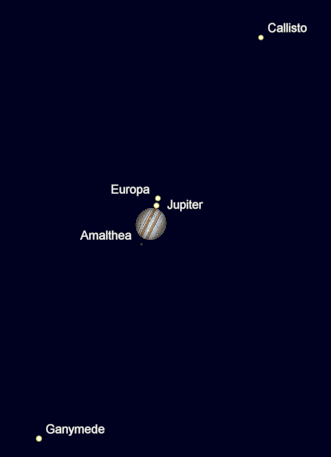
Jupiter and its moons at 10 p.m. March 7, 2016. Created using Cartes du Ciel (Sky Charts).
Io and Europa and their shadows transit the face of Jupiter
This evening there will be two satellites transiting across the face of Jupiter at the same time: Europa and Io. The start of Europa’s transit won’t be seen locally, since Jupiter will rise at 6:30 p.m. Locally, because of Jupiter being low in the sky I wouldn’t expect to spot the transiting satellites or their shadows. However observers in Europe, whose Jupiter rising has a 5 hour head start on us, will be in perfect position. In any case this takes a very good telescope to see. The appearance of Europa and Io in and out of transit can easily be seen in any telescope. In the table below I give the timing of these events for both the Eastern time zone (us) and Universal Time for others. Note the transits start on the 7th of March and end on the 8th for Universal Time.
The shadows of the moons themselves will appear very close to the moons, and may be obscured by them because we are just hours from opposition, and looking at Jupiter from nearly in line with the Sun. That should be a challenge. Watch for pictures from astrophotographer’s Twitter, Instagram and Facebook sites.
Times for this table are from Project Pluto: http://www.projectpluto.com/jevent.htm.
| Event | Eastern Time Zone | Universal Time | ||
| Date | Time | Date | Time | |
| Europa Shadow Start* | 7 | 6:08 p.m. | 7 | 23:08 |
| Europa Transit Start* | 7 | 6:11 p.m. | 7 | 23:11 |
| Io Shadow Start | 7 | 7:27 p.m. | 8 | 00:27 |
| Io Transit Start | 7 | 7:28 p.m. | 8 | 00:28 |
| Europa Transit End | 7 | 8:56 p.m. | 8 | 01:56 |
| Europa Shadow End | 7 | 8:56 p.m. | 8 | 01:56 |
| Io Transit End | 7 | 9:42 p.m. | 8 | 02:42 |
| Io Transit End | 7 | 9:42 p.m. | 8 | 02:42 |
| * The Europa Shadow and Transit Start Events cannot be seen in Michigan because they will occur before Jupiter will rise. |
||||
02/23/2016 – Ephemeris – The king of the planets is planning to conquer the evening sky. Tonight its enlisting help from the Moon.
Ephemeris for Tuesday, February 23rd. The Sun will rise at 7:31. It’ll be up for 10 hours and 50 minutes, setting at 6:21. The Moon, 1 day past full, will rise at 7:32 this evening.
Rising with the Moon tonight will be the planet Jupiter which will appear to the left of the Moon as they rise, to the upper left of the Moon at 10 p.m. and above the Moon at midnight. NASA’s Juno spacecraft, launched in 2011, is planned to arrive at Jupiter on July 4th this year. No, it’s not a coincidence. It will orbit the planet for nearly two years. It’s the only solar-powered spacecraft that can operate as far from the Sun as Jupiter, which is 5 times farther from the Sun as the Earth, which gets one 5th squared or one twenty-fifth the intensity of sunlight. It has 3 huge solar panels making the spacecraft 66 feet wide. It’s mission is about Jupiter, its internal structure, atmosphere and magnetic and radiation fields.
Times are for the Traverse City/Interlochen area of Michigan. They may be different for your location.
Addendum
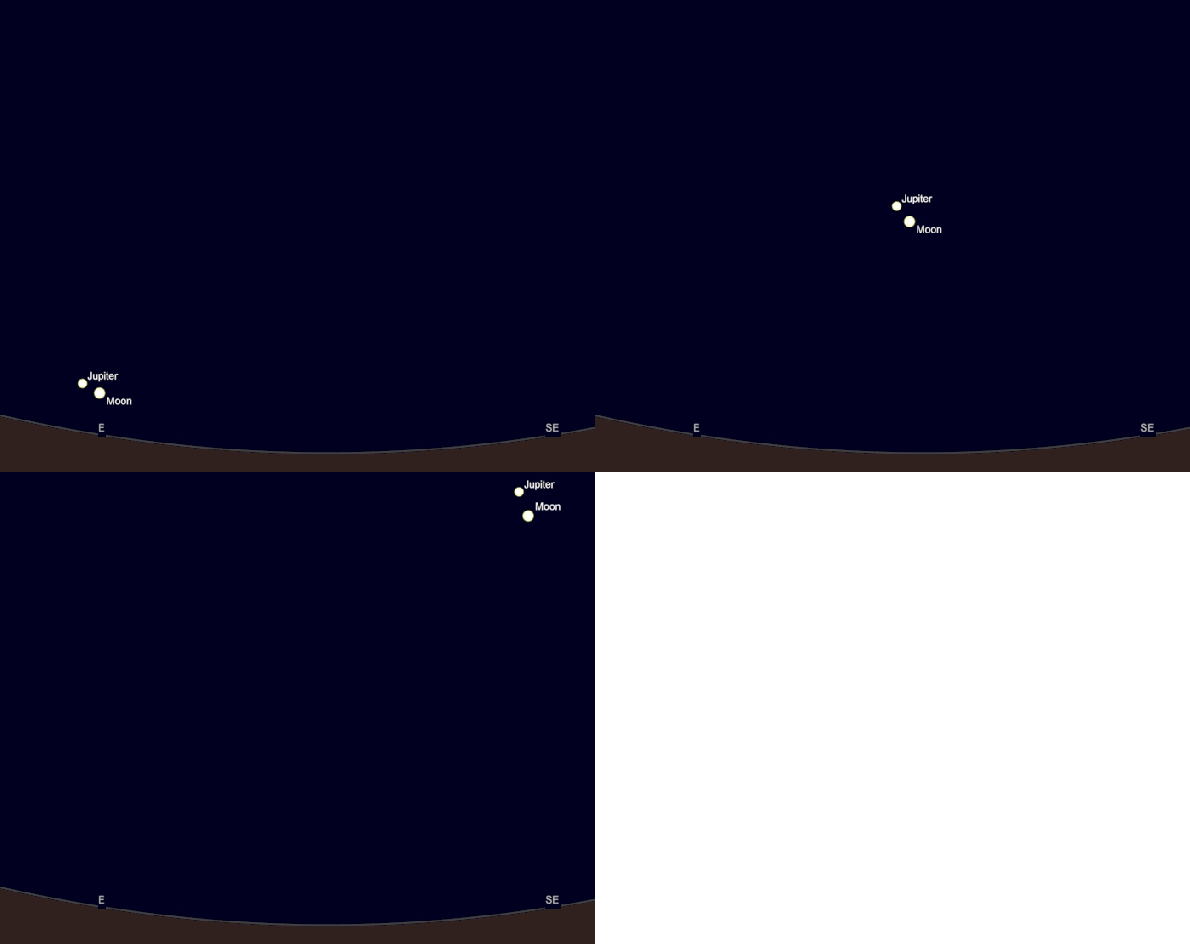
Jupiter and the Moon animation. Note their change in position relative to each other at 8 p.m., 10 p.m. and midnight. Created using Cartes du Ciel (Sky Chart) and GIMP.
.m.
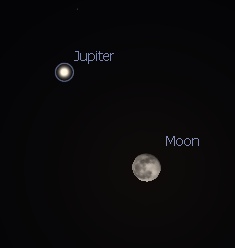
Closeup of Jupiter and the Moon at 10 p.m., February 23, 2016. The Moon is a whole lot brighter, and Jupiter dimmer than what’s shown here. Created using Stellarium.
The Juno spacecraft. Credit: NASA.
 Bob Moler's Ephemeris Blog