Archive
11/26/2018 – Ephemeris – NASA’s InSight spacecraft lands on Mars this afternoon
Ephemeris for Monday, November 26th. The Sun will rise at 7:54. It’ll be up for 9 hours and 11 minutes, setting at 5:05. The Moon, half way from full to last quarter, will rise at 8:43 this evening.
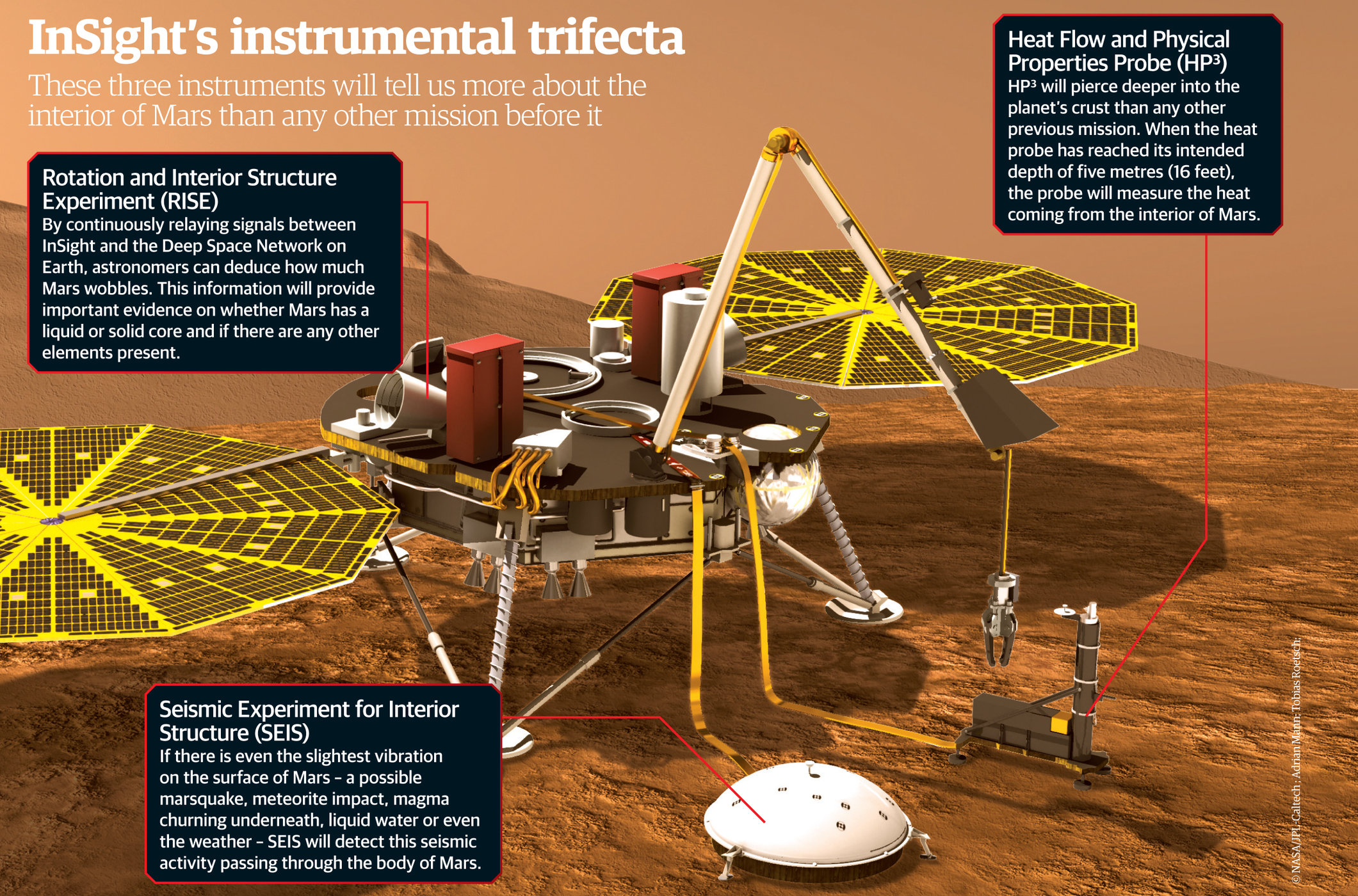
This afternoon NASA’s InSight spacecraft will land on Mars. It will drill into the martial soil to place a temperature probe to measure Mars’ heat flow to determine the interior temperature of Mars. It will also deploy a seismometer to detect marsquakes and seismic waves generated by meteorite impacts to ascertain the interior structure of the planet. The entry, decent and landing or EDL as it’s called begins at 2:47 p.m. Eastern Standard Time, with landing 6 minutes, 45 seconds later. The Jet Propulsion Laboratory calls it Seven Minutes of Terror. The spacecraft is on its own so everything has to go right. Mars is 8 light minutes away. The spacecraft will be on the ground one way or the other for over a minute by the time we get word that the spacecraft has entered the atmosphere of Mars. NASA-TV, available on the Internet, starts its coverage at 2 p.m. Eastern Standard Time.
The times given are for the Traverse City/Interlochen area of Michigan. They may be different for your location.
Addendum
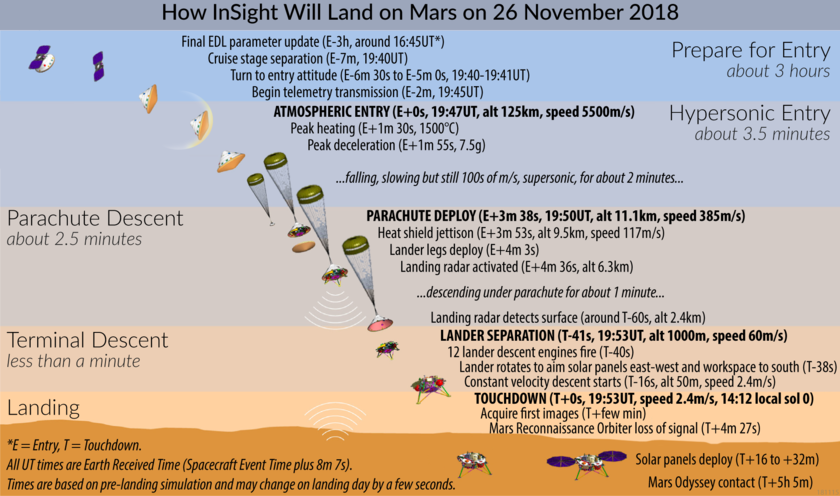
To see Emily’s post with a lot more information, click on this URL: http://www.planetary.org/blogs/emily-lakdawalla/2018/mars-insight-landing-preview.html. The post has a link to NASA’s 68 page pdf Mars InSight Landing Press Kit, which covers all aspects of entry, descent and landing, the Mars Insight components, and science instruments, and what they expect to learn about Mars’ interior.
08/02/2018 – Ephemeris – Has liquid water been found on Mars?
Ephemeris for Thursday, August 2nd. The Sun rises at 6:30. It’ll be up for 14 hours and 37 minutes, setting at 9:07. The Moon, 2 days before last quarter, will rise at 12:09 tomorrow morning.
The European Space Agency has announced the possible discovery of liquid water beneath Mars’ southern polar cap. Perhaps it’s like the lakes found under Earth’s Antarctic ice sheet. The discovery was made by the Mars Express orbiter’s ground penetrating radar. Mars south polar cap is primarily made of water ice up to 3.7 kilometers thick, covered in winter by a meter, give or take, thickness of carbon dioxide ice, what we call dry ice. Mars elliptical orbit happens to make southern hemisphere summers short and hot, and winters long and especially cold. Liquid water could exist several kilometers below the martian surface. Mars’ internal heat flow is what NASA’s InSight lander, now en route to Mars is going to tell us.
The times given are for the Traverse City/Interlochen area of Michigan. They may be different for your location.
Addendum

Mars Express detects water buried under the south pole of Mars. Click on the image to enlarge. Credit: European Space Agency (ESA)
07/30/2018 – Ephemeris – Early tomorrow morning Mars will be the closest to is in 15 years
Ephemeris for Monday, July 30th. The Sun rises at 6:26. It’ll be up for 14 hours and 44 minutes, setting at 9:10. The Moon, 3 days past full, will rise at 10:51 this evening.
Mars’ closest approach to the Earth since August 27, 2003 is tomorrow at about 3:51 a.m. at a distance of 35.8 million miles (57.6 million km). The last really close approach of Mars was on August 27, 2003 when it was about 600 thousand miles (a million km) closer. That close approach was probably the closest in 50 thousand years. Mars and the Earth get close in their orbits about every 26 months. But because Mars has a much more elliptical orbit than the Earth, the very best close encounters occur every 15 or 17 years. Despite the fact that we have satellites that orbit Mars and two rovers operating on its surface, amateur astronomers still challenge themselves to observe and photograph Mars at its very closest.
The times given are for the Traverse City/Interlochen area of Michigan. They may be different for your location.
Addendum
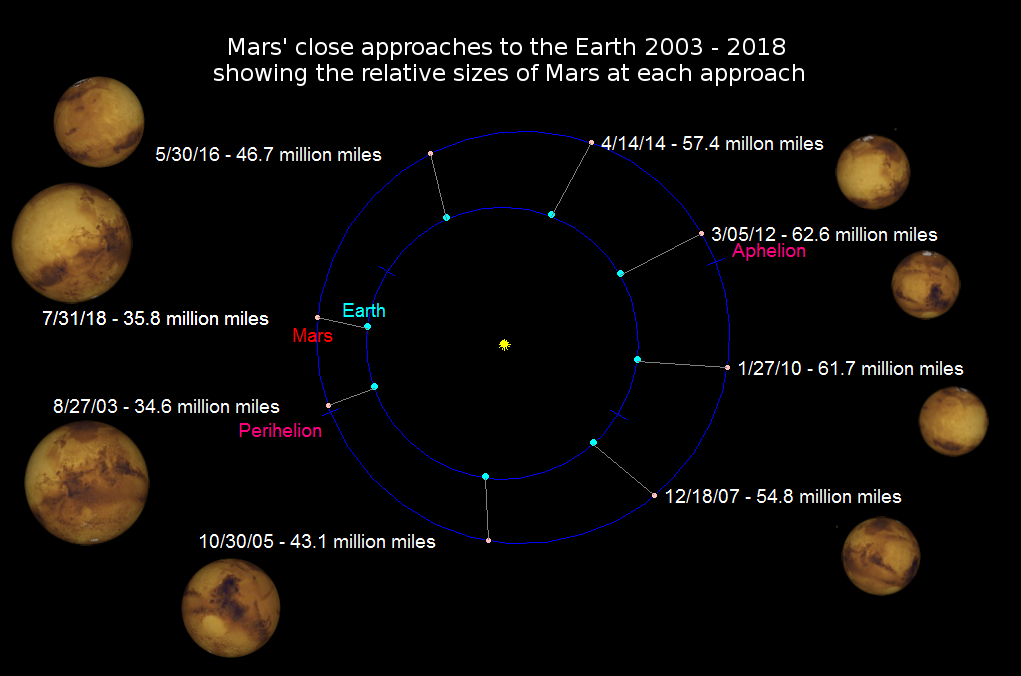
Mars’ closest approaches to the Earth in the period 2003 to 2018 also showing the apparent sizes of the planet at each approach. Click on image to enlarge. Created using my LookingUp program and Cartes du Ciel (Sky Charts).
07/27/2018 – Ephemeris – Mars is at opposition from the Sun today
Ephemeris for Friday, July 27th. The Sun rises at 6:23. It’ll be up for 14 hours and 50 minutes, setting at 9:14. The Moon, at full today, will rise at 9:16 this evening.
The planet Mars was at opposition with the Sun early this morning, that is opposite the Sun in the sky. It is a time when a planet rises at sunset and sets at sunrise. For us it will rise tonight at 9:40 p.m. 26 minutes after sunset and will set tomorrow at 6 a.m., 24 minutes before sunrise. This odd behavior is due to the fact that Mars is actually south of a lime from the Sun through the Earth. Mars’ orbit is tilted to the Earths’ so it will appear lower in the sky as one would expect for a planet in its position. Today Mars is 35.9 million miles (57.7 million km) away. In four days it will be a bit closer to us due to its elliptical orbit taking it a bit closer to the Sun. How much closer? About 93,000 miles (150,000 km) to us.
The times given are for the Traverse City/Interlochen area of Michigan. They may be different for your location.
Addendum
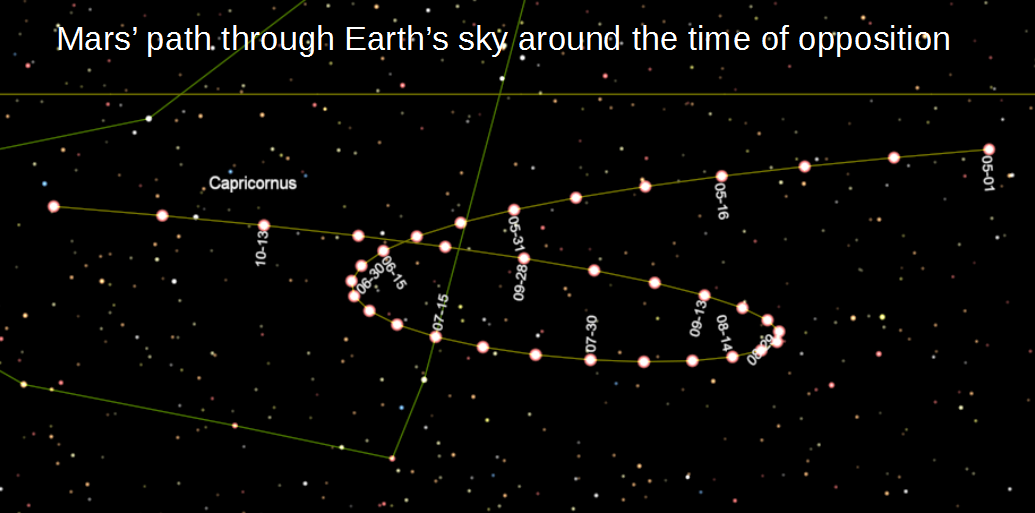
This chart is shown with the horizontal being parallel to the ecliptic, which is the horizontal line near the top of the image. Created using Cartes du Ciel (Sky Charts).
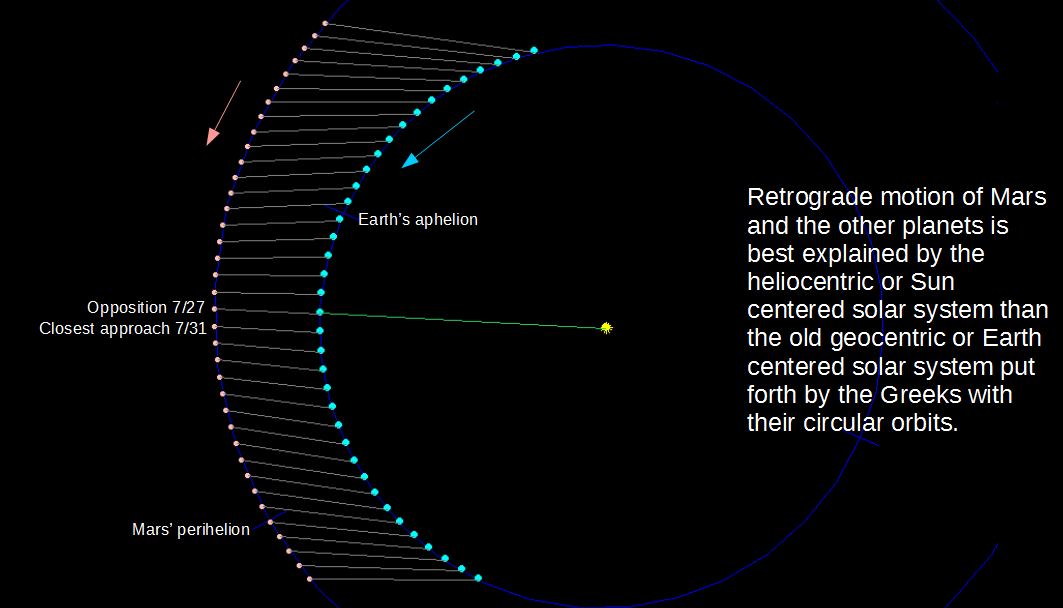
Created using Cartes du Ciel (Sky Charts).
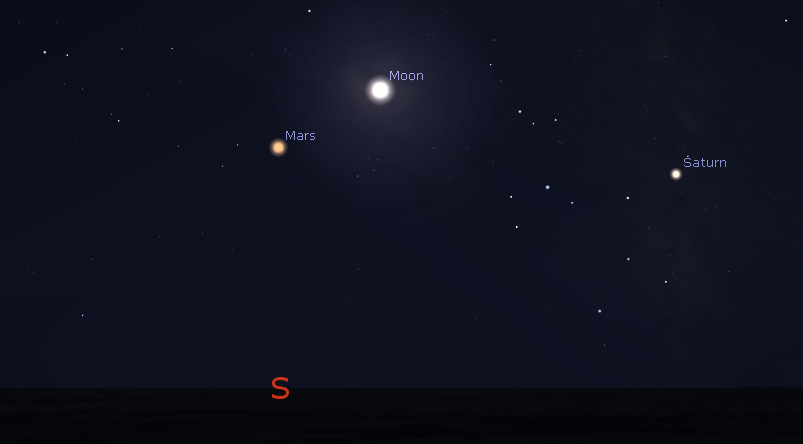
Mars on opposition day, July 27, 2018 at 1:55 a.m. as it crossed the meridian due south. In the Interlochen/Traverse City area a bit south of 45 degrees north latitude. Mars appears a an altitude of slightly less than 20 degrees altitude. Created using Stellarium.
Update
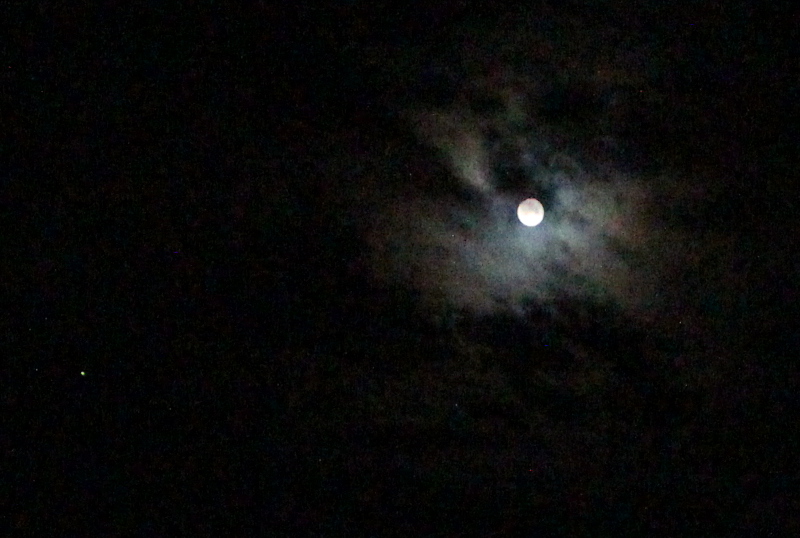
Mars at opposition and the full Moon at 2:01 a.m. July 27, 2018. I thought I’d go out near the Mars transit time this morning and photograph the Moon and Mars. Earlier we had a pop-up rain shower, and the clouds were clearing out. Got a lucky shot.
07/26/2018 – Ephemeris – How can you get to Mars – the Hohmann transfer orbit
Ephemeris for Thursday, July 26th. The Sun rises at 6:22. It’ll be up for 14 hours and 53 minutes, setting at 9:15. The Moon, 1 day before full, will set at 6:06 tomorrow morning.
How does one get a spacecraft to another planet, like Mars? One might think to wait until the two planets are closest and zip across. That would take more energy than we are capable of. We cab barely escape the Earth and get a spacecraft into solar orbit. Also one needs energy to slow down to be captured by the planet if one wants to orbit it. The most economical way was devised way before the space age by Walter Hohmann, a German scientist in 1925. The idea is to launch a spacecraft with enough velocity to reach the other planet half way around the Sun, so the transfer orbit is tangent to both the Earth’s and the planet’s orbit. Transit times to Mars would be in the range of 7 months. The InSight lander is currently on such a trajectory.
The times given are for the Traverse City/Interlochen area of Michigan. They may be different for your location.
Addendum
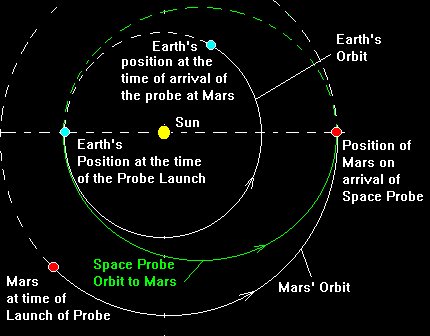
Hohmann transfer orbit. Credit Planetary Society-Myron Kayton
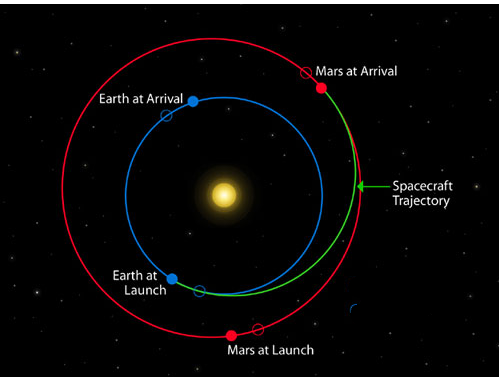
A Hohmann lowest energy transfer orbit to Mars. This diagram is for the Mars Exploration Rovers Spirit and Opportunity orbits, launched in 2003, arrived in 2004. Solid planets, Spirit launch and arrival. Ghost planets, Opportunity launch and arrival. Credit NASA/JPL.
07/24/2018 – Ephemeris – What about those martian canals
Ephemeris for Tuesday, July 24th. The Sun rises at 6:20. It’ll be up for 14 hours and 57 minutes, setting at 9:17. The Moon, 3 days before full, will set at 4:25 tomorrow morning.
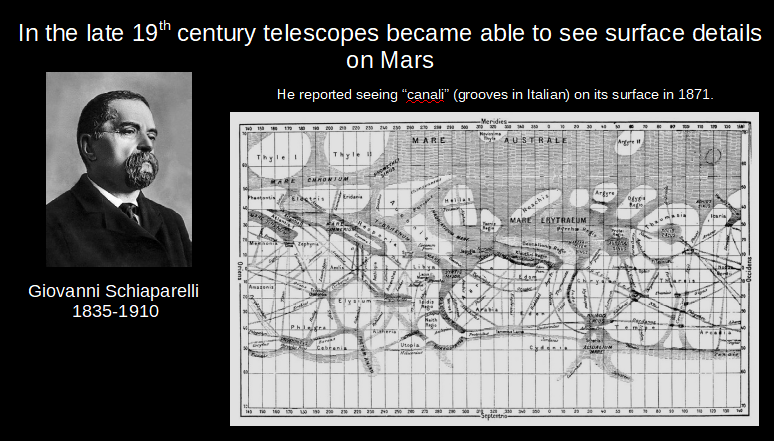
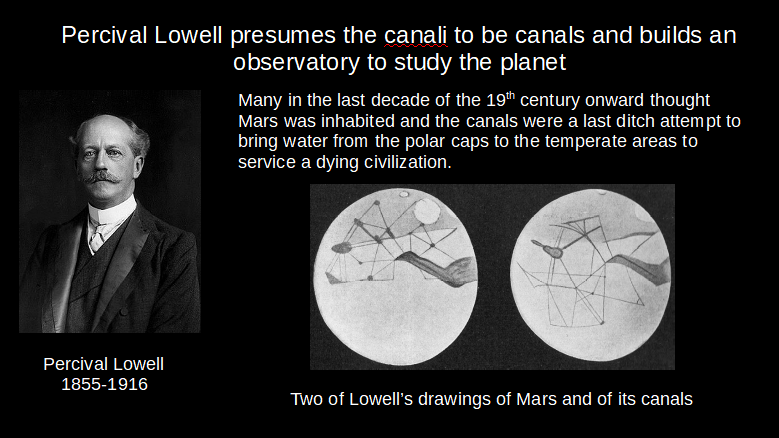
The greatest mystery of the late 19th and early 20th century of Mars was the discovery of fine linear marking seen by visual observers of Mars. They were first reported by an Italian astronomer Giovanni Schiaparelli in 1871 as grooves, canali in Italian. It was turned into canals by the English language newspapers of the day. Canals are artificial constructions. Thus one Percival Lowell of Massachusetts built an observatory in Flagstaff Arizona to observe and map Mars for himself, dying in 1916 still believing in an ancient martian civilization bringing water from the polar caps to the equatorial region by canals in order to survive. Alas, there are no canals. Mars is a barren world, whose secrets we now probe below its red dust.
The times given are for the Traverse City/Interlochen area of Michigan. They may be different for your location.
Addendum
The source if the images below is the talk “Mars 2018” I gave at the Betsie Valley District Library, July, 20, 2018.
***
06/28/2018 – Ephemeris – Saturn at opposition, what it means
Ephemeris for Thursday, June 28th. Today the Sun will be up for 15 hours and 32 minutes, setting at 9:32, and it will rise tomorrow at 6:00. The Moon, at full today, will rise at 9:54 this evening.
Just before midnight last night Saturn was in opposition to the Sun. We’re not talking about an argument here. To the astronomer opposition simply means that a planet, in this case Saturn, is 180 degrees from the Sun, or opposite the Sun in the sky. It is a time when the planet rises at sunset and sets at sunrise. It is also a time when the planet is around its closest to the Earth. It’s not a big deal for Saturn, which is almost 10 times farther from the Sun than we are. However it is a big deal for a nearby planet like Mars, which at the end of July will be closer to us than at any time since 2003, at 35.8 million miles. That’s a big deal since Mars is a small planet, a bit more than half the size of the Earth.
The times given are for the Traverse City/Interlochen area of Michigan. They may be different for your location.
Addendum
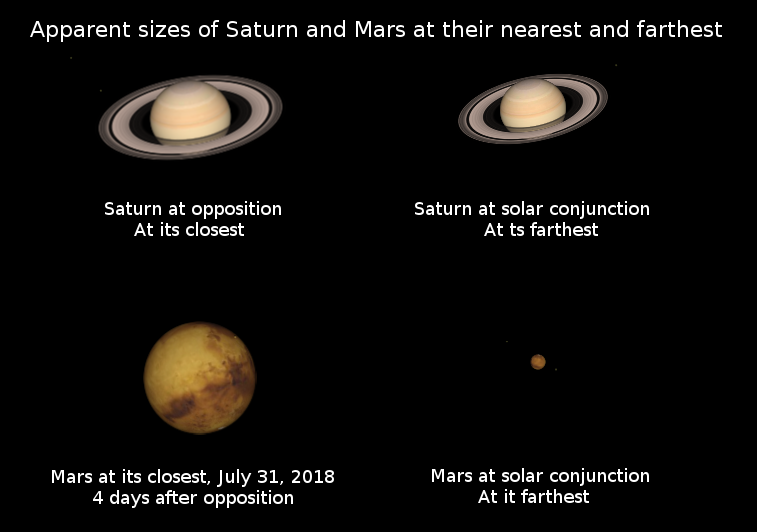
The apparent sizes of Saturn and Mars as seen from the Earth at opposition and solar conjunction. All at the same scale. Created using Cartes du Ciel (Sky Charts).
06/24/2018 – Ephemeris Extra – Mars Summers
This is a reprint of “Mars Summer” which I wrote for the Grand Traverse Astronomical Society newsletter Stellar Sentinel’s June 2018 issue.
The planet Mars has oppositions from the Sun about every 26 months more or less. These oppositions are a time when Mars is closest to the Earth for its position in orbit. It’s distance at these times range from 34.6 to almost 63 million miles, a range of almost 2 to 1. This is because Mars has a very elliptical orbit as can be seen below.
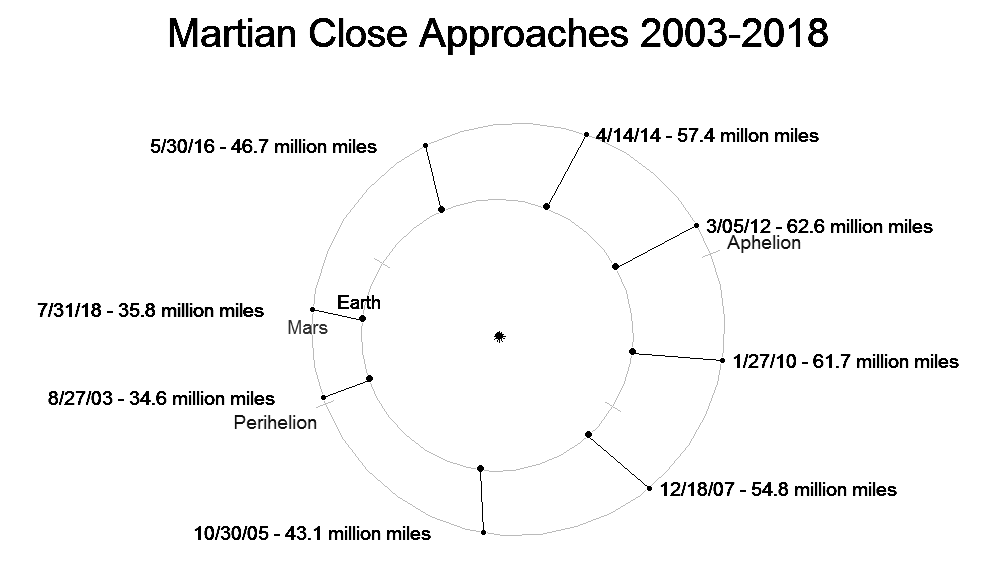
Mars closest approaches to the Earth from August 27, 2003 to July 31, 2018. Diagram created using Bob Moler’s LookingUp program.
Especially close approaches to the Earth occur every 15 or 17 years in the latter half of summer in those years. My first close approach was September 7, 1956. It was a famous one for the time. Professional astronomers of that time were pretty sure that Mars didn’t have canals, features that were ‘discovered’ by Giovanni Schiaparelli in 1877. To him the features were grooves or channels. Unfortunately the Italian word for them was canali. The world press proclaimed that there were “canals” on Mars. Canals by definition are artificial and require canal builders, Martians by inference.
Like I said, professional astronomers had discounted them by 1956. But science fiction read by young impressionable amateur astronomers like myself talked about old races of Martians hoarding every last drop of water. So maybe we believed. With my 5 inch reflector I observed the polar cap and the large dark feature Syrtis Major.
My next close approach of Mars was August 12, 1971. That summer I was working out of town and in the midst of a move from Grand Rapids to Traverse City, so was unable to observe Mars properly.
In the summer and autumn of 1973 I was able to do an observing program of Mars when it was almost as close as in 1971, drawing its features. I found out that to really observe a planet it takes time to educate the eye and brain to see faint, fuzzy detail. And since I didn’t believe in canals by this time, I didn’t see them.
The next close approach was September 22, 1988. The first “Mars Night” held by the society. We had a great turnout. But Mars was tiny as seen in telescopes. At best it was 23.81 seconds of arc in diameter. The Moon and Sun are about 1,800 seconds in diameter. It would be a bit larger than half the apparent diameter of Jupiter at average distance.
On August 27, 2003 Mars came closer than at any time in 50,000 years some astronomers said. The society held its second “Mars Night” at the Rogers Observatory, and wow, the lines of people ran down the drive and onto the shoulder of the road. As in 1988, I was stationed on the lawn at the front of the observatory with the portable Celestron 11 telescope, which actually gave clearer views than the 14 inch telescope in the dome. (Hot bodies in dome make for lousy seeing.)
2003 is also memorable or rather infamous for the “Mars Hoax” email. Proclaiming that Mars would appear as large as the Moon on August 27th. This hoax has been propagated every two years since. I expect 2018 to be a banner year for the resurrection of the hoax.
We come to this year, 2018, 15 years after the 2003 closest approach. Mars will reach opposition on July 27th. It’s closest approach to the Earth will be on July 31st, at the distance of 35,784,000 miles. The reason the dates aren’t the same is that Mars will still be a month before reaching perihelion, its closest to the Sun, so it’s getting even closer than at the time of opposition.
The Mars oppositions of October 2020, December 2022, January 2025 and February 2027 will be of increasing distances up to 63.0 million miles. This will be followed by oppositions of decreasing distances in March 2029, May 2031, and July 2033 leading to another close approach on September 11, 3035 at 35.4 million miles.
However by 2035 there may be humans on Mars waving back at us. It’s odd that anyone on Mars at the time probably wouldn’t be able to see the Earth at that time. Martian oppositions for us, are the time of inferior conjunctions of Earth with the Sun. We’d be lost in the Sun’s glare.
For the very closest views of Mars get on the Internet and search for Mars Curiosity, Mars Opportunity and Mars Hirise. No telescope required.
06/19/2018 – Ephemeris – The Mars rover Opportunity is facing its greatest challenge
Ephemeris for Tuesday, June 19th. Today the Sun will be up for 15 hours and 34 minutes, setting at 9:31, and it will rise tomorrow at 5:57. The Moon, 1 day before first quarter, will set at 2:01 tomorrow morning.
The Mars Exploration Rover-B, named Opportunity landed on the Red Planet on January 25, 2004 for a mission hoping to last 90 Martian days or sols. It has been going strong for over 5,000 sols, or nearly 14 ½ Earth years, and has driven over 28 miles. Now Oppy, as its controllers affectionately call it, is meeting it’s greatest challenge. A huge dust storm, threatening to engulf the entire planet is building up. It has cut off the sunlight that power’s Oppy’s solar panels. Day has become night. The Jet Propulsion Laboratory controllers have put Oppy in deep sleep mode, powering only its clock to wait out the storm. They are awaiting Oppy’s phone home call scheduled for 11 a.m. at its local time each sol.
The times given are for the Traverse City/Interlochen area of Michigan. They may be different for your location.
Addendum
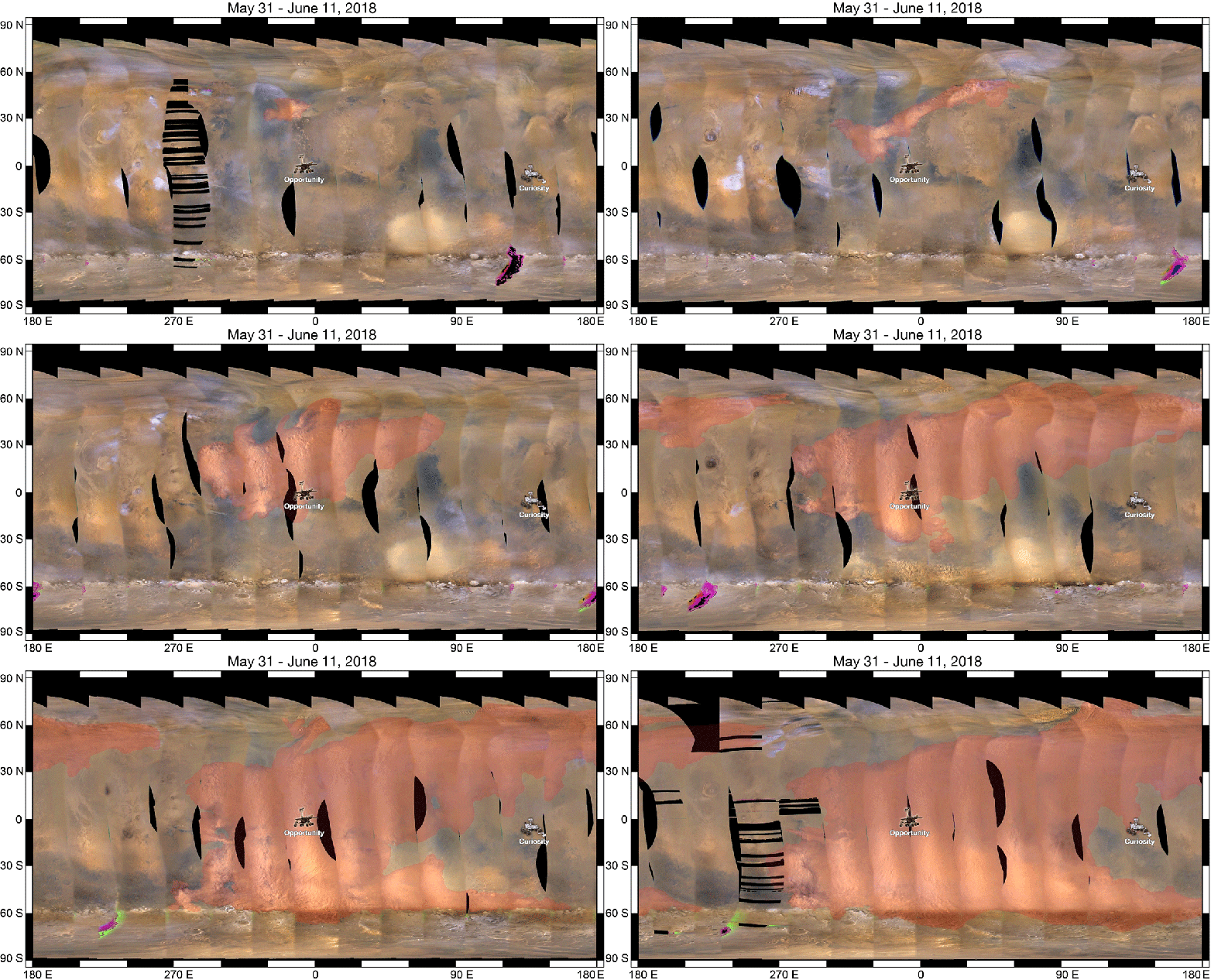
An animation of Mars global scans by the Mars Reconnaissance Orbiter over the period of May 31 to June 11, 2018. Two dust storms, one from the north, and another from the south converge and threaten to go global. Click on the image to enlarge. Credit: NASA/JPL-Caltech/MSSS.
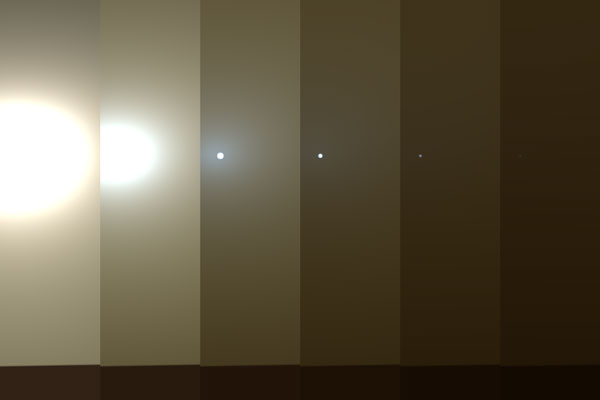
Lights out for Oppy. The Sun photographed by Opportunity over several sols. Credit NASA/JPL-Caltech.
Below, the News Conference about Opportunity and the dust storm, recorded June 13, 2018.
04/02/2018 -Ephemeris – Mars is appearing to pass Saturn in the morning
Ephemeris for Monday, April 2nd. The Sun will rise at 7:21. It’ll be up for 12 hours and 49 minutes, setting at 8:11. The Moon, 2 days past full, will rise at 10:40 this evening.
At 3:02 this afternoon the planet Mars will pass the planet Saturn. The event is called a conjunction, which simply means they are on nearly the same line of sight from the Earth, and nothing more. It will make a pretty sight tomorrow morning before the sky gets too bright with reddish Mars being just below Saturn, by a bit less than 3 moon widths. Conjunctions of these two planets occur at intervals of two years give or take, since it involves the orbital motions of Mars and Saturn while viewing them from a third planet also orbiting the Sun.
Currently both planets are moving eastward against the stars. Saturn will slow and stop its motion on April 18th, while Mars will continue until June 28th. They will track westward for a while. This is because the Earth will be passing these planets this summer, which is called opposition (from the Sun). Saturn will reach opposition on June 27th, Mars on July 27th. Mars closest approach will occur four days later at a distance of 35.76 million miles (57.59 million kilometers). This is Mars’ closest approach to the Earth since August 27th, 2003. Expect the return of the Mars hoax emails this summer.
The times given are for the Traverse City/Interlochen area of Michigan. They may be different for your location.
Addendum
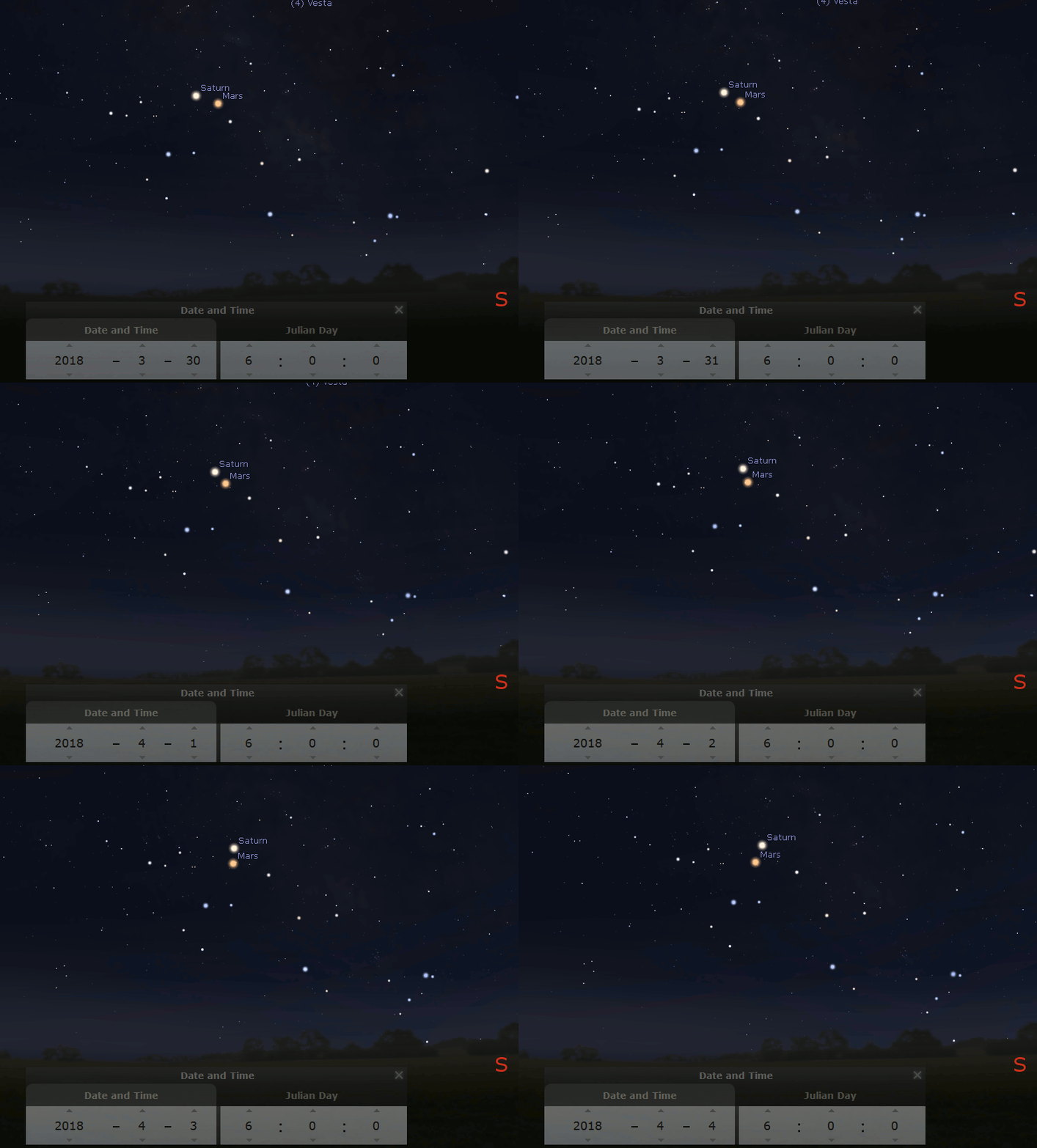
Conjunction animation of Mars passing Saturn at daily intervals at 6 a.m. for March 30 to April 4, 2018. This will occur above the Teapot asterism of the constellation of Sagittarius. Created using Stellarium and GIMP.
I covered the Mars hoax 5 years ago here on an August 27th when Mars was nowhere close to us.
 Bob Moler's Ephemeris Blog