Archive
Ephemeris: 08/19/2025 – Mercury makes its morning appearance
This is Ephemeris for Tuesday, August 19th. Today the Sun will be up for 13 hours and 51 minutes, setting at 8:41, and it will rise tomorrow at 6:51. The Moon, 3 days past last quarter, will rise at 3:25 tomorrow morning.
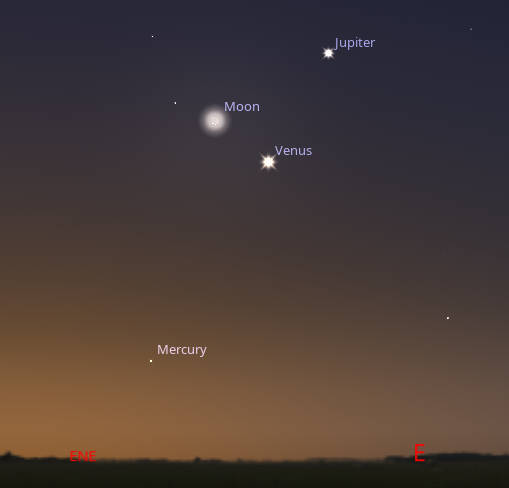
The tiny planet Mercury is making an appearance in the morning sky now. For the next week or so it will be visible around 6 AM. At least it’s time to start looking for it. Once found, it might be followed for another 20 minutes or so. This morning Mercury was at its greatest angular separation or elongation from the Sun of 18.6°. We have two periods where Mercury is easier to spot: on late winter and early spring evenings, and in the morning sky in late summer and early autumn. Of course Mercury must be at the proper elongation point at the time. Mercury is the smallest of the planets, being only 50% larger in diameter than our moon. In closeup, it looks much like our Moon, gray and cratered.
The astronomical event times given in this blog are for the Traverse City/Interlochen area of Michigan (Lat 44.7° N, Long 85.7° W; EDT, UT – 4 hours) unless stated otherwise. Times will be different for other locations.
Addendum
Ephemeris: 08/08/2025 – Mercury’s strange rotation
This is Ephemeris for Friday, August 8th. Today the Sun will be up for 14 hours and 21 minutes, setting at 8:58, and it will rise tomorrow at 6:38. The Moon, 1 day before full, will set at 6:42 tomorrow morning.
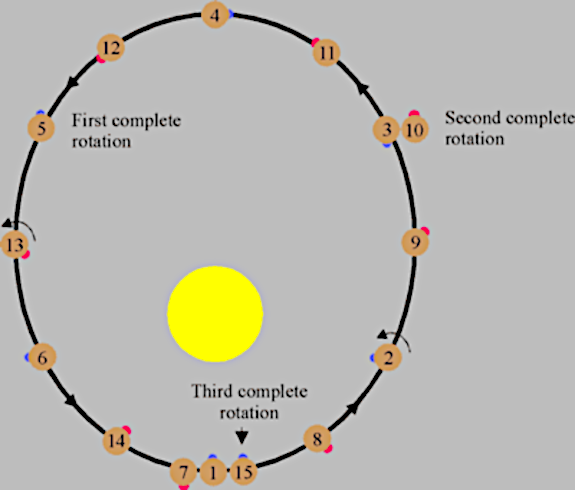
The planet Mercury is the closest planet to the Sun, and for a long time was thought to have synchronous rotation. That is it rotated in the same 88 days it took to orbit the Sun. However, in 1965 using radar from the Arecibo Observatory in Puerto Rico, astronomers learned that the rotation was exactly 2/3 of that 88 days. An interesting relationship of the sidereal rotation of 59 days against the stars, 2/3 of the Mercury’s year. Earth’s solar day, noon to noon is 3 minutes 56 seconds longer than the sidereal day. Mercury’s solar day turns out to be exactly 2 Mercurian years long.
The astronomical event times given in this blog are for the Traverse City/Interlochen area of Michigan (Lat 44.7° N, Long 85.7° W; EDT, UT – 4 hours) unless stated otherwise. Times will be different for other locations.
Addendum
06/16/2022 – Ephemeris – Mercury’s poor showing in the morning sky at greatest elongation
This is Ephemeris for Thursday, June 16th. Today the Sun will be up for 15 hours and 34 minutes, setting at 9:30, and it will rise tomorrow at 5:56. The Moon, 2 days past full, will rise at 12:17 tomorrow morning.
The planet Mercury has its greatest elongation to the west of the Sun around 11 this morning. That’s astronomer talk. It will be at its greatest angular separation west of the Sun. That angle will be 23 degrees. Being west of the Sun, it will rise before the Sun, and will be seen in the east. That makes perfect sense, but sounds weird. Not all Mercury greatest elongations are created equal, and being inhabitants of the Northern Hemisphere, we get the short end of the orbit. Mercury has the most elliptical orbit of any planet, since Pluto was kicked out of the planet club. That and Earth’s own axial tilt works against us. This is a poor elongation for us since Mercury is more to the side than above the Sun in the morning.
The astronomical event times given are for the Traverse City/Interlochen area of Michigan (EDT, UT – 4 hours). They may be different for your location.
Addendum
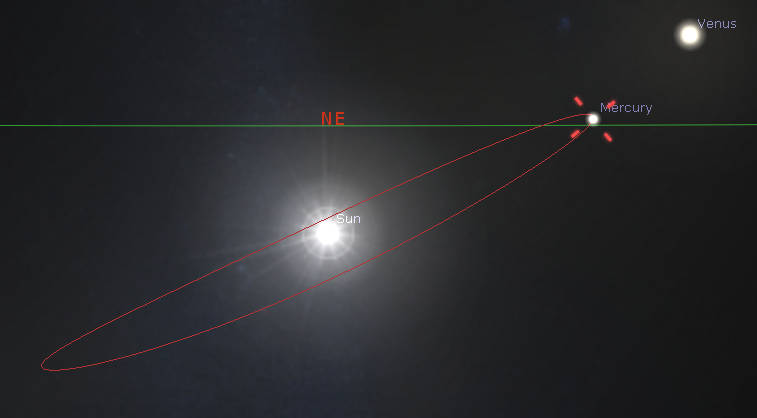
Mercury at greatest western elongation this morning, June 16, 2022. Note that Mercury is more to the right of the Sun, than above it. This is a poor elongation for us. Created using Stellarium.
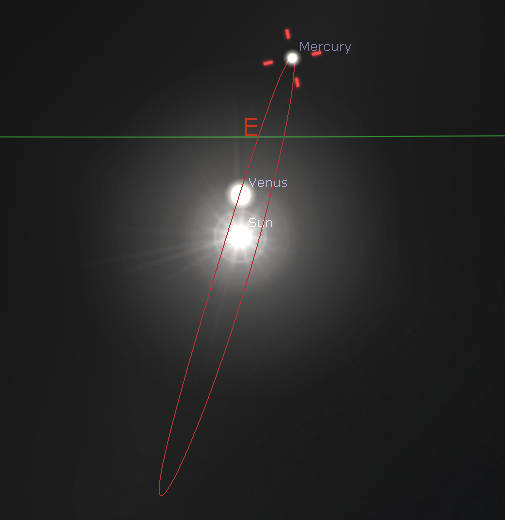
Mercury at greatest western elongation, October 8, 2022. Note that Mercury is more above the Sun, than to the right of it. This will be a good elongation for us. But also note Mercury’s orbit. Mercury is near its perihelion point, its closest to the Sun. Southern Hemisphere observer good elongations feature Mercury near its aphelion, it’s farthest from the Sun. Those southerners get a much better look at Mercury than we do. Created using Stellarium.
10/22/2021 – Ephemeris 3,001st post – Mercury is now visible in the morning before sunrise
This is Bob Moler with Ephemeris for Friday, October 22nd. Today the Sun will be up for 10 hours and 38 minutes, setting at 6:46, and it will rise tomorrow at 8:09. The Moon, 2 days past full, will rise at 7:53 this evening.
The planet Mercury is now visible on clear mornings, low in the east-southeastern sky after 7 am, and twilight gets too bright around 7:50 am. Tiny Mercury is the smallest planet, only 50% larger than our Moon. It looks a lot like our Moon, close up, all gray and covered in craters. But the resemblance is only skin deep. Before the Arecibo radio telescope could bounce radar pulses from the planet in the 1960s, we thought Mercury held one side pointed at the Sun and the other side eternally away. That wasn’t the case due to its elliptical orbit. It rotates in 59 days, two-thirds of its year of 88 days. This makes its solar day, noon to noon, last two of its years. The European BepiColombo mission to orbit Mercury just made its first pass of the planet.
Addendum
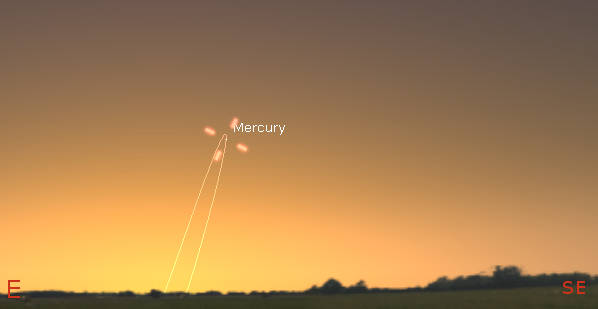
Mercury and its apparent orbit for 7:49 am tomorrow, October 23, 2021, two days before its greatest western elongation (separation from the Sun). Created using Stellarium.
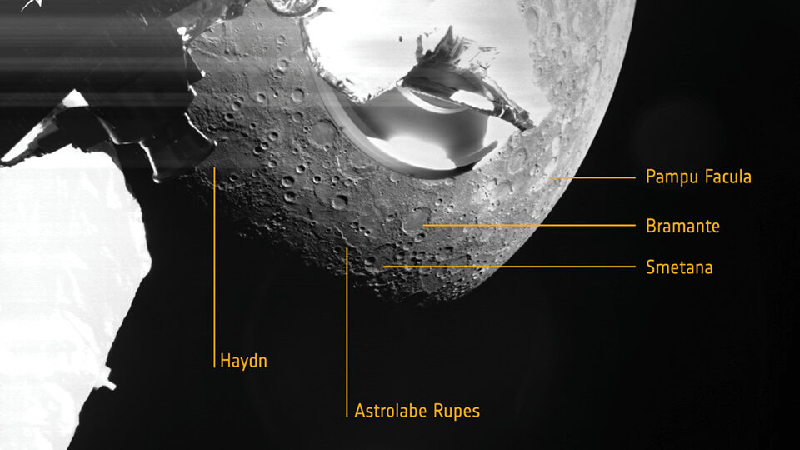
BepiColombo takes a picture of Mercury on its first of 6 flybys, October 1st, before settling into orbit of the planet on December 5, 2025. BepiColombo is actually two spacecraft connected together, and parts of the other spacecraft will get into each other’s images until they separate. Credit: ESA/JAXA.
01/22/2021 – Ephemeris – Mercury will be at it’s greatest angular distance from the Sun in the evening tomorrow
This is Ephemeris for Friday, January 22nd. Today the Sun will be up for 9 hours and 26 minutes, setting at 5:37, and it will rise tomorrow at 8:10. The Moon, 2 days past first quarter, will set at 3:43 tomorrow morning.
The planet Mercury, tomorrow night, will reach its greatest elongation or separation east of the Sun. It will be visible low in the southwestern sky around and for a half hour or so after 6 pm. Mercury, being the closest planet to the Sun, never strays far from it. Here in the Northern Hemisphere never see it outside of twilight. It’s apparent angular separation from the Sun will be 18.6 degrees. We will have a somewhat better view of an evening appearance of Mercury in May when Venus will again be in our evening sky and near Mercury. Mercury takes 88 days on to orbit the Sun. However, we are viewing it from another moving planet. So it takes about 116 days for Mercury to appear to orbit the Sun from our vantage point.
The event times given are for the Traverse City/Interlochen area of Michigan. They may be different for your location.
Addendum
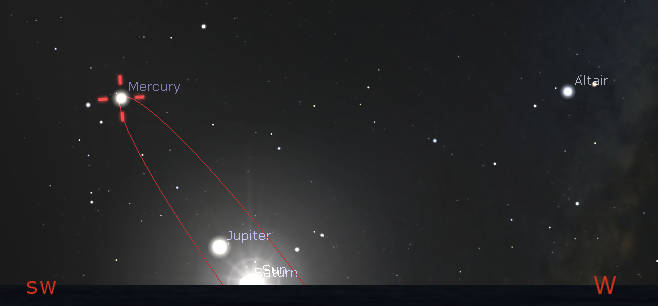
Mercury at greatest elongation at sunset January 23, 2021. It also shows Mercury’s orbit that evening plus Jupiter. Saturn is actually behind the Sun that evening as can be seen by the over display of the labels for Saturn and the Sun. Created using Stellarium by removing Earth’s atmosphere.
11/10/2020 – Ephemeris – Mercury will reach it greatest separation from the Sun in the morning today
This is Bob Moler with Ephemeris for Tuesday, November 10th. Today the Sun will be up for 9 hours and 45 minutes, setting at 5:19, and it will rise tomorrow at 7:35. The Moon, 2 days past last quarter, will rise at 2:42 tomorrow morning.
Mercury will reach its greatest western elongation from the Sun near noon today (17:00 UT). That means it was visible this morning before sunrise in the east. And will be visible again tomorrow morning. The next Mercury greatest elongation will be January 24th, next year. It will be a greatest eastern elongation, which will be visible in the western sky in the evening after sunset. So western elongations are seen in the east and eastern elongations are seen in the west. The “from the Sun” is usually omitted in astronomical lists of events, but implied. Sounds a bit confusing, but it makes weird sense. Mercury’s morning appearance will last about a week before it get too low to easily spot, below and left of Venus.
The event times given are for the Traverse City/Interlochen area of Michigan. They may be different for your location.
Addendum
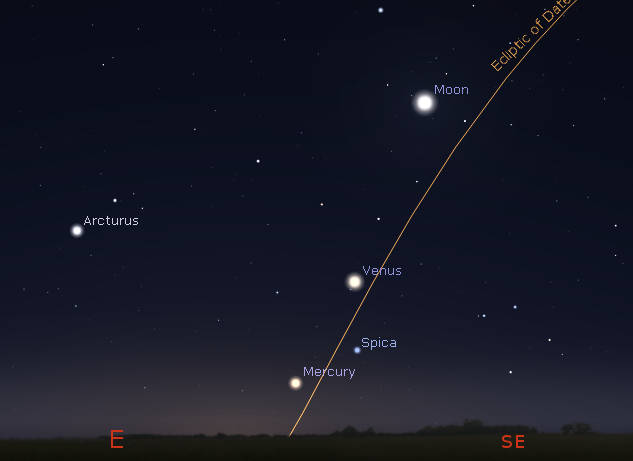
Mercury, Venus, Moon tomorrow morning November 11, 2020 at 6:30 am. The orange line is the ecliptic, the plane of the Earth’s orbit. It is the path of the Sun in the sky, The Moon and planets also stick close to that line. The Moon is a crescent, though that can’t be seen at this scale. Over the next week Venus and Mercury will slide downward along the ecliptic in relation to the stars, as will the Moon at greater speed. Created using Stellarium.
11/09/2020 – Ephemeris – Tiny Mercury makes an appearance in the morning sky
This is Ephemeris for Monday, November 9th. Today the Sun will be up for 9 hours and 48 minutes, setting at 5:20, and it will rise tomorrow at 7:33. The Moon, 1 day past last quarter, will rise at 1:26 tomorrow morning.
The tiny planet Mercury is now visible in the morning twilight. It will reach its greatest separation from the Sun in the morning sky. Astronomers call it “greatest western elongation”. It’s west of the Sun, but we’ll see it in the eastern sky as it rises at 5:49 am in the east-southeast. That’s an hour and 44 minutes before the Sun. By 6:15 or 6:30 am, it should be high enough to spot. That is if it’s clear, an iffy prospect this time of year. It will start to move back to the Sun and actually brighten retaining its best visibility for the next 7 days or so. Mercury has a very elliptical orbit of the Sun. During our two good seasons to view the planet, spring evenings and autumn mornings Mercury is closest to the Sun. Mercury is best seen in the southern hemisphere when its autumn morning appearances and spring evening appearances are seen when Mercury is farthest from the Sun.
The event times given are for the Traverse City/Interlochen area of Michigan. They may be different for your location.
Addendum
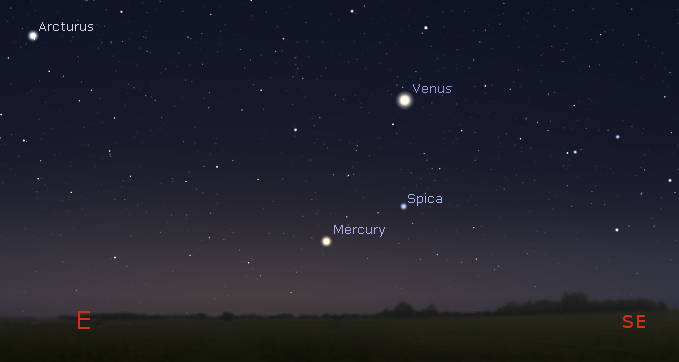
Mercury and Venus in the morning at 6:30 am. Created using Stellarium.
02/25/2020 – Ephemeris – Mercury at inferior conjunction with the Sun today
Ephemeris for Fat Tuesday, February 25th. Today the Sun will be up for 10 hours and 56 minutes, setting at 6:24, and it will rise tomorrow at 7:26. The Moon, 2 days past new, will set at 8:27 this evening.
A bit more than two weeks ago Mercury was visible in the evening twilight at its greatest elongation from the Sun, then at 8:37 this evening it will pass between the Earth and the Sun and enter the morning sky. The event is called an inferior conjunction. That’s not a dig on the quality of the event. Indeed an inferior conjunctions are more important and can produce a transit of the planet across the Sun. A rare and formerly important event when we were trying to determine the distance to the Sun. In astronomy an inferior planet is one that orbits the Sun inside the Earth’s orbit. A superior planet orbits the Sun farther than the Earth. It’s not a sign of quality. The best time to spot Mercury in the morning is in August to October, so we’ll miss Mercury this time.
The times given are for the Traverse City/Interlochen area of Michigan. They may be different for your location.
Addendum
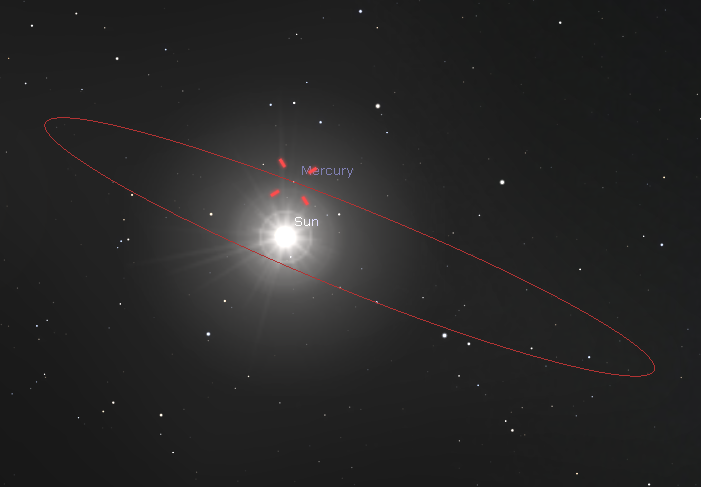
Mercury about 7 hours before inferior conjunction February 25, 2020 near local solar noon. The last inferior conjunction of Mercury on November 11, 2019 Mercury passed across the Sun’s disk in a transit. The red ellipse is Mercury’s orbit as seen From the Earth. It’s orbit is tilted about 7 degrees from the Earth’s orbit, so transits are fairly rare events. Created using Stellarium.
11/28/2019 – Ephemeris – This is the best time to spot Mercury in the morning
Ephemeris for Thanksgiving Day, Thursday, November 28th. Today the Sun will be up for 9 hours and 8 minutes, setting at 5:05, and it will rise tomorrow at 7:57. The Moon, 2 days past new, will set at 6:59 this evening.
The planet Mercury is at its greatest western elongation from the Sun this morning. Being west of the Sun it rises first. It being a planet inside the Earth’s orbit it appears to swing from the east side to the west side of the Sun, from the evening to the morning side of the Sun. It never appears outside of twilight around here. For the next week it will be going away from us, and becoming more illuminated by the Sun from our perspective, and actually is getting brighter. Then it will seem to fall back, actually moving around and behind the Sun. This evening the thin sliver of the Moon will appear near brilliant Venus. The best time to look is around an hour after sunset, which is about 6 p.m. Venus will set at 6:43 p.m.
The times given are for the Traverse City/Interlochen area of Michigan. They may be different for your location.
Addendum
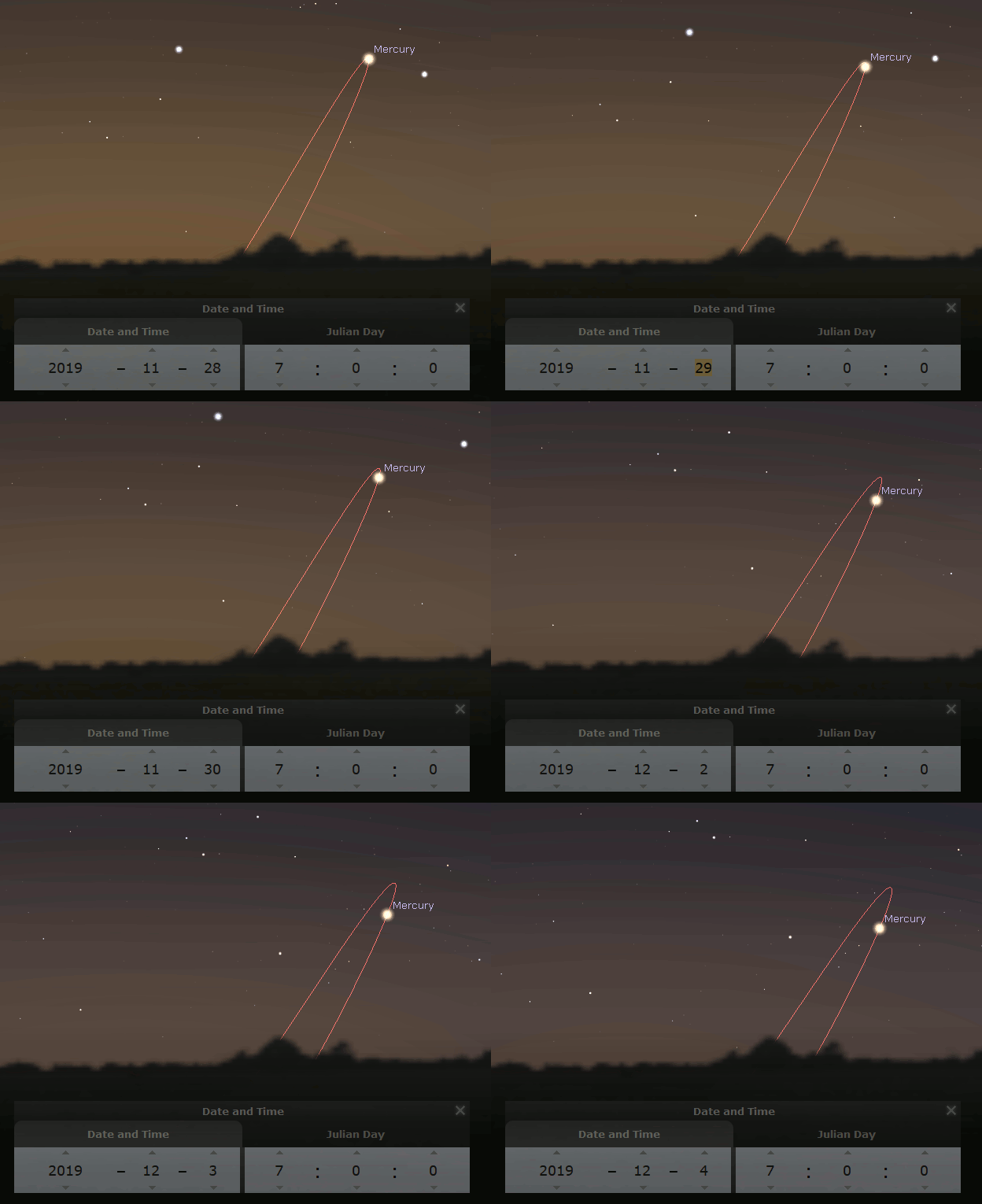
Mercury in the morning, about an hour before sunrise (7 a.m. here) for the next week. The aspect of its orbit changes for two reasons, sunrise time is advancing a bit, and the Earth is changing its position with respect to Mercury and its orbit, and Mercury too is moving. Create using Stellarium and GIMP.
06-18-2019 – Ephemeris – Mercury and Mars will be seen together tonight
Ephemeris for Tuesday, June 18th. Today the Sun will be up for 15 hours and 34 minutes, setting at 9:31, and it will rise tomorrow at 5:56. The Moon, 1 day past full, will rise at 10:49 this evening.
This evening the Planets Mercury and Mars will appear less than a moon-width apart in the evening twilight. Mercury, the brighter of the two, by a factor of 4 times, will be visible first, at about 10:15 p.m. very low in the west-northwest. Mars will be immediately below it by less than the width of the Moon. At that time they will be a bit less than the width of your fist held at arm’s length above the horizon. Binoculars are the best way to spot them. Mercury will continue to move eastward in the sky away from Mars. Until after it reaches its greatest separation from the Sun on the 23rd. It will then head back and pass at a much greater distance below Mars on July 5th. This is the best chance to spot Mercury in the evening sky this year.
The times given are for the Traverse City/Interlochen area of Michigan. They may be different for your location.
Addendum
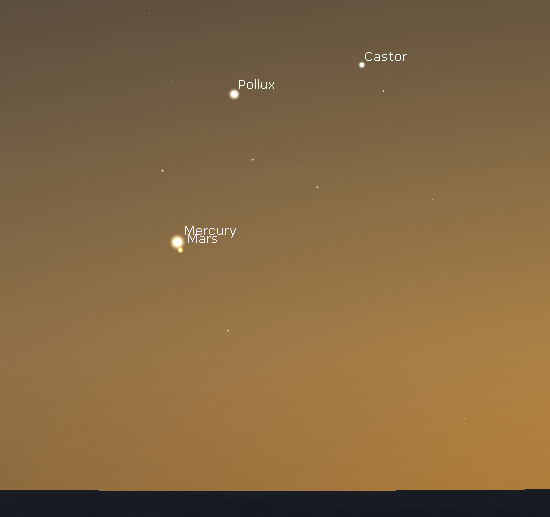
Mercury and Mars this evening at 10:30 p.m., June 18, 2019. Created using Stellarium.
 Bob Moler's Ephemeris Blog