Archive
10/25/2018 – Ephemeris – Europe and Japan launch a joint mission to Mercury
Ephemeris for Thursday, October 25th. The Sun will rise at 8:11. It’ll be up for 10 hours and 30 minutes, setting at 6:41. The Moon, 1 day past full, will rise at 7:44 this evening.
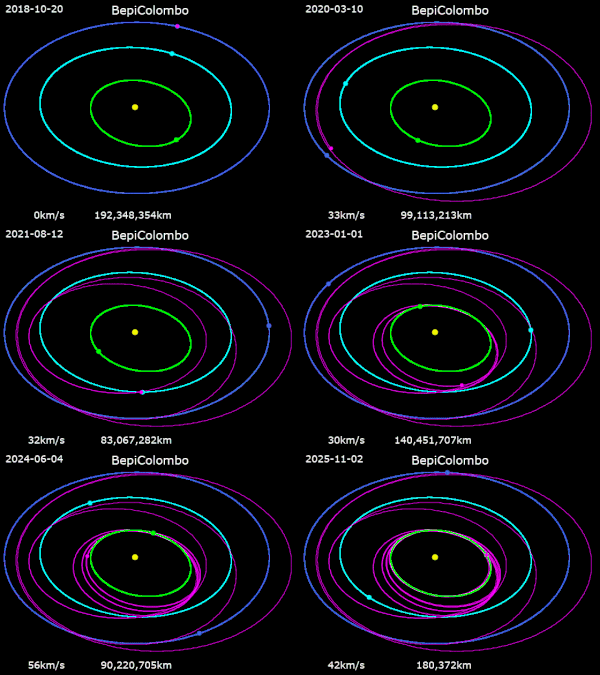
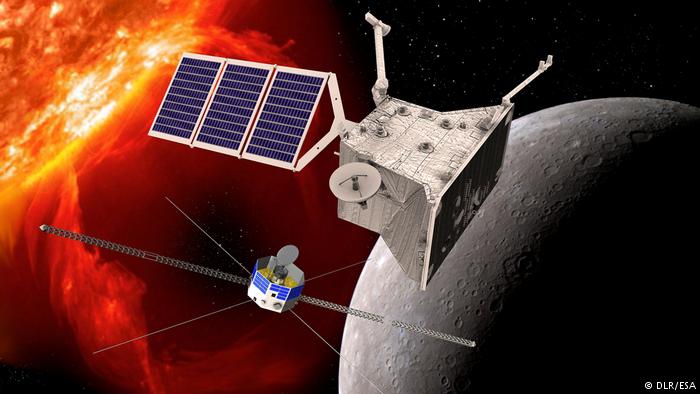
A joint mission to Mercury by the Europeans and the Japanese called BepiColumbo was launched late Friday night October 19th our time (EDT), 20th (UT). It will take 7 years to be able to drop into orbit of the innermost planet to make only the second spacecraft to do so. To drop into Mercury’s orbit from the Earth’s orbit the spacecraft will need to lose a whole lot of velocity. The trip there will entail one flyby of the Earth, two of Venus, and six of Mercury itself. Planetary flybys have been used since the 1970s to use a planet’s velocity to add to or subtract from a spacecraft’s velocity, depending on how it approaches the planet. If crossing in front of a planet some velocity is subtracted from the spacecraft, allowing it to drop closer to the Sun. If coming up from behind the spacecraft gets to add to its velocity relative to the Sun.
The times given are for the Traverse City/Interlochen area of Michigan. They may be different for your location.
Addendum
08/23/2018 – Ephemeris – Mercury’s morning appearance
Ephemeris for Thursday, August 23rd. The Sun rises at 6:54. It’ll be up for 13 hours and 40 minutes, setting at 8:35. The Moon, 3 days before full, will set at 4:56 tomorrow morning. | The tiny and elusive planet Mercury is making an appearance in the morning sky now. On Sunday afternoon our time Mercury will at its greatest elongation or separation west of the Sun. So Sunday or Monday mornings are the very best time to spot it. Look to the east-northeast at a low horizon to spot it. It should be visible from about 6 a.m. to about 6:40 a.m. before twilight swamps it. There are no stars of comparable brightness near it. It’s seen against the dim stars of Cancer the crab. The bright stars Pollux and Castor of Gemini will appear a ways above it. It should be visible from now through next week. Today is the day of the mini-Moon, its smallest of the month at 252 thousand miles (406 thousand km) away.
The times given are for the Traverse City/Interlochen area of Michigan. They may be different for your location.
Addendum
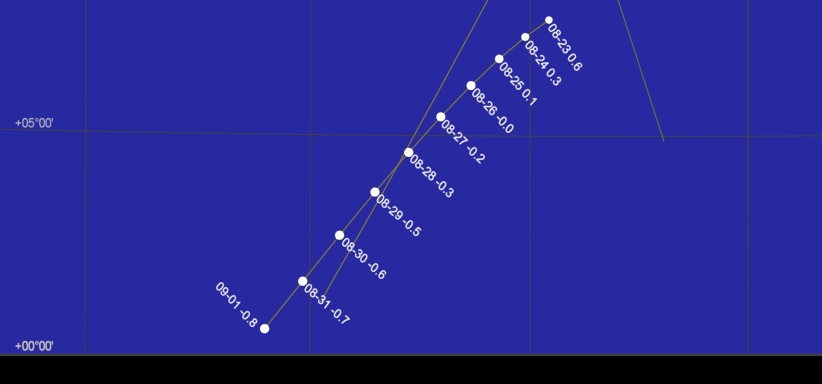
The motion of Mercury from August 23 to September 1, 2018. For each day the magnitude of Mercury is given. Note that gets brighter over the period. That is the magnitudes get more negative. The is due to Mercury’s increasing phase, getting fuller as it moves around the Sun. Created using Cartes du Ciel (Sky Charts).
03/28/2017 – Ephemeris – Mercury is visible in the evening sky now
Ephemeris for Tuesday, March 28th. The Sun will rise at 7:30. It’ll be up for 12 hours and 35 minutes, setting at 8:05. The Moon, 1 day past new, will set at 8:56 this evening.
Mercury is in the evening sky now for it’s spring appearance. Mercury is best seen when it’s near its farthest from the Sun on spring evenings and autumn mornings. Mercury will reach its greatest elongation east of the Sun this coming Saturday with a 19 degree angle of separation from the Sun. This tiny planet is brighter before eastern elongating than after it. I find that the optimal time to look for Mercury is about 45 minutes after sunset. That makes it about 8:50 p.m. At that time Mercury will be low in the west only 9 degrees above the horizon. That’s a bit less than the width of a fist held at arm’s length above the lake or sea horizon, or the base of distant trees that are on your level. Mercury will be visible for about a week or so.
Times are for the Traverse City/Interlochen area of Michigan. They may be different for your location.
Addendum
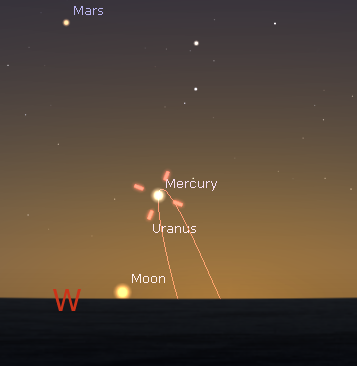
Mercury near the western horizon at 8:50 p.m. or 45 minutes after sunset. Also shown is its orbit as it appears tonight. The Moon and Uranus are not actually visible in the twilight glare. Mars will be visible a bit later. The Moon will appear between Mercury and Mars tomorrow night. Created using Stellarium.
09/12/2016 – Ephemeris – Mercury passes inferior conjunction with the Sun today
Ephemeris for Monday, September 12th. The Sun will rise at 7:18. It’ll be up for 12 hours and 39 minutes, setting at 7:58. The Moon, 3 days past first quarter, will set at 3:34 tomorrow morning.
Today the Planet Mercury will pass inferior conjunction, that is move between the Earth and the Sun. Unlike last inferior conjunction, when it passed directly in front of the Sun on May 9th. This time it will pass below the Sun. The term inferior means it is between the Earth and the Sun. A superior conjunction is when Mercury passes the back side of the Sun. Mercury will be moving into the morning side of the sky, and toward the end of the month it will be much easier to spot than it was last month when it was low in the west. On autumn mornings the ecliptic, the path of the Sun and planets, sticks up, close to vertical, while in the evenings it lies close to the horizon, which is also why Venus sets so soon after the Sun now.
Times are for the Traverse City/Interlochen area of Michigan. They may be different for your location.
Addendum
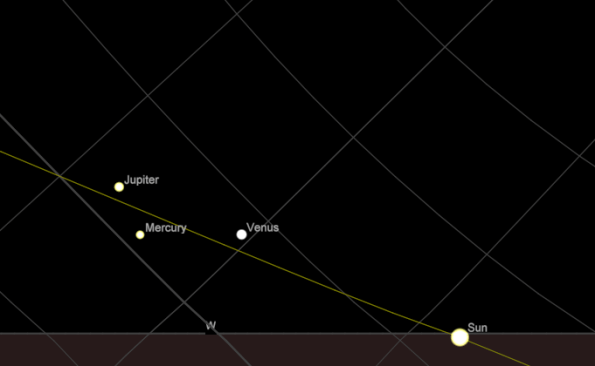
Mercury last August 16 at greatest eastern elongation. Note how low Mercury is to the horizon at sunset. Created using Cartes du Ciel (Sky Charts).
Note in the charts above and below the line passing through the Sun, and the one the planets hang around is the ecliptic, the projection of the Earth’s orbit on the celestial sphere. The grid line running through the west compass point at the horizon is the celestial equator. I’m allowing us to see below the horizon. As planets rise, move across the sky and set they will appear to move parallel to the celestial equator.
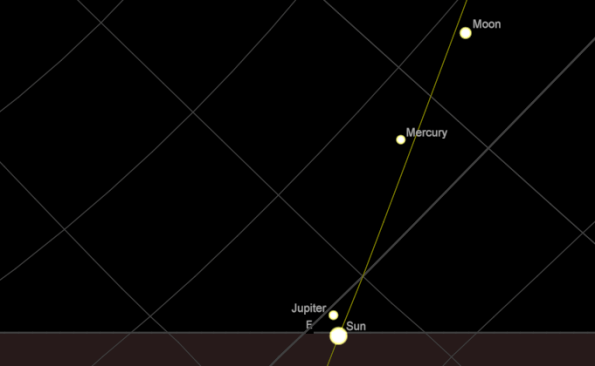
Mercury this coming September 28 at greatest western elongation. Note how high Mercury is to the horizon at sunrise. Created using Cartes du Ciel (Sky Charts).
Note too that Mercury appears farther from the Sun on August 16th than at September 28th. And it is. On August 16th Mercury appears 27.4 degrees from the Sun. On September 28th, it’s only 17.8 degrees. That’s a big advantage for observers in the southern hemisphere. The best times to see an eastern elongation of Mercury is on winter and spring evenings, and the best times to see a western elongation of Mercury is on summer and autumn mornings. Since the seasons are reversed from the northern hemisphere to the southern hemisphere. Our not so good August 16th elongation of Mercury was a really good one for folks south of the equator. We’ll return the favor September 28th. But the best southern hemisphere greatest elongations are always greater in the separation of Mercury from the Sun than northern ones because Mercury has a markedly elliptical orbit.
Some views of the festivities at the Sleeping Bear Dunes National Lakeshore Dune Climb for the transit of Mercury earlier today
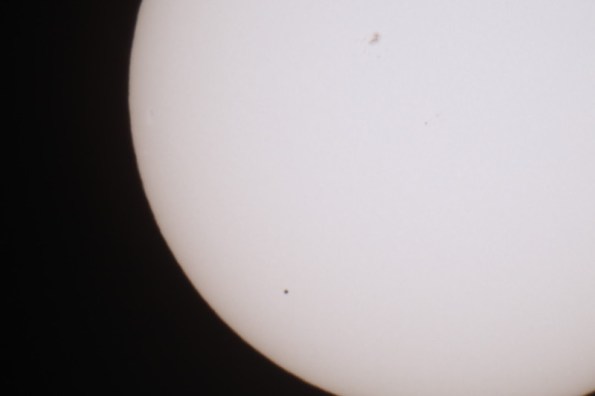
Mercury and some sunspots at 8:30 a.m. through my telescope. Thought I’d take a shot before we had visitors. C8 Cassigrainian focus, ISO 100, 1/100 second.
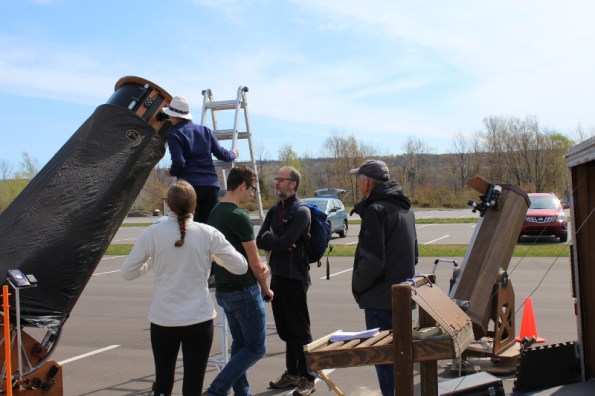
Checking the transit via the “Dobinator” through the Grand Traverse Astronomical Society’s (GTAS) 25 inch Dobsonian stopped down with an 8″ solar filter.
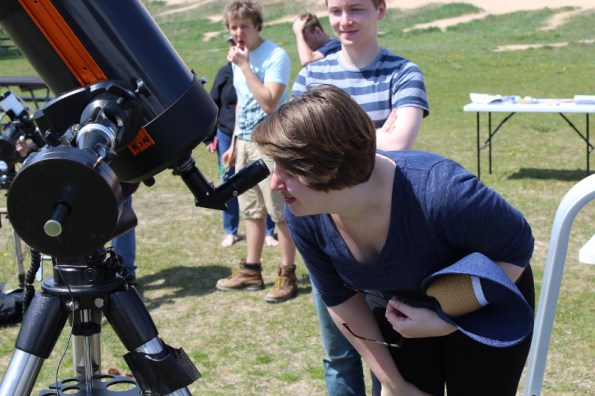
Viewing the transit through my Celestron C8.

Kids viewing the transit through the society’s Lunt hydrogen alpha solar telescope.

Youngster viewing the transit through Emmett Holmes’ 13″ homemade Dobsonian telescope and Poncet tracking mount.
Credit: Bob Moler
05/09/2016 – Ephemeris – The transit of Mercury is today!
Ephemeris for Monday, May 9th. The Sun rises at 6:21. It’ll be up for 14 hours and 36 minutes, setting at 8:58. The Moon, 3 days past new, will set at 12:12 tomorrow morning.
In less than an hour from now the planet Mercury will begin to cross the face of the Sun. It starts at 7:12 a.m. The transit will end at 2:42 this afternoon. Mercury is a tiny planet making a tiny dot against the face of the Sun, and smaller than any sunspot. If it’s clear or when its clear come out and view part of the transit. The Northwestern Michigan College’s Rogers Observatory will be open for that period. Also telescopes with be stationed at the Dune Climb at the Sleeping Bear Dunes National Lakeshore by yours truly to view the transit. The event is not visible to the naked eye and dangerous to even attempt. If you miss this transit, there will be another in 2019, 3 ½ years from now. After that, a Mercury transit visible from here will have to wait until 2049.
Times are for the Traverse City/Interlochen area of Michigan. They may be different for your location.
Addendum
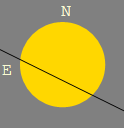
The track of Mercury across the face of the Sun. Mercury will travel from upper left to lower right. Mercury will not be visible until it impinges upon the disk of the Sun. Credit IOTA’s program Occult4.
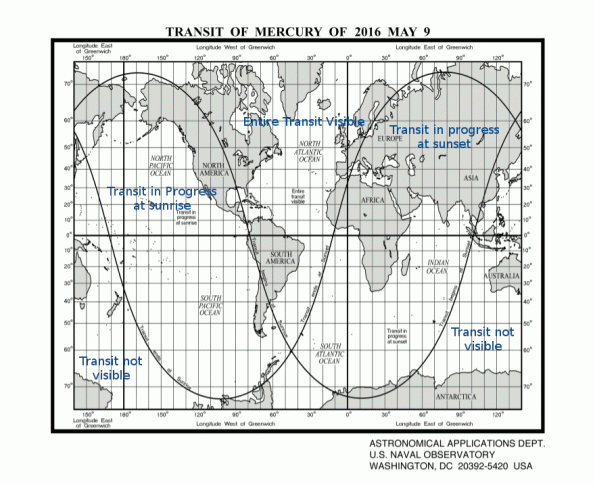
Transit visibility map with added captions to make it more readable. Credit United States Naval Observatory, The Astronomical Almanac Online.
For more information see my prior day’s posts.
Ephemeris Extra – Transit of Mercury
Transit of Mercury – May 9, 2016*
Monday, May 9th the planet Mercury will cross in front the Sun in an event called a transit. Transits of Mercury are not as rare as those of Venus. No one alive who saw that last transit of Venus, will see the next in 2117. The last transit of Mercury was in 2006, and the next will be in 2019, though it’s a long jump to the transit after that in 2032.
Occult4’s geocentric ingress time is 7:12 a.m. (11:12 UT) at position angle 83.1° Farthest penetration onto the Sun’s face is 10:57 a.m. (14:57 UT) Egress time is 2:42 p.m. (18:42 UT) at position angle 224.4°. Position angle is measured from the North point on the Sun counterclockwise.
The track of Mercury across the face of the Sun. Mercury will travel from upper left to lower right. Mercury will not be visible until it impinges upon the disk of the Sun. Credit IOTA’s program Occult4.
Looking at the Sun normally from northern Michigan, Mercury’s ingress point is close to the 8 o’clock point on its edge, since the Sun will rise tilted to the left nearly 45°. Mercury is tiny, 6.8 seconds of arc in diameter, and will be very hard to spot, smaller than most sunspots. Venus was nearly 58 seconds of arc in diameter when it transited the Sun in 2012.
Since Mercury is invisible before the transit starts. Checking out the Sun in the telescope and moving it in right ascension and declination or altitude and azimuth and altitude so the ingress point can be determined. Newtonian telescopes give an upside down image, actually rotated 180°. Refractors and Schmidt or Maksutov telescopes generally give a mirror reversed image due to the diagonal mirror that the eyepiece is placed into. The image is right side up or upside down depending on the rotation of the diagonal.
The use of a Hydrogen Alpha solar telescope allows an early peek at the transit. These telescopes look at the Sun’s chromosphere, a layer of gas 6,000 miles thick directly above the photosphere. Since the chromosphere is twice as thick as the diameter of Mercury. This should give you a few minutes heads up before white light telescopes can spot the start of the transit. I noticed the effect with the transit of Venus in 2012.
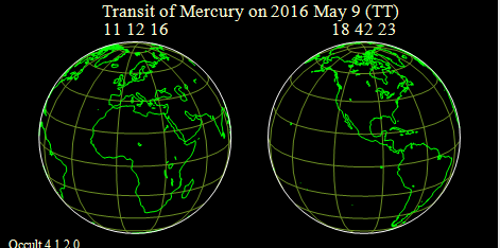
Parts of the Earth facing the Sun at the start of the transit (Left) and the end of the transit (Right). At the start of the transit Michigan is near the limb of the Earth at the upper left. The transit starts about 51 minutes after sunrise in norther Michigan. From Occult 4.
The only way to view the transit in white light is with a telescope with a front mounted solar filter. Using an eyepiece to project an unfiltered telescope image with an eyepiece may work, but Mercury is very small and projecting the Sun’s image in the ambient light doesn’t give a contrasty image.
To help everyone out the Grand Traverse Astronomical Society will have telescopes in two locations: The NMC Rogers Observatory and the Dune Climb at the Sleeping Bear Dunes National Lakeshore. Since the transit lasts 6 ½ hours the usual cancellation rules won’t be in effect. If it’s cloudy at the start, it could clear up later on. I’ll be stationed at the Dunes and will be there for the duration, so if we have an all day rain I’ll still be out there, hoping it’ll clear up. Check bobmoler.wordpress.com for the latest on viewing conditions there.
* Based on my article in the May 2016 edition of the Stellar Sentinel, the monthly publication of the Grand Traverse Astronomical Society.
05/06/2016 – Ephemeris – Learn about Monday’s transit of Mercury tonight
Ephemeris for Friday, May 6th. The Sun rises at 6:25. It’ll be up for 14 hours and 29 minutes, setting at 8:54. The Moon is new today, and won’t be visible.
Learn more about next Monday’s transit of Mercury across the Sun at tonight’s meeting of the Grand Traverse Astronomical Society at 8 p.m. at the Northwestern Michigan College’s Rogers Observatory, on Birmley Road, South of Traverse City. Afterward at 9 p.m., there will be another program and weather permitting there will be viewing of Jupiter, and later Mars. On Monday the Society will host transit viewing at two locations. The transit runs 6 ½ hours from 7:12 a.m. to 2:42 p.m. The Rogers Observatory will be open for that period. Also telescopes with be stationed at the Dune Climb at the Sleeping Bear Dunes National Lakeshore by yours truly to view the transit. The event is not visible to the naked eye and dangerous to even attempt it.
The program will also preview the coming opposition of Mars and closest approach since 2003 on the 30th.
Times are for the Traverse City/Interlochen area of Michigan. They may be different for your location.
Addendum
I posted these yesterday, but here they are again:
Transit visibility map with added captions to make it more readable. Credit United States Naval Observatory, The Astronomical Almanac Online.
The track of Mercury across the face of the Sun. Mercury will travel from upper left to lower right. Mercury will not be visible until it impinges upon the disk of the Sun. Credit IOTA’s program Occult4.
From IOTA’s Occult4 program
Transit of Mercury on 2016 May 9 (TT)
   {'+' => next day; '-' => previous day }
                                           Overhead at
     Geocentric Event      UTC         P.A.  Long  Lat
                         h  m  s       o      o    o
[1]  Exterior Ingress   11 12 16     83.1     11   17
[2]  Minimum Separation 14 57 38             -45   18
[3]  Exterior Egress    18 42 23    224.4   -102   18

Minimum sepn 318.5";  Radii - Sun 950.4", Mercury 6.0"
delta T =  68.2 secs,  Ephemeris = DE0
Note: These timings are geocentric. Occult4 has timings for various cities of the world. Occult4.0.2 can be downloaded here. They can vary by several minutes for different cities due to parallax.
I will post more information on the transit in an Ephemeris Extra tomorrow.
05/05/2016 – Ephemeris – Previewing Monday’s transit of Mercury
Ephemeris for Thursday, May 5th. The Sun rises at 6:26. It’ll be up for 14 hours and 26 minutes, setting at 8:53. The Moon, 1 day before new, will rise at 6:38 tomorrow morning.
Next Monday, the 9th, the tiny planet Mercury will be seen to cross that face of the Sun. Astronomers call such an event a transit. The last time a planet crossed the face of it Sun, it was Venus on June 5th, 2012, almost 4 years ago. Very few, who were alive in 2012 will be around to see the next transit of Venus in 2117. Transits of Mercury are more frequent. Mercury will cross the face of the Sun from 7:12 a.m. to 2:42 p.m. on Monday. Mercury is too small to see with eclipse filters or with the naked eye. The latter could cause blindness. Only telescopes with solar filters that fit over the front of the telescope are safe to use. Mercury will be a tiny black dot, smaller than most sunspots. Tomorrow I’ll have information about where to go to see it.
Times are for the Traverse City/Interlochen area of Michigan. They may be different for your location.
Addendum
Transit visibility map with added captions to make it more readable. Credit United States Naval Observatory, The Astronomical Almanac Online! 2016
The track of Mercury across the face of the Sun. Mercury will travel from upper left to lower right. Mercury will not be visible until it impinges upon the disk of the Sun. Credit IOTA’s program Occult4.
From IOTA’s Occult4 program
Transit of Mercury on 2016 May 9 (TT)
   {'+' => next day; '-' => previous day }
                                           Overhead at
     Geocentric Event      UTC         P.A.  Long  Lat
                         h  m  s       o      o    o

[1]  Exterior Ingress   11 12 16     83.1     11   17
[2]  Minimum Separation 14 57 38             -45   18
[3]  Exterior Egress    18 42 23    224.4   -102   18

Minimum sepn 318.5";  Radii - Sun 950.4", Mercury 6.0"
delta T =  68.2 secs,  Ephemeris = DE0
Note: These timings are geocentric. Occult4 has timings for various cities of the world. Occult4.0.2 can be downloaded here. They can vary by several minutes for different cities due to parallax.
04/29/2016 – Ephemeris – Let’s preview the merry skies of May
Ephemeris for Arbor Day, Friday, April 29th. The Sun rises at 6:34. It’ll be up for 14 hours and 10 minutes, setting at 8:45. The Moon, at last quarter today, will rise at 3:01 tomorrow morning.
Sunday starts the month when the promise of spring is finally fulfilled. Daylight hours in the Interlochen/Traverse City area will increase from 14 hours and 16 minutes Sunday to 15 hours 20 minutes on the 31st. The altitude, or angle, of the Sun above the southern horizon at local noon will ascend from 60 degrees Sunday to 67 degrees at month’s end. The altitude of the sun in the Straits area will be a degree lower than that but your daylight will be a few minutes longer. The big event of May will be the transit of the tiny planet Mercury across the face of the Sun on May 9th. I’ll have more on that next week. Also Mars will be in opposition from the Sun on the 22nd which due to its elliptical orbit will actually be closest to us 8 days later on the 30th at 46.779 million miles (75.284 million km).
Times are for the Traverse City/Interlochen area of Michigan. They may be different for your location.
Addendum
May Star Chart
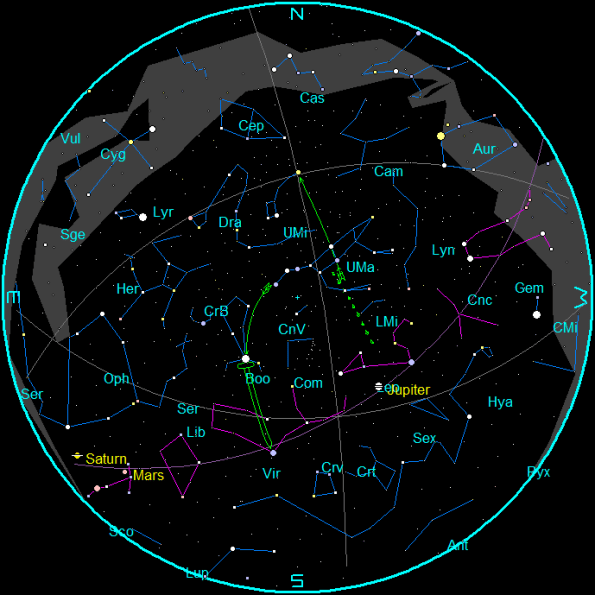
Star Chart for May 2016. Created using my LookingUp program. To enlarge in Firefox Right-click on image then click View Image.
The planets and stars are plotted for the 15th at 11 p.m. EDT. That is chart time. Note, Traverse City is located approximately 45 minutes behind our time meridian. (An hour 45 minutes behind our daylight saving time meridian.) To duplicate the star positions on a planisphere you may have to set it to 1:45 earlier than the current time.
Evening nautical twilight ends at 10:00 p.m. EDT on the 1st, increasing to 10:43 p.m. EDT on the 31st.
Morning nautical twilight starts at 5:20 a.m. EDT on the 1st, and decreasing to 4:38 a.m. EDT on the 31st.
Add a half hour to the chart time every week before the 15th and subtract a half hour for every week after the 15th. Before the 13th also subtract an hour for Standard Time.
For a list of constellation names to go with the abbreviations click here.
- Pointer stars at the front of the bowl of the Big Dipper point to Polaris the North Star
- A leaky Big Dipper drips on Leo
- Follow the arc of the handle of the Big Dipper to the star Arcturus
- Extend the ac to a spike to point to Spica
Calendar of Planetary Events
Credit: Sky Events Calendar by Fred Espenak and Sumit Dutta (NASA’s GSFC)
To generate your own calendar go to http://eclipse.gsfc.nasa.gov/SKYCAL/SKYCAL.html
Times are Eastern Time. Some additions made to aid clarity.
    Date   Time      Event
May 01 Su            Venus: 9.8° W
    02 Mo  9:27 p.m. Moon Descending Node
    04 We  2:45 p.m. Eta Aquarid Shower: ZHR = 60
    06 Fr 12:14 a.m. Moon Perigee: 357800 km
    06 Fr  3:30 p.m. New Moon
    08 Su  4:21 a.m. Moon-Aldebaran: 0.5° S
    09 Mo  7:12 a.m. Mercury transit begins
    09 Mo 10:57 a.m. Mercury mid-transit
    09 Mo  2:42 p.m. Mercury transit ends
    09 Mo  5:54 p.m. Moon North Dec.: 18.4° N
    13 Fr  1:02 p.m. First Quarter
    14 Sa  3:06 a.m. Moon-Regulus: 2.5° N
    15 Su  5:30 a.m. Moon-Jupiter: 2.2° N
    15 Su  4:39 p.m. Moon Ascending Node
    18 We  6:06 p.m. Moon Apogee: 405900 km
    21 Sa  5:15 p.m. Full Moon
    22 Su  7:15 a.m. Mars Opposition
    22 Su  5:59 a.m. Moon-Saturn: 3.5° S
    24 Tu  7:16 a.m. Moon South Dec.: 18.5° S
    29 Su  8:12 a.m. Last Quarter
    30 Mo 12:45 a.m. Moon Descending Node
    30 Mo  5:36 p.m. Mars closest to the Earth 0.50321 AU
Jun 01 We            Venus: 1.5° W
Transit of Mercury
May 9, 2016 7:12 a.m. (11:21 UT) to 2:42 p.m. (18:42 UT)
The track of Mercury across the face of the Sun. Mercury will travel from upper left to lower right. Mercury will not be visible until it impinges upon the disk of the Sun. Credit IOTA’s program Occult4.

The map showing where the transit is visible in whole or in part. If using Firefox enlarge the map by right clicking on it and select View Image.
 Bob Moler's Ephemeris Blog