Archive
Ephemeris: 06/30/2025 – Asteroid hitting the Moon in 2032 may cause spectacular meteor shower and danger to satellites
This is Ephemeris for International Asteroid Day, Monday, June 30th. Today the Sun will be up for 15 hours and 31 minutes, setting at 9:32, and it will rise tomorrow at 6:01. The Moon, 2 days before first quarter, will set at 12:46 tomorrow morning.
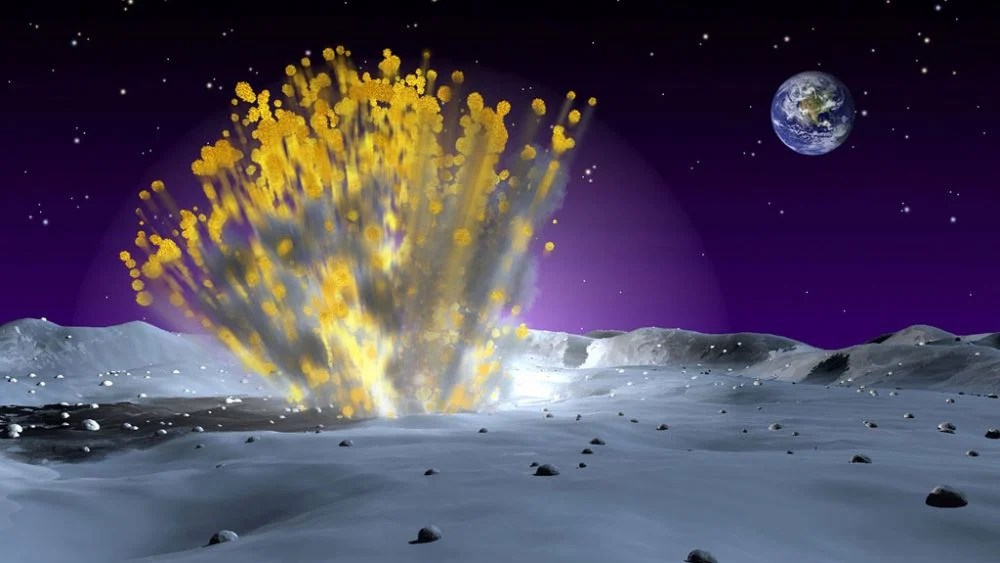
This is the 117th anniversary of the Tunguska Event, an asteroid strike that hit Siberia in 1908. An asteroid, thought to be of similar size, will pass close to the Earth, but has a 4% chance of hitting the Moon on December 22nd 2032. The asteroid was discovered near the end of last year and has the designation 2024 YR4. For a while there was a fear that this asteroid might hit the Earth. However, it was soon found that the asteroid would not hit the Earth but had a chance of hitting the Moon. Recently a paper was written that looked at what would happen to the ejecta of an impact of this asteroid on the Moon. It could be a hazard to the satellites orbiting the Earth.
The astronomical event times given in this blog are for the Traverse City/Interlochen area of Michigan (Lat 44.7° N, Long 85.7° W; EDT, UT – 4 hours) unless stated otherwise. Times will be different for other locations.
Addendum
Further reading
The Mother of All Meteor Showers Could Threaten Satellites By Evan Gough, Universe Today
Original paper: The Potential Danger to Satellites due to Ejecta from a 2032 Lunar Impact by Asteroid 2024 YR4 by Paul Wiegert et al.
Ephemeris: 10/21/2024 – Comets and meteors
This is Bob Moler with Ephemeris for Monday, October 21st. Today the Sun will be up for 10 hours and 40 minutes, setting at 6:47, and it will rise tomorrow at 8:08. The Moon, 3 days before last quarter, will rise at 9:35 this evening.
Comet Tsuchinshan-ATLAS it’s now far enough away from the sun so it stays up most of the evening, setting at 10:44 PM. It will be seen in the west southwestern sky for the most part. And now that it is dimming, it is probably best seen with binoculars. Last night was the peak of the Orionid meteor shower. The shower had to compete with a bright Moon. Meteor showers are caused by comets shedding their material as they pass close to the Sun, as the gases sublimate liberating dust and rocks. Dust and gases are blown back into the tails of a comet. The bits of rock end up in much the same orbit as the comet. If the comet’s orbit crosses the Earth’s orbit We have a meteor shower. The Orionids are caused by debris from Halley’s comet.
The astronomical event times given are for the Traverse City/Interlochen area of Michigan (EDT, UT – 4 hours). Times will be different for other locations.
Addendum
Ephemeris: 12/12/2023 – The source of the Geminid meteor shower
This is Bob Moler with Ephemeris for Tuesday, December 12th. Today the Sun will be up for 8 hours and 51 minutes, setting at 5:02, and it will rise tomorrow at 8:11. The Moon is new today, and won’t be visible.
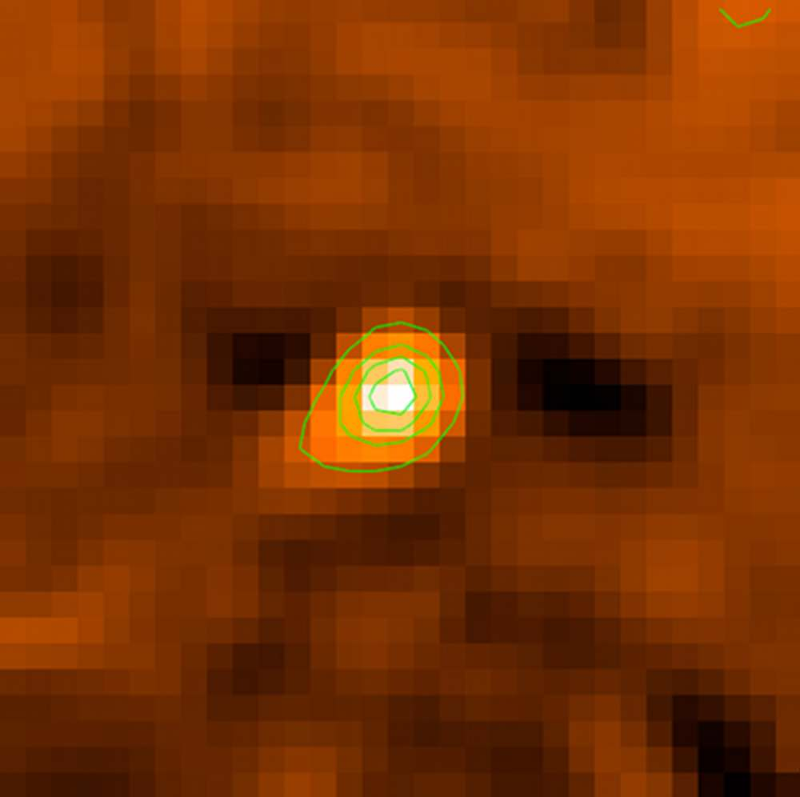
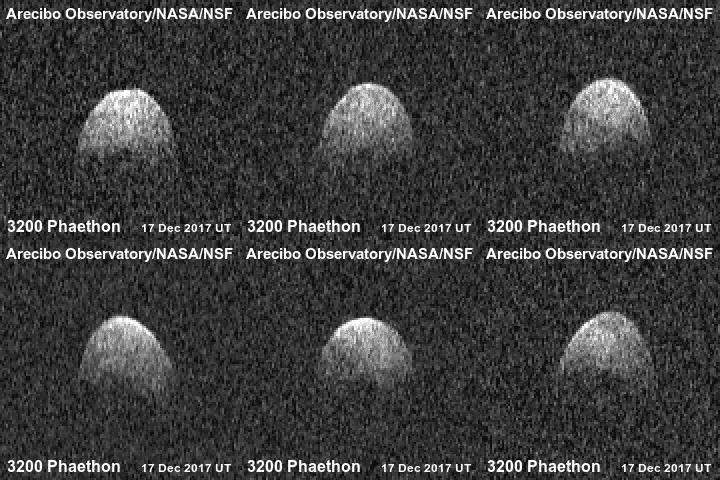
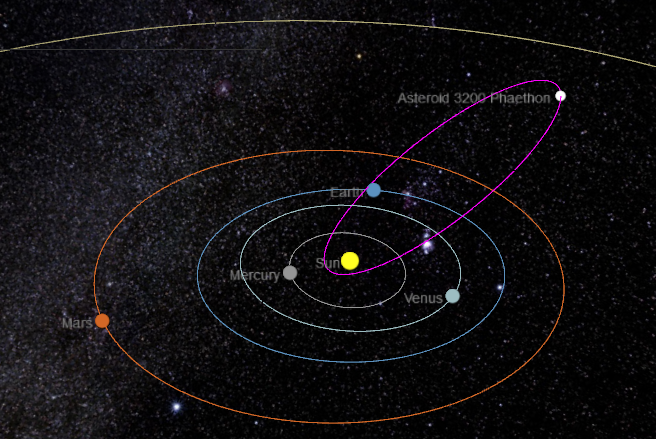
The Geminid meteor shower, which will peak this Thursday, is caused by a small body called 3200 Phaethon which looks like an asteroid but has the orbit of a comet, coming close to the Sun and back out to the asteroid belt. It’s probably a dead comet, with all the volatiles sublimated away leaving only the rocky bits. It is named Phaethon, because at the time it was the asteroid that came closest to the Sun. In Greek mythology Phaethon, the son of Helios the Sun god borrowed his father’s chariot that carried the Sun to take it out for a spin one day with disastrous results. The Geminid meteor shower was first recognized in 1862. The hourly rates of the Geminids have increased every year since then. The meteor stream has completely filled in the orbit of Phaethon, and they’re being pushed around by the gravitational effect of the planets and the pressure of sunlight.
The astronomical event times given are for the Traverse City/Interlochen area of Michigan (EST, UT –5 hours). They may be different for your location.
Addendum
11/17/2022 – Ephemeris – The peak of the Leonid meteor shower
This is Bob Moler with Ephemeris for Thursday, November 17th. Today the Sun will be up for 9 hours and 30 minutes, setting at 5:12, and it will rise tomorrow at 7:43. The Moon, 1 day past last quarter, will rise at 1:25 tomorrow morning. | The Famous Leonid meteor shower, which has had spectacular displays about every 33 years, is forecast to reach its normal peak this year, near 6 pm our time, with another smaller peak around 2 am tomorrow. The numbers of meteors, forecast during those peaks, of only about 10 per hour. The Moon will interfere after 1:25 am. And no meteors will be seen before 11:30 p.m. when the radiant rises. The last great 33 year peak was in 1998, so we’re a ways away from the next one. The responsible body for these meteors is the Comet Tempel-Tuttle. Every time the comet passes through the inner solar system, the Sun’s heat liberates gas, dust and small grains of rock. These small grains end up following and trailing the comet.
The astronomical event times given are for the Traverse City/Interlochen area of Michigan (EST, UT -5 hours). They may be different for your location.
Addendum
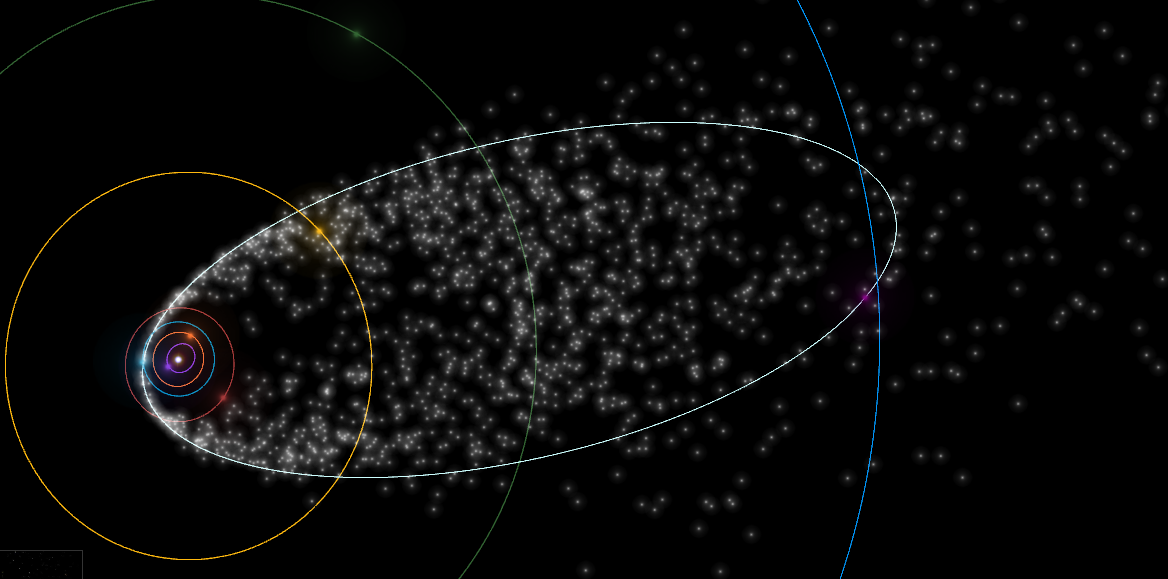
The Leonid meteor shower as seen from space. The time is set for today, so the Earth’s blue dot is lost in the stream of meteors crossing the Earth’s orbit (3rd one out from the Sun) just above 9 o’clock. The long ellipse is the orbit of Comet Tempel-Tuttle and the purple dot near the aphelion neat Uranus’ orbit is the calculated current position of the comet. The flurry of dots is the calculated positions of meteors whose orbits have been calculated. Click on the image to enlarge. Credit: NASA’s CAMS video camera surveillance network, and were calculated by meteor astronomer Peter Jenniskens of the SETI Institute and NASA Ames Research Center. This visualization is developed and hosted by Ian Webster.
08/12/2022 – Ephemeris – The Perseid meteor shower reached its peak tonight with a bright moon
This is Ephemeris for Friday, August 12th. Today the Sun will be up for 14 hours and 11 minutes, setting at 8:53, and it will rise tomorrow at 6:42. The Moon, 1 day past full, will rise at 9:48 this evening.
The Perseid meteor shower will reach its peak tonight as the nearly full Moon rises. Only the brightest of these meteors will be visible in the bright moonlit sky. Next year the Moon will be less bright and will only interfere in the early morning hours. Comet Swift-Tuttle is responsible for shedding the tiny bits of rock that end up orbiting the Sun near its path. The Earth plows through these particles every year at this time, giving us a great sky show, which at peak on a dark morning provide 60 or more of these so-called shooting stars per hour. The members of the Perseids will all seem to come from the northeastern sky, from the top of the constellation of Perseus the hero. The star figure to me instead looks like the cartoon roadrunner running up the sky.
The astronomical event times given are for the Traverse City/Interlochen area of Michigan (EDT, UT – 4 hours). They may be different for your location.
Addendum
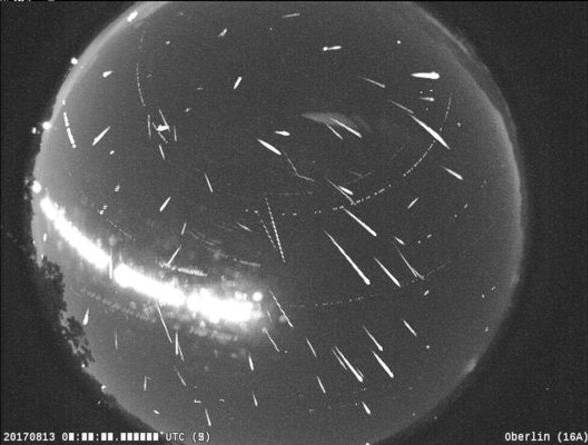
Perseid fireballs in one of NASA’s all sky cameras during the morning hours of August 13, 2017. This is a long time exposure. The bright swath in the image is the Moon that morning. Since it is a time exposure, the radiant is also moving with the earth’s rotation, so the meteors only seem to come from the northeastern sky. North is at the top, and East is to the left. The Moon that morning was 1 day before last quarter, so tonight’s Moon will be even brighter. Credit NASA.
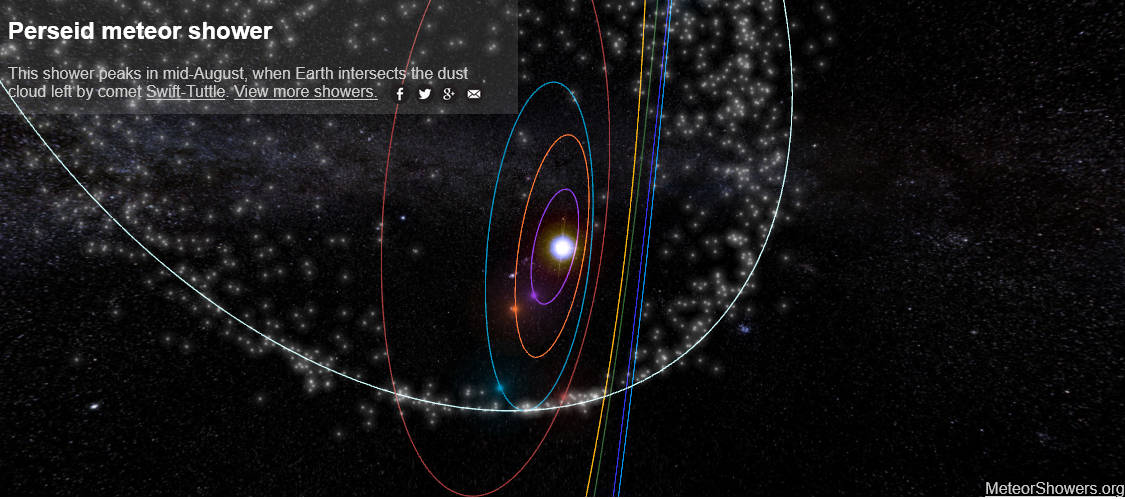
Screen capture of an interactive animation of the orbits of the Perseid meteoroids and the inner planets. The planets move counterclockwise, while the meteoroids move clockwise and cross the Earth’s orbital plane at a high angle. Image taken from the International Meteor Organization, imo.net. Interactive animation by MeteorShowers.org.
05/30/2022 – Ephemeris – There might be a spectacular meteor shower/storm tonight after midnight!
This is Ephemeris for Memorial Day, Monday, May 30th. Today the Sun will be up for 15 hours and 18 minutes, setting at 9:19, and it will rise tomorrow at 6:00. The Moon is new today, and won’t be visible.
Comet Schwassmann-Wachmann 3, SW3 for short began to breakup in 1995, 27 years ago. Two large chunks of the comet’s nucleus and dozens of smaller pieces have been seen. We expect a vast debris field to be expanding from the remnants of the comet, unseen. Astronomers, calculating what happened to that unseen debris cloud, expect the Earth to run into a part of it around 1 am (EDT, 5 hours UT), give or take, tomorrow morning. Causing, if we’re lucky, a meteor shower or meteor storm. The radiant point from which the meteors seem to come is from between the Big Dipper’s handle and the bright star Arcturus. They will appear all over the sky. I’m crossing my fingers on this one, it could be great, or it could be nothing.
The astronomical event times given are for the Traverse City/Interlochen area of Michigan (EDT, UT – 4 hours). They may be different for your location.
Addendum
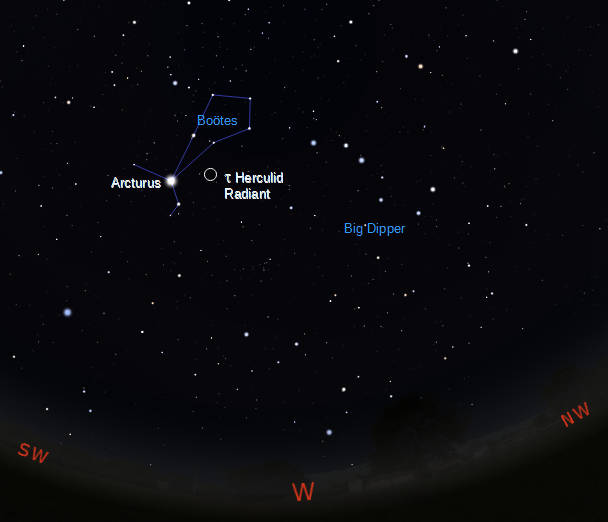
Position of the Tau Herculid radiant at 1 am, May 31, 2022. However, meteors will appear all over the sky, but could be traced back to the radiant. These meteors will appear to travel a lot slower than the Perseid meteors of August. Created using Stellarium for the star field and LibreOffice for annotations.
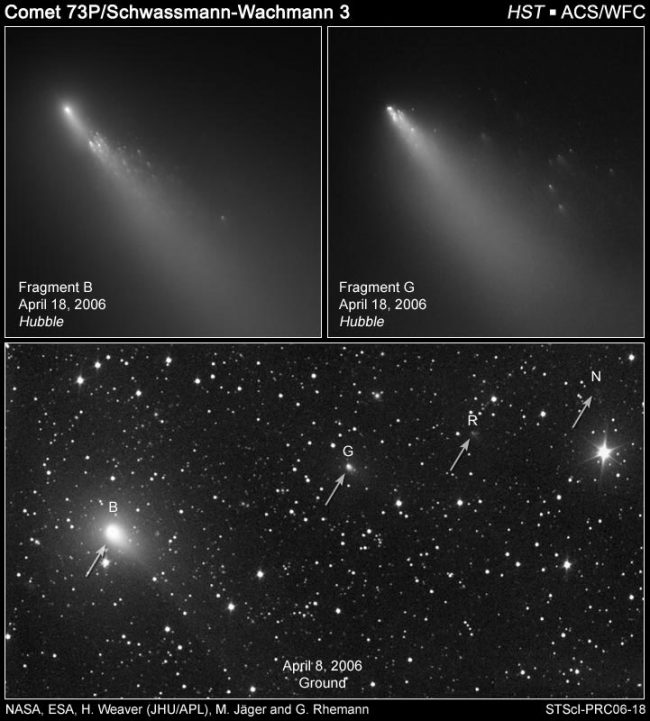
Comet Schwassmann-Wachmann 3 Hubble Space Telescope images from 2006 showing the breakup of the comet. Credit: NASA.
12/13/2021 – Ephemeris – The Geminid Meteor Shower reaches its peak tomorrow morning
This is Ephemeris for Monday, December 13th. Today the Sun will be up for 8 hours and 50 minutes, setting at 5:02, and it will rise tomorrow at 8:12. The Moon, 3 days past first quarter, will set at 3:41 tomorrow morning.
Tomorrow morning we will have the chance to see near the peak of the Geminid meteor shower after the Moon sets. Some of its members can be seen tonight, in the bright moonlight. This shower is currently besting the Perseid meteor shower of August, with a predicted 120 meteors per hour tomorrow morning. The problems for us in viewing this fabulous shower, beside the bright Moon this year, are the cold temperatures and usually cloudy skies. The source of the Geminids was discovered in 1983. It is a probably burnt out comet with the asteroid designation 3200 Phaethon, which swoops down to only 13 million miles of the Sun. Some call it a rock comet. The Geminids were first seen in 1862.
The astronomical event times given are for the Traverse City/Interlochen area of Michigan (EST, UT – 5 hours). They may be different for your location.
Addendum
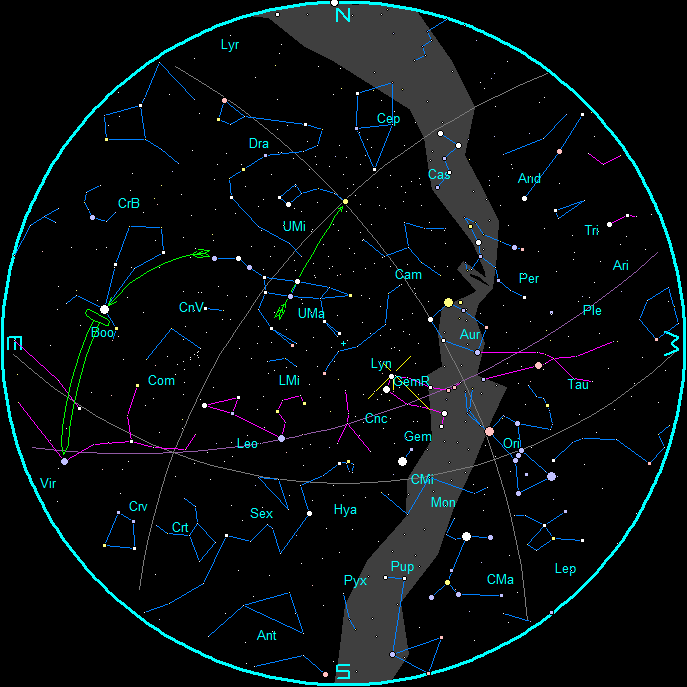
An all sky view at 4 am, December 14th, 2021, showing the radiant for the Geminid meteor shower. The meteors will be seen all over the sky. Their trails, however, can be traced back to their radiant. The radiant is marked on the chart as GemR, near the star Castor in Gemini. The sky at that hour is that of the evening sky of early spring. Created using my LookingUp program.
For a list of constellation names to go with the abbreviations, click here.
- Pointer stars at the front of the bowl of the Big Dipper point to Polaris, the North Star.
- Follow the arc of the handle of the Big Dipper to the star Arcturus, then
- Follow the spike to Spica.
05/04/2021 – Ephemeris – We cross Halley’s Comet debris this week
This is Bob Moler with Ephemeris for Tuesday, May 4th. Today the Sun will be up for 14 hours and 23 minutes, setting at 8:51, and it will rise tomorrow at 6:26. The Moon, 1 day past last quarter, will rise at 4:20 tomorrow morning.
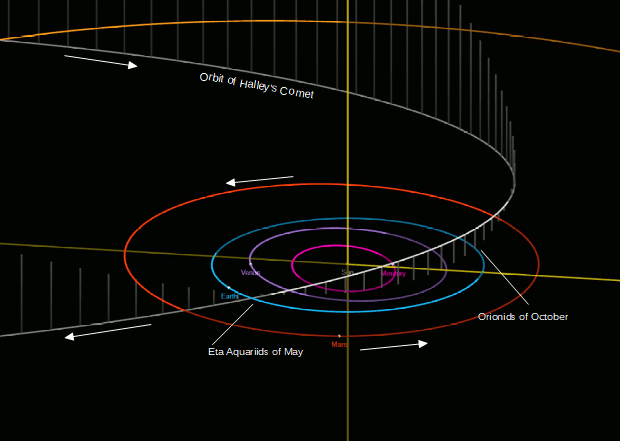
The Eta Aquariid meteor shower will reach their peak for us Thursday morning the 6th. The Eta Aquariids are caused by bits of Halley’s Comet, passing the Earth’s orbit heading out from the Sun. The Orionids of late October are debris of Halley’s comet passing the Earth’s orbit heading in toward the Sun. The Eta Aquariids are named for the star nearest the radiant of the meteor shower. The constellation of Aquarius has many shower radiants, which is why the shower is named for a star in Aquarius. The radiant rises shortly before 3:30am and astronomical twilight begins an hour later. There’s perhaps another half hour of visibility after that. The peak will occur Thursday morning where 20 meteors per hour or more might be seen.
The astronomical event times given are for the Traverse City/Interlochen area of Michigan. They may be different for your location.
Addendum
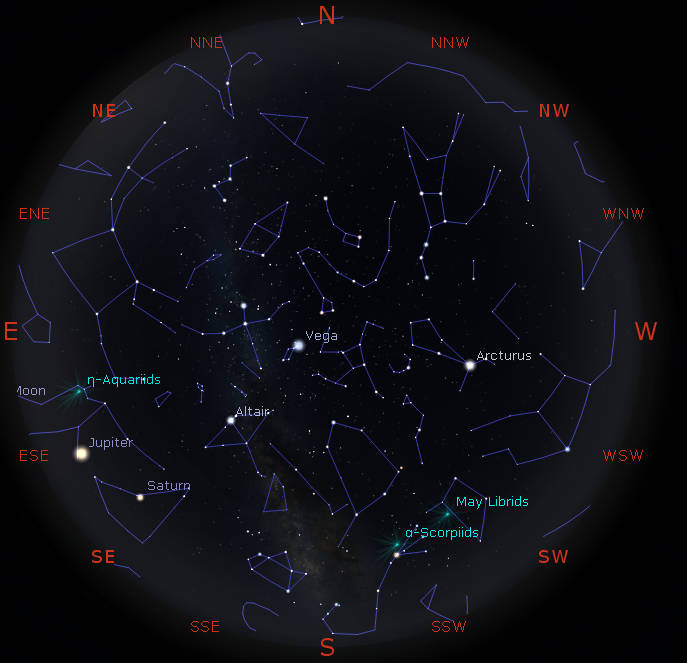
two other minor meteor showers are active then with only a handful of meteors an hour
compared to the Eta Aquariids’ somewhat higher rates. The funny looking “n” character
next to Aquariid is the Greek letter Eta. Chart created using Stellarium.
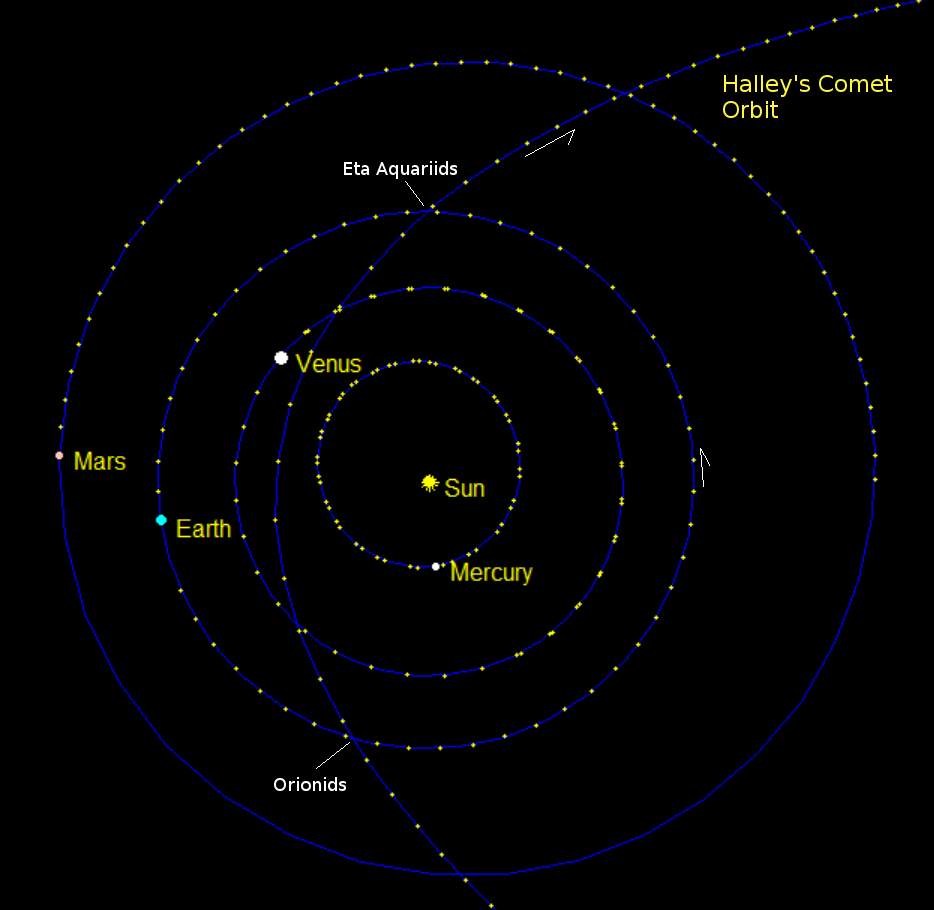
the inner solar system, and the Eta Aquariids when it’s leaving.
Credit my LookingUp program.
11/03/2020 – Ephemeris – Two meteor showers emanating from Taurus
This is Ephemeris for Election Day, Tuesday, November 3rd. Today the Sun will be up for 10 hours and 3 minutes, setting at 5:27, and it will rise tomorrow at 7:25. The Moon, 3 days past full, will rise at 7:22 this evening.
November is a month of low grade meteor showers. The first two are related showers from the same comet. They are the South Taurid and North Taurid meteor showers. The South Taurid meteor shower peaks on October 10th, while the North Taurid meteor shower peaks on November 12th. The both have Encke’s Comet as their source. Encke’s official name is 2P/Encke named after Johann Franz Encke who calculated it’s orbit after it had been observed on three earlier appearances including by Charles Messier and Caroline Herschel, sister of William Herschel, astronomer and composer. Encke has the shortest period of any reasonably bright comet of 3.3 years. The other notable meteor shower this month is the Leonids which we’ll visit later.
The event times given are for the Traverse City/Interlochen area of Michigan. They may be different for your location.
Addendum
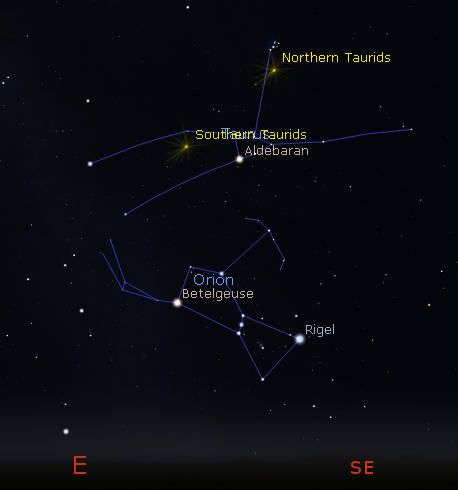
The radiants of the Northern and Southern Taurid meteor showers at 11 pm November 12, 2020. Both these radiants move eastward with time due to the Earth’s orbital motion. The activity dates of the two meteor showers overlap. The Southern Taurids are active between September 10 to November 20, while the Northern Taurids are active between October 20 to December 10. Both have peak rates of 5-10 meteors per hour. Created using Stellarium.
10/20/2020 – Ephemeris – The Orionid meteor shower reaches peak overnight
This is Bob Moler with Ephemeris for Tuesday, October 20th. Today the Sun will be up for 10 hours and 43 minutes, setting at 6:48, and it will rise tomorrow at 8:06. The Moon, 3 days before first quarter, will set at 9:44 this evening.
Halley’s Comet is back! (Pronounced Hall-ee’s) Well sorta. In the form of the Orionid meteor shower. Bits of Halley’s Comet from previous passes by the Earth’s orbit make their twice-yearly show in our skies as these bits collide with the Earth’s atmosphere. Halley’s orbit passes close to the Earth’s orbit at points where the Earth is around May 6th and again near October 21st. Light dust and ionized gas get blown back into the tail of the comet. Heavier particles will roughly following the comet’s orbit. The radiant, a spot above the constellation Orion and below Gemini from which they will seem to come will rise around 11 pm. So view them any time after that as their numbers will increase until morning twilight begins.
The event times given are for the Traverse City/Interlochen area of Michigan. They may be different for your location.
Addendum
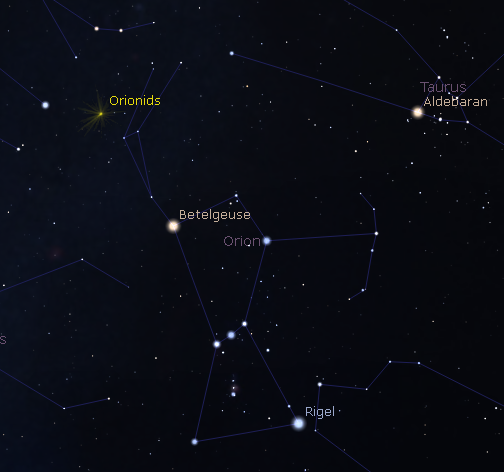
The Orionid meteor shower radiant at 5 a.m. October 21st. The radiant rises at 11 p.m., so the meteors will be visible from then into morning twilight. Despite the location of the radiant, the meteors will be seen all over the sky. However true Orionids can be traced back to the radiant point. Created using Stellarium.
We get two meteor showers from Halley’s Comet. The Orionids, when Halley’s meteoroids are approaching the inner solar system, and the Eta Aquariids when they’re leaving. Created using my LookingUp program.
 Bob Moler's Ephemeris Blog