Archive
05/06/2019 – Ephemeris Extra – The Eta Aquariids – Halley’s Comet never really left
In 1986 Halley’s Comet swam through our skies for the 28th time since the Chinese first recorded it in 240 BCE. It was not especially impressive, considering the week when my family met a group of Leelanau School students in the Florida Keys the week in April 1986 to view and photograph the comet at it’s closest to the Earth of 44 million miles. It turned out that that week the comet lost its tail, probably due to a coronal mass ejection from the Sun. Halley’s Comet was much more impressive a month later. I’ve seen more impressive comets before and since.
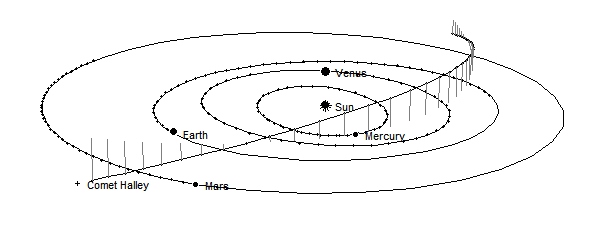
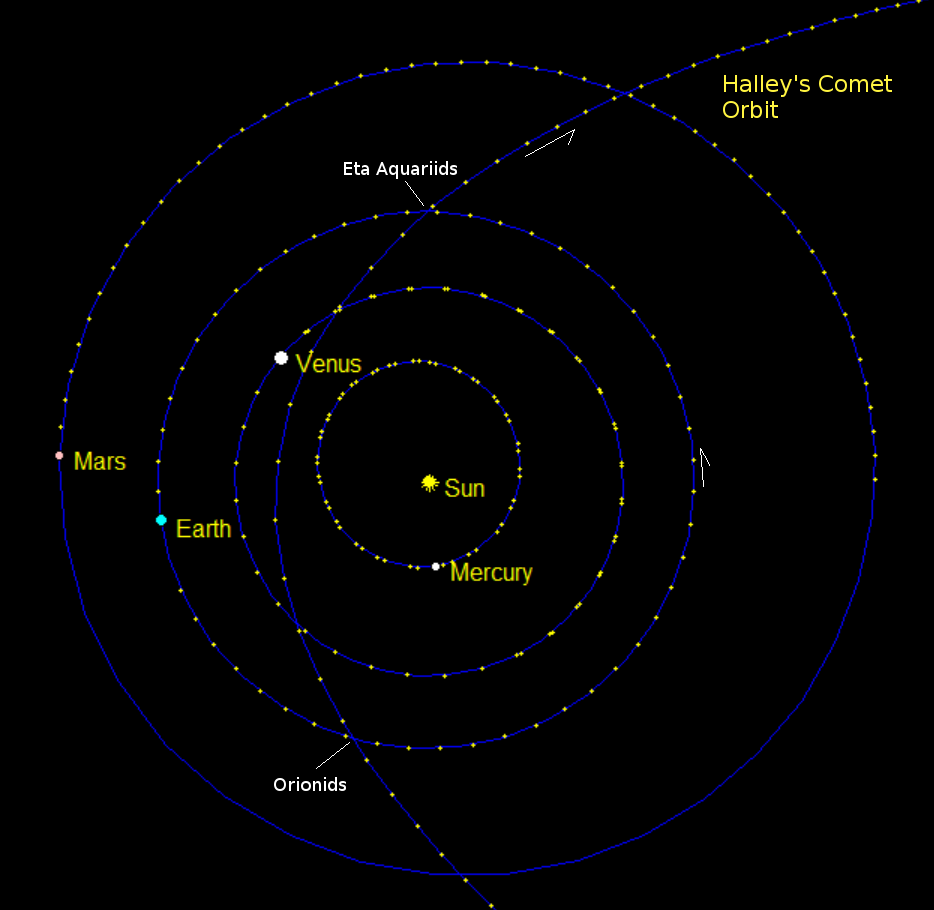
Comet Halley’s path through the inner solar system in 1985-86. Created using my LookingUp program.
Halley’s Comet has been swinging around the Sun countless times before the Chinese first recorded it. The illustration above shows the last time the comet entered the inner solar system in 1986. The comet’s path is from upper right to lower left. When the comet passes within about 3 astronomical units of the Sun, that is 3 times the Earth’s distance from the Sun, the ices in the comet begin to sublimate, escaping from the comet’s nucleus which liberates dust and larger solid material. The gasses and dust form the comet’s ion and dust tails. The larger material, gravel sized bits, end up in and around the comet’s orbit, and over time are spread out around and near the comet’s orbit. Halley’s orbit crosses the Earth’s orbit twice, inbound and outbound. In both cases these crossings are close enough to the plane of the Earth’s orbit to produce meteor showers.
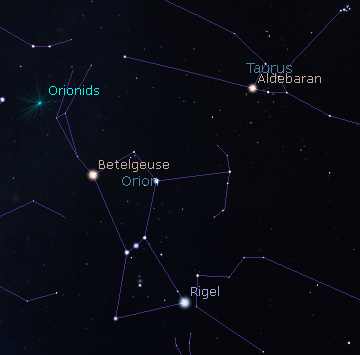
On the inboard leg of the orbit it produces the Orionid meteor shower that peaks on October 22nd. A meteor shower is generally named for the point in the sky they seem to come from, be it a constellation or star. The point, called the radiant, moves during the days or weeks the shower is visible. The Orionids are named for the constellation Orion. The radiant is near his upraised arm.
The center of the outbound meteoroid stream crosses the Earth’s orbit where the Earth is on May 6th. Though they have a broad peak of about 5 days. This meteor shower is visible from April 19th to May28th. During that period the radiant points drifts quite a bit to the east. There are several meteor shower radiants in Aquarius, so they are named for the nearest star at peak.
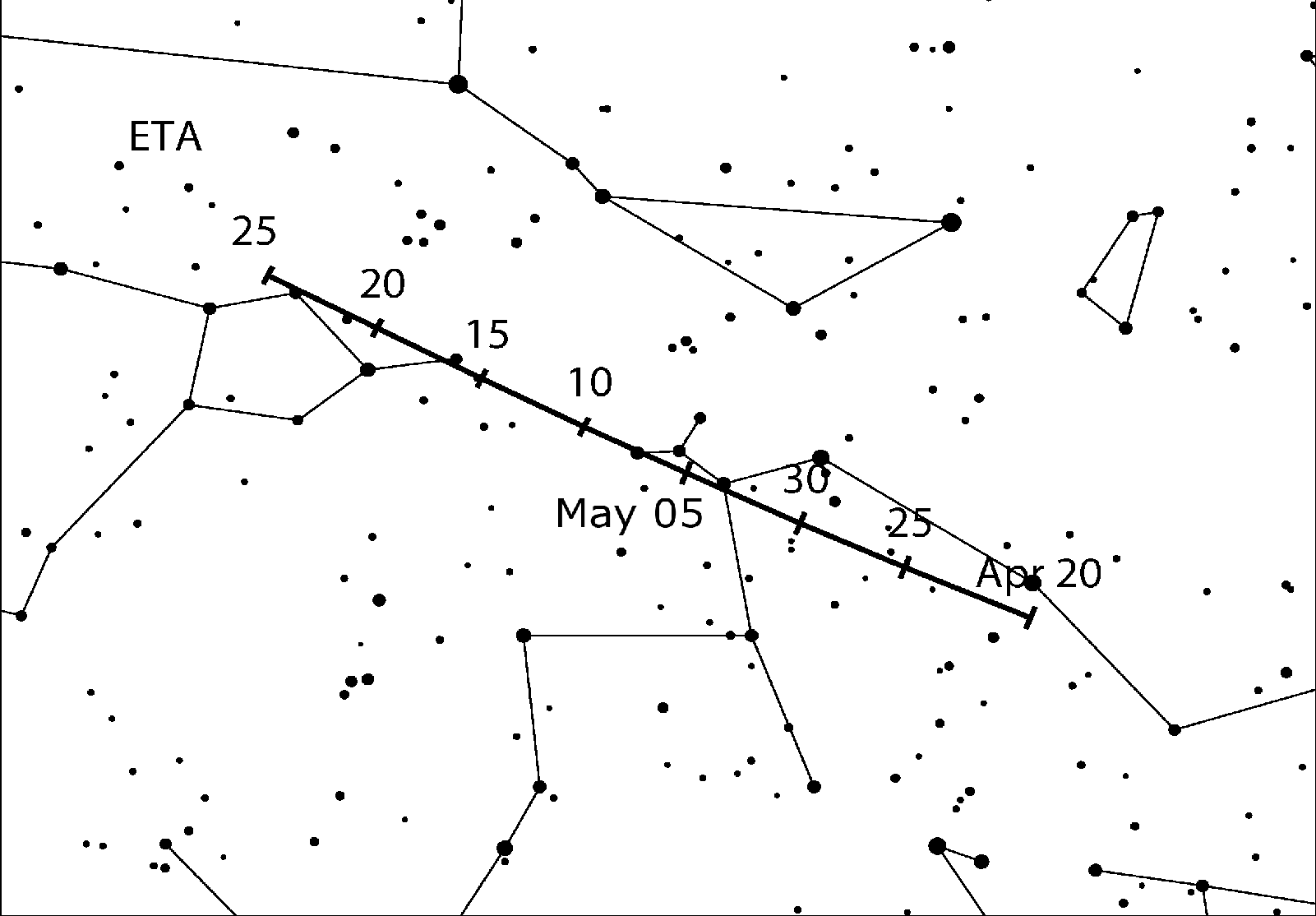
Motion of the Eta Aquariid radiant from April 20 to May 25. The triangle with the star near the center near May 05 is the asterism the Water Jar, a part of Aquarius. Eta Aquarii is the triangle star to the left. Source: PDF version of the International Meteor Organization 2019 Meteor Shower Calendar: https://www.imo.net/resources/calendar/
Though the Moon is new for this shower, the meteoroids are coming from near the direction of the Sun, so there is only an hour where the Eta Aquariids are best seen. For Northern Michigan the radiant rises at 3:30 a.m. on May 6th. Astronomical twilight begins at 4:30 a.m. when the sky begins to brighten. This meteor shower is best seen from the southern hemisphere.
01/03/2019 – Ephemeris – The Quadrantid meteor shower will reach its peak this evening
Ephemeris for Thursday, January 3rd. The Sun will rise at 8:20. It’ll be up for 8 hours and 54 minutes, setting at 5:14. The Moon, 2 days before new, will rise at 7:01 tomorrow morning.
Of the three most active meteor showers, year after year, the Quadrantids of January, Perseids of August, and Geminids of December, only the Quadrantids are not affected by a bright Moon this year. The Quadrantids, which will reach peak at 9:20 this evening have their radiant about due north at that time, only a few degrees above the horizon. The peak is rather narrow, 4 hours to achieve at least half maximum, which is 120 meteors an hour if the radiant was overhead. The radiant, from which the meteors will come from is very low, so will be the numbers. However a low radiant means that the meteor streaks all over the sky will be longer as the meteoroids strike the atmosphere overhead at a shallow angle.
The times given are for the Traverse City/Interlochen area of Michigan. They may be different for your location.
Addendum
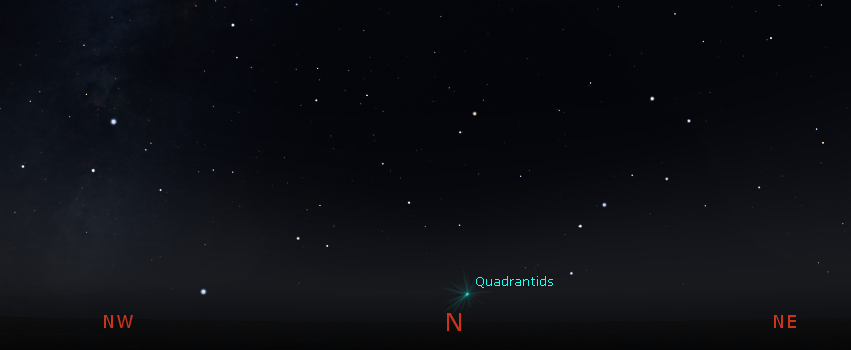
The location of the Quadrantid radiant, off the handle of the Big Dipper, at 9:20 p.m. January 3, 2019 for the peak of the meteor shower. Click on the image to enlarge. Created using Stellarium.
12/13/2018 – Ephemeris – The Geminid meteors will reach their peak numbers overnight
Ephemeris for Thursday, December 13th. The Sun will rise at 8:11. It’ll be up for 8 hours and 50 minutes, setting at 5:02. The Moon, 2 days before first quarter, will set at 11:05 this evening.
Tonight through the morning hours we will have the chance to see the peak of the Geminid meteor shower. The meteors will be most numerous tomorrow morning. This shower is currently besting the Perseid meteor shower of August with a predicted 120 meteors per hour at the peak. The problems for us in viewing this fabulous shower are the cold temperatures and usually cloudy skies. However the Moon will be a problem until it sets after 11 p.m. The source of the Geminids was discovered in 1983. It is a burnt out comet with the asteroid designation (3200) Phaethon which swoops down to only 13 million miles of the Sun, but last year passed only 6.4 million miles from Earth. The Geminids were first seen in 1862.
The times given are for the Traverse City/Interlochen area of Michigan. They may be different for your location.
Addendum
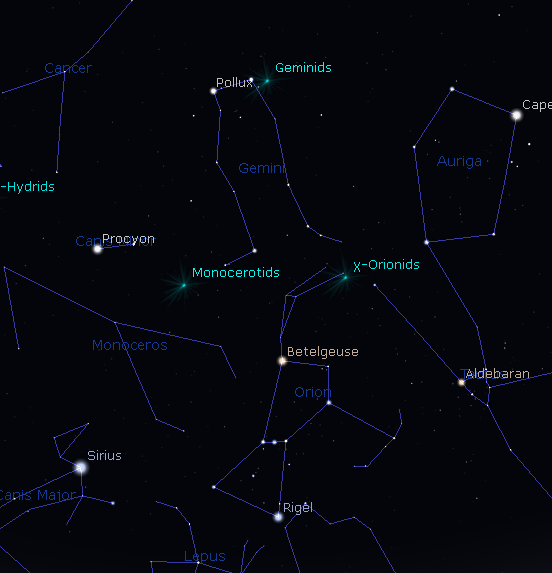
The area of the Geminid meteor shower radiant near the star Castor at 4 a.m. December 14, 2018. There are other very minor radiants that provide only a handful of meteors per hour. The Geminids will provide up to 120 meteors per hour. Created using Stellarium.
11/19/2018 – Ephemeris – The Leonids’ comet 55P/Tempel-Tuttle
Ephemeris for Monday, November 19th. The Sun will rise at 7:45. It’ll be up for 9 hours and 25 minutes, setting at 5:10. The Moon, half way from first quarter to full, will set at 4:29 tomorrow morning.
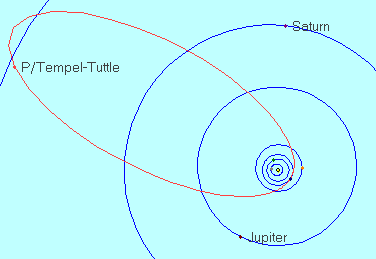
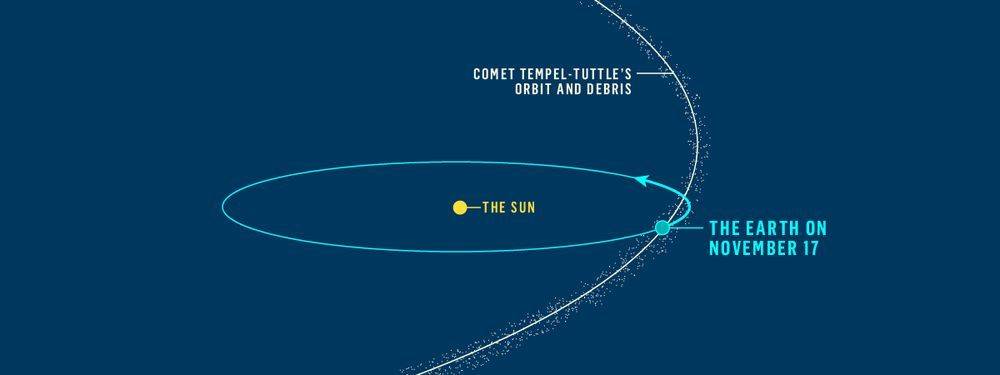
We have another day in this year’s extended Leonid meteor peak. In past years, usually every 33 years the Leonid meteors have a super peak, called a meteor storm, where thousands of meteors streak through the skies. These appear for a brief period over a rather small geographic area. In 1966 it occurred principally over the Rocky Mountains. The comet responsible is Comet Tempel Tuttle, independently discovered by two astronomers Tempel and Tuttle in 1865 & 1866. The comet had a 33 year orbit of the Sun, and its orbit crosses very close to the Earth’s orbit. Comets are notorious litter bugs, shedding gas, dust and pebble sized debris as they come close to the warming rays of the Sun.
The times given are for the Traverse City/Interlochen area of Michigan. They may be different for your location.
Addendum
11/16/2018 – Ephemeris – The Leonid meteor shower will have several peaks in the next few days
Ephemeris for Friday, November 16th. The Sun will rise at 7:41. It’ll be up for 9 hours and 32 minutes, setting at 5:13. The Moon, 1 day past first quarter, will set at 1:19 tomorrow morning.
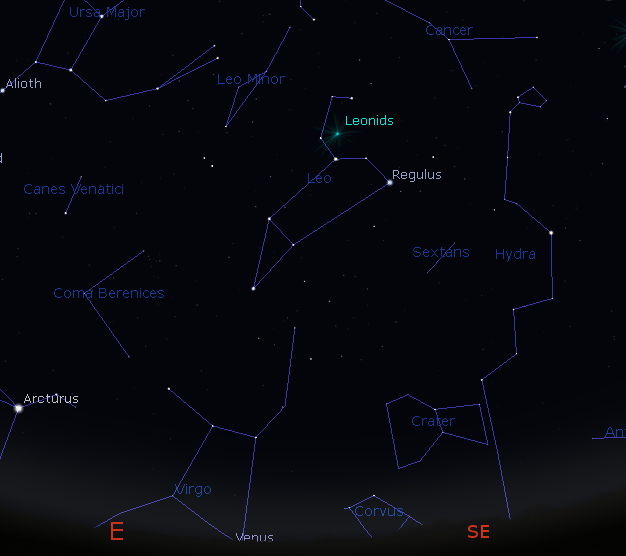
We are coming into an extended period where the Leonid meteor shower will be at its peak, or rather there is a chance of up to maybe four peaks as the Earth passes through the debris left by Comet Tempel-Tuttle on past trips through the inner solar system. We are having a pretty bright Moon now, but the best displays of the meteors are going to be occurring in the early morning hours after the Moon sets. The meteors will appear to come from the top of a backward question mark that is the head of the constellation Leo the lion. They will be seen all over the sky, but can be traced back to that point, if it’s a Leonid meteor. The Leonids are most numerous about every 33 years, which is about 15 years from now. Otherwise we get about 15 meteors an hour at peak.
The times given are for the Traverse City/Interlochen area of Michigan. They may be different for your location.
Addendum
11/06/2018 – Ephemeris – The Taurid meteor showers
Ephemeris for Election Day, Tuesday, November 6th. The Sun will rise at 7:27. It’ll be up for 9 hours and 57 minutes, setting at 5:24. The Moon, 1 day before new, will rise at 7:09 tomorrow morning.
We are in the midst of two showers of meteors that seen to come from the constellation of Taurus the bull. These are the Southern and Northern Taurids respectively. They only produce a handful of meteors per hour, but there seems to be some discrepancy in their peak dates. The International Meteor Organization has the Southern group peak October 10th. Other sources have it peak November 5th. The Northern group peaks on the 10th or 12th of November depending on the source. Anyway these are bits shed by Comet 2P/Encke, which has only a 3 year orbit of the Sun. Encke’s orbit also comes close to the Earth’s orbit where the Earth is at the end of June. I’ve always wondered if it was a piece of Encke’s nucleus that hit Siberia on June 30, 1908?
The times given are for the Traverse City/Interlochen area of Michigan. They may be different for your location.
Addendum
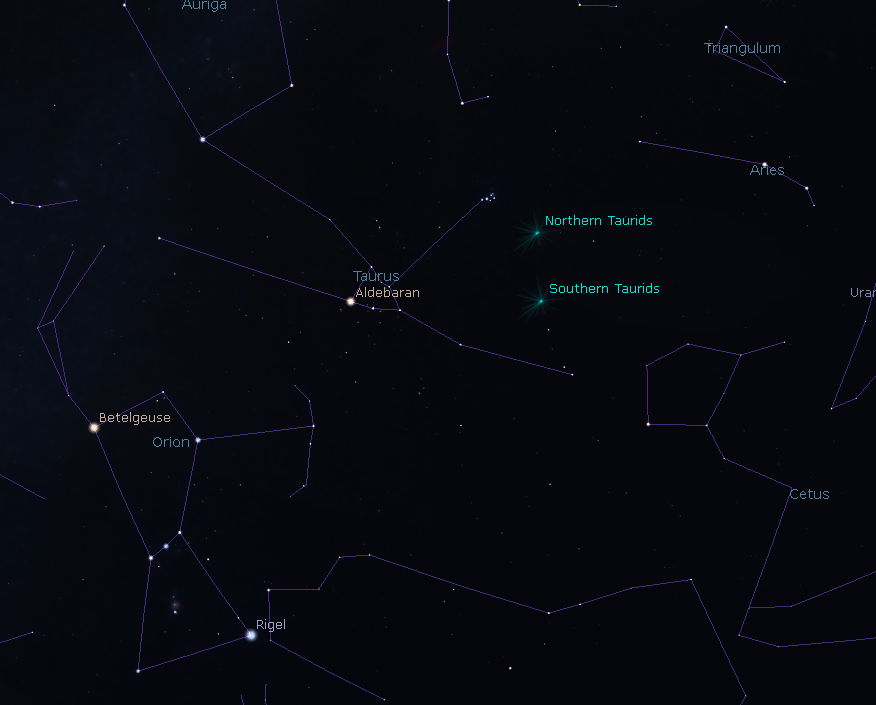
The radiants are not as nearly defined as shown here
10/18/2018 – Ephemeris – Halley’s Comet returns as the Orionids
Ephemeris for Thursday, October 18th. The Sun will rise at 8:02. It’ll be up for 10 hours and 50 minutes, setting at 6:53. The Moon, 2 days past first quarter, will set at 2:32 tomorrow morning.
Halley’s Comet is back! (Pronounced Hall-ee’s) Well sorta. In the form of the Orionid meteor shower. Bits of Halley’s Comet from previous passes by the Earth’s orbit make their twice-yearly show in our skies as these bits collide with the Earth’s atmosphere. Halley’s orbit passes close to the earth’s orbit at points where the Earth is around May 6th and again near October 21st. Light dust and ionized gas get blown back into the tail of the comet. Heavier particles, still affected by the pressure of sunlight and the gravitational pull of the Sun and planets end up roughly following the comet’s orbit. In the morning after the Moon sets should be the best time to see them. They will seem to come from a spot above Orion and below Gemini.
The times given are for the Traverse City/Interlochen area of Michigan. They may be different for your location.
Addendum
08/09/2018 – Ephemeris – How to observe the Perseid Meteor Shower
Ephemeris for Thursday, August 9th. The Sun rises at 6:38. It’ll be up for 14 hours and 19 minutes, setting at 8:57. The Moon, 2 days before new, will rise at 5:30 tomorrow morning.
Now through most of this month and reaching peak numbers Sunday evening and Monday morning the Perseid meteors will be shooting through our skies. Where to look? Up is the direction. All over the sky. They will seem to come from the northeast on parallel paths, like driving through a snow storm at night, the snowflakes will diverge from right in front of you. The numbers will generally increase as that radiant point rises higher in the sky. A diligent experienced, and undistracted, observer may see up to 100 or more an hour. Casual observers will see much less. The longest meteor streaks will be seen early in the evening when the meteoroids enter the atmosphere at 37 miles (59 km) per second at a very shallow angle, so last a bit longer. Bring a blanket, dress warmly and enjoy the show!
The times given are for the Traverse City/Interlochen area of Michigan. They may be different for your location.
Addendum
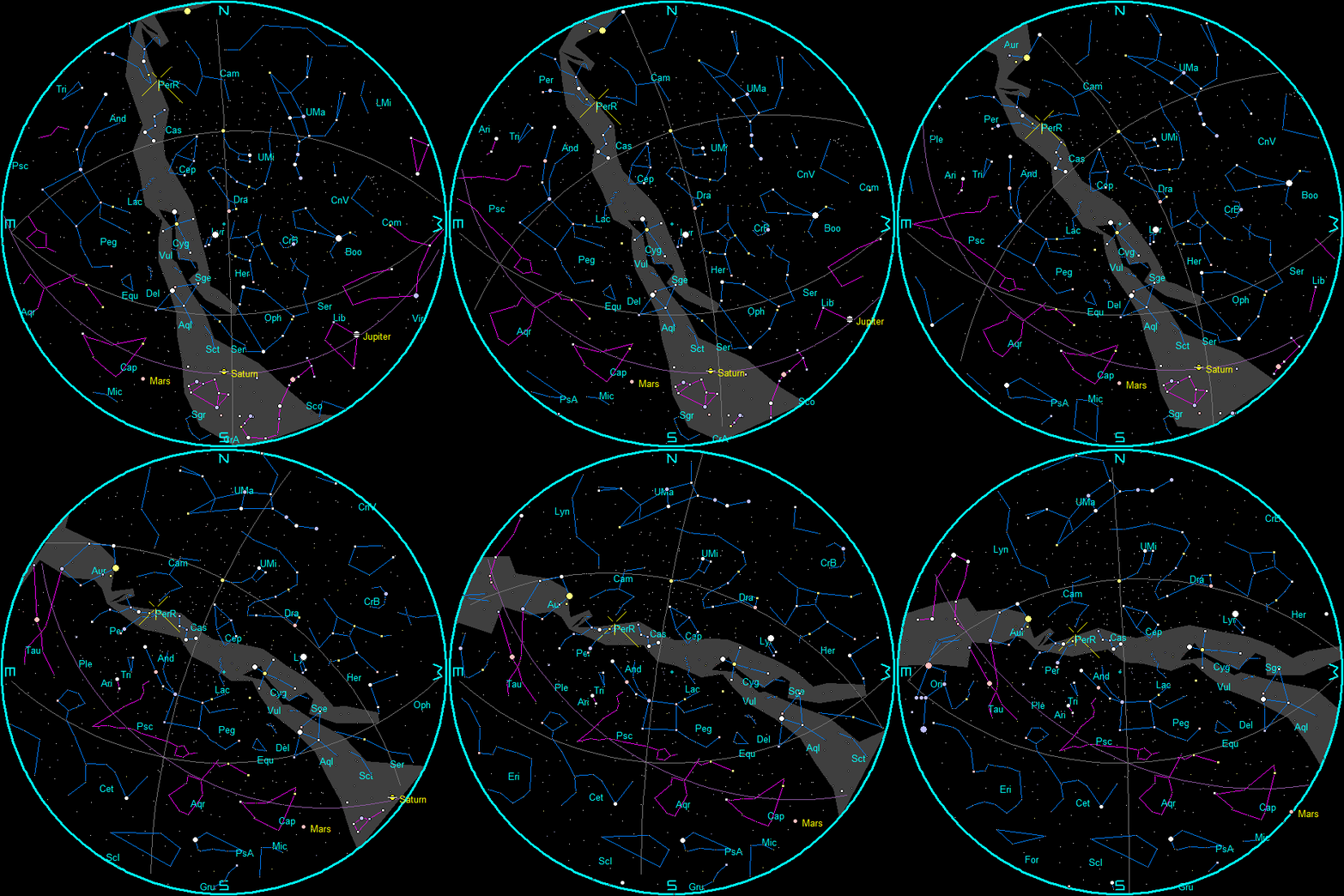
The sky dome for the night of the Perseid shower maximum at 1 hour intervals from 10:30 p.m. to 4:30 a.m. Click on image to enlarge. Created using my LookingUp program and GIMP.
For locations other than the Traverse City/Interlochen area the 10:30 step is approximately an hour and a half after sunset.
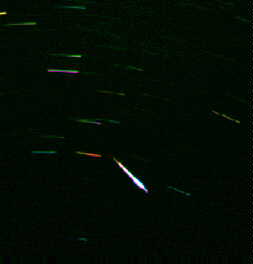
My best Perseid photo. From the 70’s.
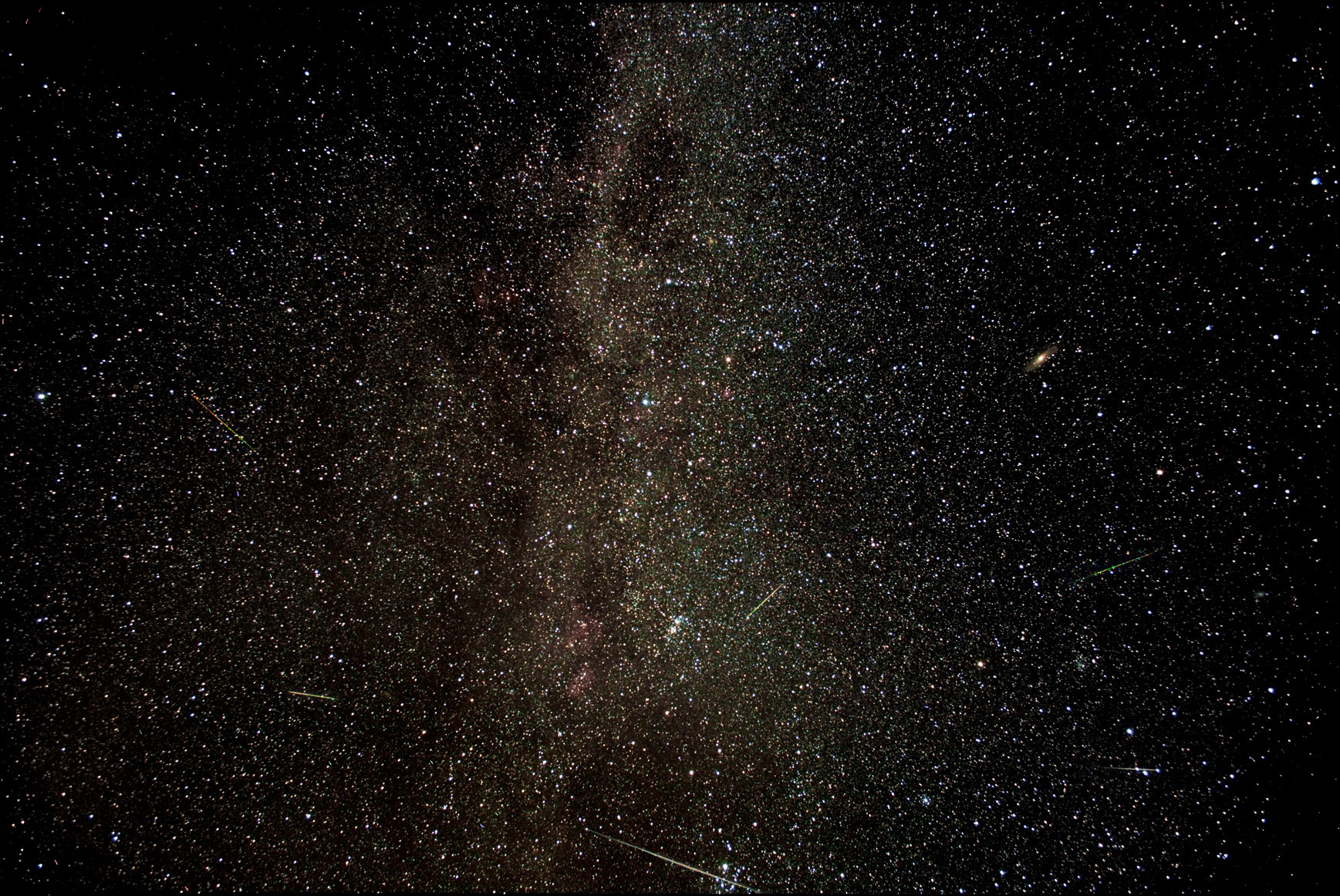
Here are some meteors seen in the 2007 Perseid meteor shower taken by Scott Anttila. The image is centered on Cassiopeia. The radiant is low and a bit left of center in the image. The Double Cluster is seen below center and the Great Andromeda Galaxy is seen on the right just above center.
The logic of taking meteor photos pointing near the radiant is the he meteors appear to travel slower there because they are coming mostly toward the camera and have a better chance of being picked up. My photograph was unguided, so the stars trailed. Scott’s was guided.
08/07/2018 – Ephemeris – The source of the Perseids
Ephemeris for Tuesday, August 7th. The Sun rises at 6:35. It’ll be up for 14 hours and 24 minutes, setting at 9:00. The Moon, 3 days past last quarter, will rise at 3:18 tomorrow morning.
The Perseid meteor shower will reach its peak Sunday night and Monday morning, less than a week from now. The meteor shower is caused by tiny particles shed by the comet 109P/Swift-Tuttle on past trips through the inner solar system. The 109P means it was recognized as the 109th comet to have seen to return to the vicinity of the Sun to be rediscovered in 1992. Lewis Swift and Horace Tuttle first discovered the comet independently in 1862. The orbit of the comet fit the orbits of the meteoroids that produce the Perseid meteor shower each year. The comet will return in 2126 after retreating to 51 times the Earth’s distance from the Sun, deep in the Kuiper belt, leaving behind a trail of meteoroids.
The times given are for the Traverse City/Interlochen area of Michigan. They may be different for your location.
Addendum
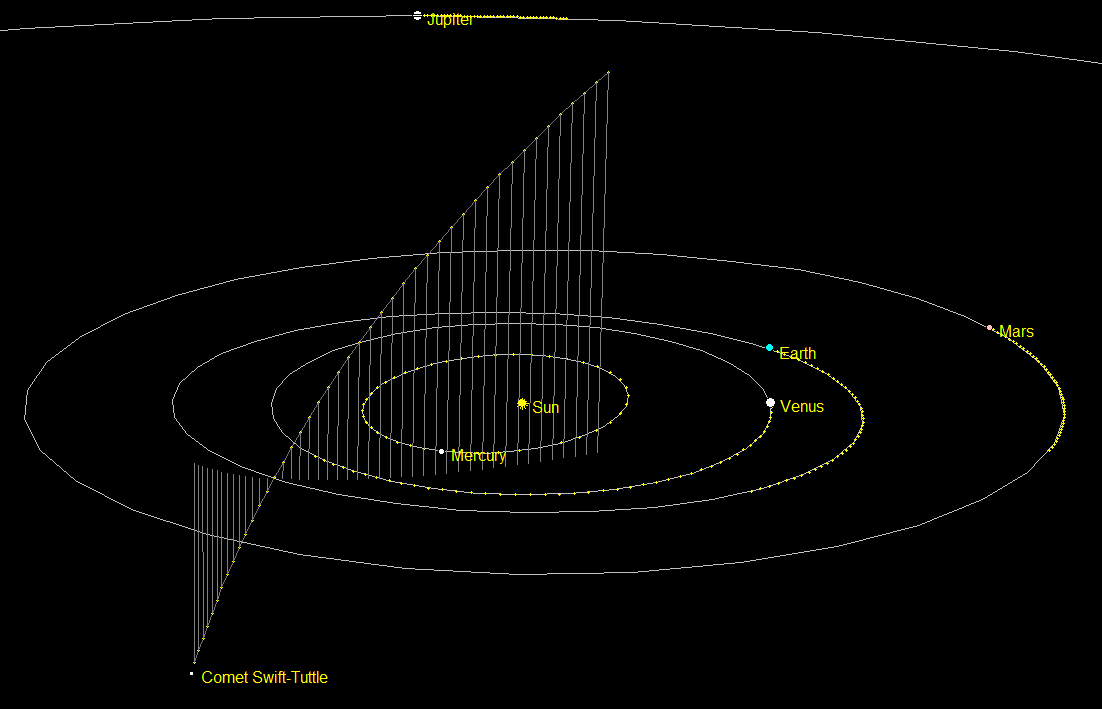
The passage of 109P/Comet Swift-Tuttle through the inner solar system November 1, 1992 to January 30, 1993. The meteoroids shed by the comet on its numerous trips close to the Sun lie close to that orbit. Note that its orbit intersects with the Earth’s orbit. That’s where the Earth will be around August 12-13 every year. Click on the image to enlarge. Created using my LookingUp program.
08/06/2018 – Ephemeris – The meteors of August, the Perseids are showing up now
Ephemeris for Monday, August 6th. The Sun rises at 6:34. It’ll be up for 14 hours and 27 minutes, setting at 9:01. The Moon, 2 days past last quarter, will rise at 2:27 tomorrow morning.
Over the past several weeks folks outdoors at night might have been seeing some shooting stars or meteors appearing to zip past in the sky. The ones I’m talking about seem to come from the northeast. These are the precursors of the Perseid meteor shower which will reach its peak on the night of August 12 and 13 this year. Over the millennia the meteoroid stream that feeds the meteors to our skies has spread out to last over a month from the latter half of July to three-quarters of August. We’ll meet the culprit for this show tomorrow. I try to use the proper terminology for all this. Meteoroid is the tiny body in space. In the Perseid’s case the size of a grain of sand to a pea. Meteor is the streak we see in the sky as it burns up. Meteorite is the body that makes it to the ground. To my knowledge no Perseid meteoroid has made it that far.
The times given are for the Traverse City/Interlochen area of Michigan. They may be different for your location.
Addendum
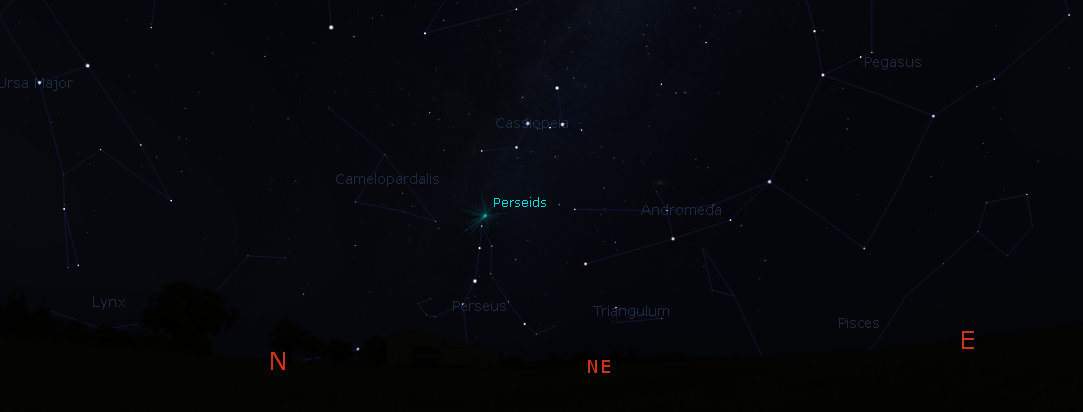
The Perseid radiant at 11 p.m. tonight, August 6, 2018. Note that the radiant position is different from what I show on my charts for the month. The radiant there is for the night of the Maximum, August 12th. The radiant point shifts with time due to Earth’s changing position with the meteoroid stream. Click on image to enlarge. Created using Stellarium.

