This is Ephemeris for Wednesday, November 18th. Today the Sun will be up for 9 hours and 27 minutes, setting at 5:11, and it will rise tomorrow at 7:45. The Moon, 1 day past first quarter, will set at 1:47 tomorrow morning.
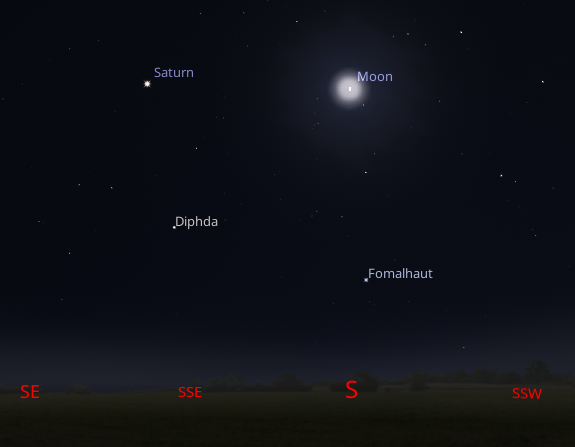
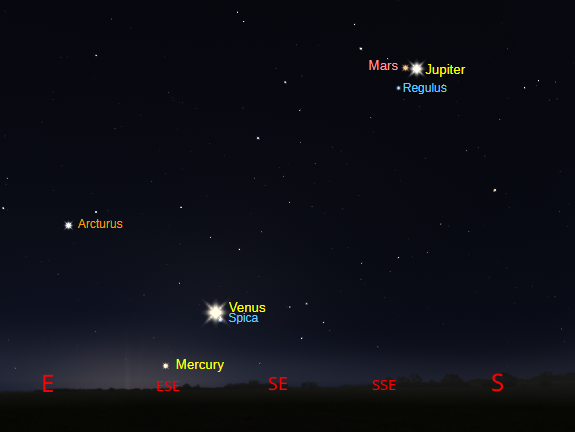
Let’s take our weekly look at the whereabouts of the naked-eye planets. All five of the naked-eye planets are visible in the night sky now. Tonight, Saturn will be in the southeastern sky as it gets dark. It is the brightest starlike object in that direction, The Moon is a bit lower in the southwest. The star Fomalhaut will be low in the south. Venus will be seen in the morning sky, rising at 4:50 AM. By 6:30 AM Mercury will join her near the horizon to the left. Jupiter and Mars will be in the southeastern sky, above and right of it, with the dimmer and red Mars just to the left of the brighter Jupiter. The bright blue-white star Regulus is below and left of both Mars and Jupiter.
The astronomical event times given in this blog are for the Traverse City/Interlochen area of Michigan (Lat 44.7° N, Long 85.7° W; EST, UT – 5 hours) unless stated otherwise. Times will be different for other locations.
Addendum
Saturn appears in the south southeast by 8 PM, to the left of the Moon in the south, November 18, 2026. Created using Stellarium.
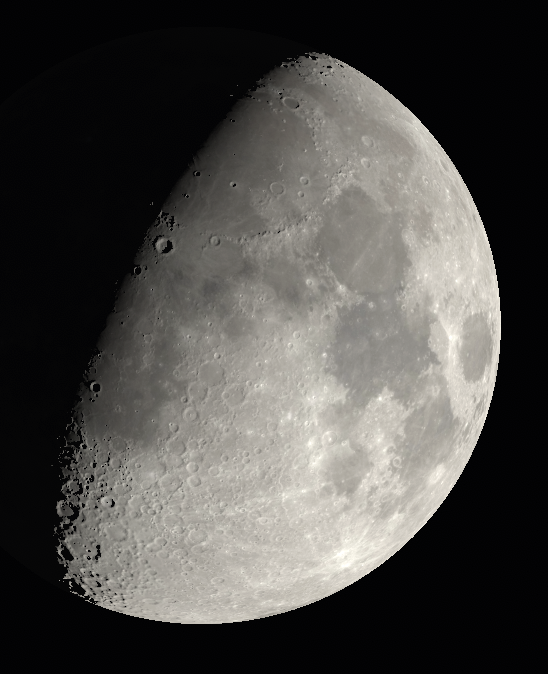
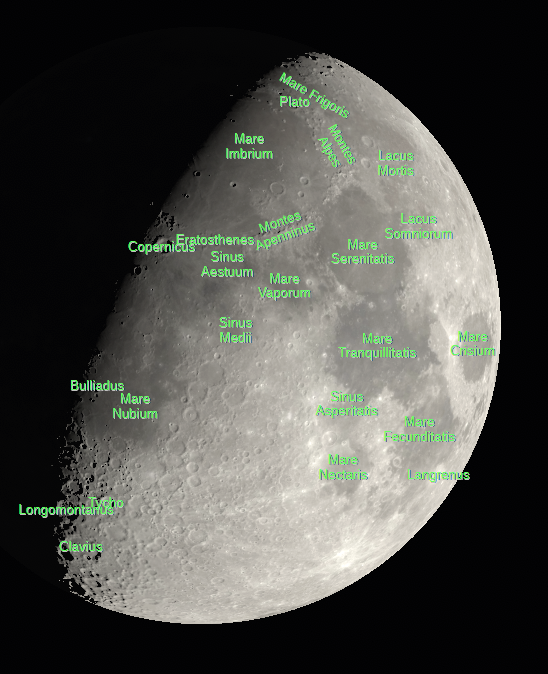
The Moon, 1 day after first quarter, at 8 PM tonight, November 18, 2026. A view visible in small telescopes showing an image with and without selected features labeled. Created using Stellarium, LibreOffice Draw, and GIMP.
Jupiter, Mars, Venus and Mercury appear with the brightest stars of the evening spring sky at 6:30 AM, November 19 2026. Created using Stellarium and LibreOffice Draw.
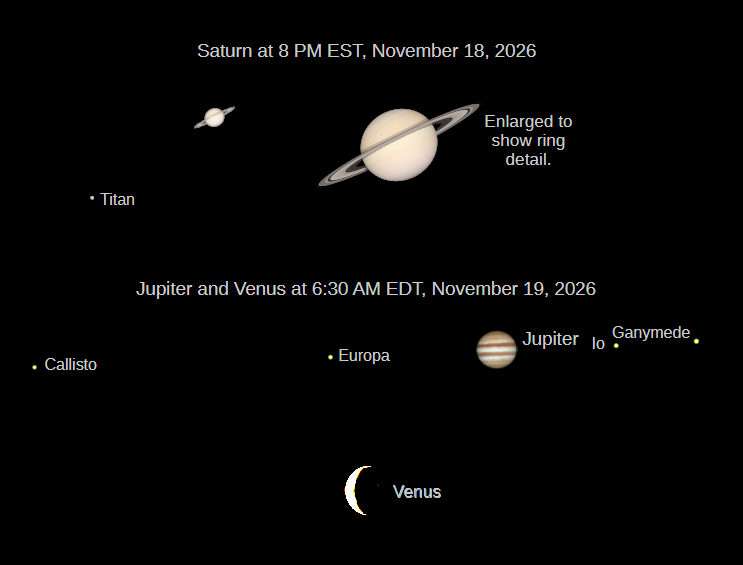
Telescopic views of the naked-eye planets as seen in a small telescope: At 8 PM, Saturn will be 19.0″ in diameter, and its rings extend to 44.3″. At 6:30 AM, Jupiter will be 37.8″ in diameter. Mars, not shown, will appear 7.3″ in diameter. Venus will be 47.1″ in diameter and 17.6% illumonated. Mercury, also not shown, will be 7.0″ in diameter, and 54.6% illuminated. The (”) symbol means seconds of arc, or 1/3600th of a degree. Created using Cartes du Ciel (Sky Charts), LibreOffice Draw and GIMP.
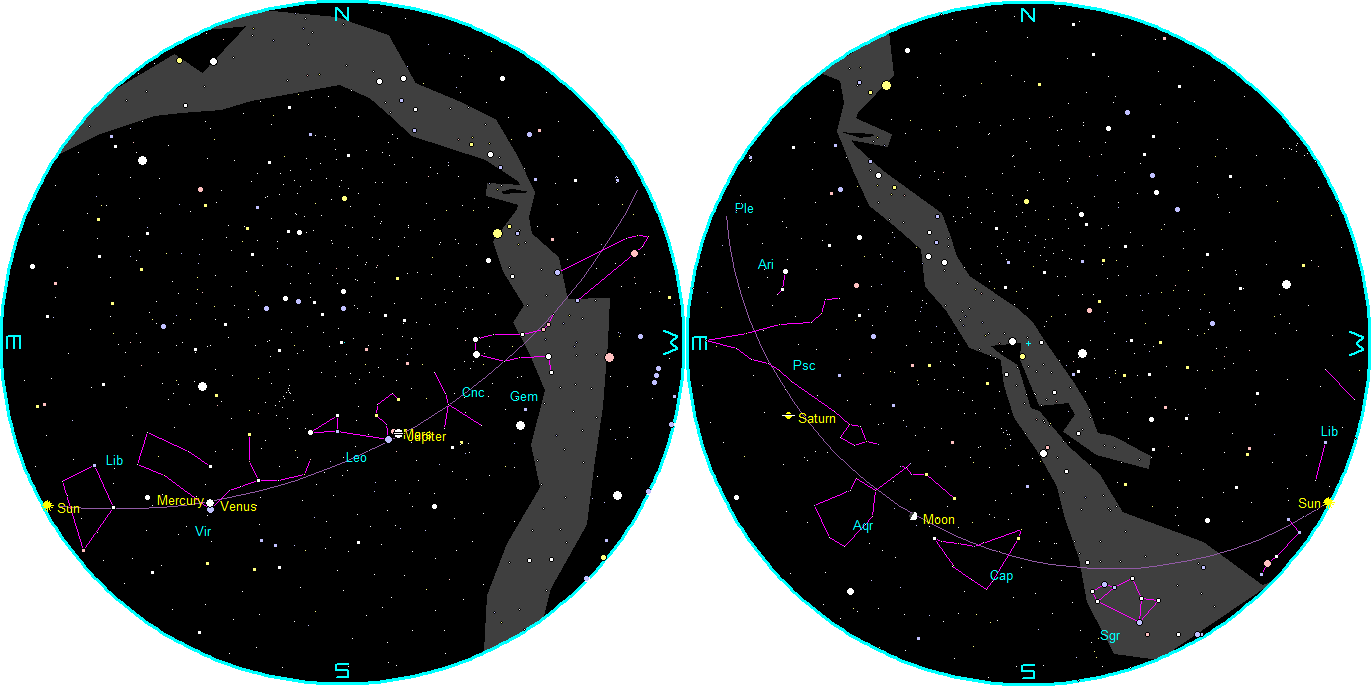
The naked-eye planets at sunset and sunrise on a single night, starting with sunset on the right on November 18, 2026. The night ends on the left with sunrise on the 19th. Click or tap on the image to enlarge it. Created using my LookingUp app and GIMP.
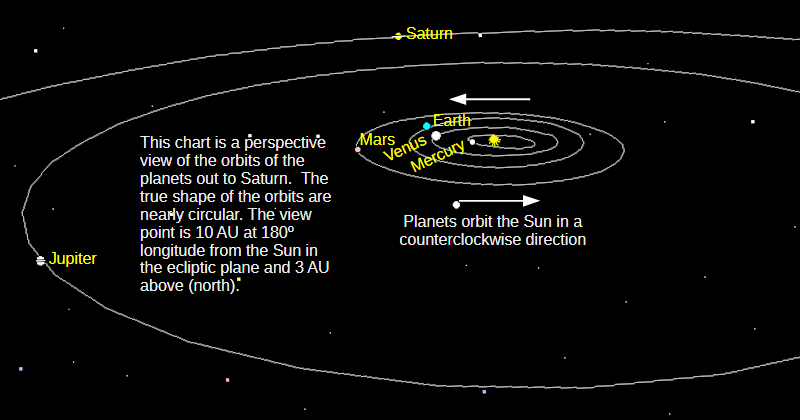
The naked-eye planets, from Mercury to Saturn, in a low angle perspective view of the solar system from above and a bit beyond Saturn’s orbit for today, November 18, 2026. Created using my LookingUp app, text and arrows created using LibreOffice Draw and produced a unified image using GIMP.