Archive
05/28/2018 – Ephemeris – NASA’s Juno spacecraft takes deep dives at Jupiter
Ephemeris for Memorial Day, Monday, May 28th. Today the Sun will be up for 15 hours and 15 minutes, setting at 9:17, and it will rise tomorrow at 6:02. The Moon, 1 day before full, will set at 6:24 tomorrow morning.
NASA’s Juno spacecraft has made 11 close passes of Jupiter since being inserted into Jovian orbit in July 2016. It has a highly elliptical orbit. It comes in over the north pole, passes only 2,000 miles over the cloud tops at the equator and heads out over the south pole, avoiding the most intense parts of Jupiter’s radiation belts. The high latitude and polar clouds appear more chaotic than expected. We can’t see these very well from the Earth. The magnetic field is much stronger and lumpier than thought before. A very much improved and complex picture of our largest planet is emerging, as we expected. The mission isn’t over and years of analysis are ahead to begin to more fully understand the solar system’s greatest planet.
The times given are for the Traverse City/Interlochen area of Michigan. They may be different for your location.
Addenda
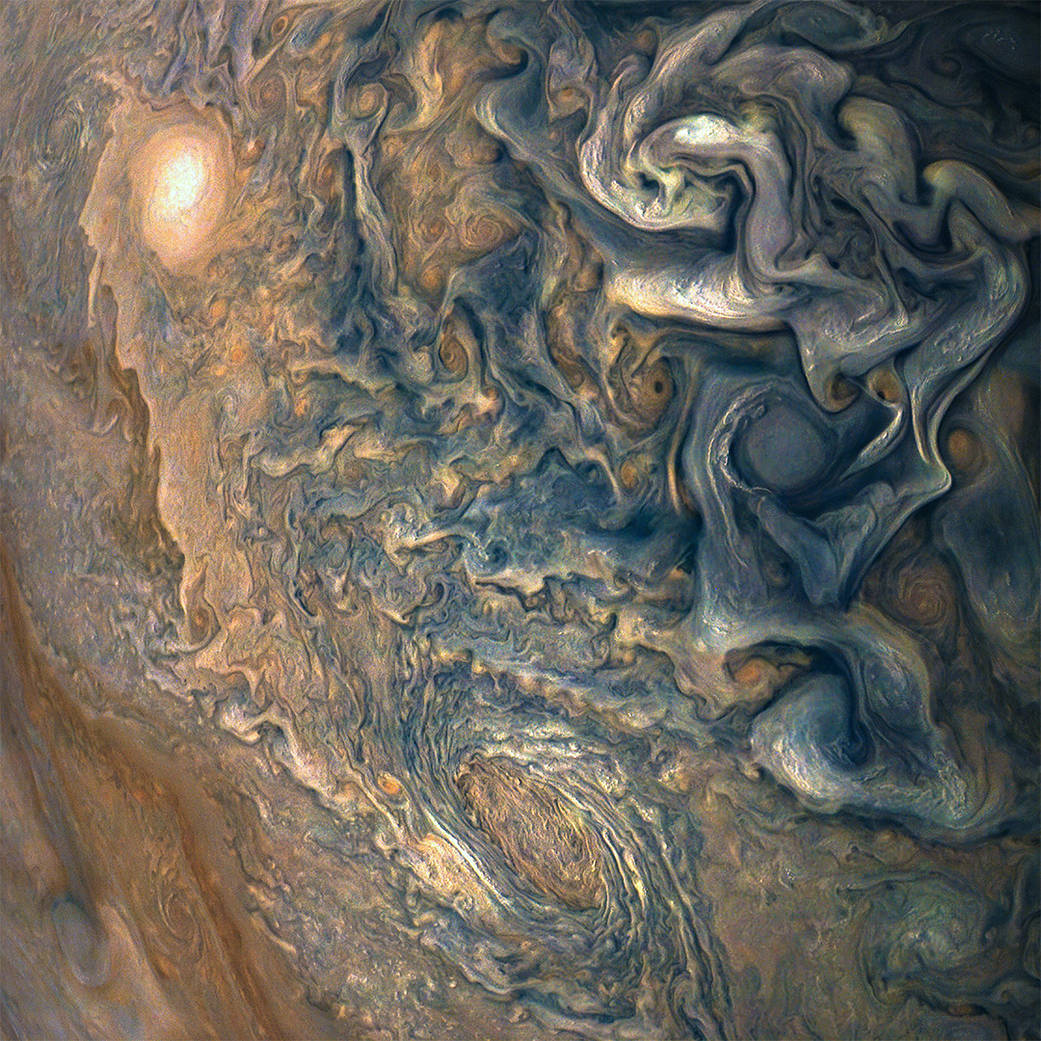
Chaotic storms at Jovian high latitudes. Credit NASA/JUNO
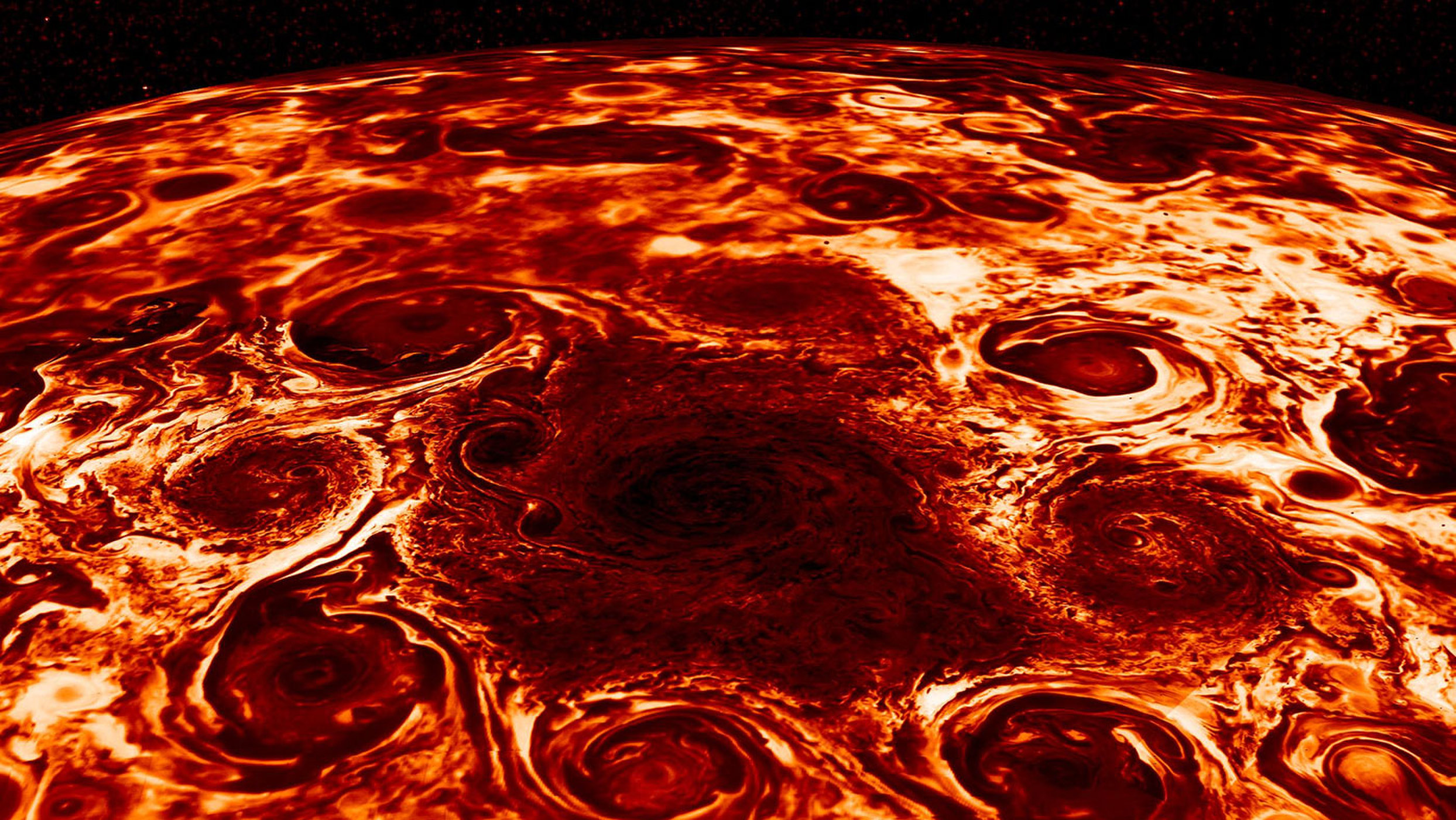
Jupiter’s North Pole in the infrared. 8 cyclones surrounding a 9th at the pole. Credit: NASA/JPL-Caltech/SwRI/ASI/INAF/JIRAM
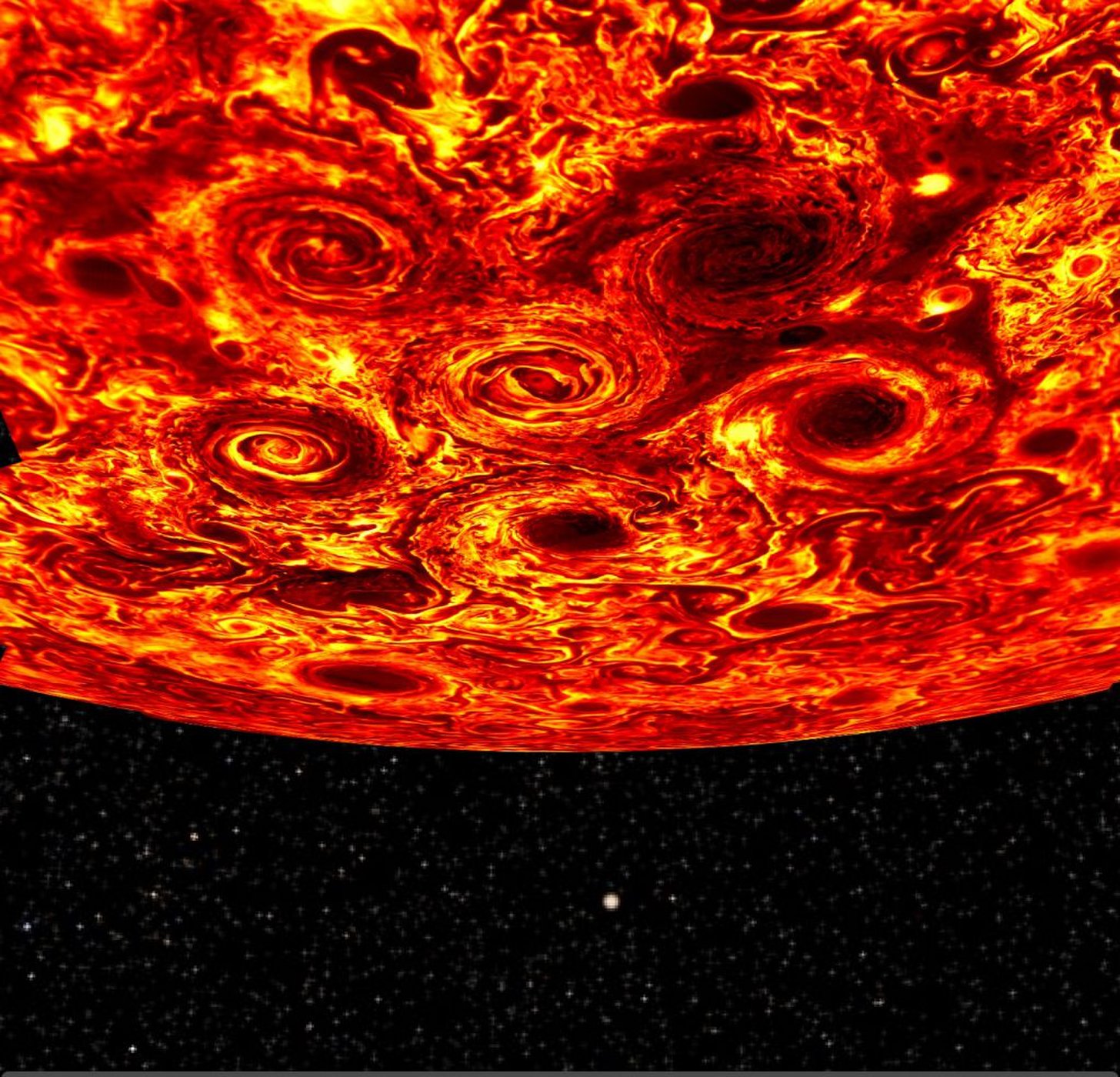
Jupiter’s South Pole in the infrared. 5 cyclones surrounding a 6th at the pole. Credit: NASA/JPL-Caltech/SwRI/ASI/INAF/JIRAM
Alan Bean
Astronaut Alan Bean, 4th person to walk on the Moon with Apollo 12 passed away this weekend. He also commanded the second Skylab mission and retired to become an artist, a painter of his adventures on the Moon and in space. Of the twelve men who walked on the Moon, only four survive.
10/03/2017 – Ephemeris – OSIRIS-REx and the asteroid Bennu
Ephemeris for Tuesday, October 3rd. The Sun will rise at 7:43. It’ll be up for 11 hours and 35 minutes, setting at 7:18. The Moon, 2 days before full, will set at 6:11 tomorrow morning.
Eleven days ago, on September 22nd, a small spacecraft named OSIRIS-REx zipped past the Earth to gain speed and alter the inclination of its solar orbit to reach the asteroid Bennu late next year. Bennu is rated as a potentially hazardous asteroid, with a tiny chance of colliding with the Earth late in the next century.
Discovered in 1999, and named by a 9-year-old boy in a contest run by the Planetary Society after an Egyptian god who is depicted as a heron, because the spacecraft kinda looked like one. It is a carbonaceous asteroid, containing very primitive material from the dawn of the solar system. OSIRIS-REx will take a sample of the asteroid and return it to the Earth in 2023 if all goes well. The Earth pass also allowed it to calibrate its instruments.
The times given are for the Traverse City/Interlochen area of Michigan. They may be different for your location.
Addendum
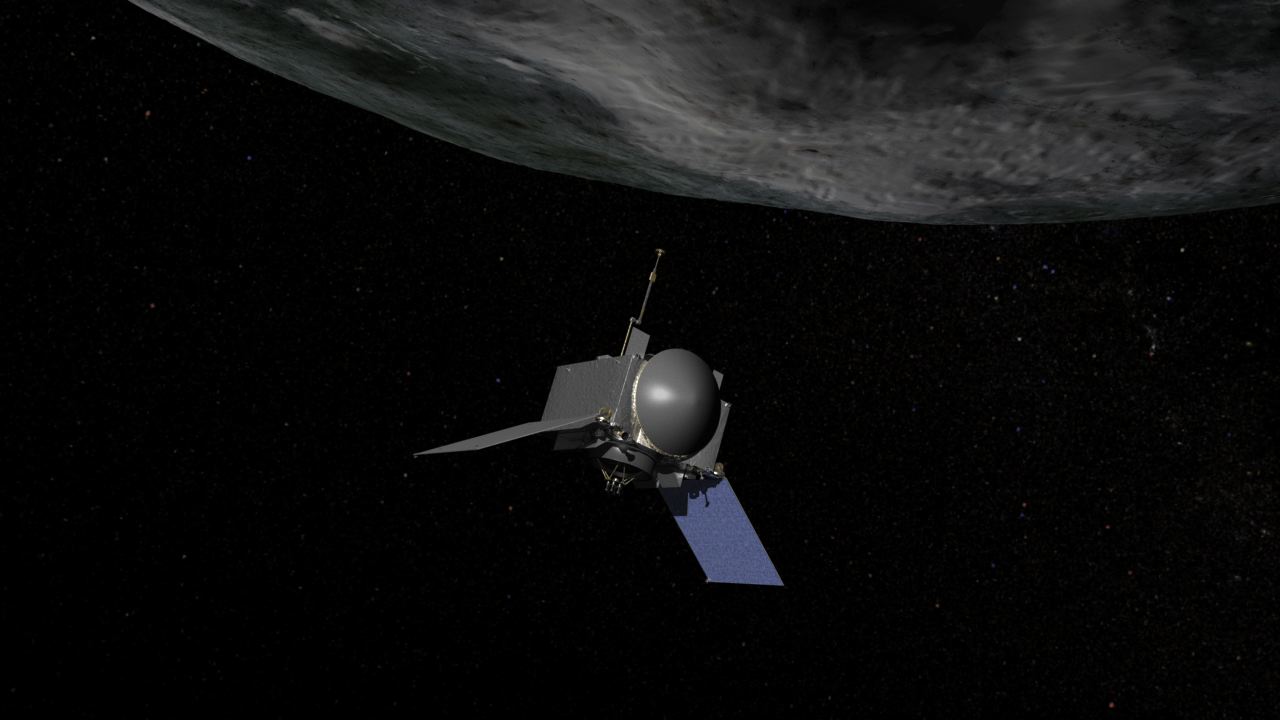
Artist’s conception of OSIRIS-REx about to collect a sample from asteroid Bennu. Image Credit:
NASA/Goddard/Chris Meaney
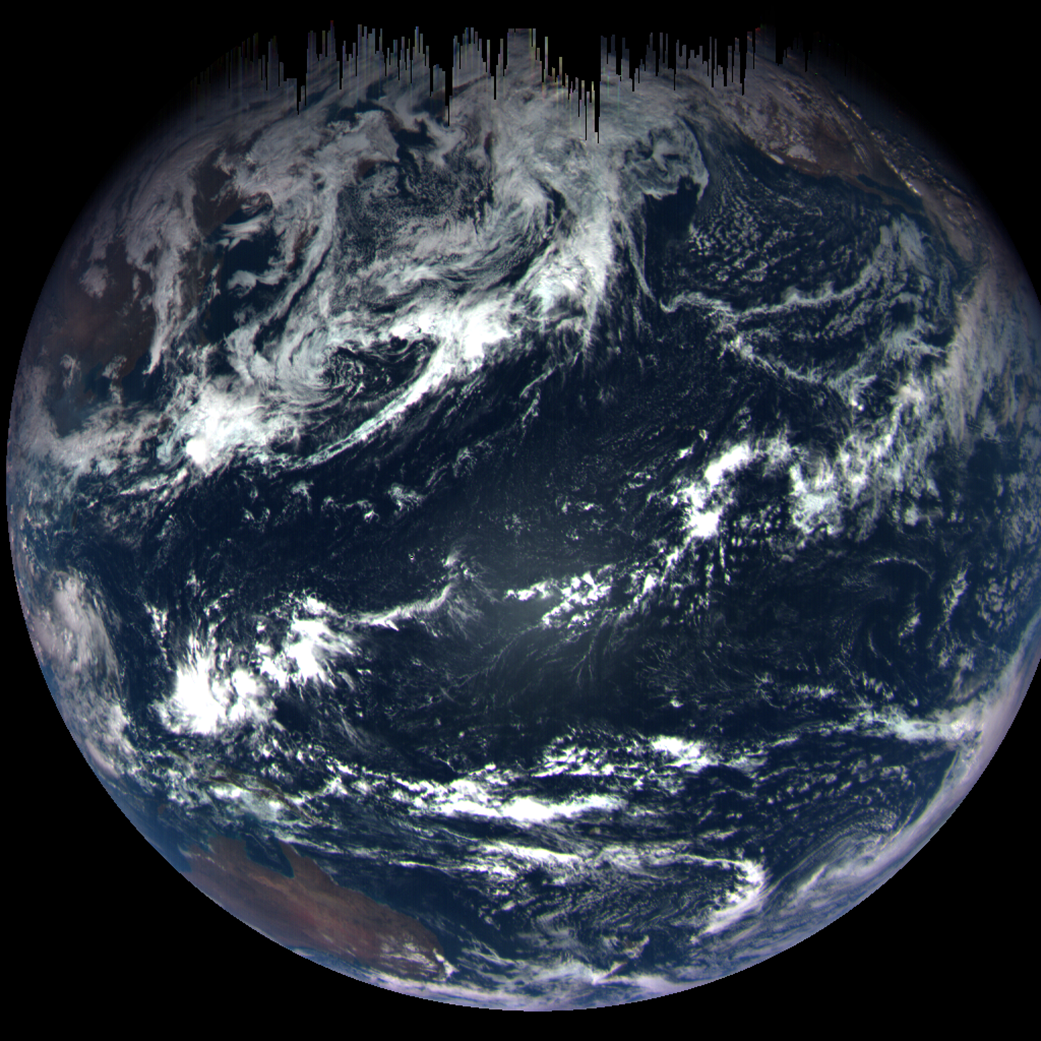
OSIRIS-REx observes the Earth. Here is the Pacific Ocean with Australia at the lower left, and the western US and Baja California at the upper right. Credit: NASA’s Goddard Space Flight Center/University of Arizona
NASA’s caption: A color composite image of Earth taken on Sept. 22 by the MapCam camera on NASA’s OSIRIS-REx spacecraft. This image was taken just hours after the spacecraft completed its Earth Gravity Assist at a range of approximately 106,000 miles (170,000 kilometers). MapCam is part of the OSIRIS-REx Camera Suite (OCAMS) operated by the University of Arizona. Visible in this image are the Pacific Ocean and several familiar landmasses, including Australia in the lower left, and Baja California and the southwestern United States in the upper right. The dark vertical streaks at the top of the image are caused by short exposure times (less than three milliseconds). Short exposure times are required for imaging an object as bright as Earth, but are not anticipated for an object as dark as the asteroid Bennu, which the camera was designed to image.
09/14/2017 – Ephemeris – Cassini will go out in a blaze of glory tomorrow morning
Ephemeris for Thursday, September 14th. The Sun will rise at 7:20. It’ll be up for 12 hours and 33 minutes, setting at 7:54. The Moon, 1 day past last quarter, will rise at 2:05 tomorrow morning.
Just about 24 hours from now the Cassini spacecraft will end its 20 year mission to Saturn and its 13 years of orbiting the planet. Monday, 4 days ago, it passed the great moon Titan for the last time, giving it one last gravitational boost into a suicidal plunge into Saturn’s atmosphere. At 7:55 tomorrow morning EDT (11:55 UTC), Cassini is expected to lose its stabilization in the thin upper atmosphere or Saturn and lose its connection with the Earth. It is expected to burn up, traveling at 70,000 miles an hour to become a part of the planet it investigated for 13 years. Instead of recording data for transmission to Earth later, it will be taking real-time atmospheric sampling, transmitting immediately up to the very end.
The times given are for the Traverse City/Interlochen area of Michigan. They may be different for your location.
Addendum
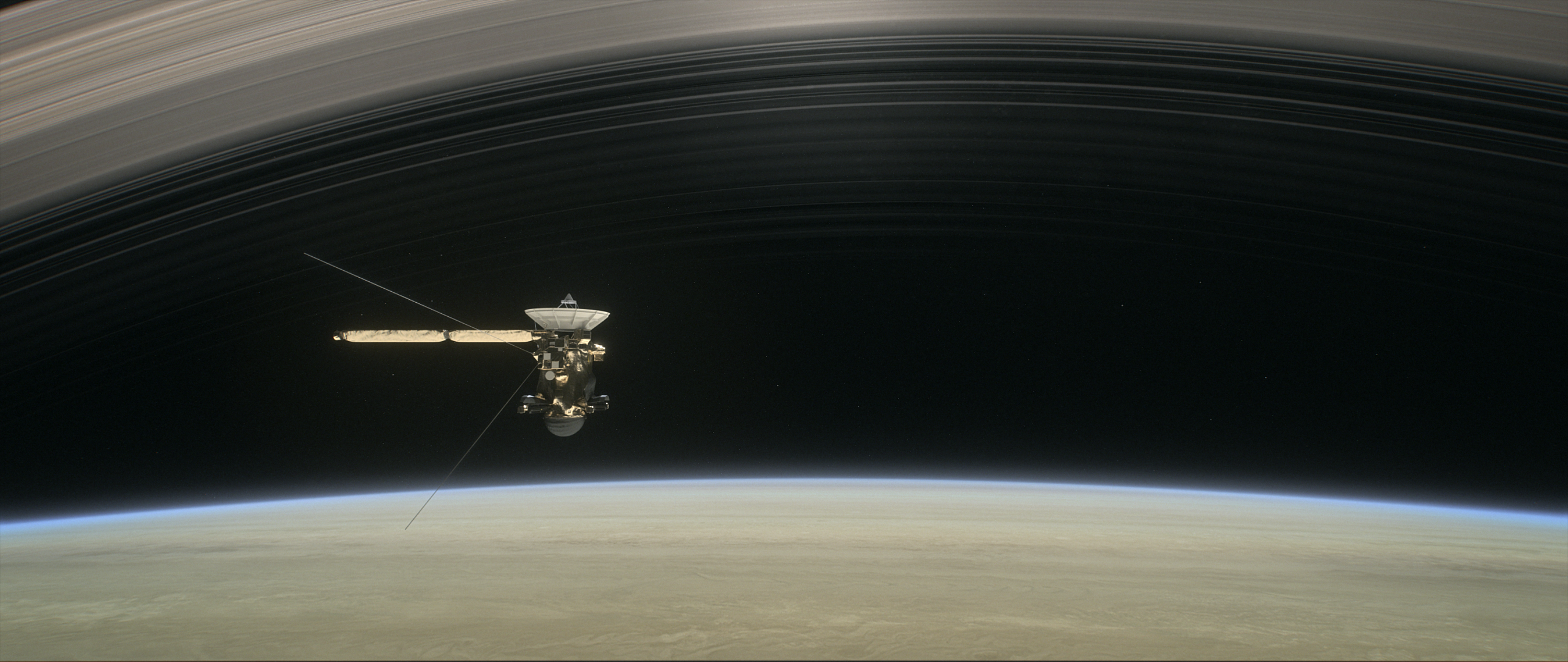
An artist’s visualization of Cassini slipping between the rings and the atmosphere of Saturn. Credit NASA/JPL.
Here’s a link to yesterday’s news conference at JPL on the end of the Cassini Mission: https://youtu.be/gs-dscW95PE.
Link to Emily Lakdawalla’s Planetary Society post on the final days of Cassini including NASA TV coverage: http://www.planetary.org/blogs/emily-lakdawalla/2017/0911-cassini-eom-timeline.html.
09/04/2017 – Ephemeris – Cassini has only 11 days to go.
Ephemeris for Labor Day, Monday, September 4th. The Sun will rise at 7:08. It’ll be up for 13 hours and 4 minutes, setting at 8:13. The Moon, 2 days before full, will set at 6:16 tomorrow morning.
In 11 days, the school bus sized Cassini spacecraft, which has orbited Saturn for the last 13 years will make it’s final plunge into Saturn’s atmosphere to burn up. Cassini’s controllers at the Jet Propulsion Laboratory decided after finding the small moon Enceladus had an internal ocean that it was venting into space with interesting compounds, that it could possibly harbor life, so leaving Cassini derelict orbiting Saturn among the moons, was thought not to be a good idea, in case the unsterilized spacecraft were to crash into Enceladus. So since this spring Cassini was directed to make a series of orbits that took it inside the rings, and on the final orbit to plunge into Saturn’s atmosphere to burn up.
The times given are for the Traverse City/Interlochen area of Michigan. They may be different for your location.
Addendum
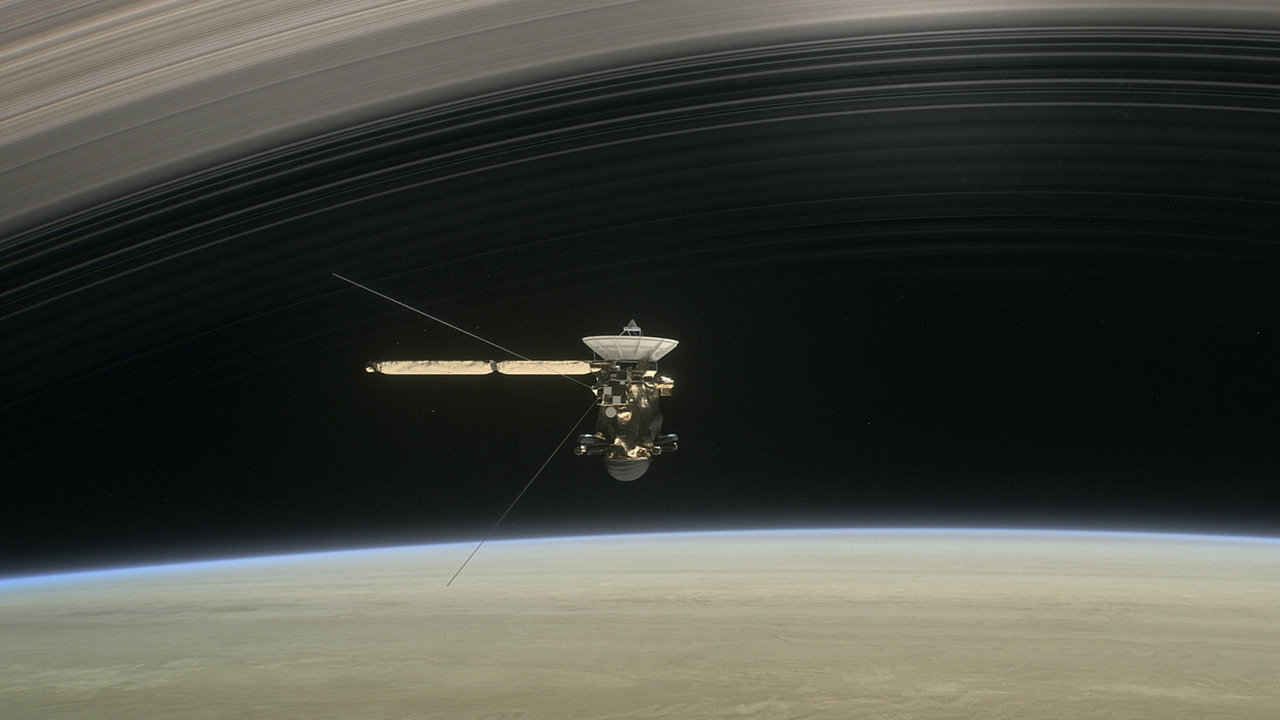
An artist’s visualization of Cassini Flying between the planet and the rings. Credit NASA/JPL. Click on the image to enlarge.
05/11/2017 – Ephemeris – Cassini is surviving its death-defying dives under the rings of Saturn
Ephemeris for Thursday, May 11th. Today the Sun will be up for 14 hours and 40 minutes, setting at 8:59, and it will rise tomorrow at 6:17. The Moon, 1 day past full, will rise at 9:42 this evening.
The Cassini spacecraft has been redirected by passing Titan on a special trajectory that sent it into a fatal set of orbits that take it a few thousand miles above Saturn’s cloud tops and under the innermost rings. So far after two passes Cassini survives. One discovery of the first pass was a storm, perhaps a hurricane, whose clear eye is at Saturn’s north pole. Cassini has yet to turn its cameras to the rings on these passes inside the rings, but it will before its final orbit. Currently it is flying communication dish first to protect its delicate instruments from ring particles. So far the gap between the rings and the planet are more free of particles than expected. Which is a good omen for the last 20 passes between the rings and planet.
The times given are for the Traverse City/Interlochen area of Michigan. They may be different for your location.
Addendum
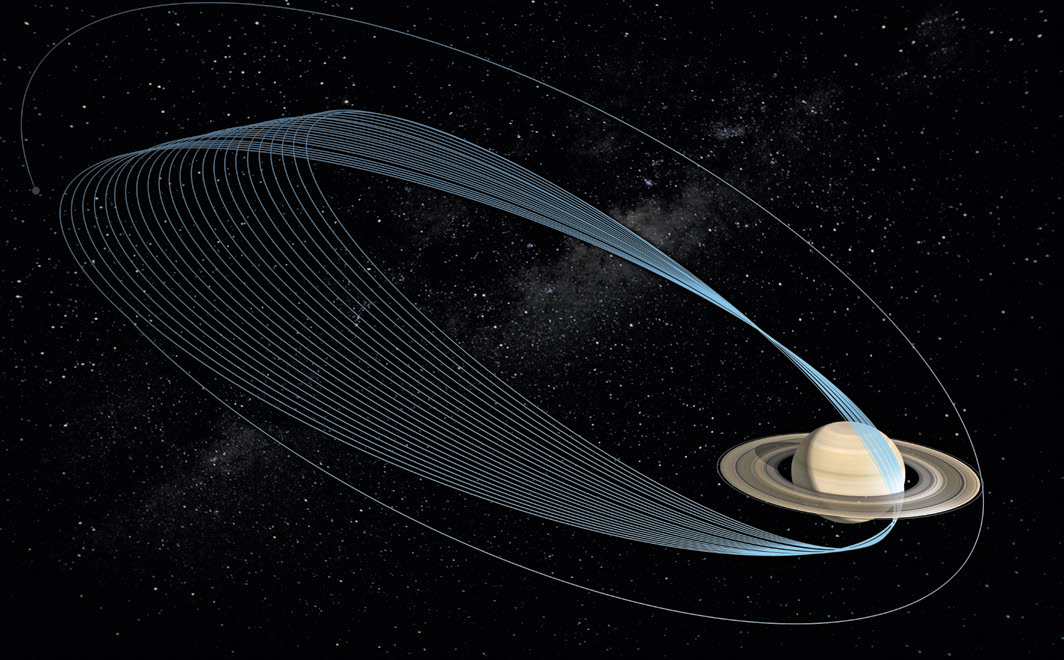
In its planned last 22 orbits of Saturn, the Cassini spacecraft will pass between the innermost ring and the planet itself. Credit NASA, JPL.
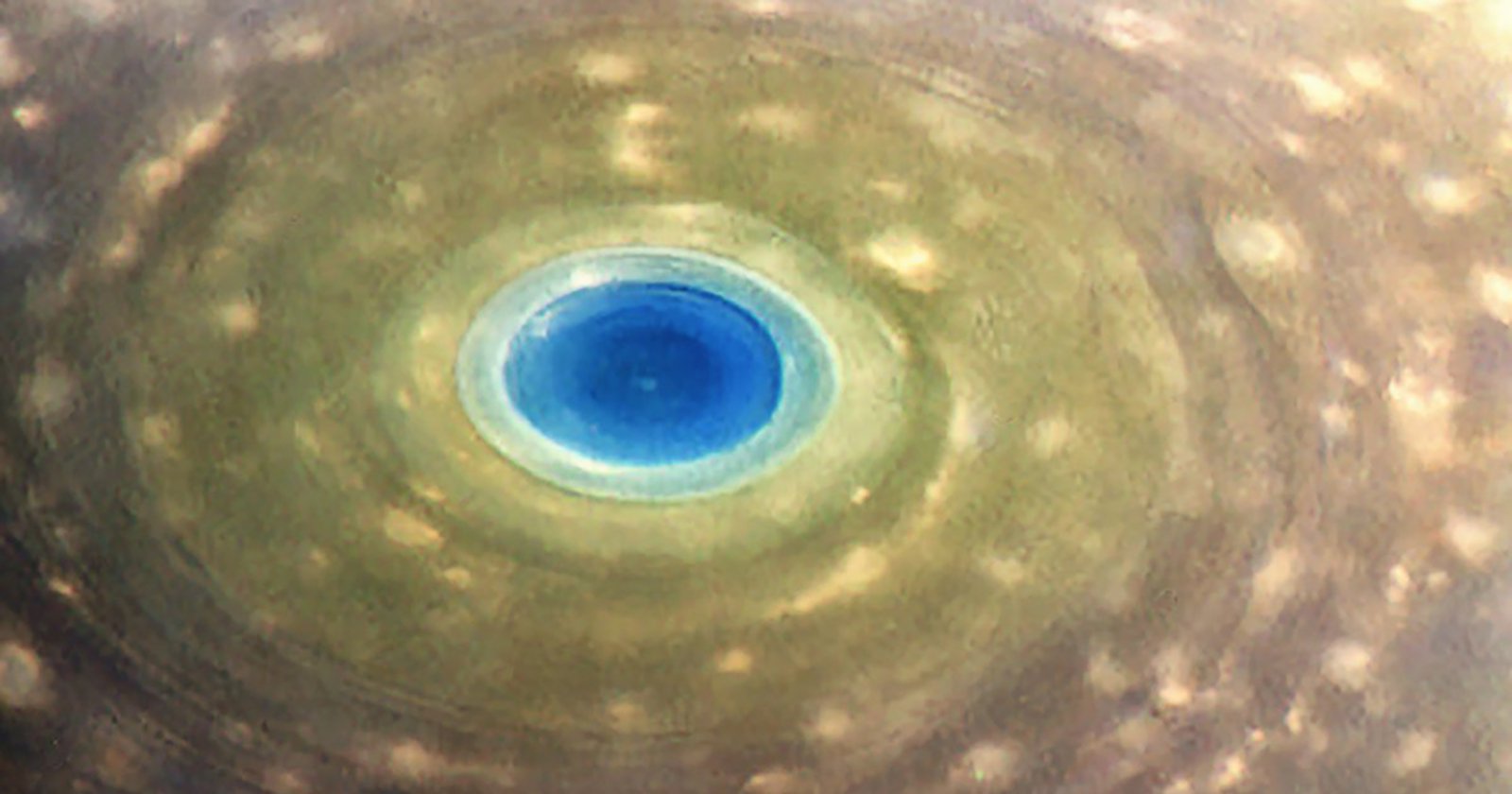
The clearing (blue sky) in the clouds at Saturn’s north pole spotted by Cassini on its first pass under the rings. Credit: NASA/JPL-Cal Tech/S Si/Sophia Nasr
04/25/2017 – Ephemeris – The Cassini spacecraft is on its last 22 orbits of Saturn
Ephemeris for Tuesday, April 25th. The Sun rises at 6:41. It’ll be up for 13 hours and 58 minutes, setting at 8:40. The Moon, 1 day before new, will rise at 7:08 tomorrow morning.
In the early hours of last Saturday, Earth Day, The Cassini spacecraft, orbiting Saturn for the last nearly 13 years, made its last pass of Saturn’s giant moon Titan. Over the past 13 years Cassini has been using Titan as a kind of fulcrum to leverage its orbits of Saturn, returning time and time again to both study this strange moon and to propel it via gravity assists into a myriad of orbits. This time however, with one last gravitational assist, Cassini was flung into a series of 22 daring orbits which will take it into a couple of thousand mile gap between the rings and the planet. On orbit 22, if it doesn’t collide with an errant ring particle, Cassini will burn up in Saturn’s atmosphere, going something like 70,000 miles an hour on September 15th.
The times given are for the Traverse City/Interlochen area of Michigan. They may be different for your location.
Addendum
In its planned last 22 orbits of Saturn, the Cassini spacecraft will pass between the innermost ring and the planet itself. Credit NASA, JPL.
04/11/2017 – Ephemeris – What’s under Jupiter’s cloud tops?
Ephemeris for Tuesday, April 11th. The Sun will rise at 7:04. It’ll be up for 13 hours and 17 minutes, setting at 8:22. The Moon, at full today, will rise at 8:54 this evening.
I made an error in yesterday’s on-air program which I fixed before posting this blog version. The moon Io will be over the face of Jupiter from when it rises tonight until 8:58 p.m.*, thereafter it will be seen just to the west of the planet. What we see of Jupiter are its cloud tops. Planetary astronomers have some very educated guesses as to what lies beneath them. An atmosphere of mainly hydrogen and helium, ending in a hot liquid ocean of hydrogen. Beneath that a core of metallic hydrogen that generates the planet’s huge magnetic field. Below that maybe a core of solid iron and other metals. NASA’s Juno spacecraft now orbiting Jupiter is tasked with finding out the interior structure by measuring the velocity of the spacecraft as it flies just above the cloud tops of this giant planet.
The times given are for the Traverse City/Interlochen area of Michigan. They may be different for your location.
* Observers in other locations around the world can check out the table from yesterday’s post of other Jovian satellite events after this entry is posted at 4:01 UT, April 11, 2017.
Addendum
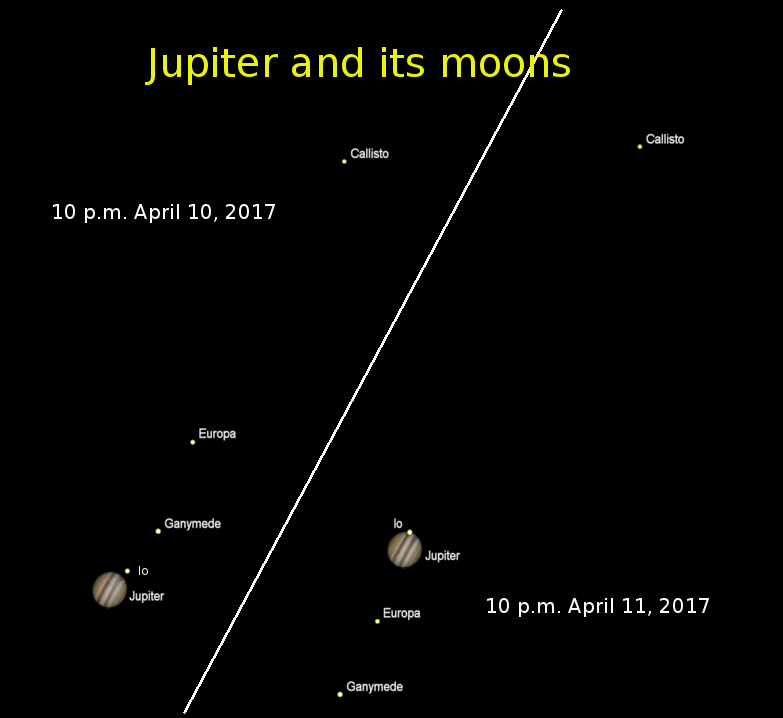
Jupiter and its moons in a telescope at 10 p.m. both April 10th & 11th, 2017. Created using Cartes du Ciel (Sky Charts).
For a year’s worth of Jovian satellite events and when the Great Red Spot crosses Jupiter’s central meridian, go to: http://www.projectpluto.com/jevent.htm.
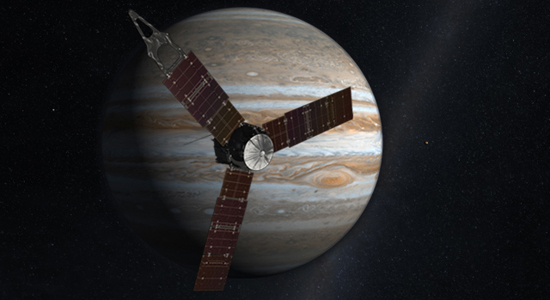
The Juno spacecraft. Credit: NASA.
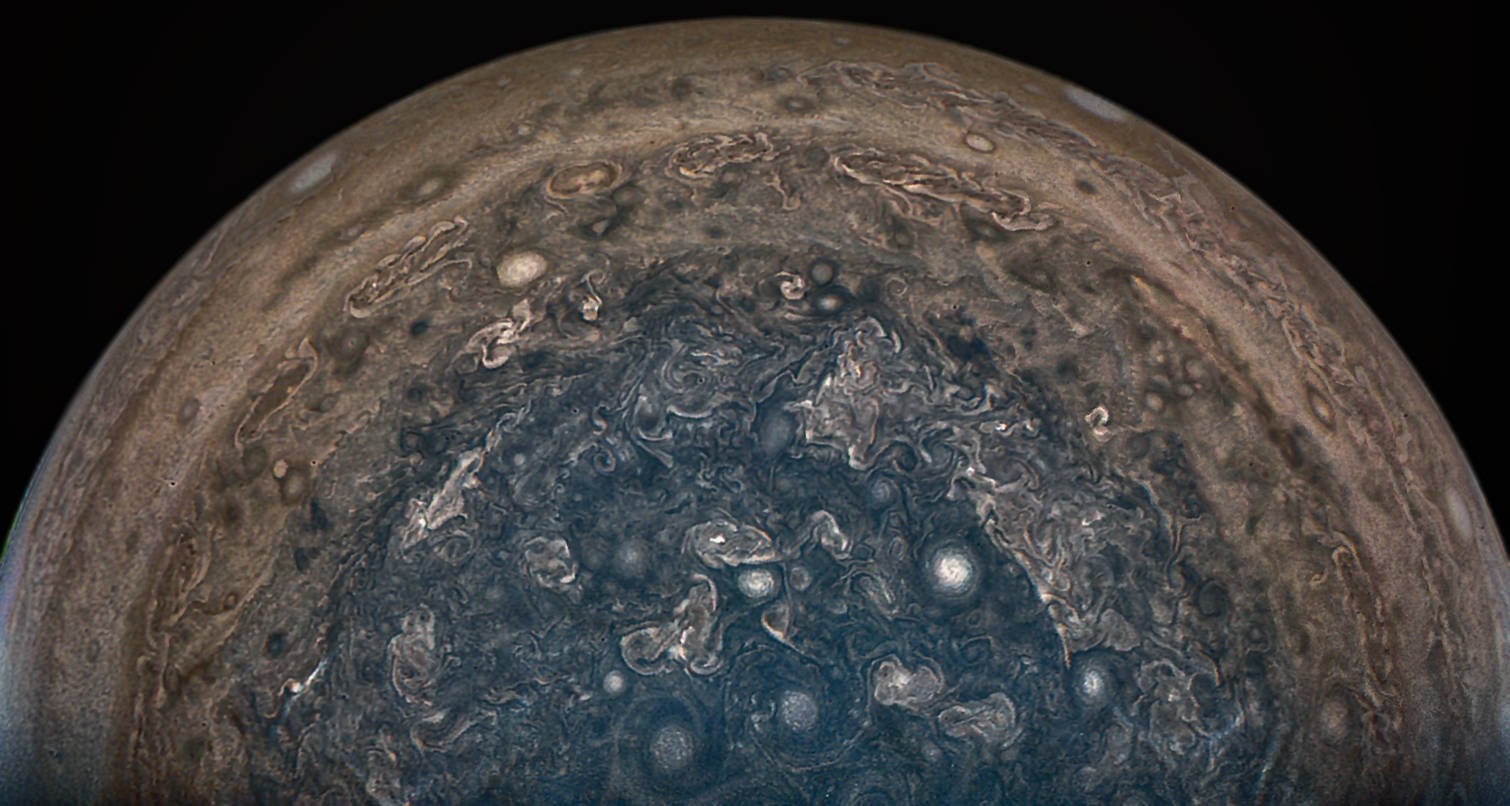
A February 2, 2017 Juno image of Jupiter’s south pole and its chaotic storm clouds. I think I have a paisley tie that looks like that. Credit NASA/JPL-Caltech/SwRI/MSSS/John Landino.
Pi Day fun
Tuesday is Pi Day (3.14) in American format. I received this email from Solar System Ambassadors Headquarters about educators, students and everyone else having fun with our favorite Greek letter:
From: Orr, Kim [mailto:Kimberly.M.Orr@jpl.nasa.gov]
Sent: Friday, March 10, 2017 10:59 AM
To:
Subject: Pi Day is Live!Hi all,
Happy Friday before Pi Day! Speaking of Pi Day, we’re now live with the following #NASAPiDayChallenge products:
- NASA Pi Day Challenge (MAIN LINK): https://www.jpl.nasa.gov/edu/nasapidaychallenge/
- “Celebrate Pi Day Like a NASA Rocket Scientist” Teachable Moment (for the science behind the challenge): http://go.nasa.gov/2m8VwpH
- Standards-aligned lesson: Pi in the Sky 4 (best for educator audiences): http://go.nasa.gov/2m8NrBB
- Share campaign: Pi Day: What’s Going ‘Round? (share what you’re doing for Pi Day): https://www.jpl.nasa.gov/edu/share/pi-day-whats-going-round/
- Twitter post: https://twitter.com/NASAJPL_Edu/status/840266573461958656
- Facebook post: https://www.facebook.com/NASAJPLEdu/posts/10158424974990397
We would, as always love any publicity, so please share like the wind. We’ll plan to tweet/post on early on March 14 with a link to the NASA Pi Day Challenge (https://www.jpl.nasa.gov/edu/nasapidaychallenge/). If you could retweet/repost us then, that would be great. For everything else, just be sure to use the hashtags: #PiDay and especially #NASAPiDayChallenge. Here’s a brief schedule of promotions:
- March 10: Promo lesson and teachable moment, focusing on educators
- March 13: Promo infographic/poster/downloadable products to general audience
- March 14: Promo NASA Pi Day Challenge to general audience, encourage participation in share campaign
- March 15: Ask for answers via social media
- March 16: Promo and release answer key
You can find all the graphics and promos in my exchange (kmorr/*PI DAY 2017) should you need them. They also include some incredible gifs made by Scott Hulme (check out the Mars crater one!).
Thanks all and let me know if you have any questions!
Best,
Kim
03/09/2017 – Ephemeris – More on the definition of a planet controversy
Ephemeris for Thursday, March 9th. The Sun will rise at 7:05. It’ll be up for 11 hours and 35 minutes, setting at 6:41. The Moon, 3 days before full, will set at 6:03 tomorrow morning.
Last Friday’s Weekly Space Hangout, on Google Hangouts featured Dr. Alan Stern, principal Investigator of the New Horizons Mission to Pluto and beyond. Dr. Stern considers himself a planetary scientist, rather than an astronomer, and doesn’t much care for the IAU or International Astronomical Union’s definition of a planet. To him and other planetary scientists: if it’s round and not a star… it’s a planet. They’re are more concerned about what it is than where it is, or what it’s orbiting. Planetary science encompasses geology, climatology, chemistry, and astrobiology among others. For instance astrobiology is looking at the origin of life on the Earth and looking for life on other worlds like the planet Mars and at least three moons, Jupiter’s Europa and Saturn’s Enceladus and Titan.
Times are for the Traverse City/Interlochen area of Michigan. They may be different for your location.
Addendum
Check out last Friday’s Weekly Space Hangout here
For the latest on astronomical, space events and discoveries this is a good place to go.
03/06/2017 – Ephemeris – TRAPPIST-1 The star with seven earth-sized planets
Ephemeris for Monday, March 6th. The Sun will rise at 7:10. It’ll be up for 11 hours and 26 minutes, setting at 6:37. The Moon, 1 day past first quarter, will set at 3:47 tomorrow morning.
The big astronomical news of two weeks ago was the announcement of a star system that had at least 7 earth-sized planets. And that three of them were in the habitable zone of their dim red dwarf star. The designation of the star is TRAPPIST-1, a Belgian telescope in South America that has nothing to do with monks. TRAPPIST is the acronym for the telescope’s rather long name. Confirmation of all the planets, their sizes and mass was carried out by NASA’s Spitzer Infrared Telescope trailing the Earth in solar orbit. Needless to say this star system will be the object of intense study as larger and more sophisticated ground and space based telescopes come on line in the next few years.
Times are for the Traverse City/Interlochen area of Michigan. They may be different for your location.
Addendum
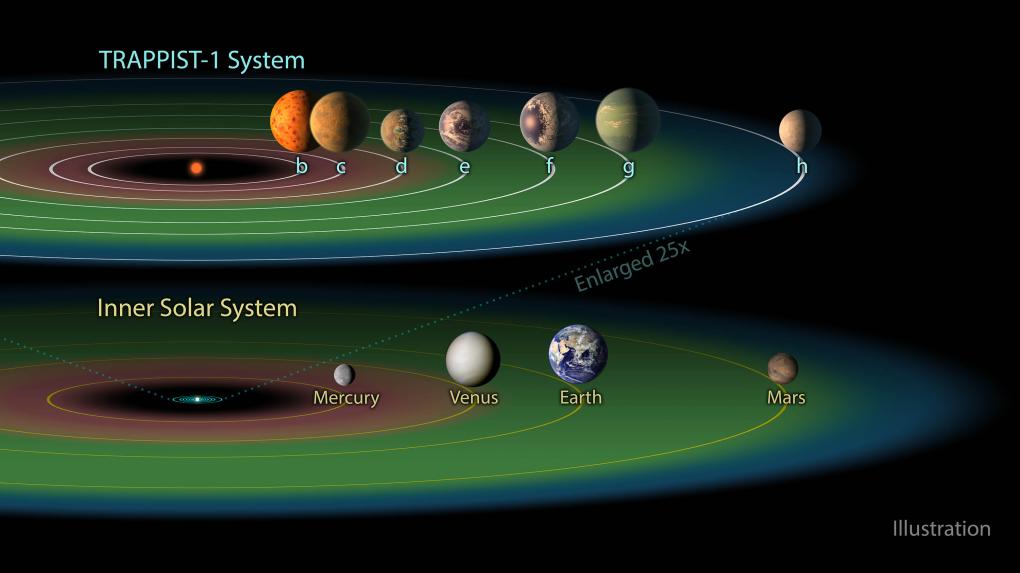
Comparison of the TRAPPIST-1 planetary system with our own inner solar system. The green zone is the habitable or Goldilocks zone Credit: NASA/JPL-Caltech/R. Hurt, T. Pyle (IPAC)
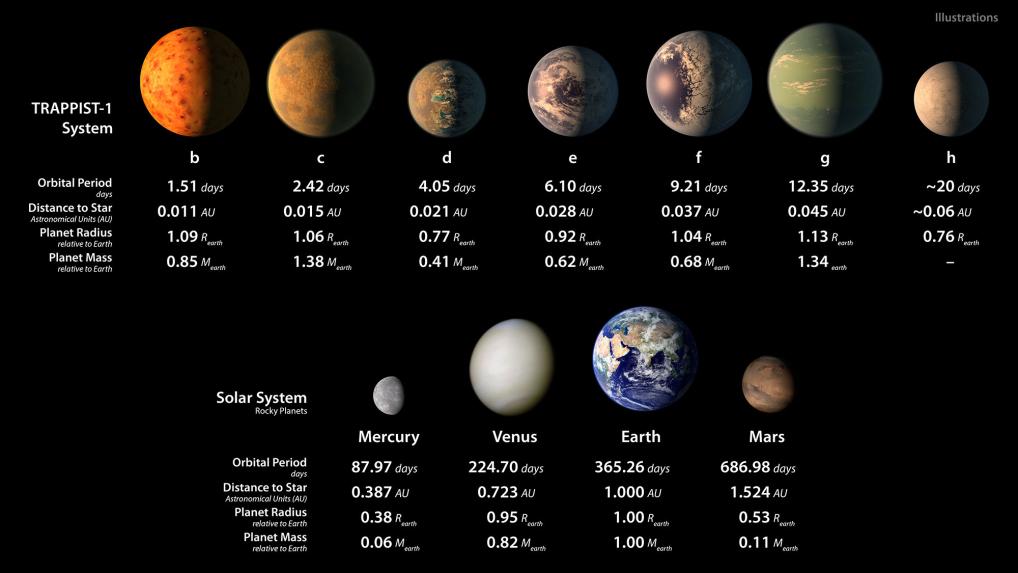
What is currently known about the TRAPPIST-1 Planets. Comparison of the TRAPPIST-1 planetary system with our own inner solar system. Credit: NASA/JPL-Caltech/R. Hurt, T. Pyle (IPAC)
Note that the surface features of these planets are in the eye of the illustrator. They are currently black shadows seen on the face of the star that they cross.
Planet g looks closest to the Earth’s density of the habitable zone planets. The problem I’d have is if I lived there at 12.35 days per year I’d be 2220 years old.
Entice your great-great-great-great grandkids with this travel poster:
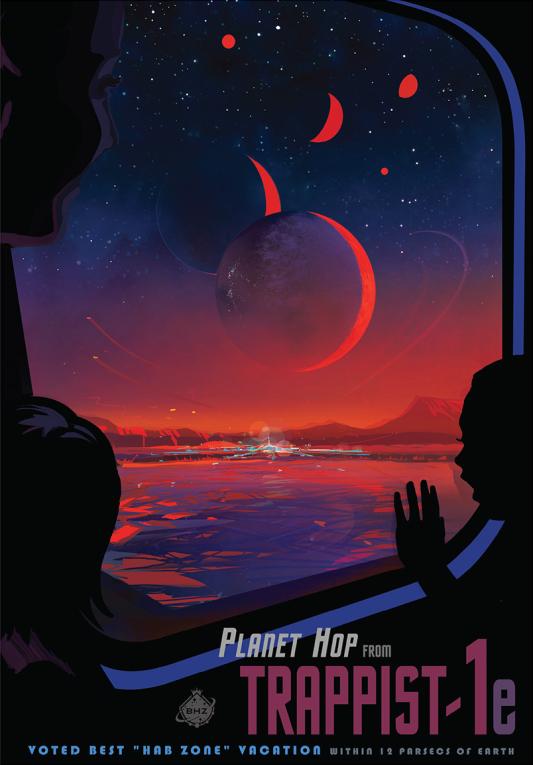
Planet Hop from TRAPPIST-1e. Maybe not next door like Proxima b, but just down the block. only 39 light years away.
For more information:
On the Spitzer site you can find:
Images
Videos (b-roll and annotated/narrated)
Planet surface maps and starfield backdrop image
http://www.spitzer.caltech.edu/trappist-1
On the JPL site you can also find:
Exoplanet Travel Poster
VR tour of TRAPPIST-1d surface
Additional videos
https://exoplanets.nasa.gov/trappist1/
On the ESO site you can also find:
Even more videos and graphics
http://www.eso.org/public/news/eso1706
Play around with the TRAPPIST-1 and other extra solar planetary systems with NASA’s Eyes: https://eyes.nasa.gov/eyes-on-exoplanets.htm.
Replay the news conference announcing the TRAPPIST-1 discovery from February 22, 2017:
http://www.ustream.tv/recorded/100200725.
 Bob Moler's Ephemeris Blog