Archive
Pi Day fun
Tuesday is Pi Day (3.14) in American format. I received this email from Solar System Ambassadors Headquarters about educators, students and everyone else having fun with our favorite Greek letter:
From: Orr, Kim [mailto:Kimberly.M.Orr@jpl.nasa.gov]
Sent: Friday, March 10, 2017 10:59 AM
To:
Subject: Pi Day is Live!Hi all,
Happy Friday before Pi Day! Speaking of Pi Day, we’re now live with the following #NASAPiDayChallenge products:
- NASA Pi Day Challenge (MAIN LINK): https://www.jpl.nasa.gov/edu/nasapidaychallenge/
- “Celebrate Pi Day Like a NASA Rocket Scientist” Teachable Moment (for the science behind the challenge): http://go.nasa.gov/2m8VwpH
- Standards-aligned lesson: Pi in the Sky 4 (best for educator audiences): http://go.nasa.gov/2m8NrBB
- Share campaign: Pi Day: What’s Going ‘Round? (share what you’re doing for Pi Day): https://www.jpl.nasa.gov/edu/share/pi-day-whats-going-round/
- Twitter post: https://twitter.com/NASAJPL_Edu/status/840266573461958656
- Facebook post: https://www.facebook.com/NASAJPLEdu/posts/10158424974990397
We would, as always love any publicity, so please share like the wind. We’ll plan to tweet/post on early on March 14 with a link to the NASA Pi Day Challenge (https://www.jpl.nasa.gov/edu/nasapidaychallenge/). If you could retweet/repost us then, that would be great. For everything else, just be sure to use the hashtags: #PiDay and especially #NASAPiDayChallenge. Here’s a brief schedule of promotions:
- March 10: Promo lesson and teachable moment, focusing on educators
- March 13: Promo infographic/poster/downloadable products to general audience
- March 14: Promo NASA Pi Day Challenge to general audience, encourage participation in share campaign
- March 15: Ask for answers via social media
- March 16: Promo and release answer key
You can find all the graphics and promos in my exchange (kmorr/*PI DAY 2017) should you need them. They also include some incredible gifs made by Scott Hulme (check out the Mars crater one!).
Thanks all and let me know if you have any questions!
Best,
Kim
03/09/2017 – Ephemeris – More on the definition of a planet controversy
Ephemeris for Thursday, March 9th. The Sun will rise at 7:05. It’ll be up for 11 hours and 35 minutes, setting at 6:41. The Moon, 3 days before full, will set at 6:03 tomorrow morning.
Last Friday’s Weekly Space Hangout, on Google Hangouts featured Dr. Alan Stern, principal Investigator of the New Horizons Mission to Pluto and beyond. Dr. Stern considers himself a planetary scientist, rather than an astronomer, and doesn’t much care for the IAU or International Astronomical Union’s definition of a planet. To him and other planetary scientists: if it’s round and not a star… it’s a planet. They’re are more concerned about what it is than where it is, or what it’s orbiting. Planetary science encompasses geology, climatology, chemistry, and astrobiology among others. For instance astrobiology is looking at the origin of life on the Earth and looking for life on other worlds like the planet Mars and at least three moons, Jupiter’s Europa and Saturn’s Enceladus and Titan.
Times are for the Traverse City/Interlochen area of Michigan. They may be different for your location.
Addendum
Check out last Friday’s Weekly Space Hangout here
For the latest on astronomical, space events and discoveries this is a good place to go.
03/06/2017 – Ephemeris – TRAPPIST-1 The star with seven earth-sized planets
Ephemeris for Monday, March 6th. The Sun will rise at 7:10. It’ll be up for 11 hours and 26 minutes, setting at 6:37. The Moon, 1 day past first quarter, will set at 3:47 tomorrow morning.
The big astronomical news of two weeks ago was the announcement of a star system that had at least 7 earth-sized planets. And that three of them were in the habitable zone of their dim red dwarf star. The designation of the star is TRAPPIST-1, a Belgian telescope in South America that has nothing to do with monks. TRAPPIST is the acronym for the telescope’s rather long name. Confirmation of all the planets, their sizes and mass was carried out by NASA’s Spitzer Infrared Telescope trailing the Earth in solar orbit. Needless to say this star system will be the object of intense study as larger and more sophisticated ground and space based telescopes come on line in the next few years.
Times are for the Traverse City/Interlochen area of Michigan. They may be different for your location.
Addendum
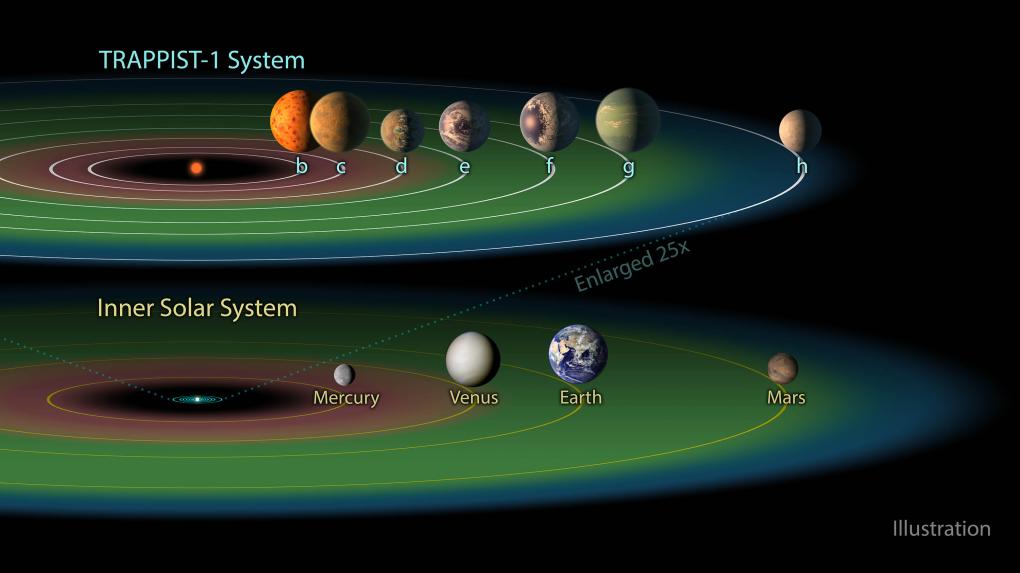
Comparison of the TRAPPIST-1 planetary system with our own inner solar system. The green zone is the habitable or Goldilocks zone Credit: NASA/JPL-Caltech/R. Hurt, T. Pyle (IPAC)
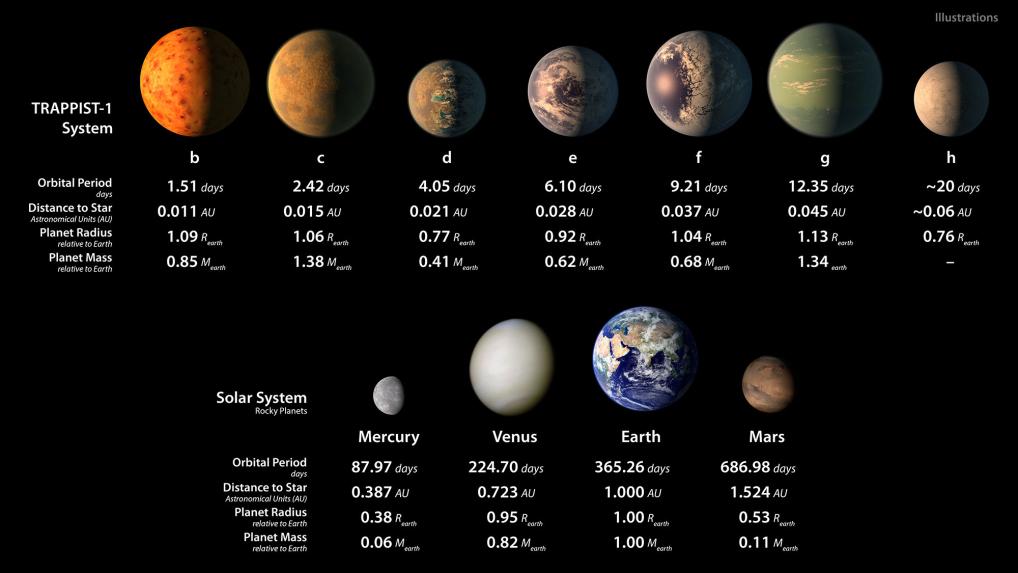
What is currently known about the TRAPPIST-1 Planets. Comparison of the TRAPPIST-1 planetary system with our own inner solar system. Credit: NASA/JPL-Caltech/R. Hurt, T. Pyle (IPAC)
Note that the surface features of these planets are in the eye of the illustrator. They are currently black shadows seen on the face of the star that they cross.
Planet g looks closest to the Earth’s density of the habitable zone planets. The problem I’d have is if I lived there at 12.35 days per year I’d be 2220 years old.
Entice your great-great-great-great grandkids with this travel poster:
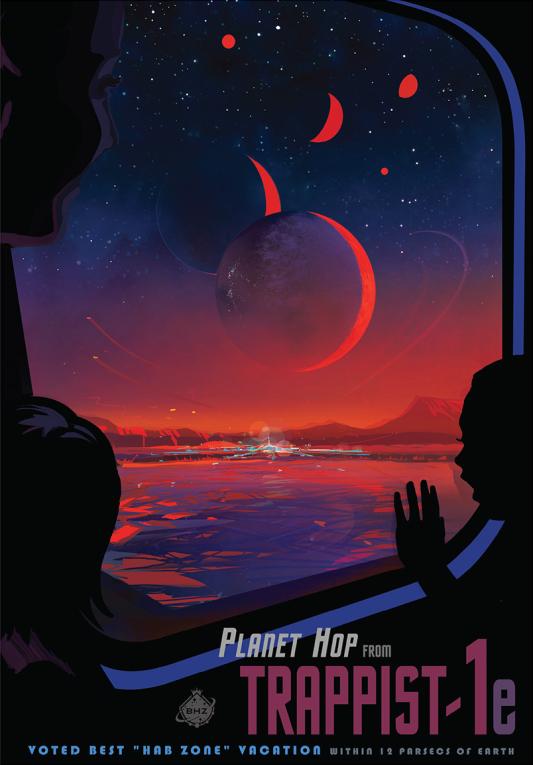
Planet Hop from TRAPPIST-1e. Maybe not next door like Proxima b, but just down the block. only 39 light years away.
For more information:
On the Spitzer site you can find:
Images
Videos (b-roll and annotated/narrated)
Planet surface maps and starfield backdrop image
http://www.spitzer.caltech.edu/trappist-1
On the JPL site you can also find:
Exoplanet Travel Poster
VR tour of TRAPPIST-1d surface
Additional videos
https://exoplanets.nasa.gov/trappist1/
On the ESO site you can also find:
Even more videos and graphics
http://www.eso.org/public/news/eso1706
Play around with the TRAPPIST-1 and other extra solar planetary systems with NASA’s Eyes: https://eyes.nasa.gov/eyes-on-exoplanets.htm.
Replay the news conference announcing the TRAPPIST-1 discovery from February 22, 2017:
http://www.ustream.tv/recorded/100200725.
02/21/2017 – Ephemeris – Finding Saturn this morning and Cassini’s future
Ephemeris for Tuesday, February 21st. The Sun will rise at 7:32. It’ll be up for 10 hours and 47 minutes, setting at 6:19. The Moon, 3 days past last quarter, will rise at 4:48 tomorrow morning.
This morning the crescent Moon will act as a pointer to the planet Saturn. The ringed planet will appear to the right of our Moon. Saturn’s rings will show in any telescope with 20 times magnification or greater. Out at Saturn for the last 13 years and for the next 7 months the robot spacecraft Cassini has been orbiting the ringed planet using gravity assists from the giant moon Titan as a fulcrum to leverage itself into many different orbits to study Saturn’s rings and collection of moons. In a bit over seven months it’s fantastic journey will be over. Low on fuel, it will plunge between the rings and the cloud tops, spiraling in towards its doom September 30th into the planet’s atmosphere so as not to contaminate the icy moons which could possibly harbor life.
Times are for the Traverse City/Interlochen area of Michigan. They may be different for your location.
Addendum
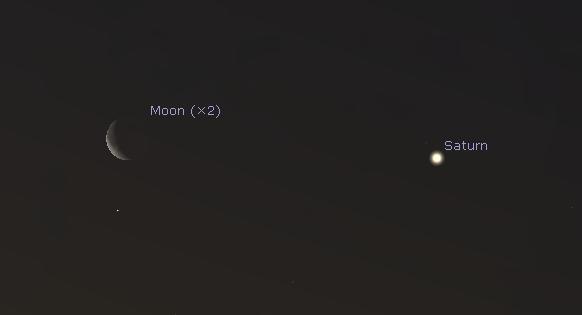
Using the Moon to locate Saturn in the southeast at 7 a.m. or earlier on February 21, 2017. The Moon is enlarged to show it better. Created using Stellarium.
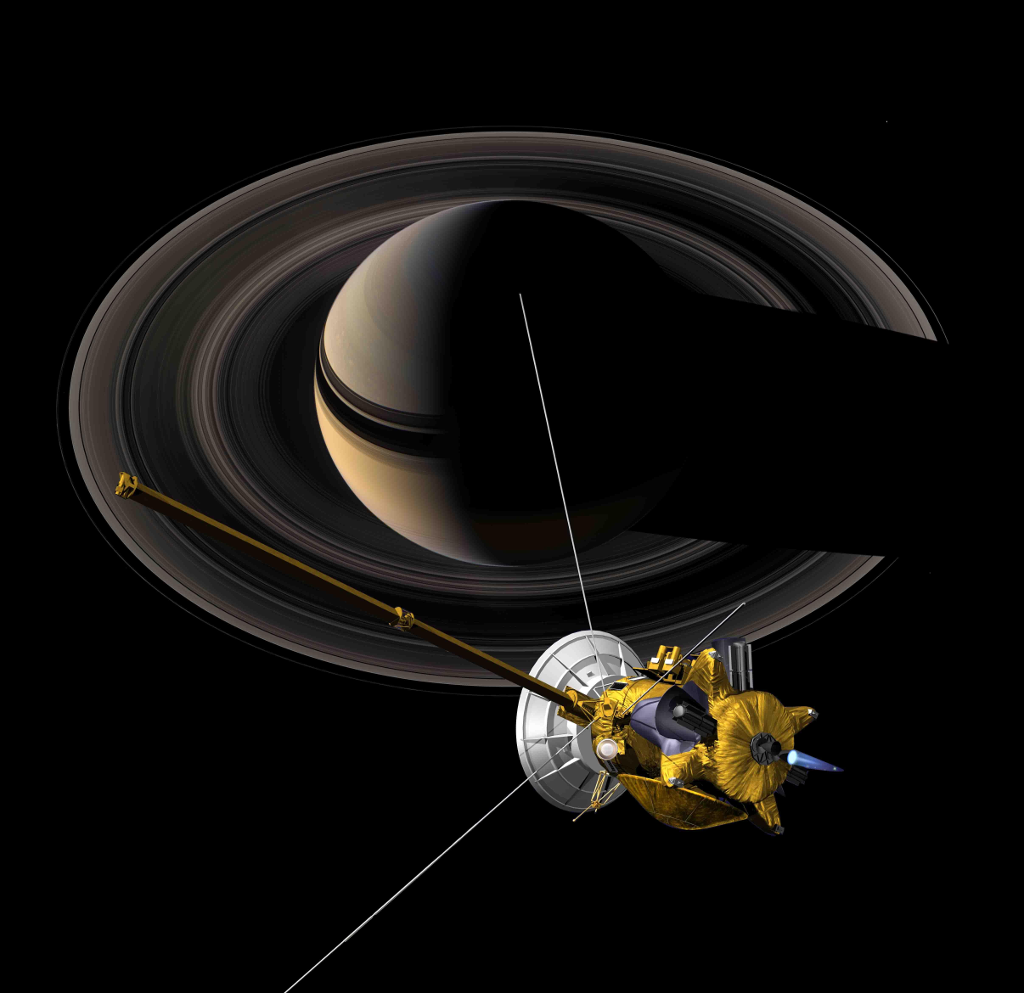
The Cassini spacecraft at Saturn. Credit: NASA/JPL.
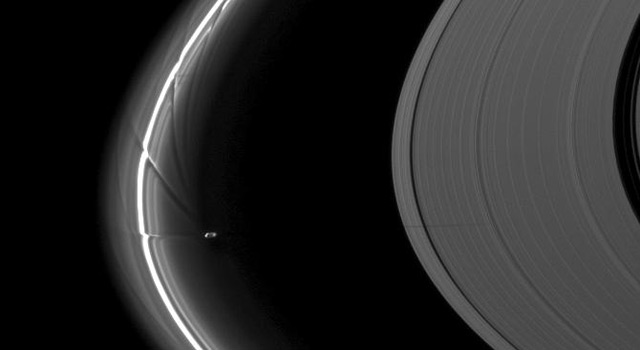
The shepherd satellite Prometheus leaving a wake in Saturn’s outer F Ring. Credit: NASA/JPL.
01/18/2017 – Ephemeris – Where are the bright planets this week?
Ephemeris for Wednesday, January 18th. The Sun will rise at 8:13. It’ll be up for 9 hours and 18 minutes, setting at 5:32. The Moon, 1 day before last quarter, will rise at 12:32 tomorrow morning.
Let’s check out the bright planets for this week. Saturn can be glimpsed this morning at 7 a.m. It will rise tomorrow at 5:49 in the east-southeast. Jupiter can be seen in the south-southwest this morning above the star Spica in Virgo. Jupiter will rise tomorrow at 12:40 a.m. Tomorrow the last quarter Moon will appear near Jupiter. Venus and Mars are in the evening sky. At 6:30 p.m. these planets will be seen in the southwestern sky. Venus is unmistakable as the brilliant evening star, Mars will be above and left of it and much dimmer and will set at 10:14. Venus itself will set at 9:39 p.m. Venus exhibits a fat crescent in small telescopes now, but next month as it gets closer the thinning crescent will be big enough to be seen in binoculars.
Times are for the Traverse City/Interlochen area of Michigan. They may be different for your location.
Addendum
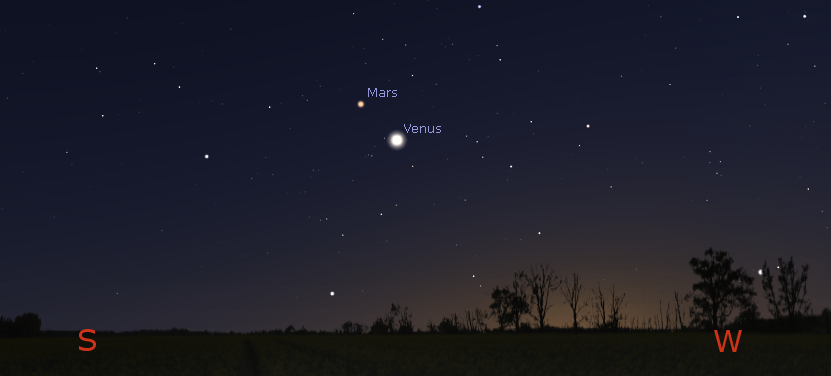
Venus, and Mars in the evening twilight of about an hour after sunset. 6:30 p.m. January 18, 2017. Created using Stellarium. Click image to enlarge.
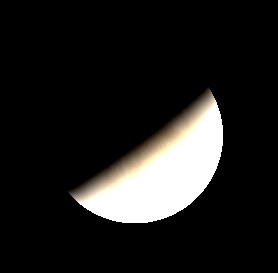
Venus as it might appear in a telescope tonight January 18, 2016. I processed the image to overexpose it as it would appear in a telescope. Created using Stellarium.
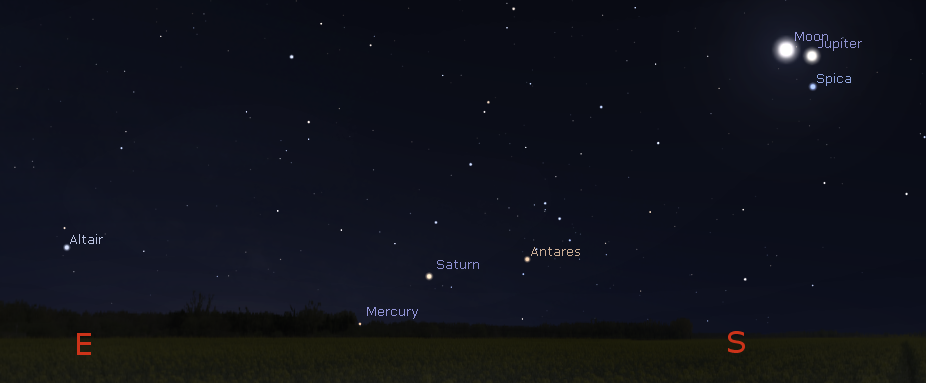
The Moon and Jupiter in the south above the star Spica with Saturn and Mercury peeking over the horizon in the southeast at 7 a.m. tomorrow morning, January 19, 2017. Created using Stellarium. Click image to enlarge.
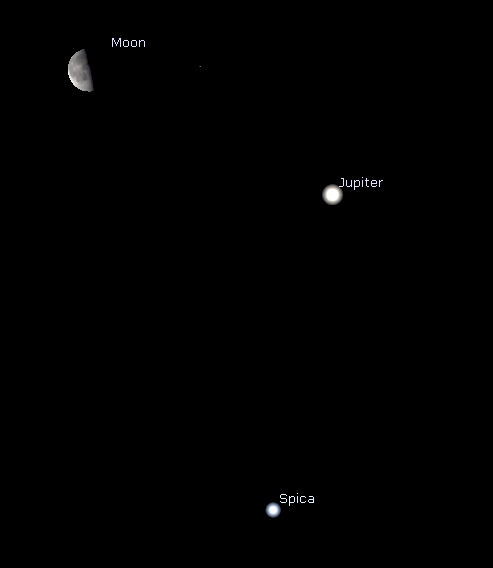
The Moon, Jupiter, and the star Spica tomorrow at 7 a.m., January 19, 2017. Created using Stellarium.
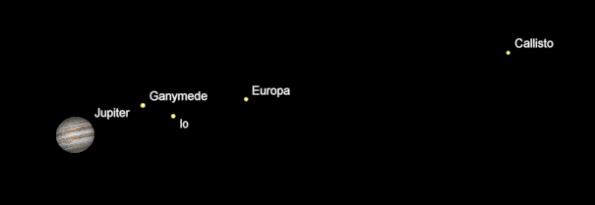
Jupiter and its moons tomorrow morning at 7 a.m., January 19, 2017. Created using Stellarium.
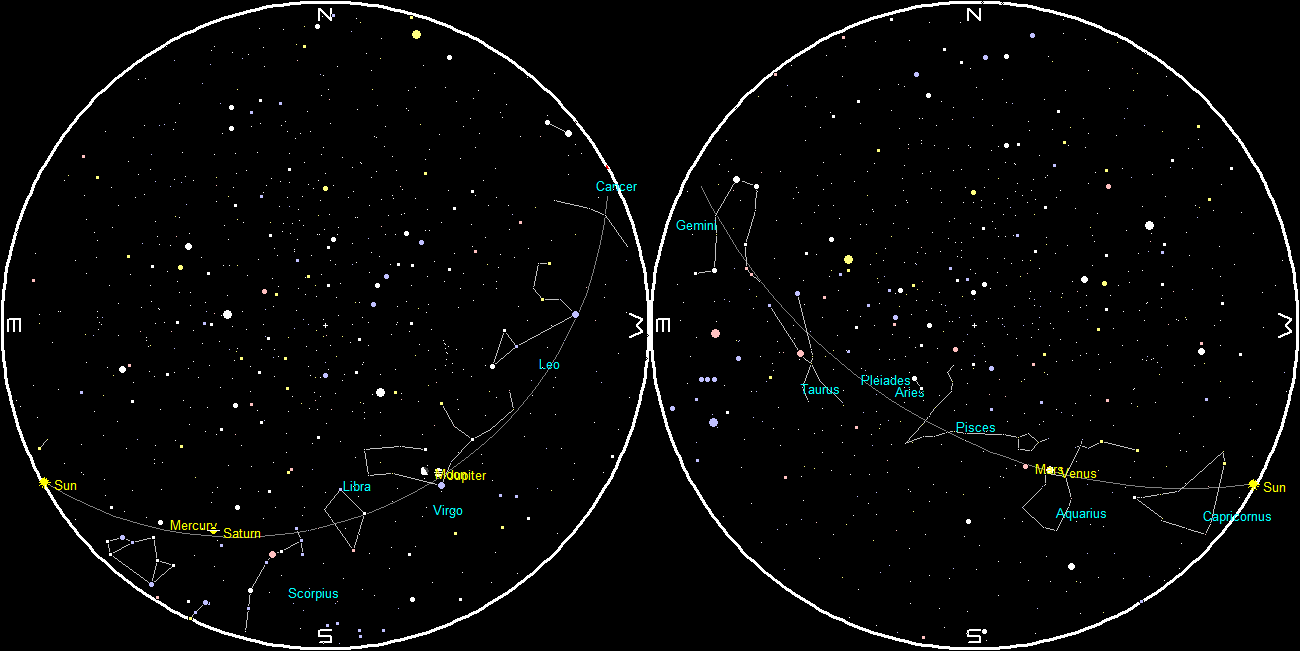
Planets and Moon at sunset and sunrise of a single night starting with sunset on the right on January 18, 2017. The night ends on the left with sunrise on January 19. Click on image to enlarge. Created using my LookingUp program.
In Memorium
Yesterday we lost the 11th man to set foot on the Moon and the last one to leave it. Eugene Cernan, the commander of Apollo 17 hated the title of “The last man to walk on the Moon”, and hoped before he died that another would walk on the Moon, lifting that title from his shoulders. Of the 12 men who walked on the Moon, half are now gone. The way things are going the next person to walk on the Moon will probably be Chinese. Godspeed Eugene Cernan.
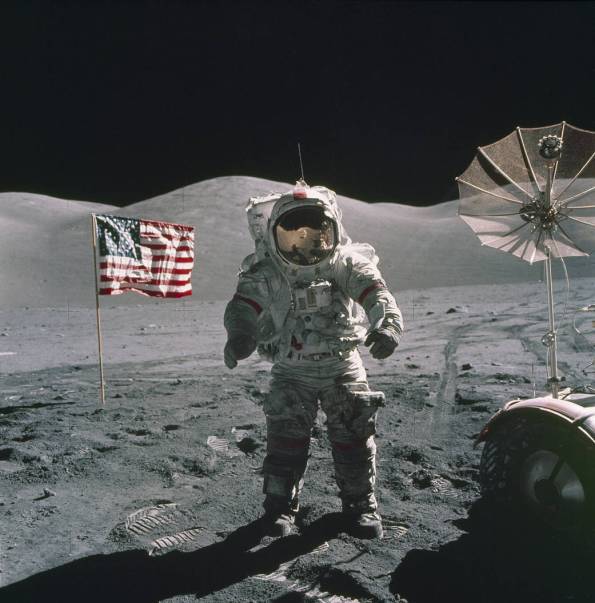
Eugene Cernan with the American Flag and the lunar rover. Credit: NASA/Harrison Schmitt

The first and last men on the Moon. Neil Armstrong, left and Eugene Cernan. File photo.
Godspeed John Glenn
With these words from the Capcom John Glenn was launched into the clear Florida sky on February 20, 1962, the first American to orbit the Earth. I cut my college classes to witness the launch on TV that day. He and Alan Shepard were the astronauts of firsts in the Mercury program and my special heroes. With Glenn’s passing all the Mercury astronauts now belong to history.
Godspeed John Glenn and Rest in peace.
10/13/2016 – Ephemeris – Europa appears to have water geysers like Enceladus
Ephemeris for Thursday, October 13th. The Sun will rise at 7:56. It’ll be up for 11 hours and 4 minutes, setting at 7:00. The Moon, 3 days before full, will set at 5:48 tomorrow morning.
On September 26th NASA announced that the Hubble Space Telescope has confirmed earlier observations that Europa, Jupiter’s second large moon is venting water vapor. It is pretty much known that Europa has a moon girdling ocean many tens of miles below its icy surface. The surface is devoid of craters, showing that there is some interaction with the ocean below and the cracks we see on the surface. Having plumes or geysers will allow spacecraft and landers to sample the ocean below without having to drill down to the ocean. NASA has okayed a mission to Europa. This could change the mission and instruments and maybe add a lander to probe the geysers, though first the have to find them.
Times are for the Traverse City/Interlochen area of Michigan. They may be different for your location.
Addendum
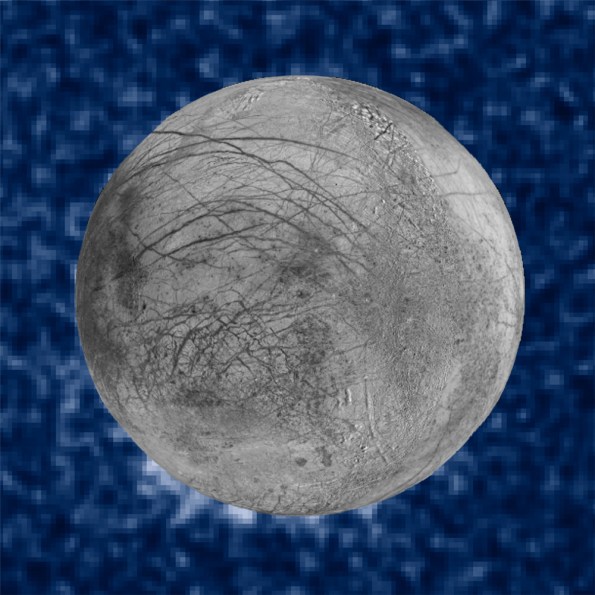
Composite photograph of plumes at the bottom of Europa with a Galileo image of Europa. Credit: NASA/Hubble/Galileo.
09/13/2016 – Ephemeris
Ephemeris for Tuesday, September 13th. The Sun will rise at 7:19. It’ll be up for 12 hours and 36 minutes, setting at 7:56. The Moon, 3 days before full, will set at 4:40 tomorrow morning.
Last Thursday evening an Atlas V rocket lifted off with NASA’s only interplanetary mission this year. The spacecraft called by one of NASA’s tortured acronyms OSIRIS-Rex is on its way to the asteroid Bennu, which was discovered in 1999, and named by a 3rd grader in a contest. Bennu is an Egyptian deity resembling a heron and also resembling the spacecraft. OSIRIS-Rex will take two years to reach the small asteroid, orbit it for two years mapping it in great detail and will approach to retrieve a sample. It will take 3 years to return the sample to the Earth in 2023. Bennu is interesting because it contains organic compounds from the origin of the solar system and because of the tiny chance it could hit the Earth in 200 years or so.
Times are for the Traverse City/Interlochen area of Michigan. They may be different for your location.
Addendum
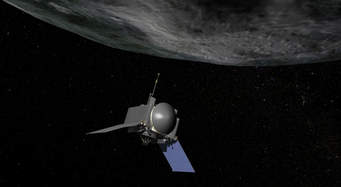
The OSIRIS-REx spacecraft with its sampler boom extended.
07/04/2016 – Ephemeris – NASA’s going to light off fireworks at Jupiter tonight
Ephemeris for Independence Day, Monday, July 4th. Today the Sun will be up for 15 hours and 27 minutes, setting at 9:31, and it will rise tomorrow at 6:03. The Moon is new today, and won’t be visible.
There are two astronomical highlights for your Independence Day enjoyment. The first comes at 11:59 this morning (15:59 UT) when the Earth is at its very farthest from the Sun this year. Some 1.7% farther than average. You’re still gonna need your sun screen anyway. Later this evening, a half billion miles from Earth NASA’s Juno spacecraft will fire it’s rocket engine for 35 minutes to begin to decelerate over the north pole of Jupiter to drop into a long elliptical orbit of that planet. NASA TV will begin broadcasting the event at 10:30 p.m. (2:30 UT, July 5) The 35 minute engine burn will start at 11:18 p.m. (3:18 UT, July 5) What we’ll see is a real-time graph of the Doppler signal from the spacecraft as it slows down to drop into orbit of Jupiter.
Times are for the Traverse City/Interlochen area of Michigan. They may be different for your location.
Addendum
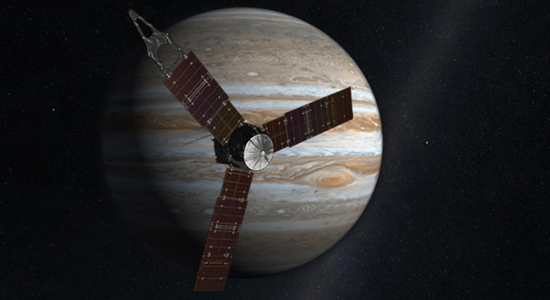
The Juno spacecraft. Credit: NASA.
The Planetary Society’s Emily Lakdawalla has more information on How to watch Juno’s orbit insertion at http://www.planetary.org/blogs/emily-lakdawalla/2016/07011514-how-to-watch-junos-orbit.html.
NASA also has an application in which you can see simulations of Juno’s orbital insertion. It’s called NASA’s Eyes and can be downloaded from http://eyes.nasa.gov/.
06/06/2016 – Ephemeris – Venus passes behind the Sun today
Ephemeris for Monday, June 6th. Today the Sun will be up for 15 hours and 27 minutes, setting at 9:25, and it will rise tomorrow at 5:57. The Moon, 2 days past new, will set at 10:52 this evening.
Today the planet Venus will be in superior conjunction with the Sun, and indeed will pass directly behind the Sun. That event will be completely unobservable due to the Sun’s brilliance. Fours years ago we observed the transit of Venus across the Sun. June 6, 2012. It got me thinking. Transits of Venus occur in pairs 8 years apart followed by a very long interval of over 100 years. It turns out the Venus orbits the Sun 13 times in approximately the same time that the earth orbits the Sun 8 times. In 4 years Venus goes around the Sun 6 ½ times and put’s Venus behind the Sun 4 years after 2012. Today to be precise. In another 4 years we’ll have Venus between the Earth and the Sun again, except Venus will be a bit too far north to transit the Sun.
Times are for the Traverse City/Interlochen area of Michigan. They may be different for your location.
Addendum
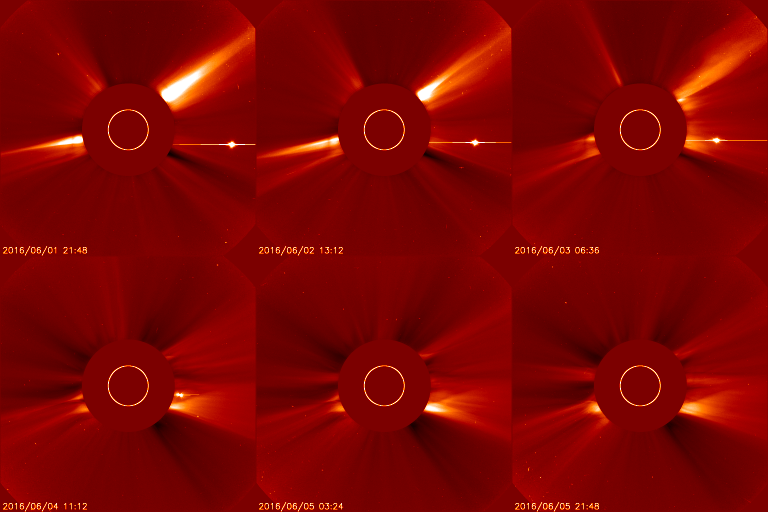
SOlar and Heliospheric Observatory (SOHO) stationed at the Earth-Sun Lagrangian point 1 (L1) a million miles sunward of the Earth. Sent back this animated GIF of Venus approaching the Sun in the last few days. In the LASCO C2 coronagraph the large disk at the center blocks the brightest part of the Sun’s image. The white circle represents the Sun’s disk size. Credit ESA/NASA.
 Bob Moler's Ephemeris Blog