Archive
04/24/2015 – Ephemeris – The Dawn spacecraft is descending to dwarf planet Ceres’ day side
Ephemeris for Arbor Day, Friday, April 24th. Today the Sun will be up for 13 hours and 54 minutes, setting at 8:38. The Moon, 1 day before first quarter, will set at 2:26 tomorrow morning. Tomorrow the Sun will rise at 6:42.
The Dawn spacecraft with its ion engine is descending into orbit of that other dwarf planet Ceres, the largest body in the asteroid belt. Over the past month Dawn has been maneuvering over Ceres’ night side to descend into a polar orbit to better survey the planet. Last week the Jet Propulsion Laboratory team that has been operating the spacecraft released a video of several photographs of Ceres’ pole as it rotated. It was still a crescent view, but soon we’ll see Ceres up close and very personal. We’ll get a closer look at those enigmatic white spots. Are they just white ice patches on the surface, or are they ice cryovolcanoes spewing water, or something else? Stay tuned.
Times are for the Traverse City/Interlochen area of Michigan. They may be different for your location.
Addendum
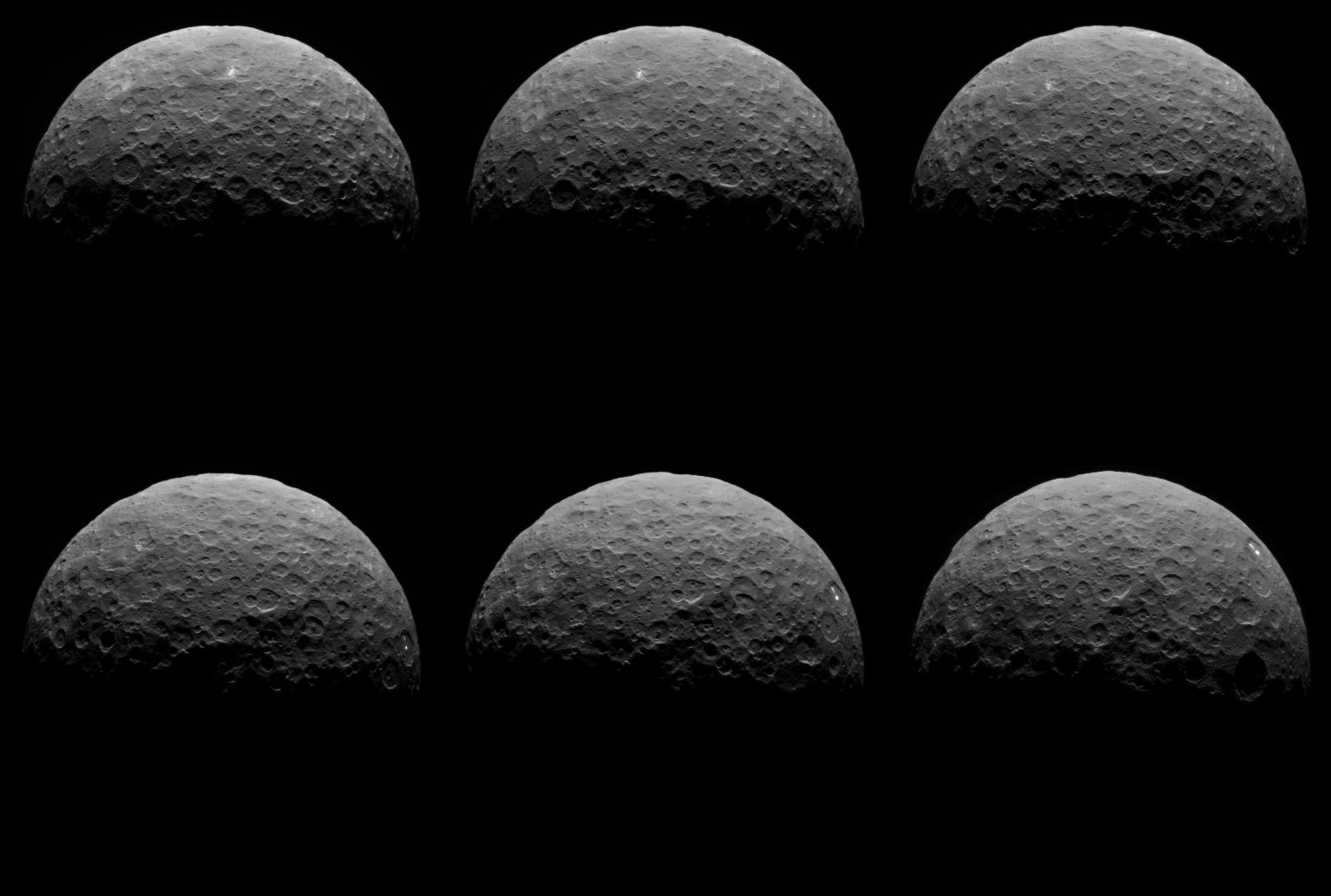
Ceres animation from April 14-15, 2015. Dawn was 14,000 miles (22,000 km) from Ceres. Credit: NASA/JPL-Caltech/UCLA/MPS/DLR/IDA. Click the image to enlarge.
This is a newer animation than the one mentioned in the transcript above that was actually written on the 19th. Here’s a link to the NASA page that describes the image. It also has a link to an enlarged frame containing the double bright spot.
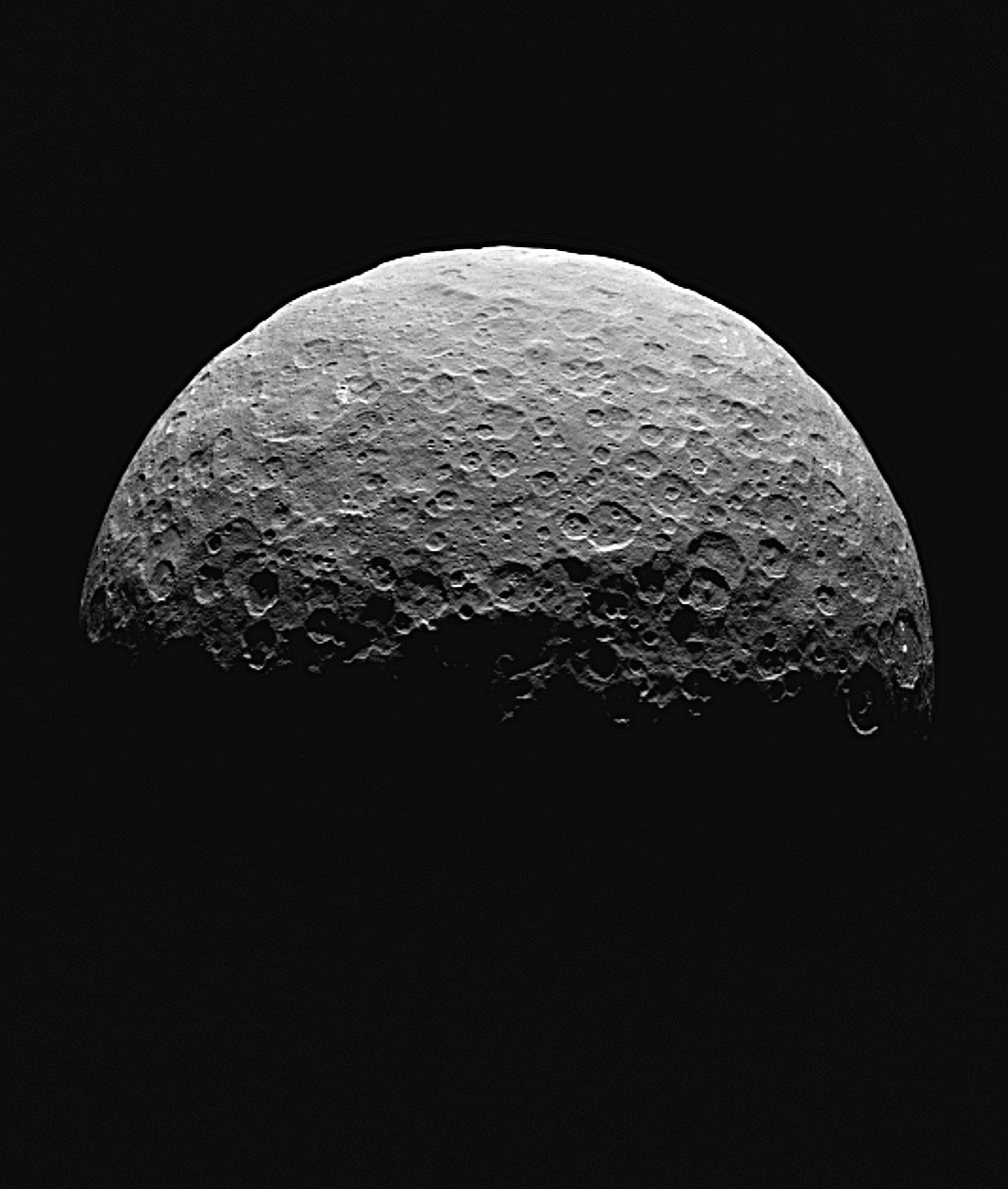
This is a processed still image of Ceres from the above animated sequence of images.
Credit: NASA/JPL-Caltech/UCLA/MPS/DLR/IDA
There’s no help figuring out what they are but the smaller spot is resolved into two spots. The bright one is still unresolved. As of yesterday the Dawn spacecraft should be in its first circular orbit of Ceres at an altitude of 8,400 miles (13,500 km) from Ceres for a few weeks before descending to a lower orbit of Ceres the starting the first week in May.
04/23/2015 – Ephemeris – New Horizons’ first glimpse of Pluto and Charon in color
Ephemeris for Thursday, April 23rd. Today the Sun will be up for 13 hours and 52 minutes, setting at 8:37. The Moon, 2 days before first quarter, will set at 1:44 tomorrow morning. Tomorrow the Sun will rise at 6:43.
Last week NASA’s New Horizons team running the spacecraft that’s been in flight to the dwarf planet Pluto released their first color of Pluto and it’s moon Charon. The photo doesn’t show any surface features. That’s to come in the next month or two. However, Pluto shows kind of a pale orange-pink color, hinting of the colorful images to come. Charon is a dull gray like the dwarf planet Ceres, which Dawn is approaching, and our own Moon. How could two bodies with a common origin appear so different? Stay tuned. New Horizons will pass through the Pluto system in a couple of hours on July 14th, but will send back the mother lode of its data over the next 16 months.
Times are for the Traverse City/Interlochen area of Michigan. They may be different for your location.
Addendum

First color picture of Pluto and its moon Charon taken by the New Horizons spacecraft. Credit: NASA/Johns Hopkins University Applied Physics Laboratory/Southwest Research Institute. Click to enlarge.
From the NASA website:
“This image of Pluto and its largest moon, Charon, was taken by the Ralph color imager aboard NASA’s New Horizons spacecraft on April 9 and downlinked to Earth the following day. It is the first color image ever made of the Pluto system by a spacecraft on approach. The image is a preliminary reconstruction, which will be refined later by the New Horizons science team. Clearly visible are both Pluto and the Texas-sized Charon. The image was made from a distance of about 71 million miles (115 million kilometers)—roughly the distance from the Sun to Venus. At this distance, neither Pluto nor Charon is well resolved by the color imager, but their distinctly different appearances can be seen. As New Horizons approaches its flyby of Pluto on July 14, it will deliver color images that eventually show surface features as small as a few miles across.”
03/03/2015 – Ephemeris – The bright spots on Ceres are still a mystery
Ephemeris for Tuesday, March 3rd. The Sun will rise at 7:17. It’ll be up for 11 hours and 15 minutes, setting at 6:32. The Moon, 2 days before full, will set at 6:30 tomorrow morning.
The Dawn spacecraft is approaching the asteroid Ceres. It will be gently captured by Ceres on the 6th. This as an update from the date I gave you yesterday. Then the spacecraft will spiral closer and closer to the asteroid over the next few months. There is a mystery spot on Ceres, a bright spot that was visible by the Hubble Space Telescope orbiting Earth. As Dawn got close enough to resolve Ceres it too saw the bright spot. As the spacecraft got even closer the spot showed to be smaller and smaller. I thought it might be a crater that penetrated into Ceres icy interior. But the latest image, taken February 19th shows that the bright spot has a companion spot, both inside a crater and still too small to resolve. It’s still a mystery.
Times are for the Traverse City/Interlochen area of Michigan. They may be different for your location.
Addendum

Hubble’s best photo of Ceres. Note the white spot near the top of the image. Image Credit: NASA, ESA, J. Parker (Southwest Research Institute), P. Thomas (Cornell University), L. McFadden (University of Maryland, College Park), and M. Mutchler and Z. Levay (STScI)
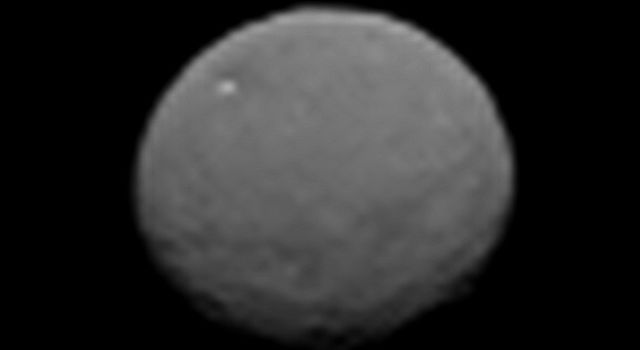
The white spot shows as Dawn approaches Ceres. Credit: NASA/JPL.
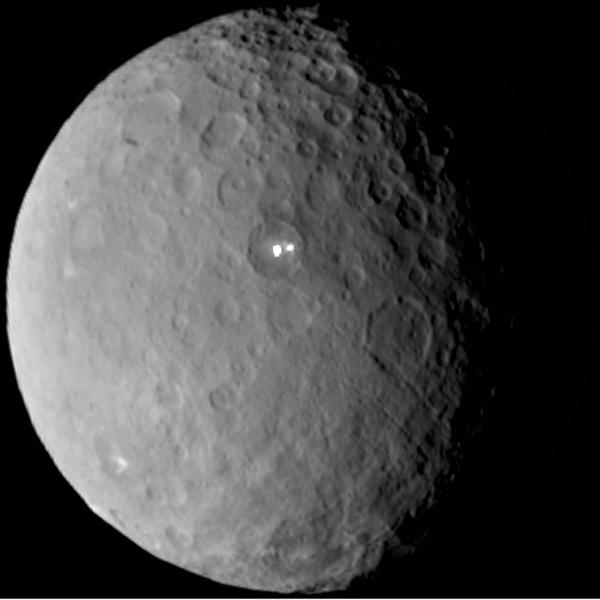
The bright spot is two. Picture taken February 19, 2015 from 29,000 miles (46,700 km). Credit: NASA/JPL-Caltech/UCLA/MPS/DLR/IDA.
This photo will be the best photo of the bright spots until the end of April, an Dawn maneuvers over the night side of Ceres.
On March 2nd NASA held a Dawn Mission Pre- Close Approach News Briefing which can be found on YouTube.
03/02/2015 – Ephemeris – The Dawn spacecraft (The turtle wins the race)
Ephemeris for Monday, March 2nd. The sun will rise at 7:19. It’ll be up for 11 hours and 12 minutes, setting at 6:31. The moon, 3 days before full, will set at 6:00 tomorrow morning.
On Thursday March 5th NASA’s Dawn spacecraft will fall under the gravitational influence of the asteroid, or actually recently promoted dwarf planet Ceres and enter orbit. The journey took 7 years including an intermediate year-long stop at the asteroid Vesta. Dawn uses the latest in ion thrusters, or latest when it was launched. Using power generated by its solar panels it ejects xenon ions from one of its three ion thrusters to produce a thrust comparable to the weight of a piece of paper. It can accelerate the spacecraft from zero to 60 miles per hour in a few days. In the tale of the hare and the tortoise it’s in the tortoise class, at least to start. Ion engines are 10 times as efficient as chemical rockets and they can thrust for years.
Times are for the Traverse City/Interlochen area of Michigan. They may be different for your location.
Addendum
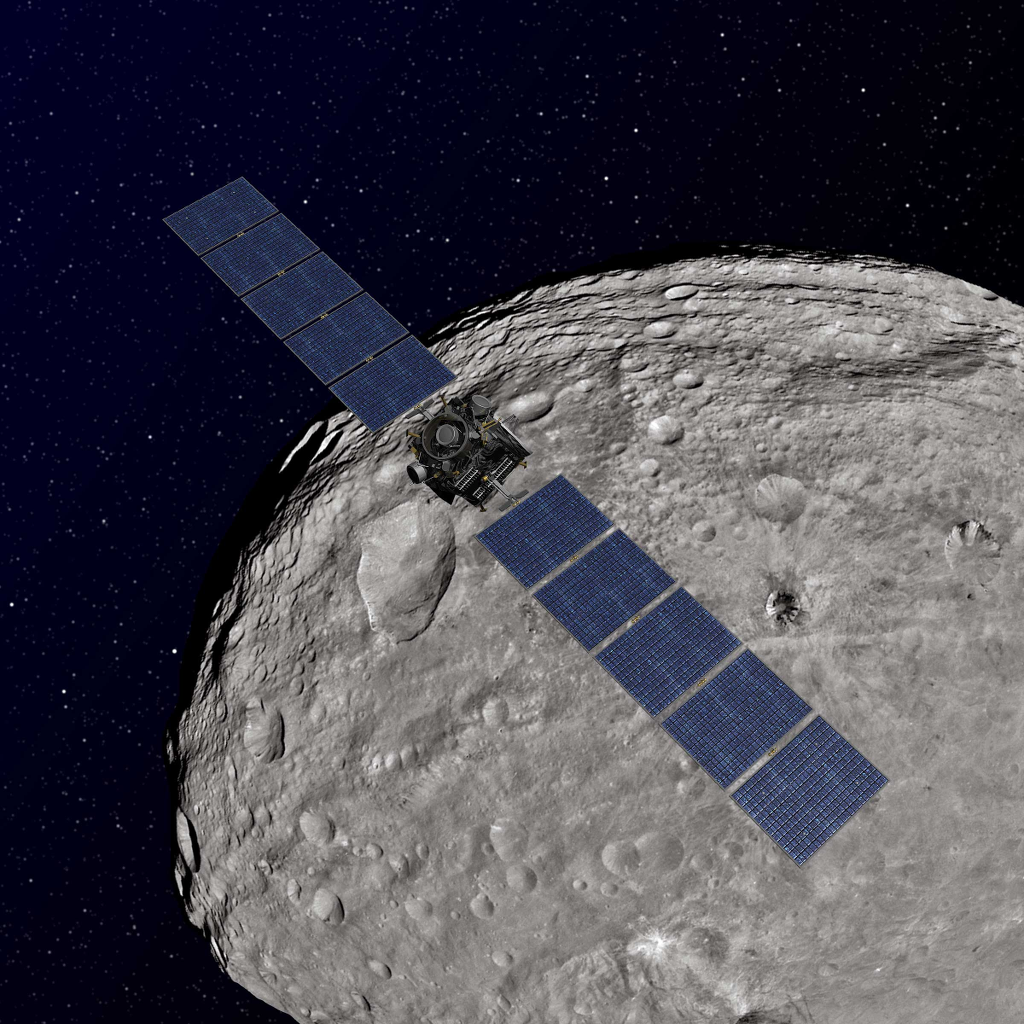
Artist’s rendition of the Dawn spacecraft at Vesta. Credit: NASA/JPL
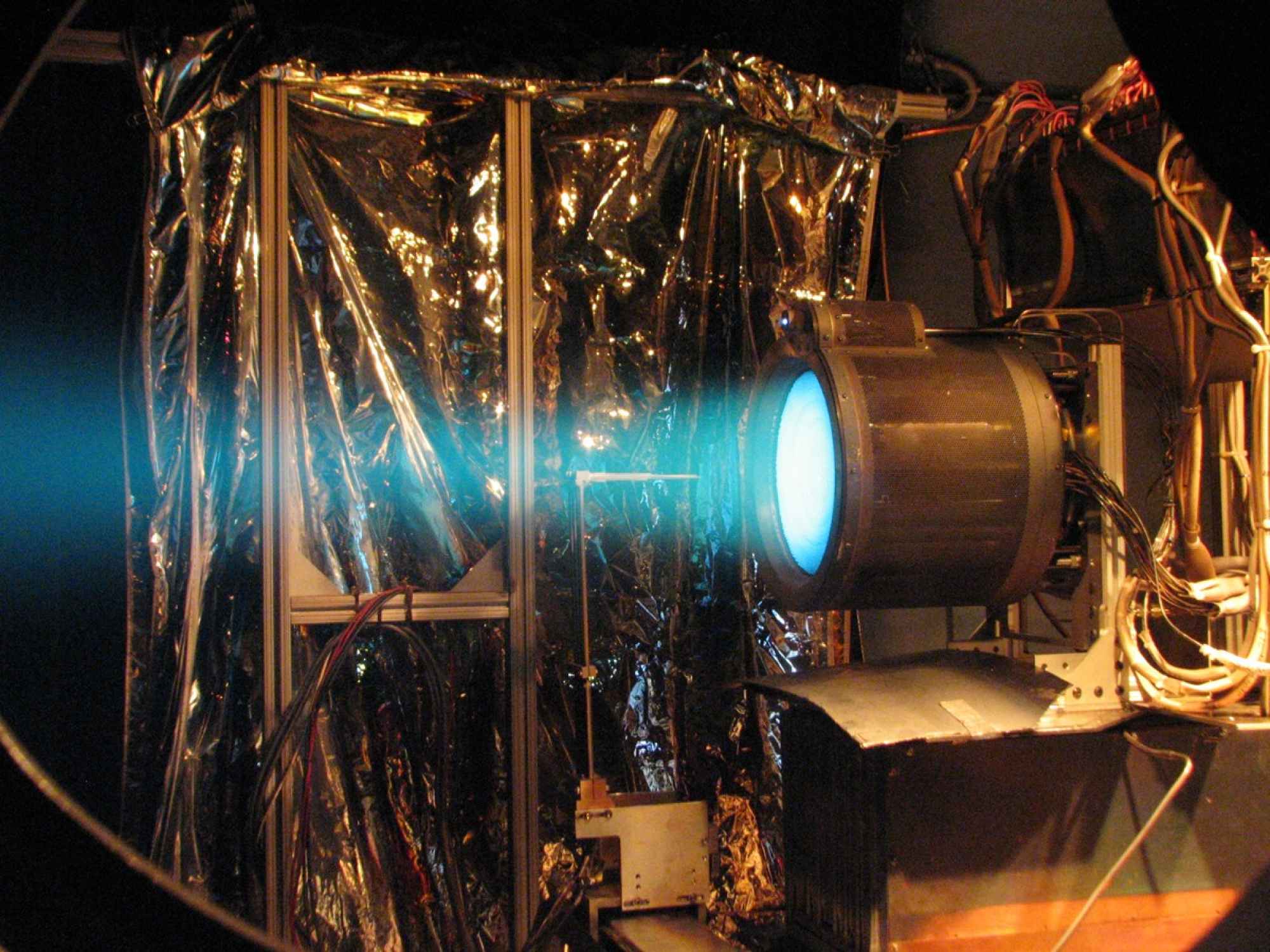
Ion engine test. Xenon ions glow blue. Credit NASA.
02/23/2015 – Ephemeris – The Launch of the DSCOVR satellite
Ephemeris for Monday, February 23rd. The sun will rise at 7:30. It’ll be up for 10 hours and 51 minutes, setting at 6:22. The moon, 2 days before first quarter, will set at 12:24 tomorrow morning.
On Wednesday the 11th the DSCOVR satellite was launched to a special point between the Earth and the Sun called the Lagrangian point 1 or the Earth-Sun L1 point. It’s a point of gravitational equilibrium between the Earth and the Sun, about a million miles sun-ward of the Earth, or four times the distance of the Moon. It will take the craft over 100 days to get there, which it will slowly orbit. It will act as an early warning sentinel, replacing the aging ACE spacecraft. It will give us about an hour’s warning of incoming coronal mass ejections or CMEs erupting from the Sun. It also has an earth pointing camera with various filters pointed to the full earth and occasionally the far side of the new Moon.
Times are for the Traverse City/Interlochen area of Michigan. They may be different for your location.
Addendum
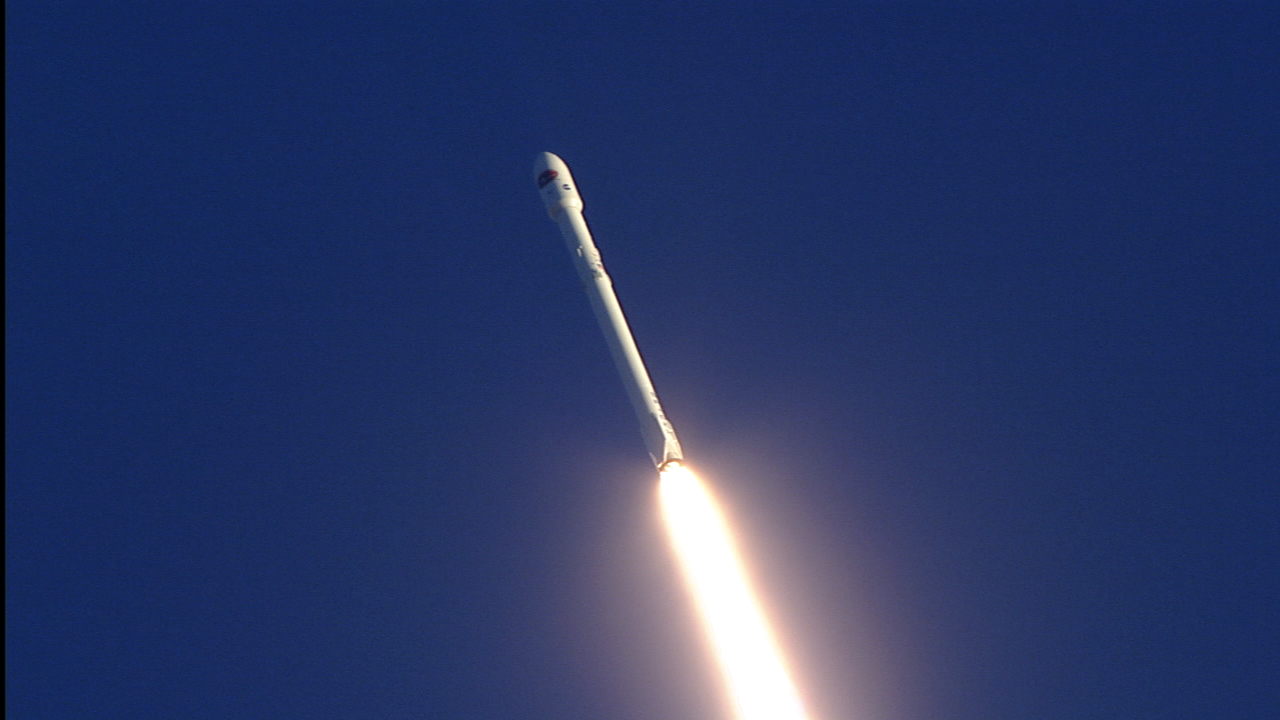
SpaceX Falcon 9 V1.1 first stage burns to launch DSCOVR to the Earth-Sun L1 point. Credit: NASA. Click to enlarge.
Click to enlarge
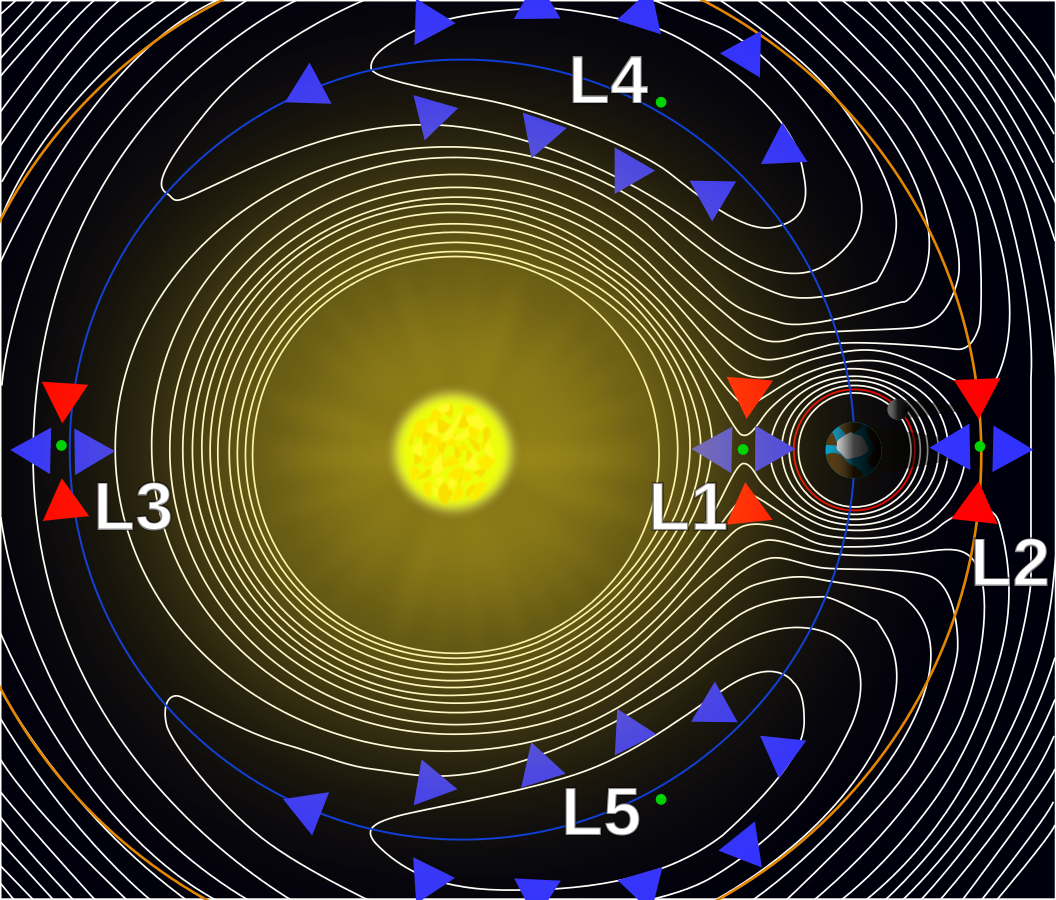
Earth-Sun Lagrangian Points. Source: Wikimedia Commons, Xander89. Click to enlarge.
12/26/2014 – Ephemeris – Tragedies and triumphs of 2014
Ephemeris for Friday, December 26th. The sun will rise at 8:18. It’ll be up for 8 hours and 49 minutes, setting at 5:08. The moon, 2 days before first quarter, will set at 11:02 this evening.
2014 was a year of personal tragedy and also tragedy and triumph in space. The Space tragedies came in October with the destruction and loss of Orbital Science’s third supply mission to the International Space Station when the their Antares rocket blew up right after launch. A few days later Virgin Galactic’s SpaceShipTwo disintegrated on a test flight killing a pilot. In the Triumph department the European Space Agency’s Rosetta caught up and orbited its comet 67P, for short, in August and bounced down its lander Philae in November. It wasn’t supposed to bounce, but stick the landing. Bruised and battered Philae delivered its science before its batteries died. And this month an unmanned Orion capsule made its maiden voyage into space.
Times are for the Traverse City/Interlochen area of Michigan. They may be different for your location.
Addendum

Orbital Sciences Antares rocket explodes seconds after liftoff on October 28, 2014. Credit NASA.

SpaceShipTwo disintegrates October 31, 2014 killing a pilot. Credit USA Today.
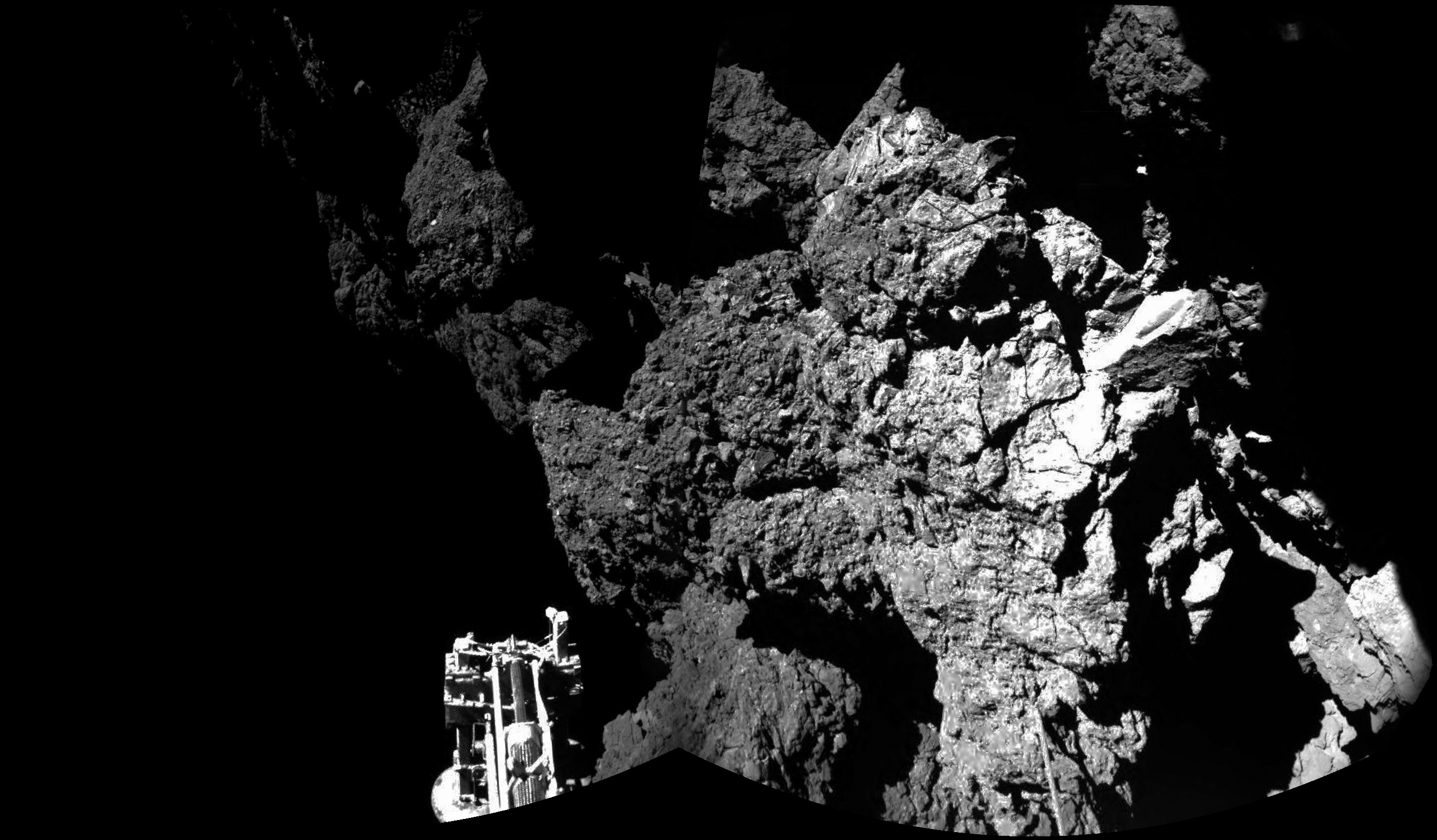
After a second bounce on the Comet 67P the Philae lander ended up sideways apparently on the base of a cliff. Researchers were able to get data from just about all the instruments before the battery discharged. The team hopes and the comet gets closer to the sun and the sun angle changes they can revive Philae. Credit: ESA.

Screen capture of Delta IV Heavy rocket liftoff carrying the Orion test article into orbit on December 4, 2014. Credit .NASA via BBC
Ride back to the earth with Orion via a camera mounted in a window. The window is facing aft as the capsule re-enters the atmosphere heat shield first at 20,000 miles per hour. You’ll experience everything except the G forces. It comes with appropriate spacey music. It’s as close as I’ll ever get to ride in one of these things.
Here’s your chance to name some craters on Mercury
Here’s a message from Heather Weir at NASA’s Goddard Space Center:
“TO HONOR THE ASTOUNDING ACHIEVEMENTS OF THE MESSENGER MISSION, THERE WILL BE AN INTERNATIONAL COMPETITION TO NAME A CRATER ON MERCURY!
“OPENS DECEMBER 15, 2014 (00:00 UTC) CLOSES JANUARY 15, 2015 (11:59 UTC)
“The MESSENGER Team is seeking help from all Earthlings to suggest names for five impact craters on Mercury. This is a chance to immortalize an important person in the Arts and Humanities from any nation or cultural group by having a crater on the planet Mercury named in their honor! We will accept submissions beginning midnight (00:00 UTC) December 15, 2014 until January 15, 2015 (23:59 UTC). All entries will be reviewed by Team representatives and expert panels. Then, 15 finalist names will be submitted to the International Astronomical Union (IAU) for selection of the 5 winners. Winning submissions will be announced by the IAU to coincide with MESSENGER’s End of Mission Operations in late March/April 2015. Full details are available on the MESSENGER web site http://namecraters.carnegiescience.edu/.”
As the MESSENGER mission to orbit and study the solar system’s innermost planet Mercury is coming to an end when the spacecraft runs out of fuel in a few more months, the MESSENGER team has selected five small but important craters that need names.
The link above will provide all the information needed to enter including rules, pictures, descriptions of the craters to be named and a list of craters already named.
The official naming rules for craters are these: “Deceased artists, musicians, painters, and authors who have made outstanding or fundamental contributions to their field and have been recognized as art historically significant figures for more than 50 years.”
Tip of the old astronomer’s observing cap to the NASA/JPL Solar System Ambassadors.Program.
12/08/2014 – Ephemeris – Last week was a good week in space
Ephemeris for Tuesday, December 9th. The sun will rise at 8:07. It’ll be up for 8 hours and 54 minutes, setting at 5:02, officially the earliest sunset of the year. The moon, 3 days past full, will rise at 8:25 this evening.
Last month we had two space tragedies, the explosion of a Antares rocket on its way to resupply the International Space Station and the death of a pilot of SpaceShipTwo on a test flight. This past week good news, Tuesday (Wednesday Japan time) the launch in Japan of the Hyabusa 2 spacecraft to bring back samples of an asteroid. And on Friday the first test flight of an Orion Crew Module to test, mainly its heat shield, and if it could withstand the heat of reentry coming back from deep space. It will be nearly 4 more years before the Space Launch System, the rocket to be used with the Orion module, will be ready to be launched. If you’re wondering about the slow pace, well NASA doesn’t have the budget it did back in the 1960s.
Times are for the Traverse City/Interlochen area of Michigan. They may be different for your location.
Addendum

The launch of Hyabusa 2. Credit JAXA.
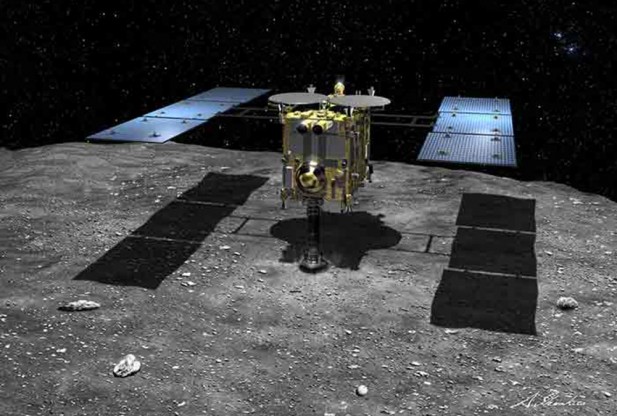
Artists rendition of Hyabusa 2 taking a sample from the asteroid. Credit: JAXA.

Orion Crew module being launched by a Delta 4 Heavy rocket. Credit: NASA.
11/07/2014 – Ephemeris – GTAS meeting tonight and Star Party
Ephemeris for Friday, November 7th. The sun will rise at 7:28. It’ll be up for 9 hours and 55 minutes, setting at 5:23. The moon, 1 day past full, will rise at 6:15 this evening.
Tonight the Grand Traverse Astronomical Society will hold their monthly meeting at he Northwestern Michigan College’s Rogers Observatory at 8 p.m. featuring yours truly presenting the Hitchhikers Guide to the Solar System. I have found, what NASA and other space agencies have found, that once orbiting the Sun in the solar system. One can go anywhere in the solar system with a minimum of energy, if one has the time. We’ll start by looking at orbits about the Earth and how they can be changed. We’ll look at escape velocity and those seemingly strange Lagrangian points, plus stealing energy from the planets. At 9 p.m. there will be a star party featuring the Moon and some of the brighter deep sky objects. The observatory is located on Birmley road.
Times are for the Traverse City/Interlochen area of Michigan. They may be different for your location.
Addendum
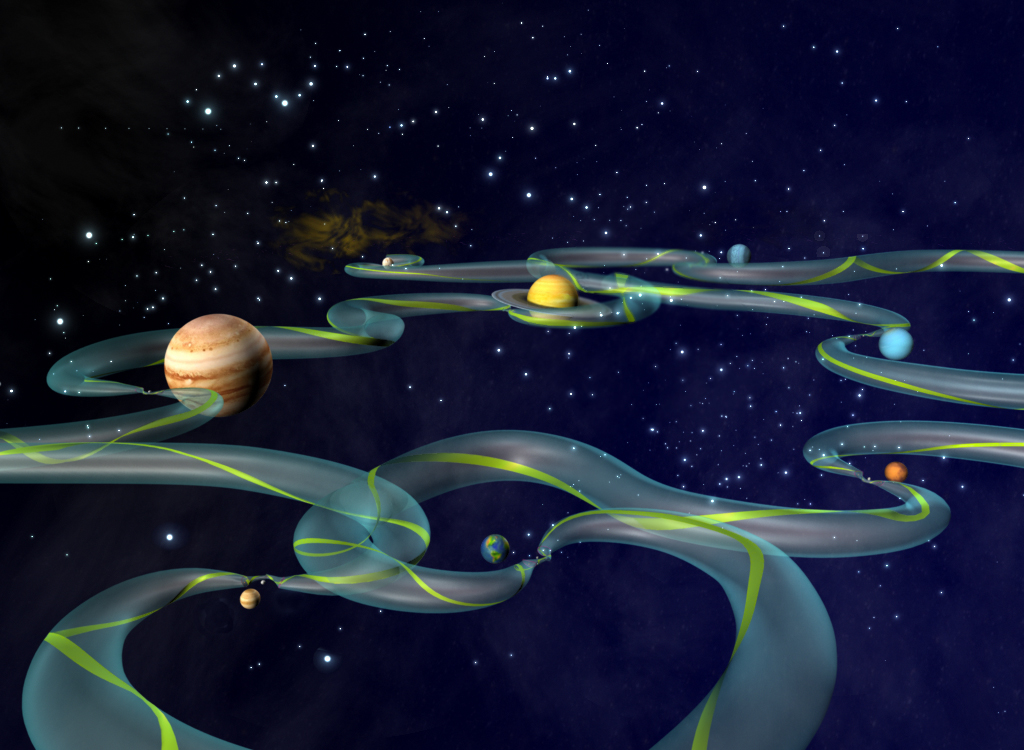
Artist’s concept of interplanetary superhighway or Interplanetary Transport Network. Credit: NASA/JPL.
11/06/2014 – Ephemeris – New Horizons headed toward the 9th planet will pass a dwarf planet instead
Ephemeris for Thursday, November 6th. The sun will rise at 7:26. It’ll be up for 9 hours and 57 minutes, setting at 5:24. The moon, at full today, will rise at 5:32 this evening.
The New Horizons spacecraft is 9 months from reaching the dwarf planet Pluto. After a 9 and a half years journey it will zip past Pluto and its moons in a day. At launch Pluto was designated as planet number 9. In less than a year later Pluto was demoted to a dwarf planet. The authority was the International Astronomical Union. It was a vote taken at the end of the last day of the meeting that year after most members have left. The definitions only pertain to the solar system, and not exoplanets orbiting other stars. Besides we cannot detect anything as small as Pluto orbiting another star…yet. The asteroid Ceres was once a planet too, it was demoted to asteroid 75 years after discovery. It was promoted to a dwarf planet with Pluto.
Times are for the Traverse City/Interlochen area of Michigan. They may be different for your location.
Addendum

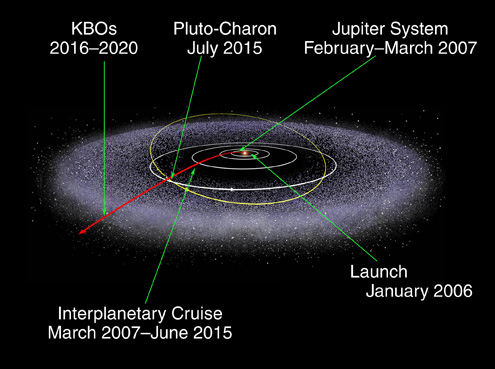
New Horizon’s trajectory through the solar system. Credit: NASA/JHAPL.
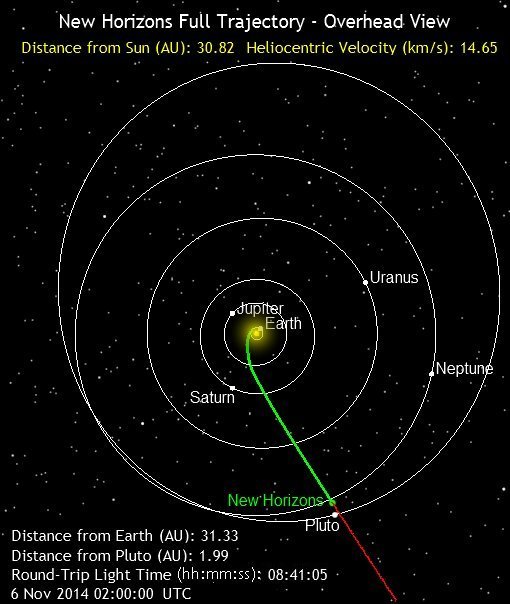
Where is New Horizons on November 6, 2014? Credit NASA/JHAPL.
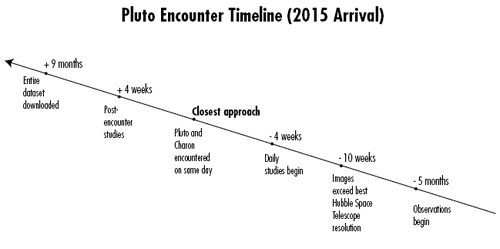
New Horizons Encounter Timeline. Credit: NASA/JHAPL.
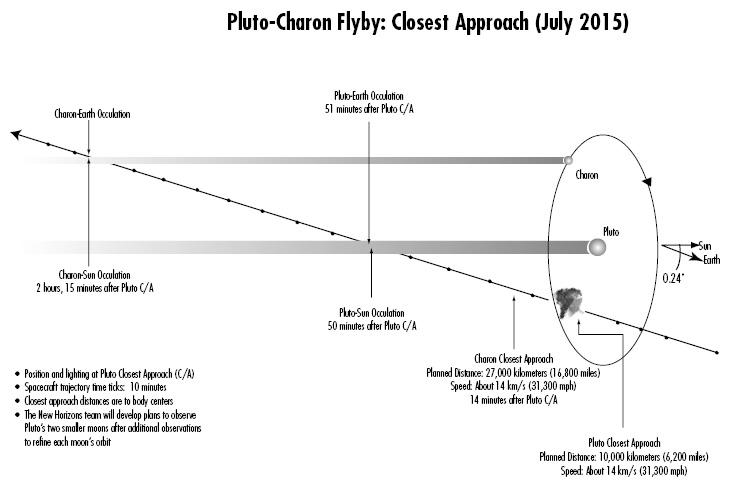
New Horizons at closest approach to Pluto. Credit: NASA/JHAPL.
 Bob Moler's Ephemeris Blog