Archive
Ephemeris: 04/29/2024 – Corona Borealis, the Northern Crown
This is Ephemeris for Monday, April 29th. Today the Sun will be up for 14 hours and 11 minutes, setting at 8:46, and it will rise tomorrow at 6:33. The Moon, 2 days before last quarter, will rise at 2:58 tomorrow morning.
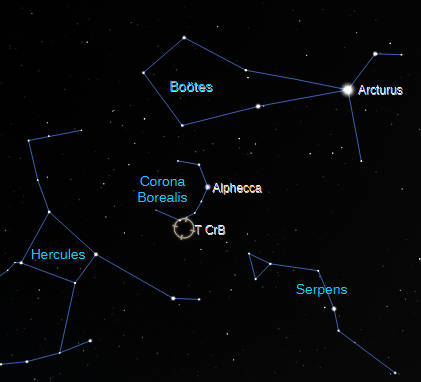
About a third of the way up the sky in the east at 10 p.m. can be found a small but easily spotted constellation of Corona Borealis, the Northern Crown. It is located just below the kite shaped constellation of Boötes, with its bright star Arcturus at the right. The Northern Crown is a three-quarter circle of stars, like a tiara, with a brighter star Alphecca at the bottom. Alphecca in Arabic means “The bright star of the broken ring of stars”, which is an accurate description of it. Check it out now for later this year we expect to have a bright star appear just below it. That star is T Coronae Borealis a recurrent Nova or exploding star. They occur when a white dwarf star is orbiting with a large red giant star and accumulating gas from that red giant star until it explodes.
The astronomical event times given are for the Traverse City/Interlochen area of Michigan (EDT, UT–4 hours). They may be different for your location.
Addendum
Ephemeris: 04/23/2024 – We are awaiting a bright nova
This is Bob Moler with Ephemeris for Tuesday, April 23rd. Today the Sun will be up for 13 hours and 54 minutes, setting at 8:38, and it will rise tomorrow at 6:42. The Moon, at full today, will rise at 8:40 this evening.
There is an event rarer than the appearance of Halley’s Comet. It’s an explosion of a star called T Coronae Borealis which means it’s in the constellation of the Northern Crown. Corona is a semicircle of stars located left of the bright star Arcturus, pointed to by the handle of the Big Dipper. The letter T means that it’s a variable star. It is something called a cataclysmic variable, or recurrent nova, and it blows up about every 80 years. The last time it did this was in 1946. Its brightness dips about 11 months before it goes kablooey. That dip has already happened. The star doesn’t destroy itself. It’s actually a white dwarf that’s siphoning off gases from a red giant star that it’s orbiting. When enough hydrogen gets accumulated, it ignites.
The astronomical event times given are for the Traverse City/Interlochen area of Michigan (EDT, UT–4 hours). They may be different for your location.
Addendum
Ephemeris: 10/24/2023 – We might see a bright nova soon
This is Ephemeris for Tuesday, October 24th. Today the Sun will be up for 10 hours and 33 minutes, setting at 6:43, and it will rise tomorrow at 8:11. The Moon, 3 days past first quarter, will set at 3:57 tomorrow morning.
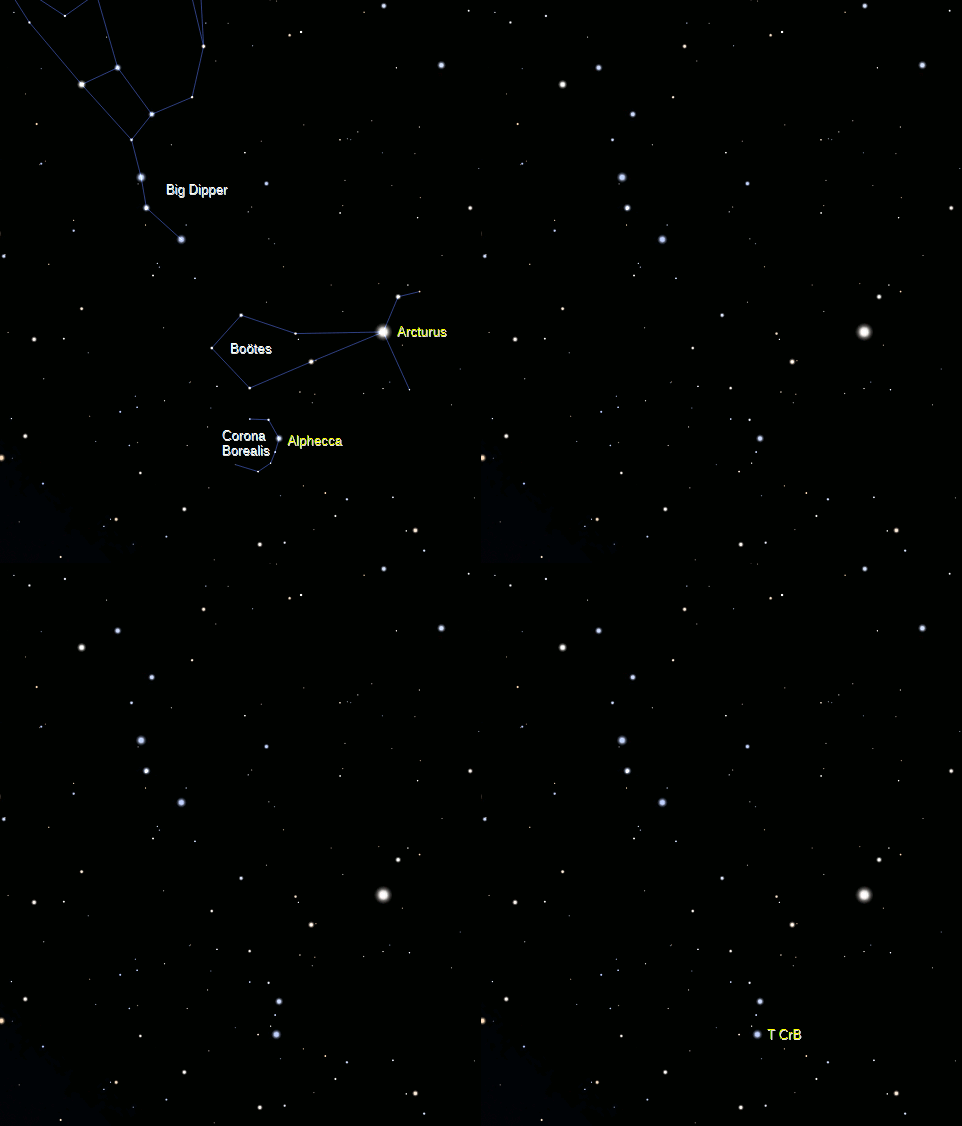
There is a star in the northern constellation of Corona Borealis the Northern Crown which we see normally on spring and summer evenings that is a recurring nova. A nova is a star that suddenly brightens from invisibility to visibility and soon fades. It is caused by a white dwarf orbiting with a larger, star siphoning off gases from the larger star until it builds up enough to create a thermonuclear explosion. This may not affect the star and may run through the process repeatedly. These are called reoccurring novae, and this one is designated T Coronae Borealis. It’s usually close to 11th magnitude which is hard to find even in binoculars to become one of the 50 brightest stars in the sky, as early as next year.
The astronomical event times given are for the Traverse City/Interlochen area of Michigan (EDT, UT –4 hours). They may be different for your location.
Addendum
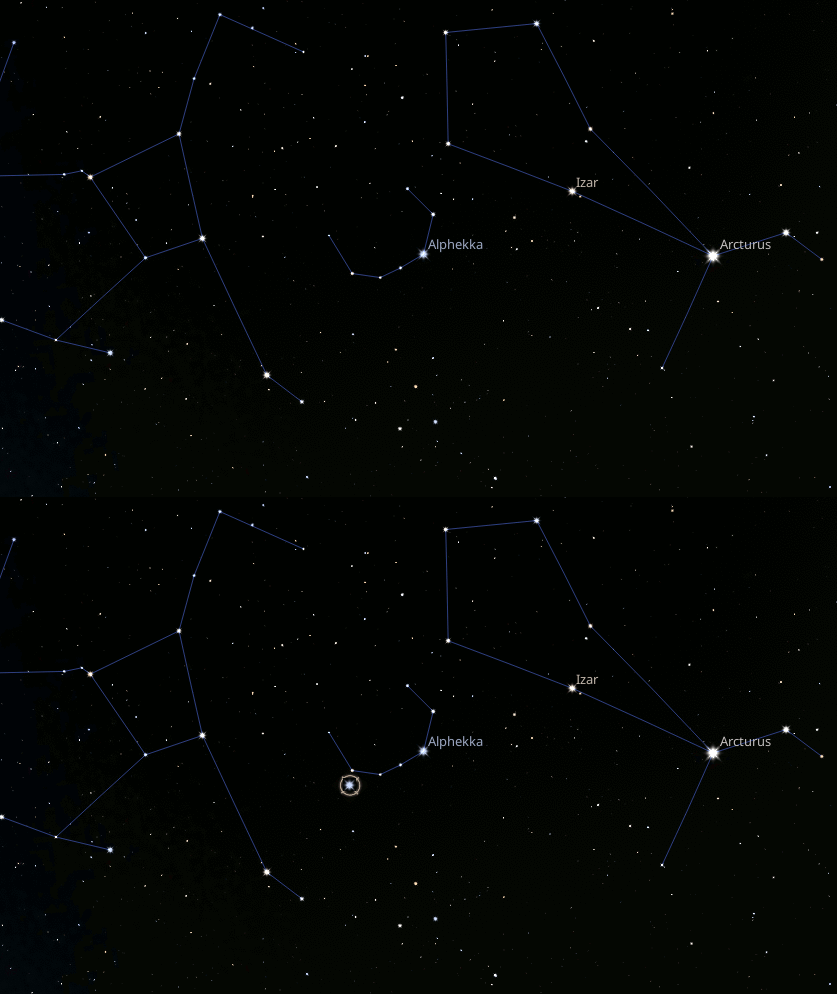
What got me onto this is an article from Universe Today for September 8th by Jon Voisey: A Medieval Manuscript Likely Hides a Record of an Impending Recurrent Nova. Another source for this Nova is to look up T CrB on Wikipedia. See below:
01/13/2017 – Ephemeris – Perhaps we’ll see a nova in 5 years, 2022
Jan 13. This is Bob Moler with Ephemeris for Friday, January 13th. The Sun will rise at 8:16. It’ll be up for 9 hours and 9 minutes, setting at 5:26. The Moon, 1 day past full, will rise at 7:12 this evening.
Professor Larry Molnar from Calvin College in my home town of Grand Rapids and his students discovered that a star, [KIC 9832227,] that was monitored by the Kepler exoplanet finding satellite in the northern constellation of Cygnus the Swan may explode in about 5 years. The star is actually two so close that they share their outer atmospheres, someone described it as two peanuts in one shell. The two orbit each other in 11 hours now, and the period is shortening at an accelerated rate as the two approach each other. Astronomers think that it will repeat the fate of a star that exploded in 2008 in the constellation of Scorpius. Such explosions, when seen are called Novae. A Nova like this could make the star briefly 10,000 times brighter than it originally was. [Current magnitude is 12, which is visible in moderate sized (6″ or 150 mm) diameter telescopes. 10,000 times brighter equals a 10 magnitude bump, which would make the star 2nd magnitude. Magnitudes are like golf scores the lower the magnitude the brighter the object. Blame Hipparchus.]
Times are for the Traverse City/Interlochen area of Michigan. They may be different for your location.
Note: The text in brackets omitted in the broadcast.
Addendum
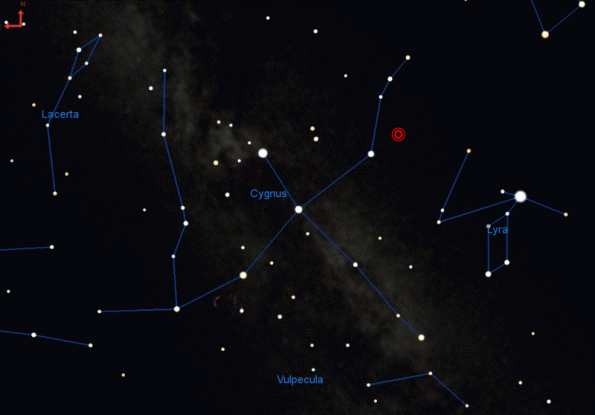
Finder Chart for KIC 9832227. It’s in the red bulls eye. Credit: Calvin College.
The position of KIC 9832227 is circumpolar or nearly so for northern Michigan. So it’s up all or most of the 24 hour day, so no matter the time of year this baby blows, we should be able to see it.
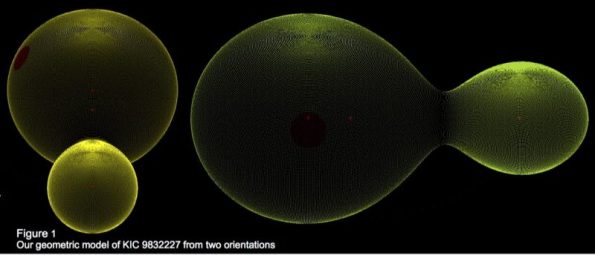
Two computer generated views of KIC 9832227. The large star is about twice the Sun’s diameter, while the smaller star is a bit less than the Sun’s size. Credit: Calvin College.
For more information click here: https://calvin.edu/news/archive/astronomy-prof-student-predict-explosion-that-will-change-the-night-sky.
08/26/2013 – Ephemeris – The constellation of Delphinus the dolphin
Ephemeris for Monday, August 26th. The sun rises at 6:58. It’ll be up for 13 hours and 30 minutes, setting at 8:29. The moon, 2 days before last quarter, will rise at 11:22 this evening.
With Nova Delphinus in our skies let’s take a look at this celestial dolphin. Located below the eastern edge of the Summer Triangle of three of the brightest stars in the sky, which is overhead in our sky at 10 p.m., is the tiny constellation of Delphinus the dolphin. Delphinus’ 6 stars in a small parallelogram with a tail, really does look like a dolphin leaping out of the water. The parallelogram itself has the name Job’s Coffin. The origin of this asterism or informal constellation is unknown. Of the dolphin itself: the ancient Greeks appreciated this aquatic mammal as we do, and told stories of dolphins rescuing shipwrecked sailors. The nova can be spotted in binoculars using the chart at http://www.skyandtelescope.com or below.
Times are for the Traverse City/Interlochen area of Michigan. They may be different for your location.
Addendum
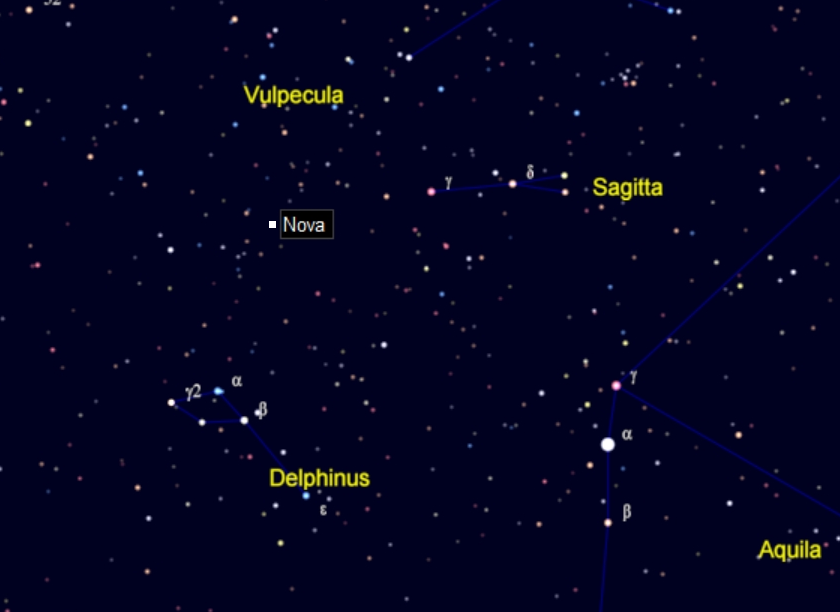
My finder chart for Nova Delphinus 2013. Created using Carte du Ceil (Sky Charts)
The dot for the Nova will show it brighter than it is. It should be fading now.
08/20/2013 – Ephemeris – A “new” star in Delphinus
Ephemeris for Tuesday, August 20th. The sun rises at 6:51. It’ll be up for 13 hours and 48 minutes, setting at 8:39. The moon, at full today, will rise at 8:07 this evening.
There’s a new nova visible to the unaided eye, well just barely, if the moon wasn’t out. “New nova” is kind of redundant because Nova is Latin for new, The entire Latin term is Nova Stellum or new star. It isn’t really a new star, but one that brightened catastrophically, siphoning gas off a companion red giant star. At least that’s what we think. Detailed analysis will come later. It’s informal name is Nova Delphinus, which lies between the tiny constellation of Delphinus the dolphin and Sagitta the arrow in and near the Summer Triangle. http://www.skyandtelescope.com has a finder chart. It’s best to use binoculars to locate it. The Arrow points right to it, while the two stars that cross the body of the dolphin also point to it. Novae are unusual, but not rare.
Times are for the Traverse City/Interlochen area of Michigan. They may be different for your location.
Addendum
My finder chart for Nova Dephinus 2013. Created using Cartes du Ceil (Sky Charts)
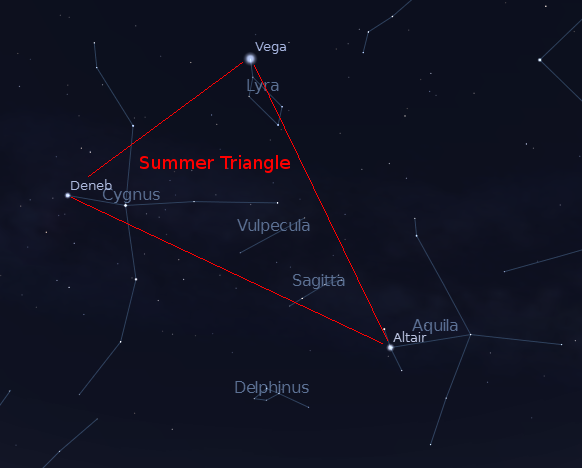
The Summer Triangle with Delphinus and Sagitta. Created using Stellarium and The Gimp.
 Bob Moler's Ephemeris Blog