Archive
Ephemeris: 12/14/2023 – The Geminids will still be near peak tonight
This is Ephemeris for Thursday, December 14th. Today the Sun will be up for 8 hours and 50 minutes, setting at 5:02, and it will rise tomorrow at 8:13. The Moon, 2 days past new, will set at 6:31 this evening.
The Earth will pass through the heart of the Geminid meteoroid stream at about 2 this afternoon, so this evening is probably the best time to be able to see these meteors. They will appear to come from the northeastern to eastern sky in the evening. The Geminids are now the most active annual shower. This hasn’t always been the case, but the meteor rate has been increasing in recent years. Our problem with it is that it happens in December when, number one it’s cold, and number 2 it’s pretty cloudy. I must admit I’ve never seen a Geminid for those reasons. This year, it seems to have been clearer than previous years, so maybe we might get a glimpse at them. Stragglers of the Geminids can be seen until almost Christmas.
The astronomical event times given are for the Traverse City/Interlochen area of Michigan (EST, UT –5 hours). They may be different for your location.
Addendum
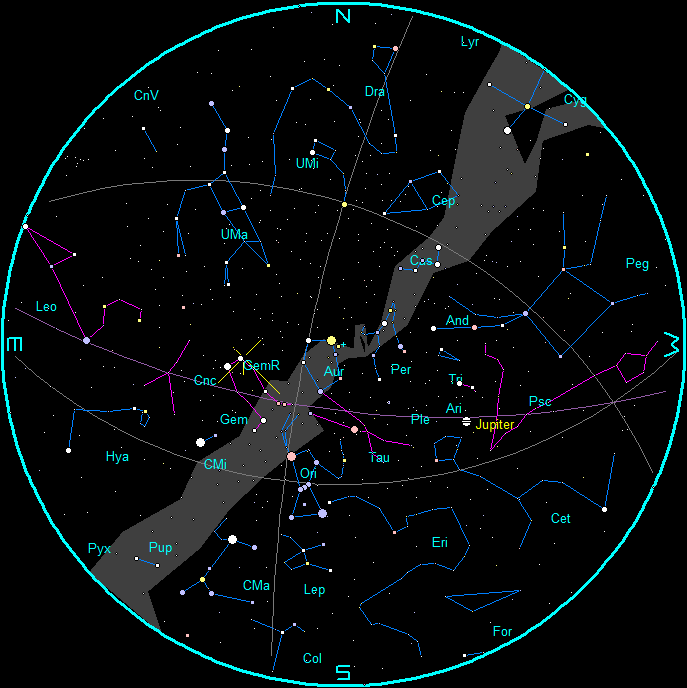
The Geminids are supposed to reach about 120 an hour at peak which would be at one or two in the morning which is about 12 hours after their actual peak. So that we won’t get the 120, but there’s an equal chance to spot them on the night of the 13/14th or 14/15th. Click or tap on the image to enlarge it. Image created using my Looking Up app.
Ephemeris: 12/11/2023 – This is the week of the Geminid meteor shower
This is Bob Moler with Ephemeris for Monday, December 11th. Today the Sun will be up for 8 hours and 52 minutes, setting at 5:02, and it will rise tomorrow at 8:10. The Moon, 1 day before new, will rise at 8:09 tomorrow morning.
The Geminid meteor shower will reach its peak this week, well Thursday afternoon, actually. I’m talking about this early hoping that we might get a clear night this week to see them. The Geminids are the most active annual meteor shower. Up to 120 meteors may be visible per hour at its peak when it’s the radiant in Gemini is directly overhead which would be on Wednesday or Thursday mornings this week. At those times it will be about half a day before or after the peak, but with such a high number of meteors it should be a spectacular show anyway. The Geminids are produced by a rock comet called Phaethon, which was discovered in 1983 by the Infrared Astronomy Satellite, the first to perform an infrared survey of the entire sky.
The astronomical event times given are for the Traverse City/Interlochen area of Michigan (EST, UT –5 hours). They may be different for your location.
Addendum
The Geminids are supposed to reach about 120 an hour at peak which would be at one or two in the morning which is about 12 hours after their actual peak. So that we won’t get the 120, but there’s an equal chance to spot them on the night of the 13/14th or 14/15th. Click or tap on the image to enlarge it. Image created using my Looking Up app.
Ephemeris: 11/17/2023 – Observing this weekend’s Leonid meteor shower
This is Ephemeris for Friday, November 17th. Today the Sun will be up for 9 hours and 30 minutes, setting at 5:12, and it will rise tomorrow at 7:43. The Moon, 3 days before first quarter, will set at 8:45 this evening.
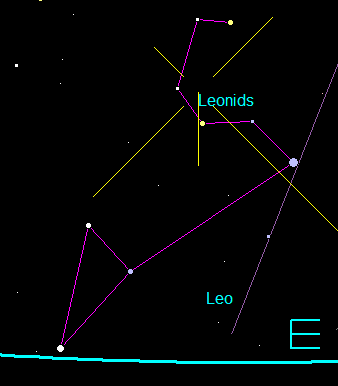
The Leonid meteor shower will reach peak this weekend. The normal peak will be actually this evening before the radiant, where the meteors seem to come from, rise which they will do at 11 pm. So tomorrow morning it would be a good time to see them. We only expect about 15 meteors an hour at peak. There is a possibility of another peak on the 21st which is Tuesday morning just before dawn composed of supposedly bright meteors from the passage of the comet crossed Earth’s orbit in 1767. So if it’s clear, and you’re willing to go outdoors and see what you can see of the Leonid meteor shower. The Leonids get really spectacular about every 33 years, and we’re about 8 or 9 years from now.
The astronomical event times given are for the Traverse City/Interlochen area of Michigan (EST, UT –5 hours). They may be different for your location.
Addendum
Ephemeris: 11/10/2023 – The Northern Taurid Meteor Shower reaches its peak Sunday night
This is Bob Moler with Ephemeris for Friday, November 10th. Today the Sun will be up for 9 hours and 47 minutes, setting at 5:20, and it will rise tomorrow at 7:34. The Moon, 3 days before new, will rise at 5:38 tomorrow morning.
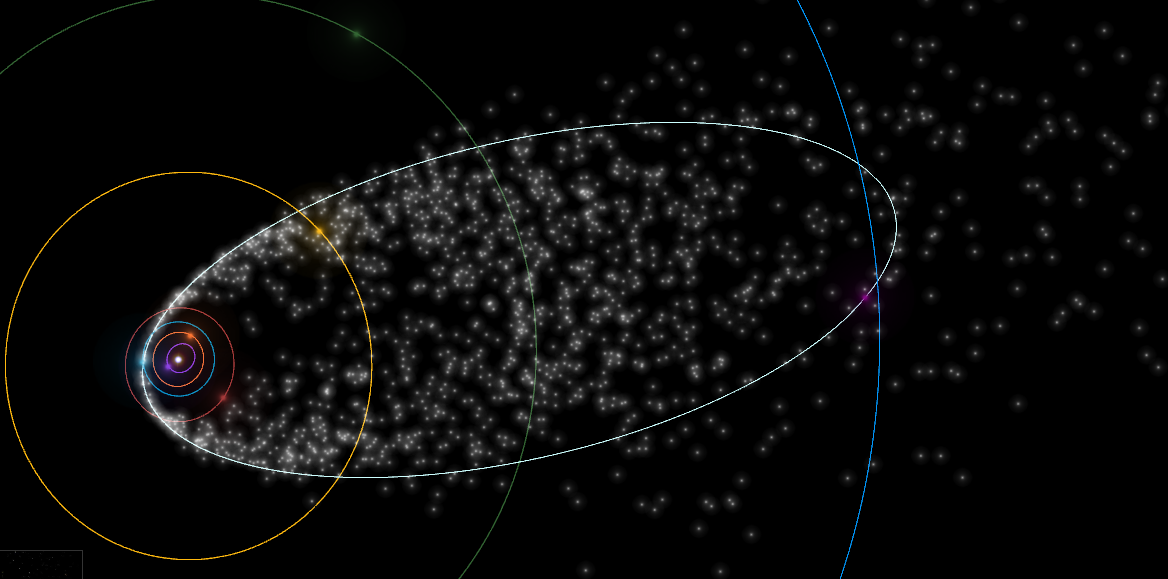
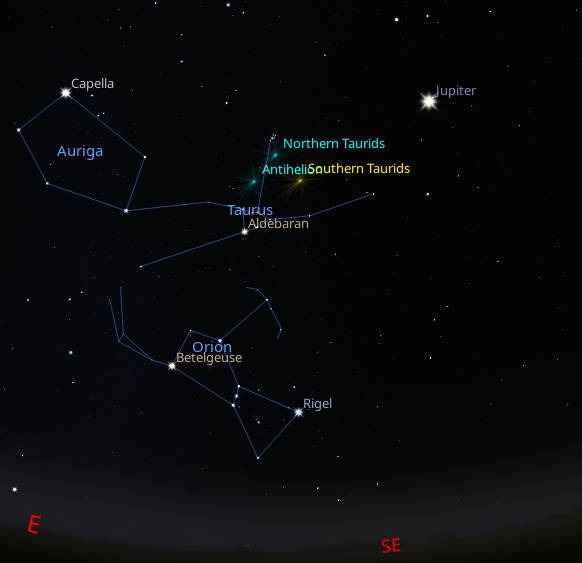
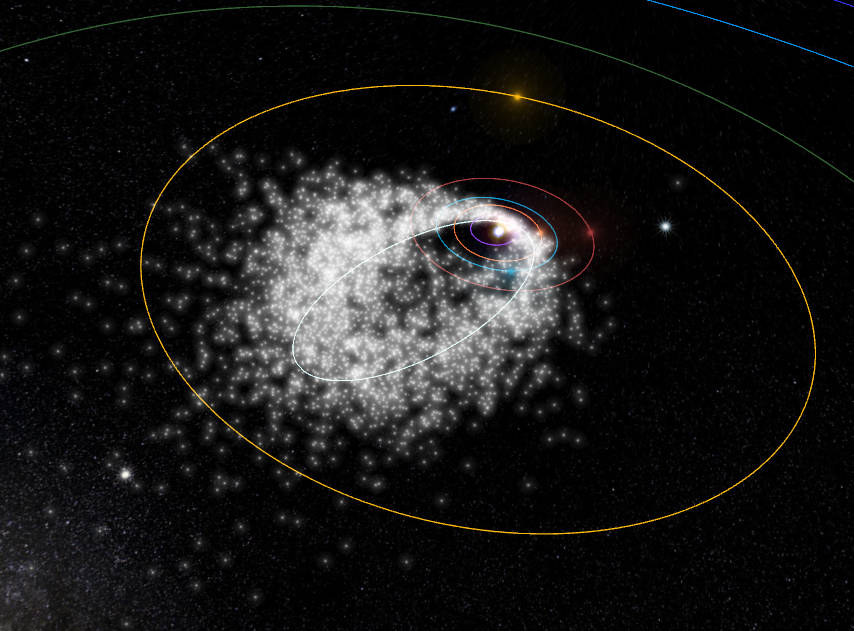
On Sunday night the North Taurid Meteor shower will reach its peak of about 15 meteors an hour. That’s not very many. However, there are reports that they are rather slow meteors and quite bright. They’re related to Encke’s comet. That comet has the shortest period of any comet of 3.3 years. So the meteoroid debris are not falling in from very far away from the Sun to reach us, so they’re moving rather slowly. The South Taurid meteor shower reached its peak last weekend with about the same number of meteors, and from the same comet. They’re also tangled up with something called the Antihelion meteor source, which is an ill-defined source of meteors which is directly opposite the Sun. Their radiant is near the Pleiades.
The astronomical event times given are for the Traverse City/Interlochen area of Michigan (EST, UT –5 hours). They may be different for your location.
Ephemeris: 10/20/2023 – Halley’s Comet is back! Sort of.
This is Ephemeris for Friday, October 20th. Today the Sun will be up for 10 hours and 45 minutes, setting at 6:50, and it will rise tomorrow at 8:05. The Moon, 1 day before first quarter, will set at 10:42 this evening.
Halley’s Comet is back! (Pronounced Hall-ey’s) Well sorta. In the form of the Orionid meteor shower. Bits of Halley’s Comet from previous passes by the Earth’s orbit make their twice-yearly show in our skies as these bits collide with the Earth’s atmosphere. Halley’s orbit passes close to the earth’s orbit at points where the Earth is around May 6th and again near October 21st. Light dust and ionized gas get blown back into the tail of the comet. Heavier particles, still affected by the pressure of sunlight and the gravitational pull of the Sun and planets end up roughly following the comet’s orbit. In the morning after the Moon sets (11:55 pm on the 21st) should be the best time to see them. They will seem to come from a spot above Orion and below Gemini.
The astronomical event times given are for the Traverse City/Interlochen area of Michigan (EDT, UT –4 hours). They may be different for your location.
Addendum
Ephemeris: 08/11/2023 – The Perseid meteor shower will reach its peak tomorrow night to early Sunday morning
This is Ephemeris for Friday, August 11th. Today the Sun will be up for 14 hours and 14 minutes, setting at 8:54, and it will rise tomorrow at 6:41. The Moon, 3 days past last quarter, will rise at 2:32 tomorrow morning.
The Perseid meteor shower at its peak and will be visible all night tomorrow. It won’t have to compete with the Moon until after 3:30 am Sunday morning. The meteors will be seen all over the sky, However Perseid meteors can be backtracked to a spot below the W shaped constellation of Cassiopeia, in the area of the constellation Perseus. As the night progresses, the radiant point will be rising higher in northeast. So lay down on a blanket in a dark location, keep mosquito repellent handy, dress warmly, because the ground and air will be chilly and dewy. Bring some hot coffee or chocolate to drink. And enjoy up to 60 meteors an hour at the peak in the morning. They will be near peak all weekend.
The astronomical event times given are for the Traverse City/Interlochen area of Michigan (EDT, UT –4 hours). They may be different for your location.
Addendum
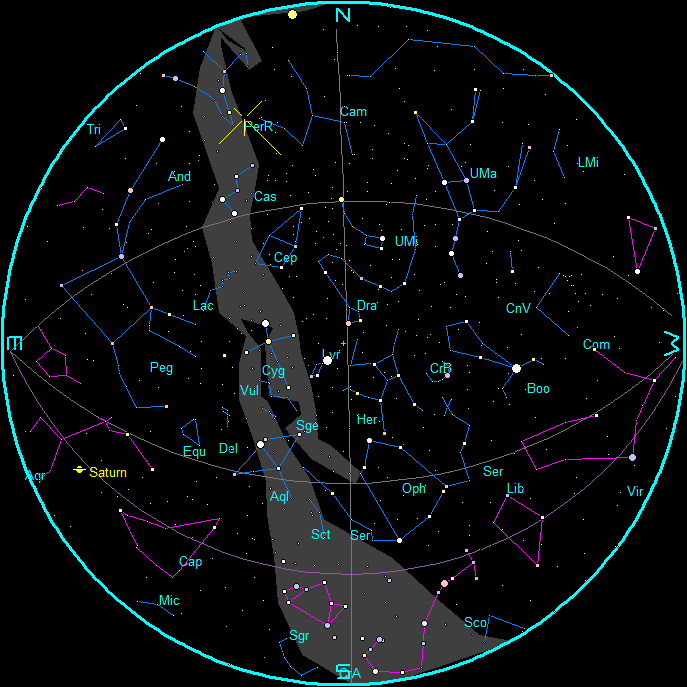
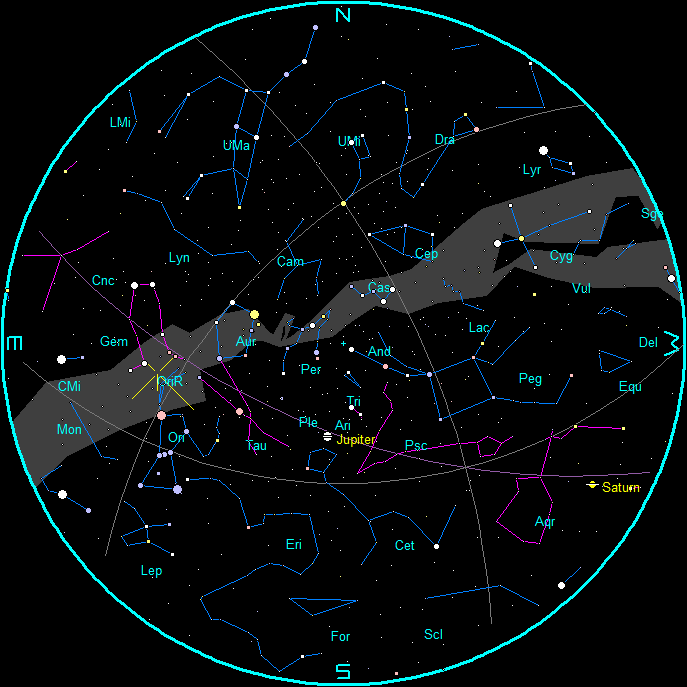
The Dome of the sky for the night of August 12th and 13th, 2023 at 10:30 PM for northern Michigan. The Perseid radiant is in the northeast and fairly low in the sky, and marked in yellow with the caption PerR. It will continue to rise in the northeast throughout the night. The constellation names are abbreviated. Their full names can be found here. Large images can be truncated on the right. Click or tap on the image to enlarge and display the complete image. Created using my LookingUp app.
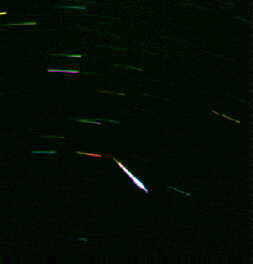
The cool thing about viewing the meteor shower early in the evening is that the meteoroids enter the Earth’s atmosphere at a grazing angle, so they seem to last longer and have longer trains. I remember one early evening meteor traveling down the Milky Way, like it was a highway.
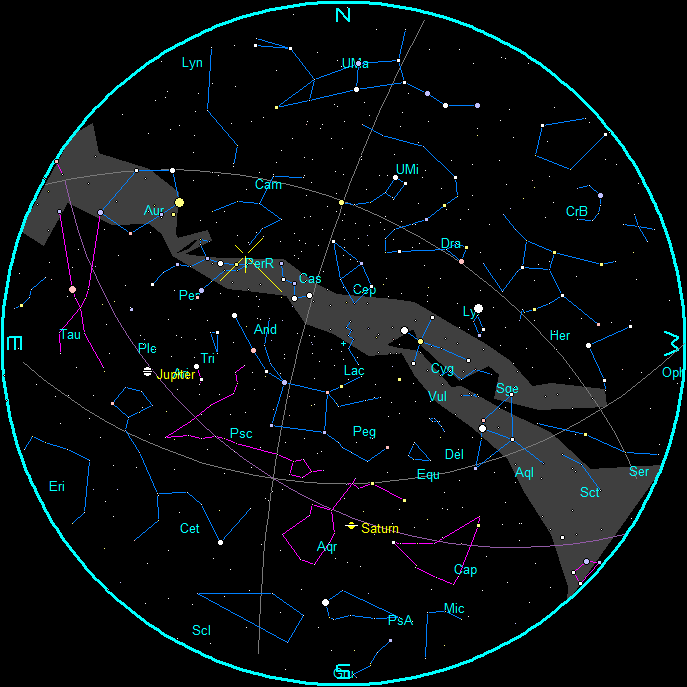
The Dome of the sky for August 12th and 13th, 2023 at 3 AM for northern Michigan. The Perseid radiant is in the northeast, much higher in the sky, and marked in yellow with the caption PerR. The constellation names are abbreviated. Their full names can be found here. Large images can be truncated on the right. Click or tap on the image to enlarge and display the complete image. Created using my LookingUp app.
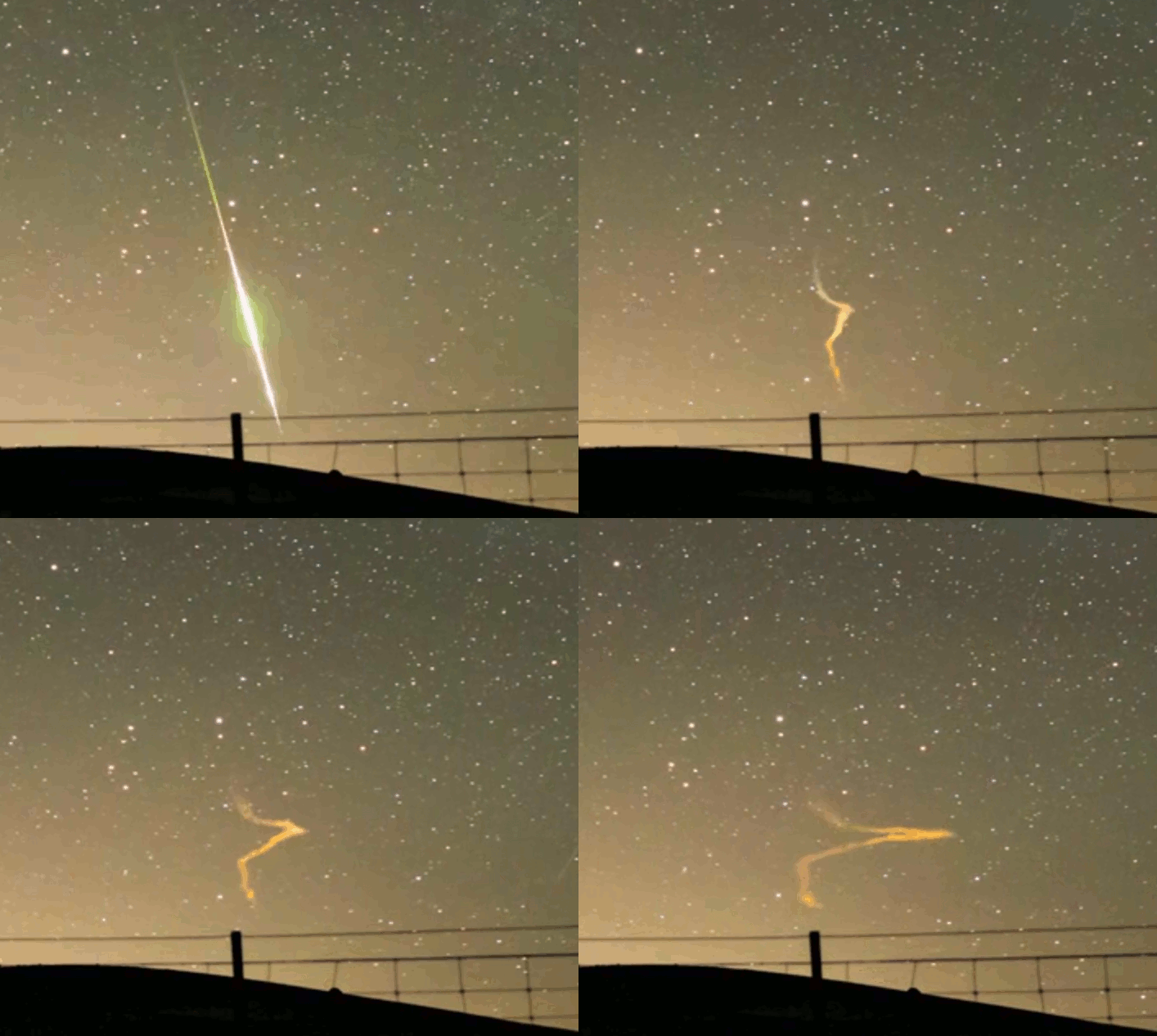
Binoculars come in handy to view the luminous trains that the brightest Perseids leave behind for a short time.
Ephemeris: 08/10/2023 – The Perseid meteor shower will reach its peak early Sunday morning
This is Bob Moler with Ephemeris for Thursday, August 10th. Today the Sun will be up for 14 hours and 17 minutes, setting at 8:56, and it will rise tomorrow at 6:40. The Moon, 2 days past last quarter, will rise at 1:43 tomorrow morning.
Back before astronomers recognized the major meteor shower that occurs at this time of year, the streaks of light in the sky of “falling” or “shooting” stars were called, by Christians, the Tears of Saint Lawrence, who was martyred on this day in the year 258. The bits of comet debris, ranging from the size of sand grains to that of a pea, hit our atmosphere at 38 miles (59 kilometers) per second and quickly vaporize due to friction, causing the streak of light we call a meteor. They are called the Perseids since they appear to come from the constellation of Perseus, located in the northeastern sky. They will be best seen Saturday night and into Sunday morning, with rates of up to one a minute, on average, especially in the early morning hours.
The astronomical event times given are for the Traverse City/Interlochen area of Michigan (EDT, UT –4 hours). They may be different for your location.
Addendum
The Dome of the sky for the night of August 12th and 13th, 2023 at 10:30 PM for northern Michigan. The Perseid radiant is in the northeast and fairly low in the sky, and marked in yellow with the caption PerR. It will continue to rise in the northeast throughout the night. The constellation names are abbreviated. Their full names can be found here. Large images can be truncated on the right. Click or tap on the image to enlarge and display the complete image. Created using my LookingUp app.
The Dome of the sky for August 12th and 13th, 2023 at 3 AM for northern Michigan. The Perseid radiant is in the northeast, much higher in the sky, and marked in yellow with the caption PerR. The constellation names are abbreviated. Their full names can be found here. Large images can be truncated on the right. Click or tap on the image to enlarge and display the complete image. Created using my LookingUp app.
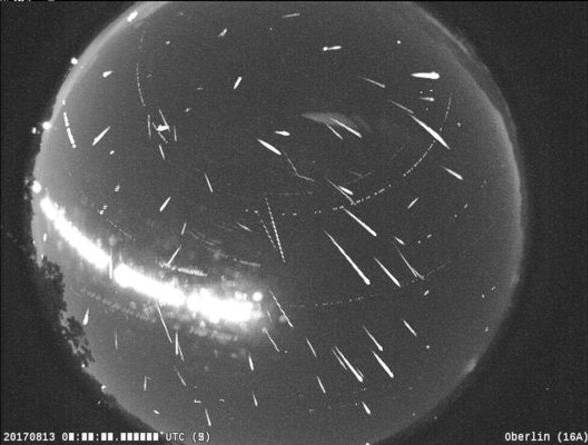
Remember, the meteors only seem to come from the radiant. They will appear all over the sky! The meteors of a shower travel in parallel paths, like train tracks, disappearing to a point in the distance.
04/21/2023 – Ephemeris – The first major meteor shower of spring reaches peak this weekend
This is Ephemeris for Friday, April 21st. Today the Sun will be up for 13 hours and 46 minutes, setting at 8:35, and it will rise tomorrow at 6:47. The Moon, 1 day past new, will set at 10:44 this evening.
Saturday night and Sunday morning will see the peak of the Lyrid meteor shower. This is the first of two major meteor showers of spring. The other one in two weeks will have to compete with a full Moon. This meteor shower will be visible all night. At the end of twilight the radiant of the shower, where the meteors will seem to come from, will be low in the northeast, to the right of the bright star Vega in the constellation of Lyra the harp, for which the meteor shower is named. The radiant point is actually between the constellations of Lyra and Hercules. Only 15 to 20 meteors an hour will be expected when the radiant is nearly overhead as morning twilight starts in the 5 am hour. The most famous meteor shower, for us, is the Perseids of August reaching peak on the morning of the 13th of August which will be seen in dark skies for most of the night.
The astronomical event times given are for the Traverse City/Interlochen area of Michigan (EST, UT –4 hours). They may be different for your location.
Addendum
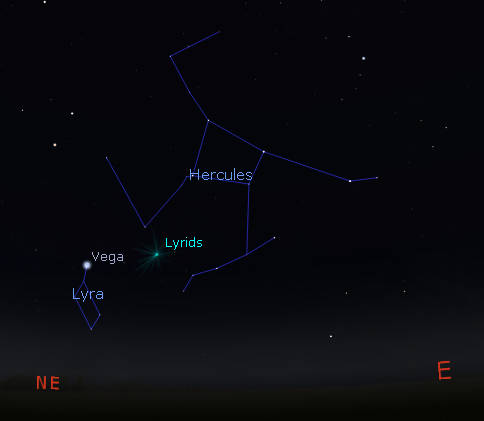
Lyrid radiant at 11 pm, looking to the east-northeast. The meteors will be seen all over the sky, but their tracks can be traced back to the radiant point, like the parallel rails of a train track recede to a point in the distance. Created using Stellarium.
10/21/2022 – Ephemeris – Lots of transient astronomical activity this weekend
This is Bob Moler with Ephemeris for Friday, October 21st. Today the Sun will be up for 10 hours and 41 minutes, setting at 6:48, and it will rise tomorrow at 8:07. The Moon, halfway from last quarter to new, will rise at 4:44 tomorrow morning. | We have several astronomical events happening tonight and over the weekend. The Orionid meteor shower may still be at peak, appearing tonight between 11 pm and moonrise tomorrow morning. Up to 20, and maybe more, meteors per hour may be spotted just prior to moonrise. Tomorrow Venus will be in superior conjunction with the Sun, the passing behind, though not directly behind the Sun, and thus entering the evening sky. It will be a month or so for Venus to separate itself from the Sun’s glare to be spotted in the early evening. Finally, on Sunday Saturn will end its retrograde or westward movement against the stars of Capricornus and resume moving eastward, its normal motion around our sky.
The astronomical event times given are for the Traverse City/Interlochen area of Michigan (EDT, UT – 4 hours). They may be different for your location.
Addendum
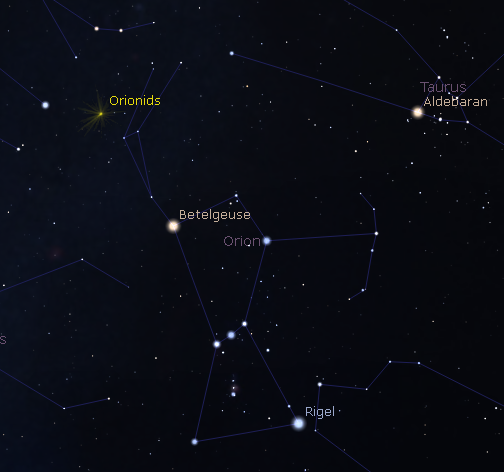
The Orionid meteor shower radiant. The radiant rises at 11 p.m., so the meteors will be visible from then into morning twilight. Despite the location of the radiant, the meteors will b e seen all over the sky. However, true Orionids can be traced back to the radiant point. This chart is from another year. This year, bright Mars would be at the top center of the image. Created using Stellarium.
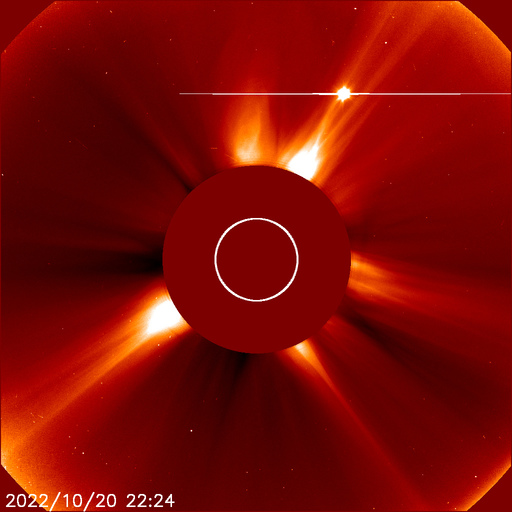
Venus near Superior conjunction through the Solar and Heliospheric Observatory (SOHO) LASCO C2 Coronagraph. The white circle inside the occulting disk is the diameter of the Sun’s photosphere, the disk we see of the Sun in white light. Launched in 1995, SOHO has been in halo orbit around the Sun-Earth L1 Lagrange point ever since.
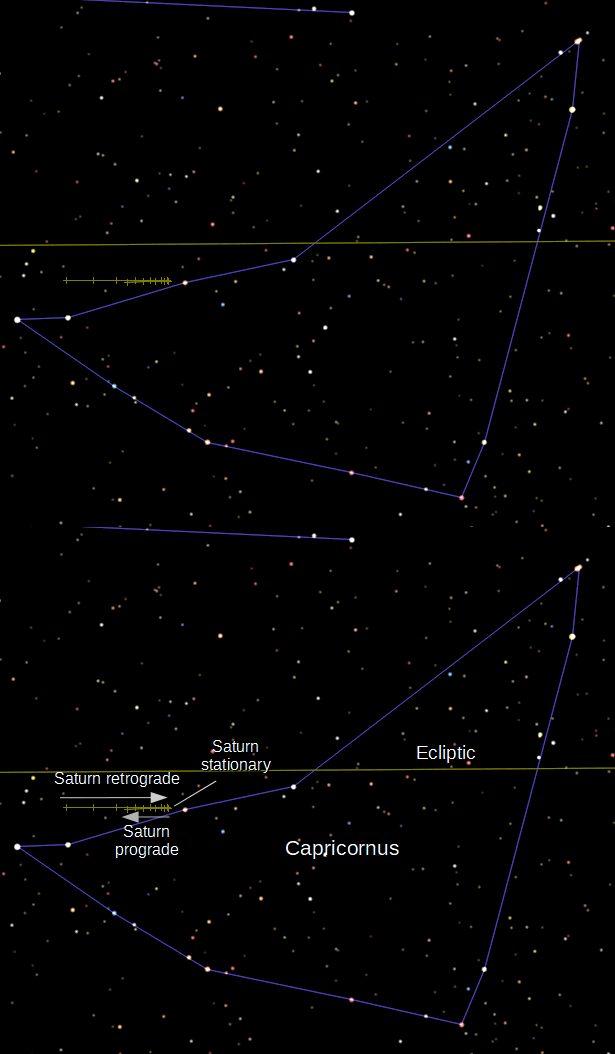
Saturn stationary animation showing it with and without annotations. The fine, folded line with tick marks is Saturn’s path. The tick marks are at 10-day intervals. Saturn starts out in retrograde motion, heading westward or to the right. On October 23rd, it slows and stops that motion. It begins to head back eastward in its normal prograde motion to the left. Outer planets like Saturn, Jupiter, Mars and the rest exhibit retrograde motion when the Earth in effect passes them on the same side of the Sun. Click on the image to enlarge it slightly. Created using Cartes du Ciel (Sky Charts), LibreOffice Draw, and GIMP.
10/20/2022 – Ephemeris – Halley’s Comet returns… in little bitty pieces
This is Bob Moler with Ephemeris for Thursday, October 20th. Today the Sun will be up for 10 hours and 44 minutes, setting at 6:49, and it will rise tomorrow at 8:06. The Moon, 3 days past last quarter, will rise at 3:36 tomorrow morning.
Halley’s Comet is back! (Pronounced Hawley’s) Well sorta. In the form of the Orionid meteor shower. Bits of Halley’s Comet from previous passes by the Earth’s orbit make their twice-yearly show in our skies as these bits collide with the Earth’s atmosphere. Halley’s orbit passes close to the Earth’s orbit at points where the Earth is around May 6th and again near October 21st. Light dust and ionized gas get blown back into the tail of the comet. Heavier particles will roughly follow in the comet’s orbit. The radiant, a spot above the constellation Orion and below Gemini from which they will seem to come, will rise around 11 pm. So view them any time after that as their numbers will increase until the Moon rises both tonight and tomorrow nights.
The astronomical event times given are for the Traverse City/Interlochen area of Michigan (EDT, UT – 4 hours). They may be different for your location.
Addendum
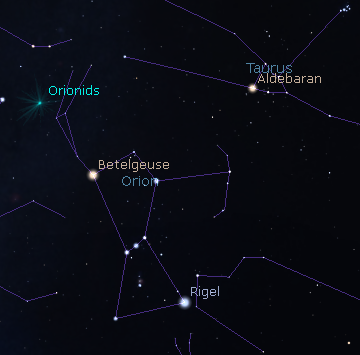
The Orionid Radiant is high in the south at 5 a.m. this weekend. Created using Stellarium.
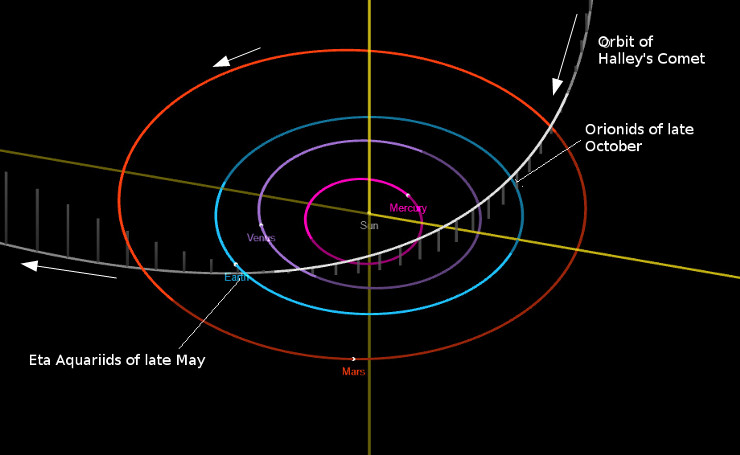
Halley’s Comet orbit with the orbits of the inner planets showing the points at which the debris from the comet intersect with the Earth’s orbit, causing meteor showers. Click on the image to enlarge it. Diagram credit JPL Small-Body Database Browser with my annotations.
 Bob Moler's Ephemeris Blog