Archive
07/25/2022 – Ephemeris – Getting an early look at the Perseid Meteor Shower
This is Ephemeris for Monday, July 25th. Today the Sun will be up for 14 hours and 55 minutes, setting at 9:16, and it will rise tomorrow at 6:22. The Moon, 3 days before new, will rise at 3:57 tomorrow morning.
The annual Perseid meteor shower, which will reach its peak on the evening of August 12th has the full moon to contend with. So the best time to spot these meteors is before the peak. Members of this meteor shower can be spotted from July 17th to August 24th, but in much reduced numbers. They are best seen after midnight, however since the point in the sky they seem to come from, the radiant, is always above the horizon, they can be spotted any time at night. They will seem to come from the northeastern part of the sky, and below the letter W shaped constellation of Cassiopeia. The Southern Delta Aquariid meteors coming from the southeast after 11 pm will predominate. Its radiant, the point from which the meteors will seem to come from, will be near the Moon. The Southern Delta Aquariids will reach their peak on the 30th of this month, with dark skies. The Southern Delta Aquariid radiant will rise about 11 pm now, and it will be possible to spot one of its meteors until the Moon rises. The hourly rates of the Perseids will increase each night until the Moon starts to interfere with the shower in early August.
The astronomical event times given are for the Traverse City/Interlochen area of Michigan (EDT, UT – 4 hours). They may be different for your location.
Addendum
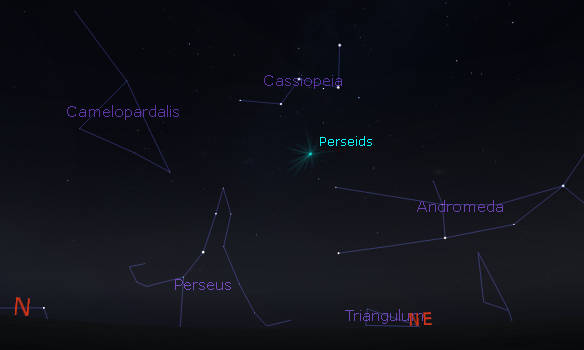
Finder chart for Perseid Radiant for August 25, 11pm. The radiant point will move slowly to the left for the duration of the meteor shower over the next month. By August 12th, the shower’s peak, the radiant will be just left of the top star of Perseus. Created using Stellarium.
05/27/2022 – Ephemeris – There could be a spectacular meteor display Tuesday early morning, or nothing!
This is Bob Moler with Ephemeris for Friday, May 27th. Today the Sun will be up for 15 hours and 13 minutes, setting at 9:16, and it will rise tomorrow at 6:02. The Moon, 3 days before new, will rise at 5:03 tomorrow morning.
Comet Schwassmann-Wachmann 3, SW3 for short began to breakup in 1995, 27 years ago. Two large chunks of the comet’s nucleus and dozens of smaller pieces have been seen. A vast, unseen debris field is expected to be expanding from the remnants of the comet. Astronomers, calculating what happened to that unseen debris cloud, expect the Earth to run into a part of it around 1 am (EDT, 5 hours UT), give or take, on Tuesday, May 31st (That’s late Memorial Day night). Causing, if we’re lucky, a meteor shower or meteor storm. The radiant point from which the meteors seem to come is from between the Big Dipper’s handle and the bright star Arcturus. They will appear all over the sky. I’m crossing my fingers on this one, it could be great, or it could be nothing.
The astronomical event times given are for the Traverse City/Interlochen area of Michigan (EDT, UT – 4 hours). They may be different for your location.
Addendum
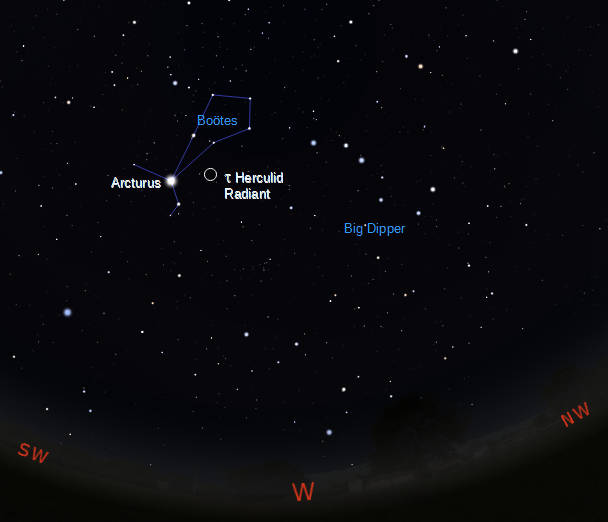
Position of the Tau Herculid radiant at 1 am, May 31, 2022. However, meteors will appear all over the sky, but could be traced back to the radiant. These meteors will appear to travel a lot slower than the Perseid meteors of August. Created using Stellarium for the star field and LibreOffice for annotations.
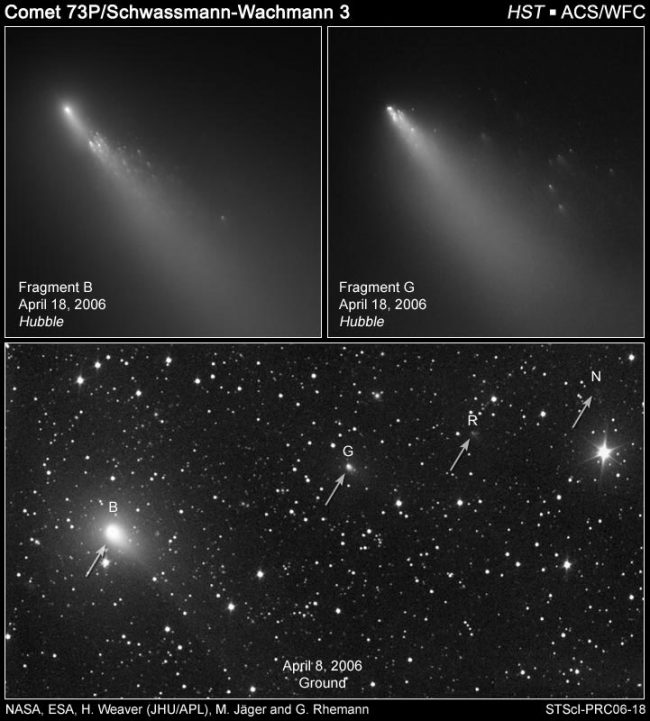
Comet Schwassmann-Wachmann 3 Hubble Space Telescope images from 2006 showing the breakup of the comet. Credit: NASA.
05/26/2022 – Ephemeris – There may be a spectacular meteor storm Tuesday am or nothing!
This is Ephemeris for Thursday, May 26th. Today the Sun will be up for 15 hours and 11 minutes, setting at 9:16, and it will rise tomorrow at 6:03. The Moon, halfway from last quarter to new, will rise at 4:42 tomorrow morning.
Early risers tomorrow morning should be able to see, if it’s clear, the planet Venus just above and right of the waning crescent Moon. The last of the visible Moon-planet encounters this month. Another event this month may be the Tau Herculid meteor shower. This may be a spectacular meteor shower, or nothing. It would be the result of the breakup of Comet Schwassmann-Wachmann 3 that started back in 1995. SW3, as it’s known for short, has a 5.44 year orbit of the Sun, so we only get a good look at it about every 11 years currently. As the nucleus breaks up, the debris field widens, with time. The comet will pass close to the orbit of the Earth in a few months. The comet’s orbit comes closest to the Earth’s orbit on May 31st. If the debris cloud has widened enough by now, the Earth should intercept it around 1 am our time that morning.
The astronomical event times given are for the Traverse City/Interlochen area of Michigan (EDT, UT – 4 hours). They may be different for your location.
Addendum
Position of the Tau Herculid radiant at 1 am, May 31, 2022. However, meteors will appear all over the sky, but could be traced back to the radiant. These meteors will appear to travel a lot slower than the Perseid meteors of August. The meteor storm, if it occurs, should peak around 1 am. However, there is an uncertainty with the time or if the meteor will show up. Created using Stellarium for the star field and LibreOffice for annotations.
Comet Schwassmann-Wachmann 3 Hubble Space Telescope images from 2006 showing the breakup of the comet. Credit: NASA.
05/05/2022 – Ephemeris – Halley’s Comet returns… in pieces
This is Ephemeris for Cinco de Mayo, Thursday, May 5th. Today the Sun will be up for 14 hours and 25 minutes, setting at 8:52, and it will rise tomorrow at 6:25. The Moon, 3 days before first quarter, will set at 1:53 tomorrow morning.
The Eta Aquariid meteor shower will reach peak at about 4 am, tomorrow morning. However, the radiant, the apparent source of the meteor streaks, doesn’t rise until 3:15 am. If you’re waiting to see the return of Halley’s Comet, you needn’t wait until the main body of the comet returns in 2061. Halley’s Comet has made many passes of the inner solar system in recorded history, and more before that, returning to the inner solar system every 76 years or so, before returning to its frigid home beyond Neptune. It’s closest pass to the Sun, called perihelion, is inside Venus’ orbit. On the way in and out, it passes close to the Earth’s orbit. It has left a trail of debris, which we pass through in May and again in October.
The astronomical event times given are for the Traverse City/Interlochen area of Michigan (EDT, UT – 4 hours). They may be different for your location.
Addendum
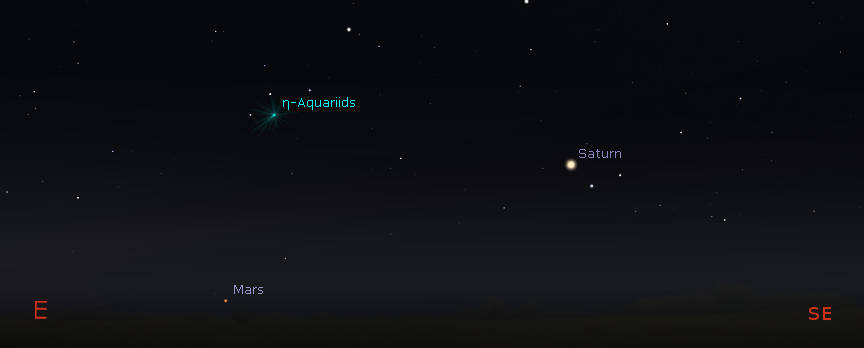
The Eta Aquariid meteor shower radiant as it will be apparent tomorrow morning at 4:30 or at the beginning of nautical twilight. The radiant isn’t a ting that can be seen, but the point from which all the meteors of this shower can be traced back to. The funny looking lower case “n” is the Greek letter eta. The shower is named for the star seen just above the radiant, which is in the center of a small triangle of stars that make up Aquarius’ water jar. Click on the image to enlarge it. Created using Stellarium.
04/21/2022 – Ephemeris – The Lyrid Meteor Shower reaches its peak tomorrow afternoon
This is Bob Moler with Ephemeris for Thursday, April 21st. Today the Sun will be up for 13 hours and 47 minutes, setting at 8:35, and it will rise tomorrow at 6:46. The Moon, 2 days before last quarter, will rise at 2:54 tomorrow morning.
The second major meteor shower this year will reach its peak tomorrow afternoon around 2 pm (~19h UT). One of the best times to see it will be tonight from about 10 pm to near 3 am when the Moon rises. The other is tomorrow night. The meteor shower is called the Lyrids, because they seem to come from near the constellation Lyra the harp and the bright star Vega. At 10 p.m. Vega is the brightest star low in the northeastern sky. By 3 a.m. Vega will be high in the east. The radiant of the meteors is to the west of Vega, between Lyra and the dim constellation of Hercules. The most meteors will be visible just before the Moon begins to brighten the sky before 3 a.m. Though a major shower, the peak hourly rate is expected to be less than 20 meteors an hour.
The astronomical event times given are for the Traverse City/Interlochen area of Michigan (EDT, UT – 4 hours). They may be different for your location.
Addendum
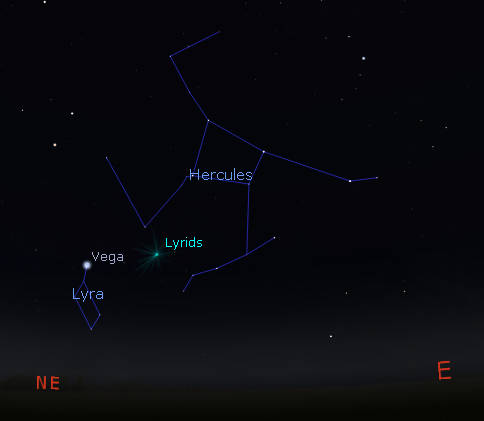
The Lyrid radiant at 11 pm, looking to the east-northeast. The meteors will be seen all over the sky, but their tracks can be traced back to the radiant point, like the parallel rails of a train track recede to a point in the distance. Click on the image to enlarge it. Created using Stellarium.
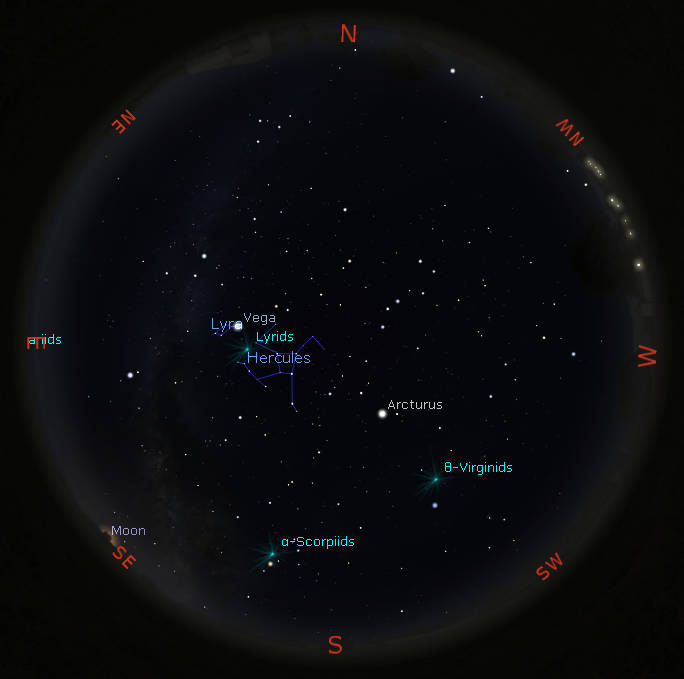
The Lyrid radiant at 3 am, looking in this all-sky view. Vega will be very high in the east and Hercules will be almost overhead. The meteors will be seen all over the sky, but their tracks can be traced back to the radiant point, like the parallel rails of a train track recede to a point in the distance. There are two other minor meteor showers happening at the same time, though neither is at peak, providing only a few meteors per hour. Click on the image to enlarge it. Created using Stellarium.
11/11/2021 – Ephemeris – The Moon passes Jupiter and a minor meteor shower tonight.
This is Bob Moler with Ephemeris for Veterans Day, Thursday, November 11th. Today the Sun will be up for 9 hours and 43 minutes, setting at 5:18, and it will rise tomorrow at 7:36. The Moon, at first quarter today, will set at 12:16 tomorrow morning.
By tonight, the Moon will have moved over and just passed Jupiter. The bright planet will be to the right and above the first quarter Moon. There is also a meteor shower occurring, well actually two. They are minor, with maybe 5 to 15 meteors per hour at peak. With both showers, the radiants, that is where the meteors seem to come from, is in Taurus the Bull near the Pleiades star cluster. The notes I have for the Northern Taurids is that they are slow and bright, not bothered by a bright Moon. So if a meteor is spotted in the evening coming from the east, it’s probably a North Taurid meteor. As the night progresses the radiant will move westward, higher in the sky and begin to set in the west as morning twilight starts.
The astronomical event times given are for the Traverse City/Interlochen area of Michigan (EST, UT – 5 hours). They may be different for your location.
Addendum
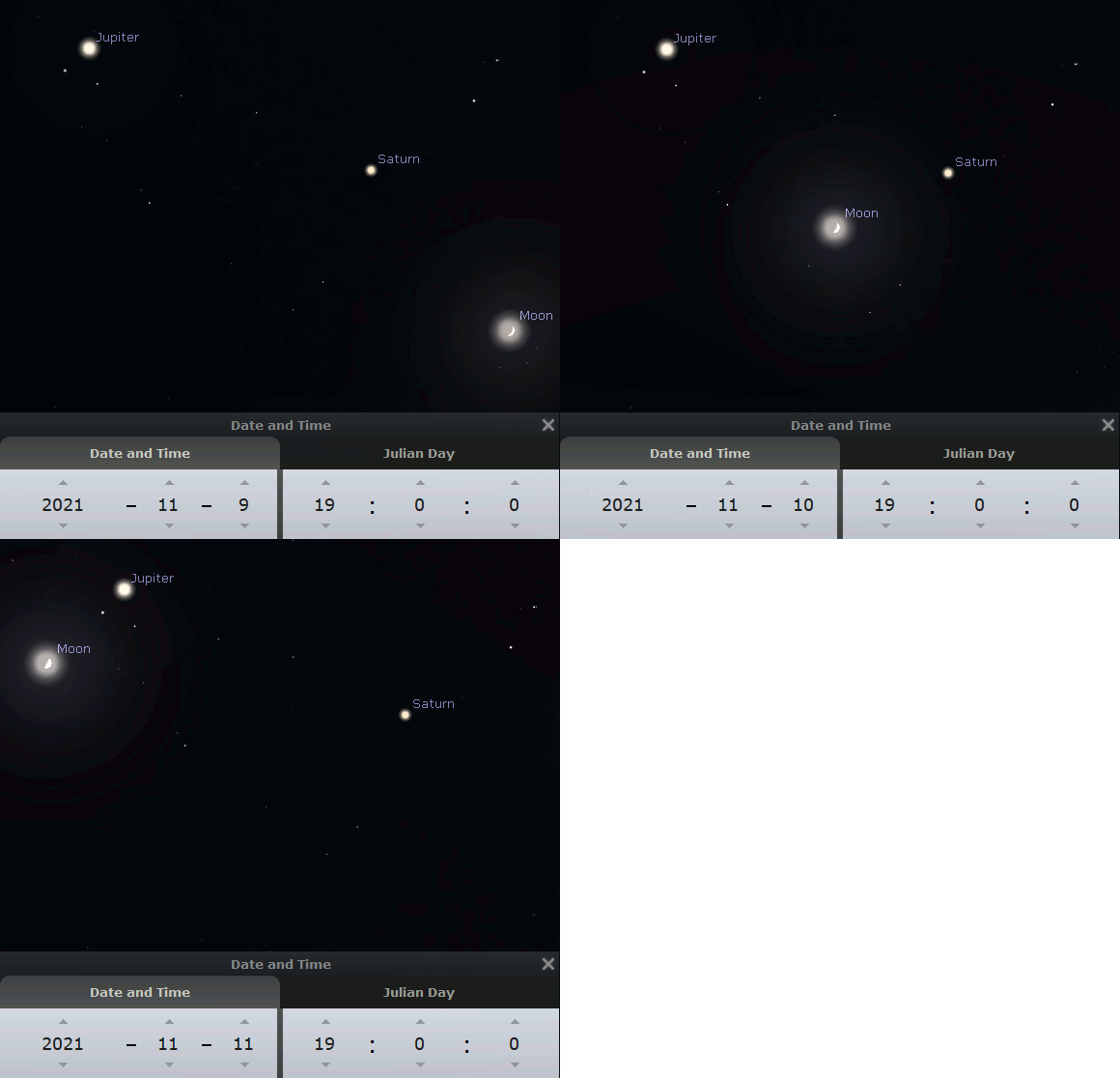
Viewing the Moon’s passage by Saturn and Jupiter for three nights, November 9, 10 and 11 2021. Note that while the Moon is jumping eastward, to the left, the planets and stars are moving the other way, but much more slowly. The Moon moves 360° around the sky in about 29 1/2 days, so it moves about 12° or 24 of its diameters every day. The movement of the stars and planets in the other direction is because we are staying at the same solar time, 7 pm. However, the Earth is orbiting the Sun at a little less than a degree a solar day. To keep the stars stationary, our daily interval should be one sidereal day, the time it takes the earth to rotate with respect to the stars, which is 23 hours 3 minutes and 56 seconds. Should we have stepped at the sidereal rate, the very slight eastward motion of these outer planets may have been noticeable. Created using Stellarium, and GIMP.
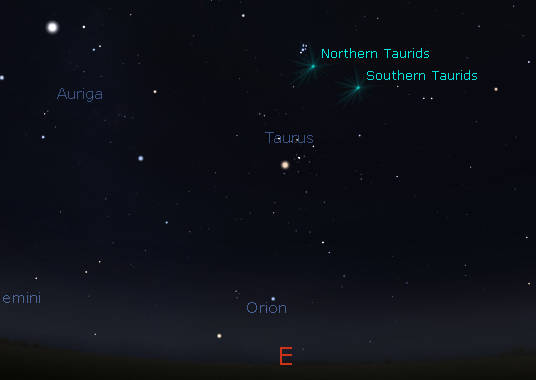
North and South Taurid radiants seen in the east at 9 pm on November 11th. The Northern Taurid radiant is the most active now. Note the Pleiades just to the upper left of the Northern Taurid radiant. The face of Taurus the bull is below as a sideways V where Taurus is displayed. However, since the meteors are seen all over the sky, it might be difficult to trace them back to a specific radiant. Created using Stellarium.
As a side note, about the face of Taurus. The stars, except the brightest one, Aldebaran, belong to a star cluster called the Hyades. They are, mythologically, the half-sisters of the Pleiades. Also, the V can be an upside down A. I am currently working on a program I’m going to present at the December Zoom meeting of the Grand Traverse Astronomical Society about astronomy in ancient times. Back when the alphabet was developed in the Middle East 4000-4500 years ago, Taurus, not Aries was the first sign of the zodiac, so apparently the first letter of the alphabet “Aleph” was modeled after the face of Taurus.
Other tidbits are: the reason there are 24 hours in a day, and 60 minutes in an hour. There are lots of others. We can handle up to 100 people joining the meeting. It’s at 8 pm EST (UT – 5 hours), December 3rd [01:00 UT, December 4th]. To join the meeting, go to www.gtastro.org for instructions and a link.
08/12/2021 – Ephemeris – It’s not too late to see the Perseids
This is Ephemeris for Thursday, August 12th. Today the Sun will be up for 14 hours and 10 minutes, setting at 8:52, and it will rise tomorrow at 6:43. The Moon, 3 days before first quarter, will set at 11:13 this evening.
It’s not too late to see the Perseid meteors. The projected peak of the shower is expected to be between 3 and 6 this afternoon. So the meteor shower should still be quite active. It has been my experience that the numbers of meteors decline more rapidly than they increase before the peak. NASA can determine their orbits using all sky cameras placed at different locations to get their paths by triangulation. The cameras have shutters the interrupt the meteor track at a specific interval, which allow them to determine the meteor’s speed and are able to calculate the particle’s orbit of the Sun. An animation of these orbital tracks can be found on the International Meteor Organization website imo.net.
The astronomical event times given are for the Traverse City/Interlochen area of Michigan (EDT, UT – 4 hr). They may be different for your location.
Addendum
I’ve been talking about the Perseid meteor shower all week, so far. Click on the calendar dates to the upper right to review those posts.
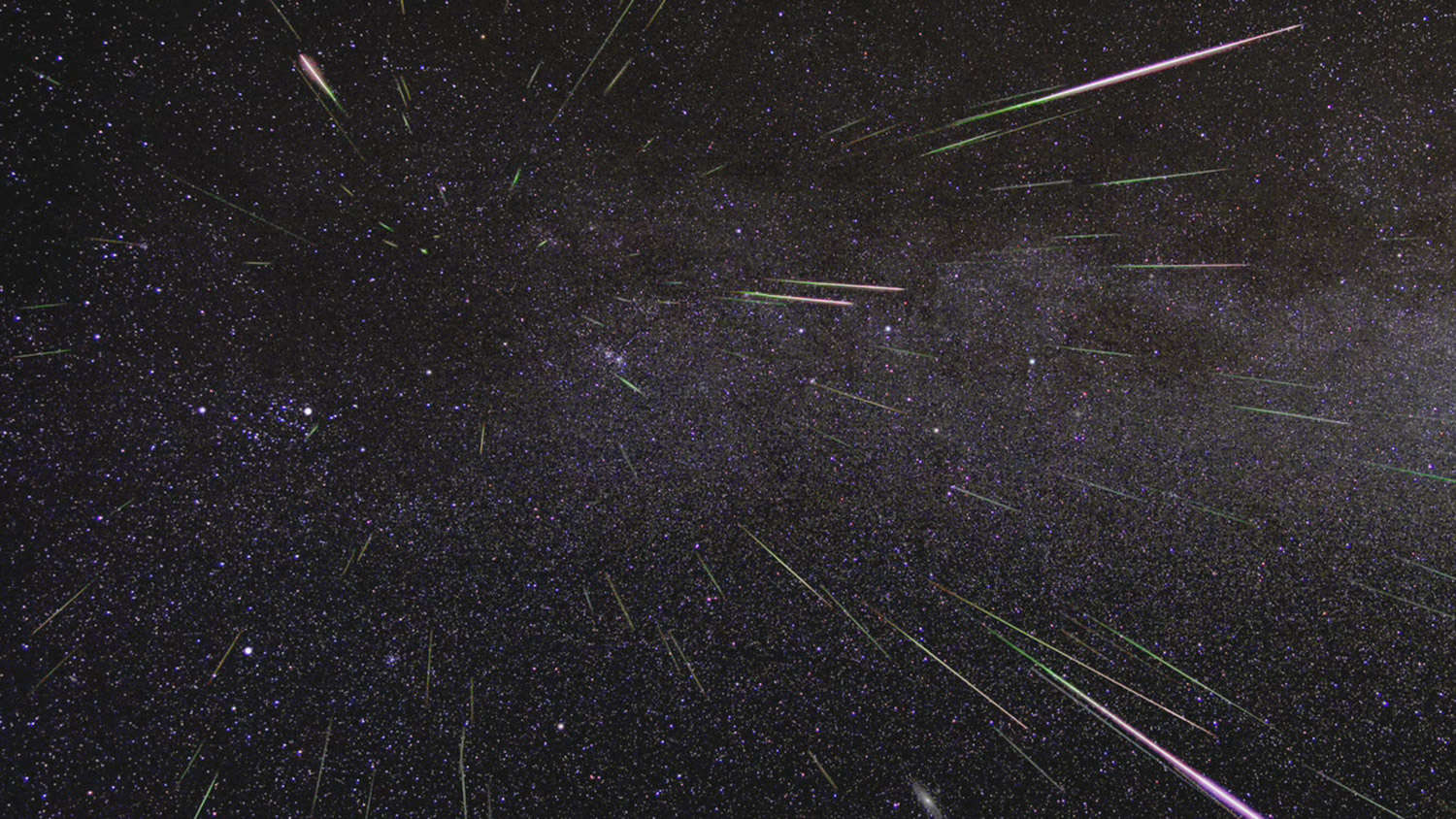
A Perseid outburst from 2009. Credit NASA/JPL via Phil Plait’s Bad Astronomy.
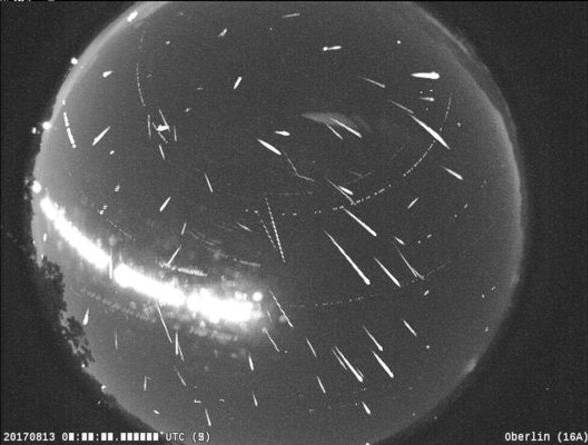
Perseid fireballs in one of NASA’s all sky cameras during the morning hours of August 13, 2017. This is a long time exposure. The bright swath in the image is the Moon that morning. Since it is a time exposure, the radiant is also moving with the earth’s rotation, so the meteors only seem to come from the northeastern sky. North is at the top, and East is to the left. Credit NASA.
08/11/2021 – Ephemeris – Let’s search for the naked-eye planets for this week, and meteors tonight
This is Bob Moler with Ephemeris for Wednesday, August 11th. Today the Sun will be up for 14 hours and 13 minutes, setting at 8:54, and it will rise tomorrow at 6:42. The Moon will be 3 days past new tonight.
Let’s search for the naked-eye planets for this week. Venus and the Moon will be close together tonight, with Venus below and right of the waxing crescent Moon by 9:30 tonight. Venus will set at 10:18 pm. With the Moon following at 10:50. By 10 pm, Jupiter and Saturn will be seen low in the southeastern sky. The brighter Jupiter will be easy to spot at that hour. Saturn will be dimmer, but a bit higher and to its right. Tonight and especially in the morning hours tomorrow, the Perseid meteors will be at their peak. These bits of Comet Swift-Tuttle, liberated by the comet’s prior passes in through the warmth of the inner solar system, will flash into incandescence as they enter the Earth’s atmosphere at interplanetary speeds.
The astronomical event times given are for the Traverse City/Interlochen area of Michigan (EDT, UT – 4 hr). They may be different for your location.
Addendum
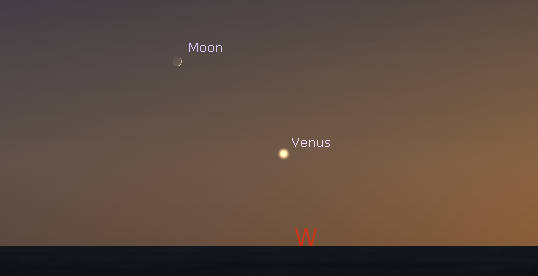
Venus and the 3-day-old Moon ion evening twilight at 9:45 tonight, August 11, 2021. Created using Stellarium.
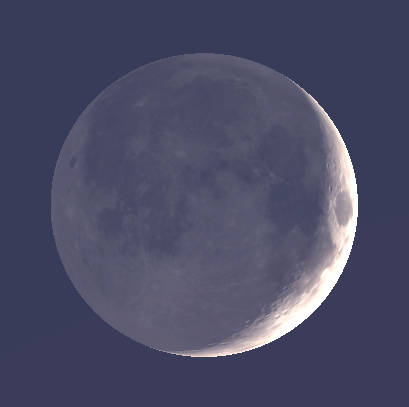
The Moon as it might appear in binoculars tonight, August 11, 2021, with earth shine on its night side, illuminated by the bright Earth in its sky.
Created using Stellarium.
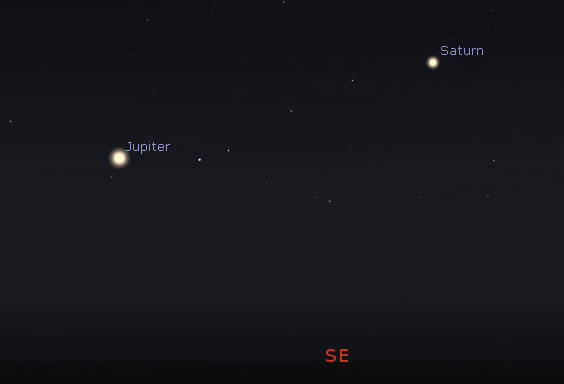
Jupiter and Saturn in the southeastern sky at 10:30 in the evening tonight, August 11, 2021. Created using Stellarium.
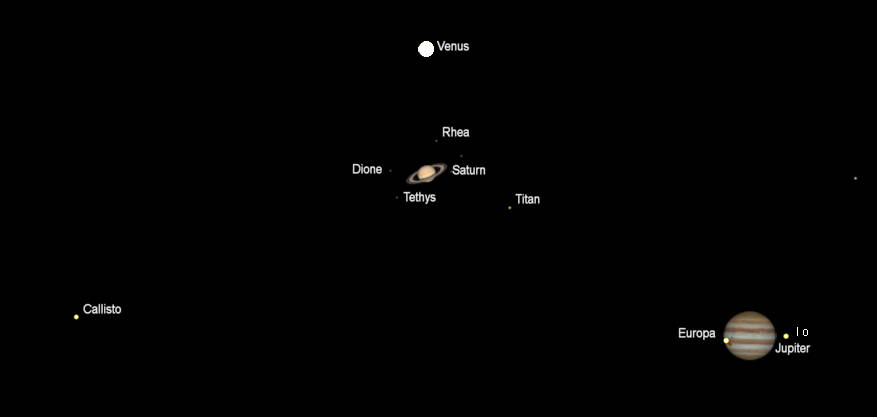
Telescopic view of the bright planets (north up) as they would be seen in a small telescope, with the same magnification, this evening, at 10 pm August 11, 2021. Apparent diameters: Venus, 13.40″; Saturn 18.57″, its rings 43.26″; Jupiter, 49.00″. Jupiter’s moon have a cluster of events in the evening. See below. The ” symbol means seconds of arc (1/3600th of a degree.) Click on the image to enlarge it. Created using Cartes du Ciel (Sky Charts).
                Jupiter's Satellite events
Moon      Event            EDT (pm-11th, am-12th) UT (12th)
Europa    Shadow enters    10:00 pm               02:00
Europa    Transit starts   10:25 pm               02:25
Io        Eclipse starts   10:41 pm               02:41
Europa    Shadow exits     12:51 am               04:51
Ganymede  Occultation ends  1:06 am               05:06
Io        Occultation ends  1:11 am               05:11
Europa    Transit ends      1:12 am               05:12
The above times were determined using Stellarium, and may be off by several minutes.
Shadow events are when a satellite’s shadow is cast onto the face of the planet
Transit events are when the satellite passes in front of the planet
Eclipse events are when a satellite passes through the planet’s shadow
Occultation events are when the satellite passes behind the planet
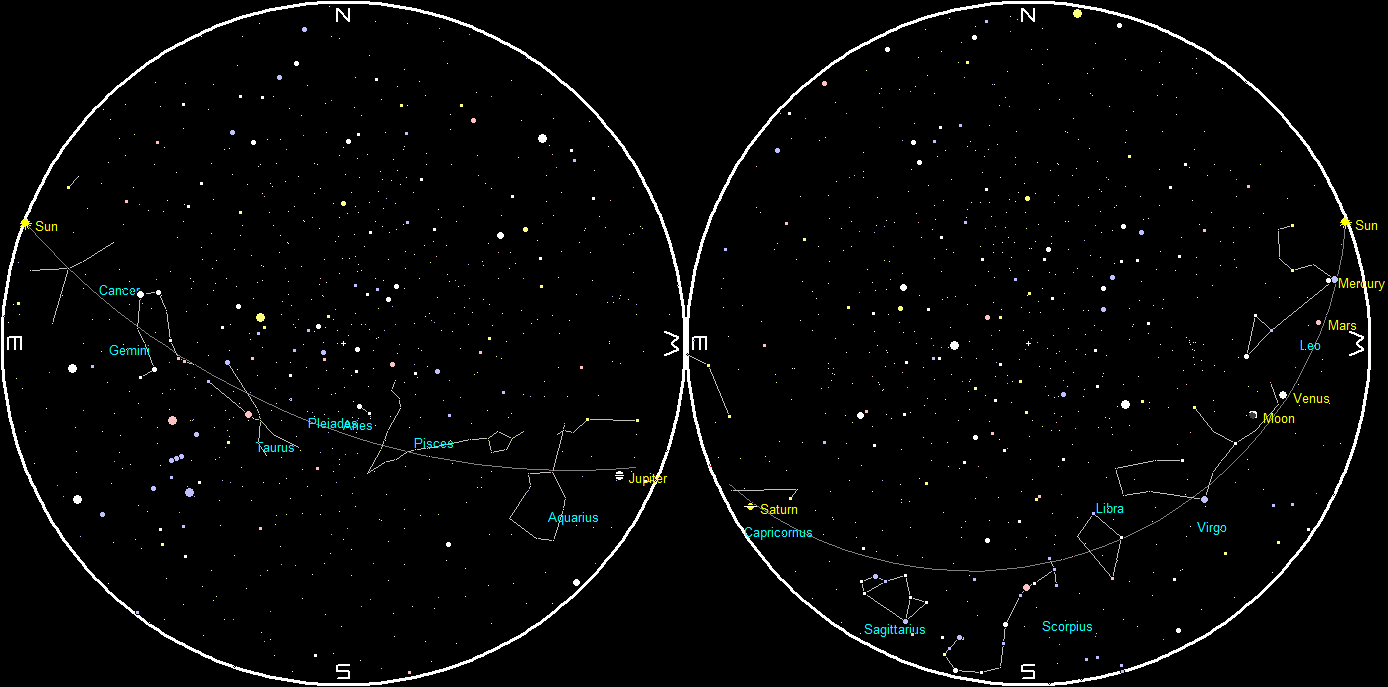
Planets and the Moon at sunset and sunrise of a single night, starting with sunset on the right on August 11, 2021. The night ends on the left with sunrise on the 12th. Click on the image to enlarge. Created using my LookingUp program.
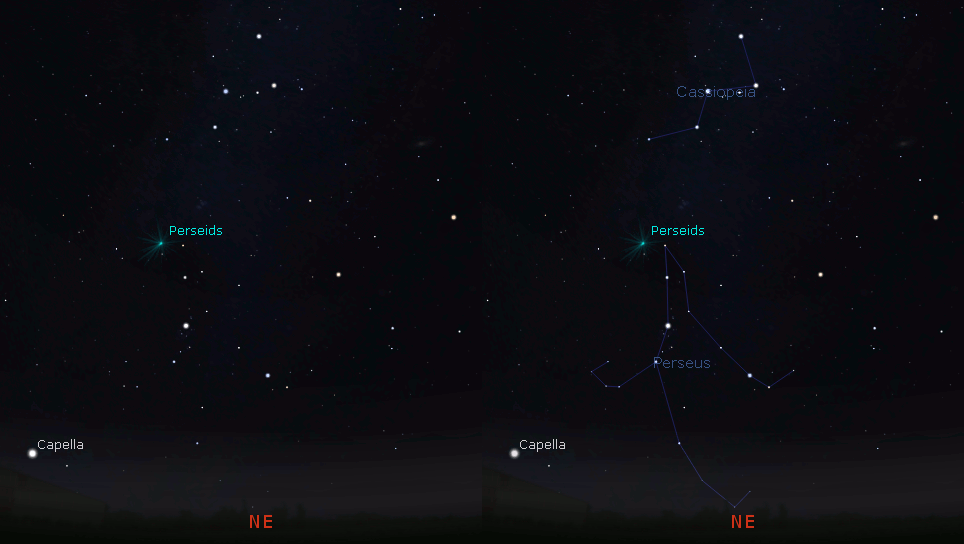
Perseid Radiant finder automation for midnight, August 11th. Created using Stellarium and GIMP.
More on the Perseids on Monday and Tuesday’s posts.
08/10/2021 – Ephemeris – Tomorrow night, all night, will see the peak of the Perseid Meteor Shower.
This is Bob Moler with Ephemeris for Tuesday, August 10th. Today the Sun will be up for 14 hours and 16 minutes, setting at 8:55, and it will rise tomorrow at 6:40. The Moon, 2 days past new, will set at 10:27 this evening.
Back before astronomers recognized the major meteor shower that occurs at this time of year, the streaks of light in the sky of “falling” or “shooting” stars were called, by Christians, the Tears of Saint Lawrence, who was martyred on this day in the year 258. The bits of comet debris ranging in size from the size of sand grains to that of a pea hit our atmosphere at 38 miles (59 kilometers) per second and quickly vaporize due to friction, causing the streak of light we call meteors. They are called the Perseids since they appear to come from the constellation of Perseus, located in the northeastern sky. They will be best seen tomorrow night and into Thursday morning, with rates of up to one a minute, on average, in the early morning hours.
The astronomical event times given are for the Traverse City/Interlochen area of Michigan (EDT, UT – 4 hr). They may be different for your location.
Addendum
Perseid Radiant finder automation for midnight, August 11th. Created using Stellarium and GIMP.
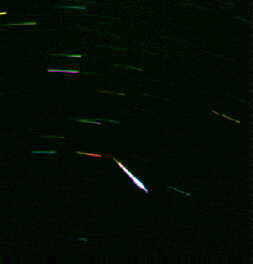
My best Perseid photo. From the 70s. The stars are trailed because this is a time exposure of perhaps 15 minutes and the camera is on a fixed tripod which rotates with the Earth.
08/09/2021 – Ephemeris – The Perseid Meteors are coming!
This is Ephemeris for Monday, August 9th. Today the Sun will be up for 14 hours and 18 minutes, setting at 8:57, and it will rise tomorrow at 6:39. The Moon, 1 day past new, will set at 10:03 this evening.
If you’ve been out and about under the dark night skies in the last week or so, you may have spotted a few, what are sometimes called, falling or shooting stars. If these could be traced back to the northeastern sky, those were advance members of the Perseid Meteor Shower. The peak of the shower will be on the afternoon of Thursday the 12th, so actually the best time to see them will be in the early hours of that morning. With few exceptions, the best time to view meteors in general or a meteor shower is in the wee morning hours. The Perseids however favor us, because the point from which they seem to come, called the radiant, is so far north that it never sets for us, so they can be seen all night. In the evening, there are just fewer of them.
The astronomical event times given are for the Traverse City/Interlochen area of Michigan (EDT, UT – 4 hr). They may be different for your location.
Addendum
Perseid fireballs in one of NASA’s all sky cameras during the morning hours of August 13, 2017. This is a long time exposure. The bright swath in the image is the Moon that morning. Since it is a time exposure, the radiant is also moving with the earth’s rotation, so the meteors only seem to come from the northeastern sky. North is at the top, and East is to the left. Credit NASA.
 Bob Moler's Ephemeris Blog