Archive
10/10/11 – Ephemeris – What happened with the Draconids last Saturday?
Columbus Day (observed), Monday, October 10th. The sun will rise at 7:51. It’ll be up for 11 hours and 16 minutes, setting at 7:07. The moon, 1 day before full, will set at 7:31 tomorrow morning.
Last Saturday nights International Observe the Moon Night coincided with the Draconid meteor shower. The Draconids are a periodic shower, not good most years, and when they do appear the shower, or rather meteor storm doesn’t last very long. The bright moon didn’t help, and the peak was predicted to occur in the afternoon our time. The meteors did appears, and right on time, too early for us to have seen it. The best way to detect them with a bright moon is with radio. And using that technique the estimated the peak of Draconid meteors was over 200 per hour. The responsible comet, Giacobini-Zinner, will pass our orbit next February, and may give us a chance to spot the Draconids in darker skies next year.
* Times are for the Traverse City/Interlochen area of Michigan. They may be different for your location.
10/06/11 – Ephemeris – The Draconid meteor shower
Thursday, October 6th. The sun will rise at 7:46. It’ll be up for 11 hours and 28 minutes, setting at 7:14. The moon, 3 days past first quarter, will set at 3:26 tomorrow morning.
This weekend astronomers expect the meteor shower called the Draconids. This is a periodic shower which is active about once every six years. That is because it is related to a short period comet called Giacobini-Zinner. It was discovered in 1900 by the two named astronomers. Its orbit stretches from the earth’s orbit to somewhat past Jupiter’s. When the comet passes near the earth’s orbit we pass through a cloud of its debris when we get to that same spot. Giacobini-Zinner will do so next February. The comet’s nucleus is estimated to be a bit more than a mile in diameter. The Draconid meteors will appear to come from north of the bright star Vega, which is a bit west of overhead at 9 in the evening.
* Times are for the Traverse City/Interlochen area of Michigan. They may be different for your location.
Addendum
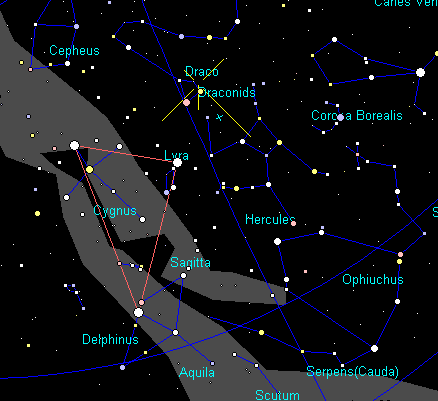
Draconid Meteor Shower Radiant
10/03/11 – Ephemeris – More celestial events for this month
Monday, October 3rd. The sun will rise at 7:42. It’ll be up for 11 hours and 37 minutes, setting at 7:19. The moon, at first quarter today, will set at 12:10 tomorrow morning.
We have more celestial happenings this month than I could enumerate last Friday. Later on Saturday evening, if it’s clear the Grand Traverse Astronomical Society will join with astronomy groups, planetariums and observatories with International Observe the Moon Night with telescopes positioned on the 200 block east Front Street in Traverse City, near the Martinek clock. Going on that same evening will be the return of the Draconid meteor shower. Its a favorable return of a periodic shower but interferes with by the bright moon. However some bright meteors will be seen. I’ll have more information and background Thursday. Another meteor shower later this month will be the Orionids a morning shower related to Halley’s Comet.
* Times are for the Traverse City/Interlochen area of Michigan. They may be different for your location.
08/11/11 – Ephemeris – Prospects for this year’s Perseid Meteor Shower
Thursday, August 11th. The sun rises at 6:40. It’ll be up for 14 hours and 14 minutes, setting at 8:54. The moon, 2 days before full, will set at 5:31 tomorrow morning.
In the next two nights the Perseid meteor shower will be at a peak. The problem this year will be that the moon is full, or full enough that the skies will not be dark all night. Hope is not completely lost, because there will be a few really bright meteors, a few an hour, rather than the 50 or more an hour visible in dark skies. The paths of meteors appear longer in the evening where the radiant point of the meteors lies low in the north northeast, when the bits of rock skip through our atmosphere at a very low angle. These bits of rock were liberated by comet Swift Tuttle on a prior pass of the inner solar system. It orbits the sun in 130 years, and its path takes it very close to the orbit of the earth, so this time of year we pass through its debris.
* Times are for the Traverse City/Interlochen area of Michigan. They may be different for your location.
Addendum
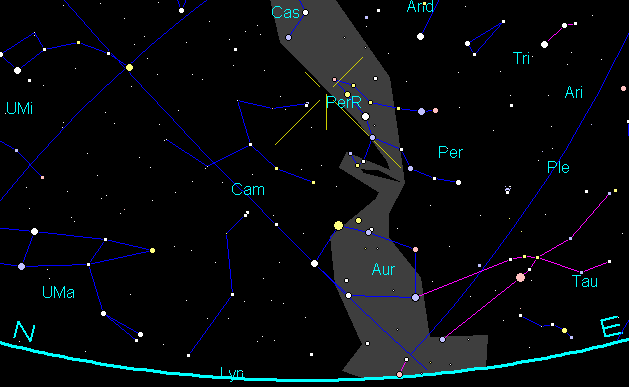
Perseid Meteor Shower radiant after midnight
The radiant is actually circumpolar for northern Michigan. At 10:30 p.m. it’s just east or the north compass point and very low on the horizon.
08/01/11 – Ephemeris – Previewing August skies
Monday, August 1st. The sun rises at 6:28. It’ll be up for 14 hours and 39 minutes, setting at 9:08. The moon, 2 days past new, will set at 9:52 this evening.
Let’s look ahead at the month of August in the skies. Daylight hours will decrease from 14 hours and 39 minutes today to 13 hours 17 minutes on the 31st. The altitude of the sun at local noon, that is degrees of angle above the horizon will decrease from 63 degrees today to just over 53 degrees on the 31st. Straits area listeners can subtract one more degree from those angles. Local noon, when the sun is due south, is about 1:43 p.m. The Perseid meteor shower will reach its peak on the morning of the 12th, but will be mostly unseen due to the bright moon. However on the nights between now and then when the moon has set these meteors will still be plentiful. We saw two bright ones Saturday night at the Sleeping Bear Dunes viewing night.
* Times are for the Traverse City/Interlochen area of Michigan. They may be different for your location.
05/05/11 – Ephmeris – The Eta Aquarid meteor shower
Thursday, May 5th. The sun rises at 6:27. It’ll be up for 14 hours and 24 minutes, setting at 8:51. The moon, 2 days past new, will set at 11:35 this evening.
The Eta Aquarid meteor shower is ramping up. The Eta Aquarids are caused by bits of Halley’s Comet, passing the earth’s orbit heading out from the sun. The Orionids of late October are debris of Halley’s comet passing the earth’s orbit heading in toward the sun. It’s the only comet I recollect caused two meteor showers. The Eta Aquarids are named for the star nearest the radiant of the meteor shower. The constellation of Aquarius has many shower radiants, which is why the shower is named for a star in Aquarius. The radiant rises shortly before 3:30 and astronomical twilight begins an hour later. There’s perhaps another half hour of visibility after that. The peak will occur tomorrow morning where up to 20 meteors per hour might be seen.
* Times are for the Traverse City/Interlochen area of Michigan. They may be different for your location.
Addendum
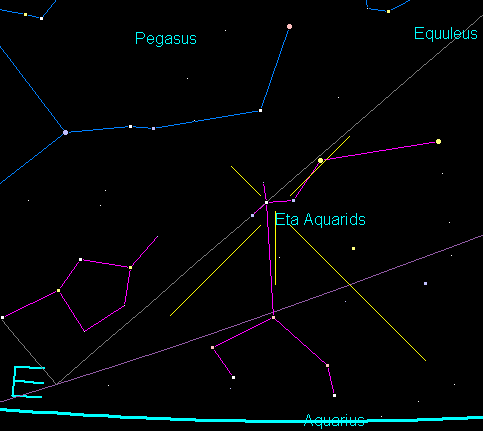
Eta Aquarid radiant
01/03/11 – Ephemeris – The earth at perihelion and the Quadrantid meteor shower
Monday, January 3rd. The sun will rise at 8:19. It’ll be up for 8 hours and 55 minutes, setting at 5:14. The moon, 1 day before first quarter, will rise at 8:26 tomorrow morning.
We have two celestial events today. Around 2:30 this afternoon the earth with be at its closest point to the sun called perihelion, only 91.4 million miles. We’re a little too far north to need the extra sun screen. What really happens is the earth travels faster in its orbit making winter the shortest season. Tonight will see the peak of the Quadrantid meteor shower. These meteors seem to come from the defunct constellation of the Quadrangle near the tip of the handle of the Big Dipper. It can be as productive as the meteors of August. Up to 100 an hour may be seen toward dawn when the radiant point is high in the sky. Early in the evening the radiant will be low in the north giving us fewer but longer meteor trails in the sky.
* Times are for the Traverse City/Interlochen area of Michigan. They may be different for your location.
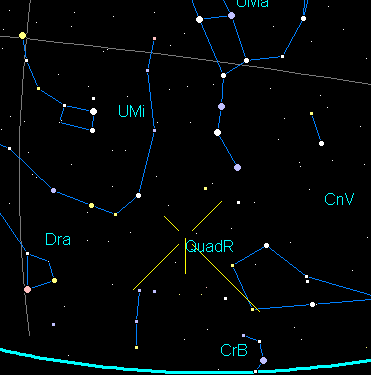
Quadrantid meteor shower radiant at 1:30 a.m. Looking northeast.
12/13/10 – Ephemeris – Geminid meteors peak tomorrow morning
Monday, December 13th. The sun will rise at 8:10. It’ll be up for 8 hours and 51 minutes, setting at 5:02. The moon, at first quarter today, will set at 1:19 tomorrow morning.
Tomorrow morning will see the peak of the Geminid meteor shower. This is one of the most active showers of the year. Some say it’s even more active than the Perseid meteor shower of August with up to 100 meteors or shooting stars visible an hour. They will seem to come from near the star Castor in the constellation Gemini which is rising high towards midnight. The moon will interfere until it sets at 1:19 a.m. After that until dawn is the best time to view them. All you’ll need then is clear skies. If it does clear up, make sure you dress warmly. It will take up to 10 minutes or even more for your eyes to get accustomed to the darkness to be able to see the meteors. This is Michigan, you never know when it will clear up.
* Times are for the Traverse City/Interlochen area of Michigan. They may be different for your location.
12/09/10 – Ephemeris – Geminid meteor preview
Thursday, December 9th. The sun will rise at 8:07. It’ll be up for 8 hours and 54 minutes, setting at 5:02, the earliest sunset of the year. The moon, half way from new to first quarter, will set at 9:11 this evening.
On Tuesday morning we will have the chance to see the peak of the Geminid meteor shower. Some of its members can be seen tonight, but the meteors will be most numerous on the morning of Tuesday the 14th. This shower rivals the Perseid meteor shower of August. The problem for us in viewing this fabulous shower is the cold temperatures and usually cloudy skies. Another problem this year is the moon which will be at first quarter and will set at 1:19 a.m. Tuesday morning. I’ll have more on Monday. The source of the Geminids was discovered in 1983. It is a burnt out comet with the asteroid designation 3200 and given the name Phaethon which swoops down to only 13 million miles of the sun.
* Times are for the Traverse City/Interlochen area of Michigan. They may be different for your location.
10/21/10 – Ephemeris – The Orionid meteors
Thursday, October 21st. The sun will rise at 8:05. It’ll be up for 10 hours and 42 minutes, setting at 6:48. The moon, 1 day before full, will set at 7:47 tomorrow morning.
We are now at the best time to see the Orionid meteor shower, but unfortunately the moon is near full and out all night.. However the brightest of the meteors will be visible. Like most meteor showers, this is best seen just before dawn. As the name suggests the so-called shooting stars will seem to come from the constellation Orion the hunter. Actually they will appear to come from above the rectangular torso of the giant. These meteors actually have nothing to do with Orion, but they are the light flashes from bits of rock that were once part of Halley’s comet, as they burn up in the earth’s atmosphere. In Halley’s many passes close to the sun, much of its solid material has been liberated by the evaporating gases, leaving a trail of litter in its orbit.
 Bob Moler's Ephemeris Blog