Archive
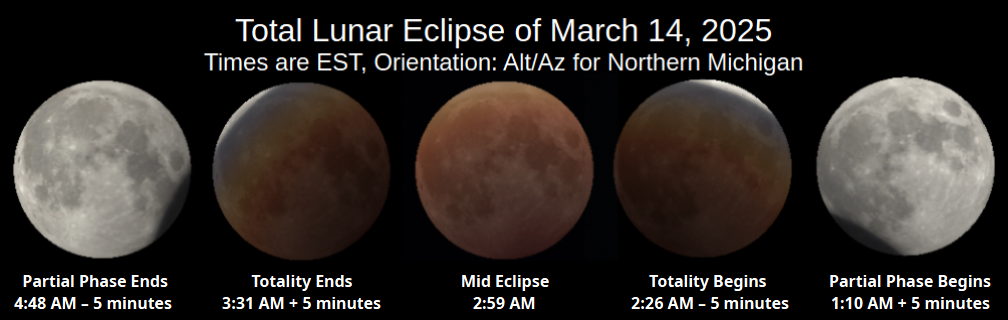
Ephemeris: 03/07/2025 – GTAS Meeting tonight (also on Zoom): Previewing 3/14’s total lunar eclipse
This is Ephemeris for Friday, March 7th. Today the Sun will be up for 11 hours and 29 minutes, setting at 6:38, and it will rise tomorrow at 7:07. The Moon, 1 day past first quarter, will set at 4:28 tomorrow morning.
The Grand Traverse Astronomical Society will host its February meeting tonight at 8 PM at Northwestern Michigan College’s Joseph H Rogers Observatory. The talk for the evening will be given by yours truly. One week from today, Friday, March 14th in the early morning hours, there will be a total eclipse of the Moon. That is my subject. I will explore some notable lunar eclipses of the past, what they are, and why we don’t see them every full moon. I’ll talk about other facts about lunar eclipses. The observatory is located on Birmley Rd. South of Traverse City between Garfield and Keystone roads. The meeting will also be available via Zoom. Instructions to join the meeting will be on the society’s website, gtastro.org.
The astronomical event times given are for the Traverse City/Interlochen area of Michigan (EST, UT – 5 hours). Times will be different for other locations.
Addendum
04/17/2023 – Ephemeris – I’m back. And a look ahead
This is Ephemeris for Monday, April 17th. Today the Sun will be up for 13 hours and 34 minutes, setting at 8:30, and it will rise tomorrow at 6:53. The Moon, 3 days before new, will rise at 6:23 tomorrow morning.
I’m back, still in physical therapy, but hopefully to stay. The next year and a half will see some spectacular celestial events, plus the Sun is getting unusually active this solar cycle, which means more displays of the northern lights or aurora borealis. For us, the first event will be a partial eclipse of the Sun on Saturday, October 14th. It’s an annular or ring eclipse, where the Moon is too far away to completely block the Sun, leaving a ring of light at its peak for a narrow path in the southwestern US. Then next April, a total solar eclipse will occur. Much more of the Sun will be blocked for us. Then the following October we might get to see a bright comet, if it performs as expected. Comet Tsuchinshan-ATLAS was discovered three months ago.
The astronomical event times given are for the Traverse City/Interlochen area of Michigan (EST, UT –4 hours). They may be different for your location.
Addendum
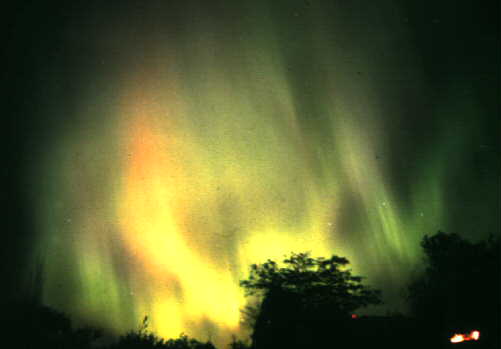
An aurora display from a couple of sunspot cycles ago. Credit: Bob Moler.
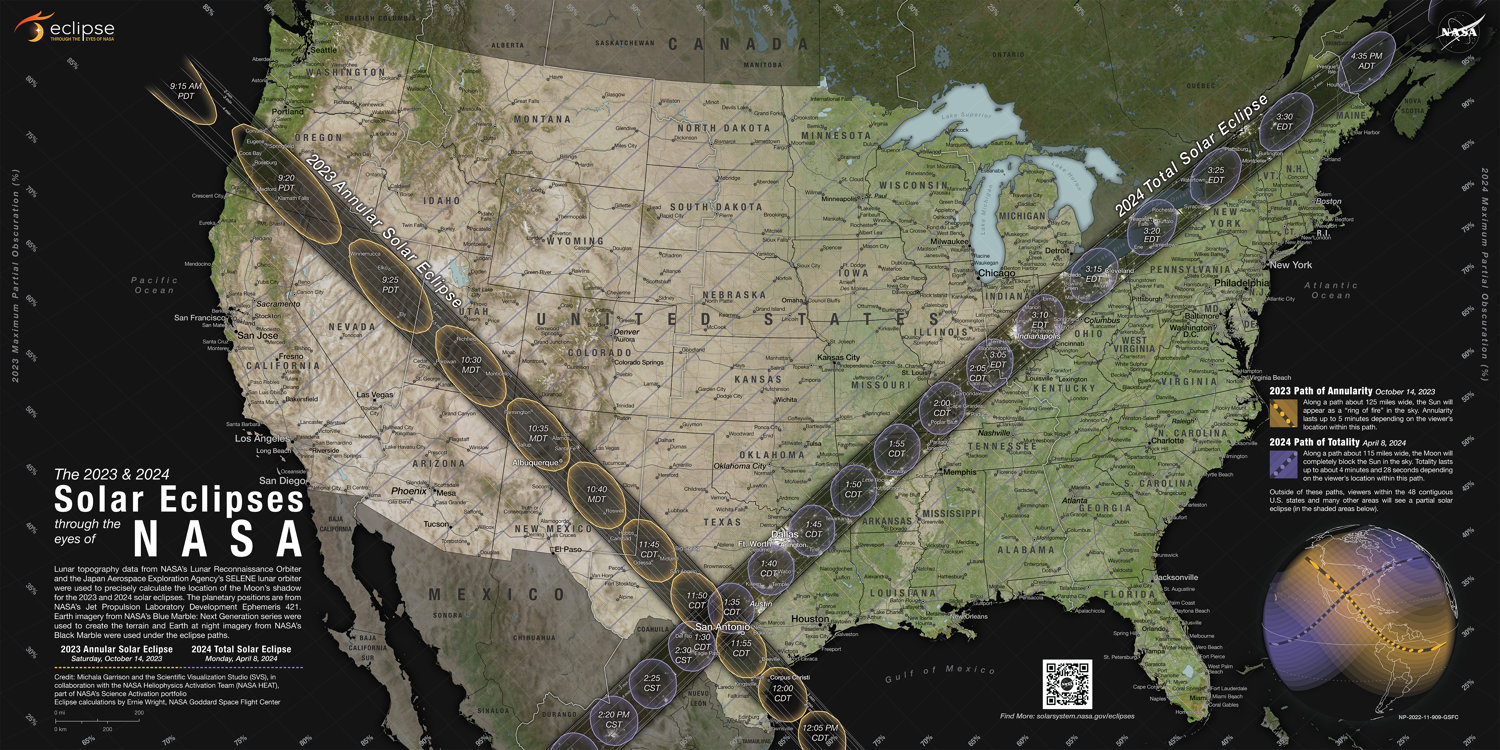
NASA Eclipse Map for the United States for the annular eclipse of October 14, 2023, and total eclipse of April 8, 2024. The tracks are the path of annularity, where the ring of light around the Moon is seen, and the path of totality, where the Sun’s face is completely covered by the Moon. Subtract 4 hours from the times given to convert to Eastern Daylight Saving Time. Click on the image to enlarge it. Credit NASA.
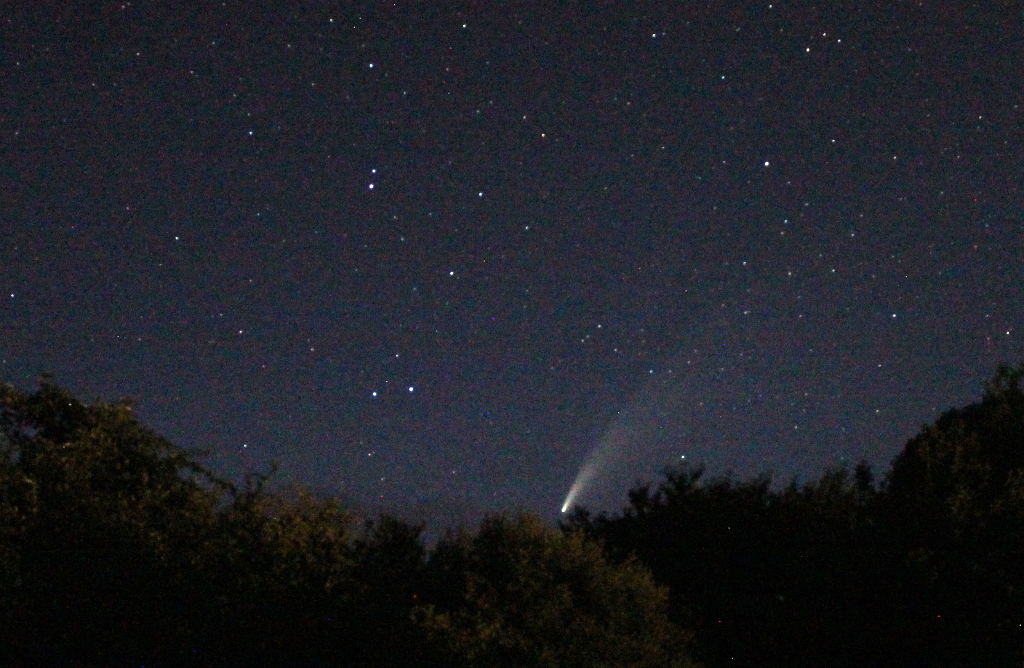
Comet NEOWISE from backyard over tall shrubbery 11:18 pm, July 16, 2020. I didn’t have time to focus properly, which actually accentuates the stars. Comet Tsuchinshan-ATLAS has the potential of being many times brighter. It was seen in the northeast before sunrise and in the northwest after sunset. Our new comet will be best seen low in the southwest in the evening.
 Bob Moler's Ephemeris Blog