Archive
08/14/2017 – Ephemeris – Safe ways to view the eclipse
Ephemeris for Monday, August 14th. The Sun rises at 6:44. It’ll be up for 14 hours and 4 minutes, setting at 8:49. The Moon, at last quarter today, will rise at 12:46 tomorrow morning.
It is one week to the Great American Eclipse, next Monday August 21st. Whether you’re heading out to the path of totality, or staying here it is imperative that you view the Sun safely. Solar filters may be purchased from some reputable stores. But there are some unsafe solar filters being sold out there. Beware. Also never use eclipse glasses to view the Sun with binoculars. The concentrated sunlight coming out of the eyepiece will burn through the plastic of the solar filter in an instant. The best method is to project the Sun’s image with a pinhole in a box or place a mirror in an envelope with a quarter-inch or so hole in it, and project the Sun on the shady side of a building. There’s plenty of Internet links at http://www.gtastro.org.
The times given are for the Traverse City/Interlochen area of Michigan. They may be different for your location.
Addendum
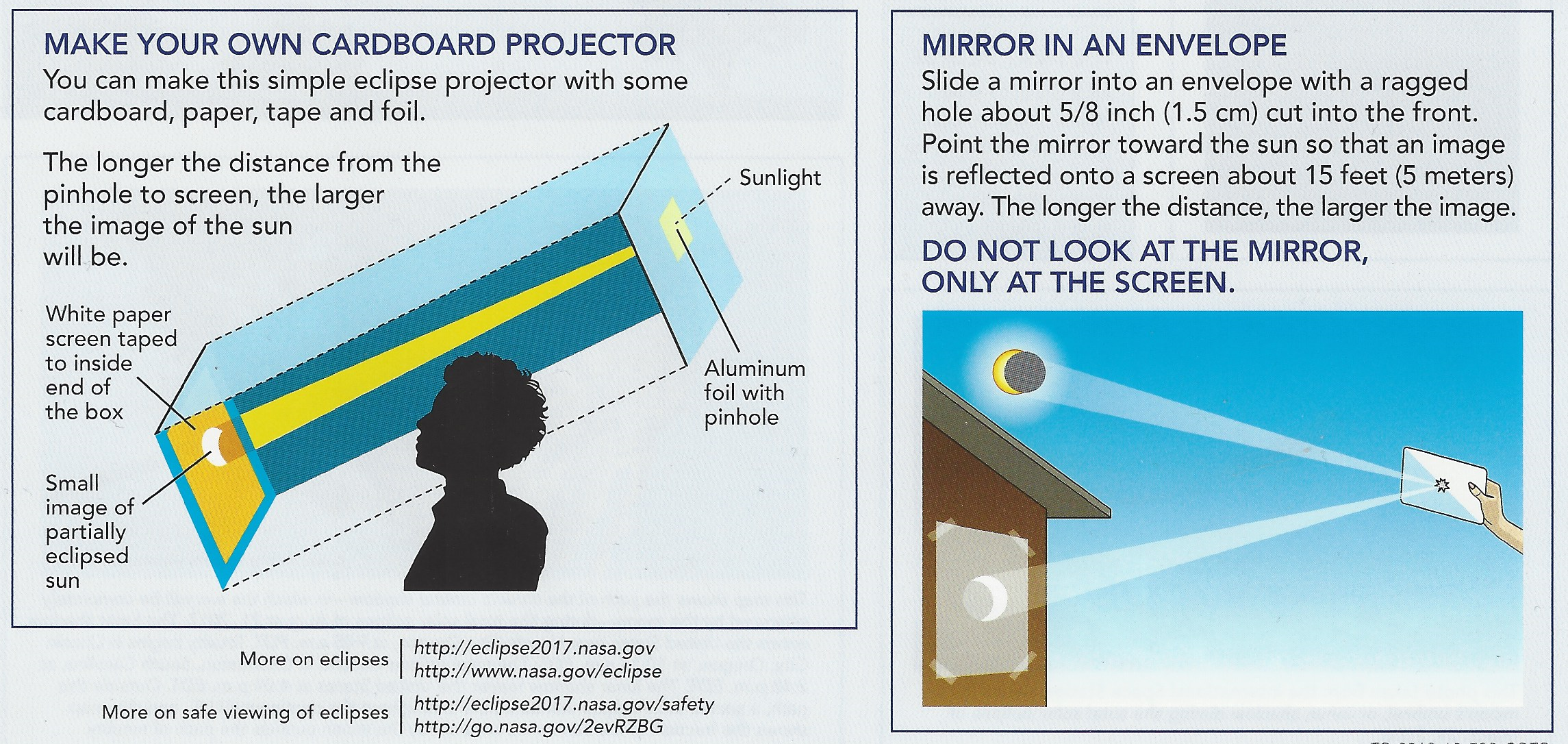
Two pinhole solar projection methods. Credit NASA.
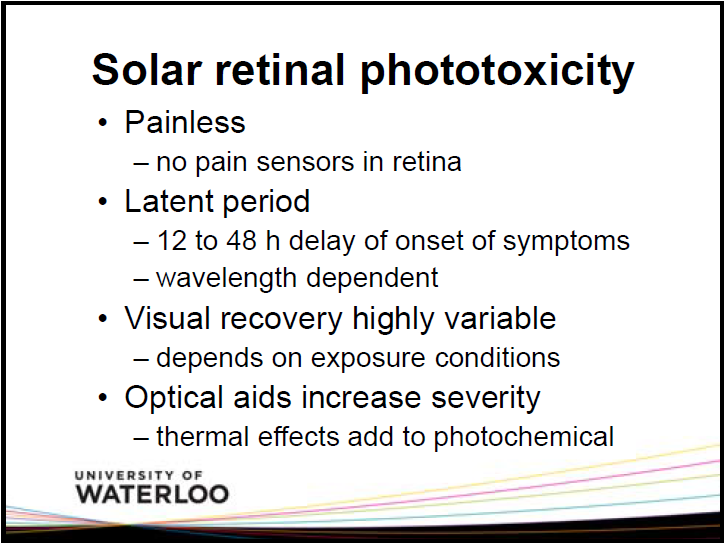
The danger at looking at the Sun without proper filter. Credit: University of Waterloo.
08/10/2017 – Ephemeris – The brief wonderland of Totality, my second total eclipse
Ephemeris for Thursday, August 3rd. The Sun rises at 6:31. It’ll be up for 14 hours and 33 minutes, setting at 9:04. The Moon, half way from first quarter to full, will set at 3:43 tomorrow morning.
The brief world of solar eclipse totality is one everyone should experience at least once in their lifetime. For this eclipse Totality will last from 2 minutes, and 5 seconds on the Oregon coast to 2 minutes 40 seconds in Kentucky, down to 2 minutes 35 seconds on the South Carolina coast. And this is for the center of the path of totality. The duration of totality is so brief that one cannot really absorb it all. As the Moon covers the last of the Sun’s bright photosphere there is a chill as the Sun’s heat is extinguished. Darkness of a deep twilight descends. Street lights come on, cocks will crow, as animals take the darkness as the approach of night. The approaching shadow of the Moon can be seen. During totality the Sun’s corona can be seen as a silvery apparition around the black spot of the Moon that’s covering the Sun’s disk. Bright planets and some stars will appear in a surreal image in the darkened sky, but the horizon is bright. Then suddenly the diamond ring appears and it’s over.
The times given are for the Traverse City/Interlochen area of Michigan. They may be different for your location.
Addendum
Somehow this is a repeat of last Thursday’s program. I’ve added a sentence or two in the text above and I’ve added different content below.
This the story of my second total eclipse, March 7, 1970.
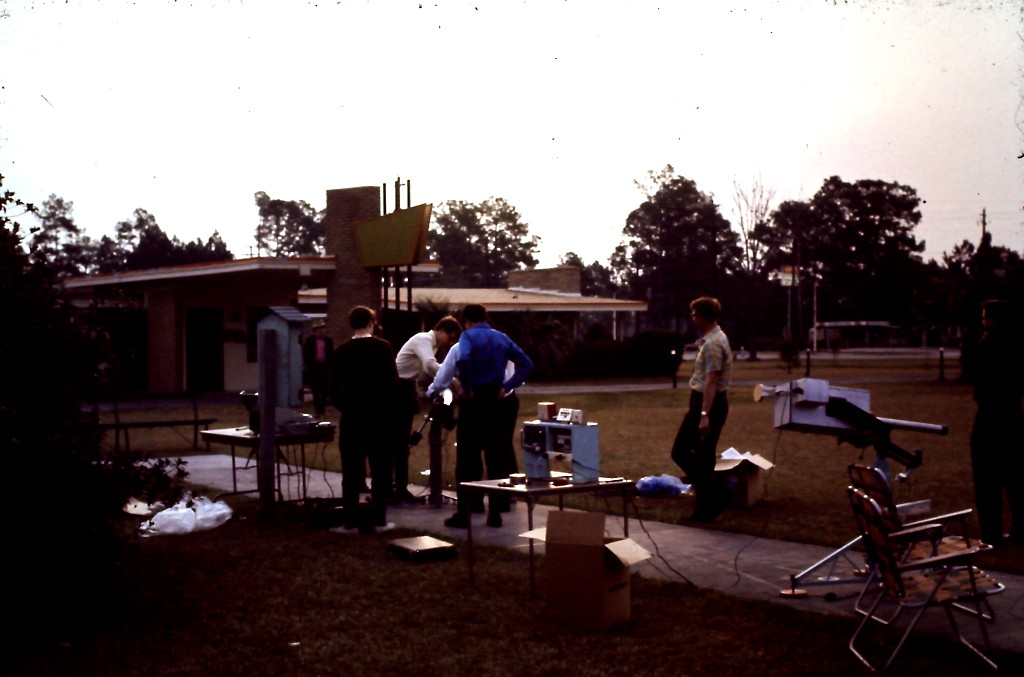
Setting up the day before the eclipse at a motel in Waycross Georgia. My automated equipment is on the right with the controller on the near table. My photo.
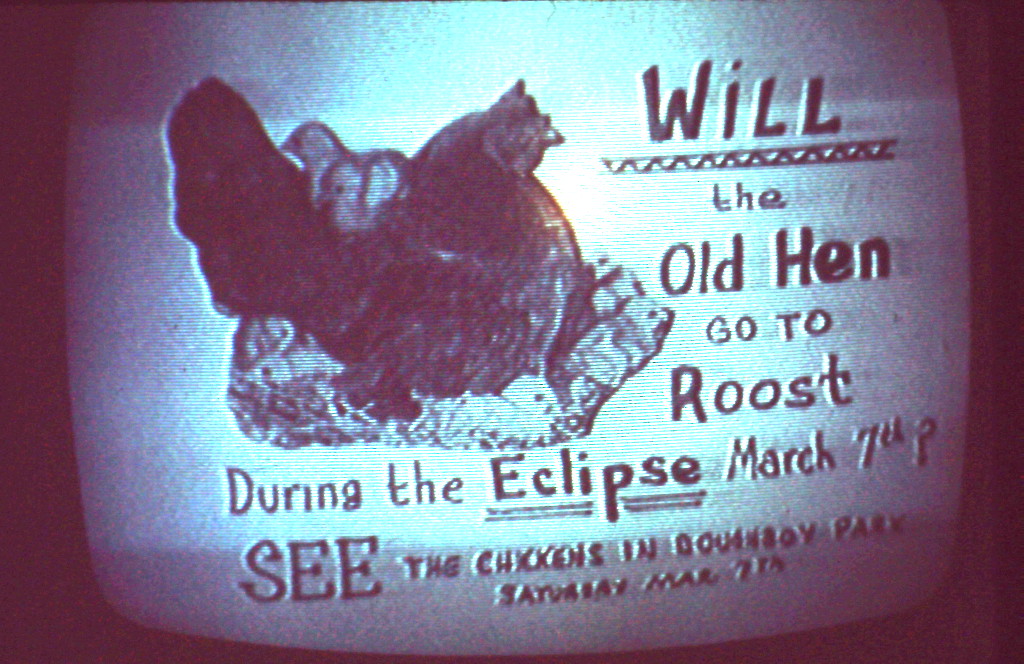
For this eclipse the path of totality ran parallel to the east coast of the US from Florida to Virginia. Perry, Florida proclaimed itself “Eclipse Capital of the World”, and attracted lots of folks down there. Waycross was lower key. This is what they ran on their weather channel:
 The local baseball park hosted a menagerie of chickens and other animals for folks could watch their eclipse antics. Also there was an ABC television crew, whose normal job was to televise golf tournaments. The big TV camera, they were big in those days, was placed on a fork lift to tilt it back far enough to reach the Sun. Scattered on the ground were lots of 2×2 inch black squares with holes in them. It turns out they were neutral density filters that they were inserting in the camera, near the focal plane. Of course the concentrated sunlight near the focal plane would burn through the filter in nothing flat. Some of the younger members in our group had created exposed x-ray film for filters, and showed the TV crew how to fasten the filters in front of the camera lens. It worked, but the guys in the TV van outside the stadium complained that something was wrong with the filters, because there were black spots on the Sun. They were of course sunspots.
All day that day, the sky was slowly clouding up, with high cirrus. There was a storm front moving up the eclipse path,
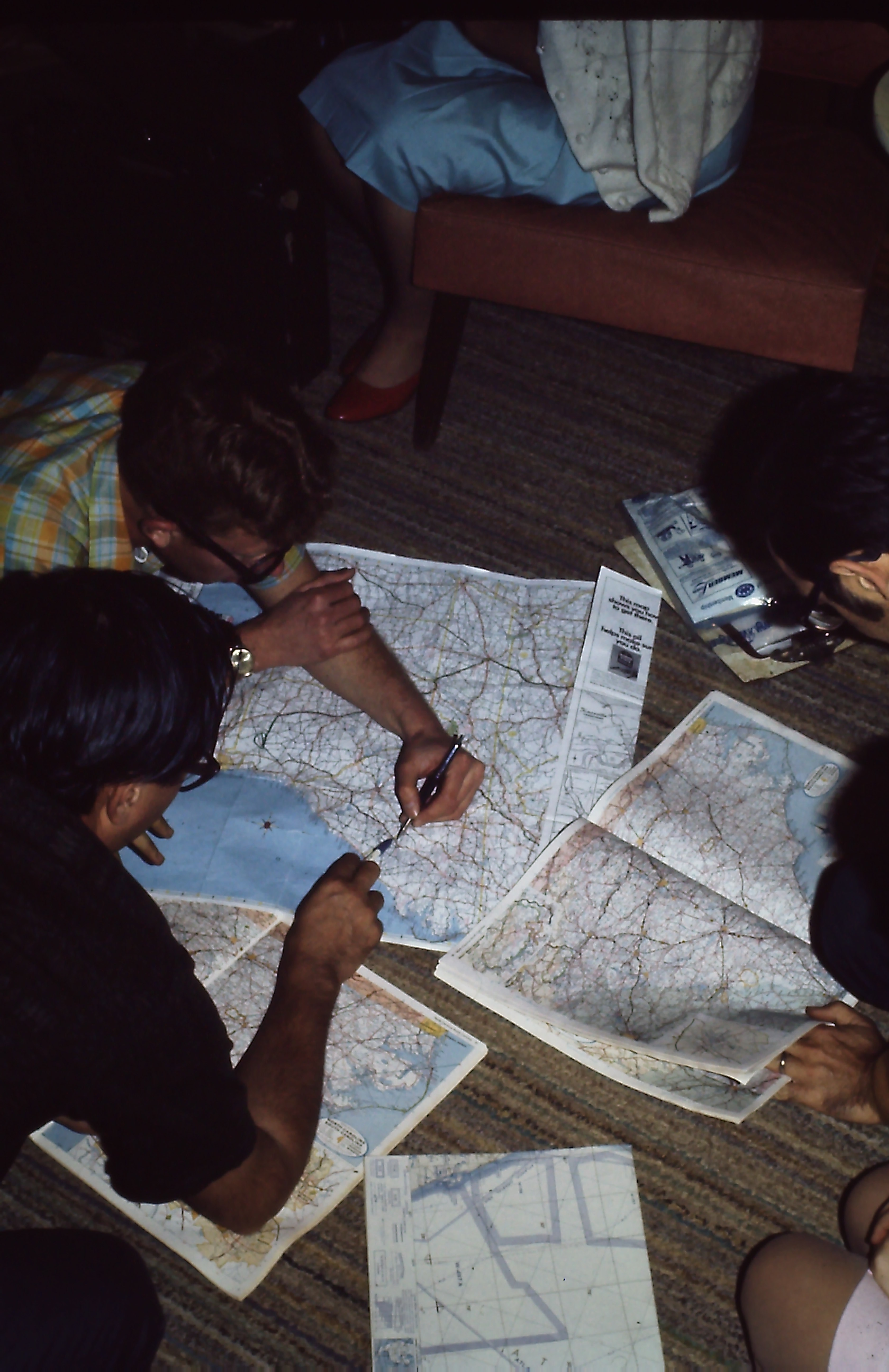
The maps came out to plot a move up the eclipse path. My photo.
The plan was to leave at midnight and drive to Florence, South Carolina and meet up for breakfast and pick a final location. We all met at a restaurant in Florence, and decided on Bladenboro NC as the spot view the eclipse from. Up to this point I drove. I turned the wheel over to my wife Judy and slipped into the back seat to recompute the eclipse timing, since I set my photographic program to start one minute before totality.
We finally ended up in a corn field, filled with corn stubble just outside the town.
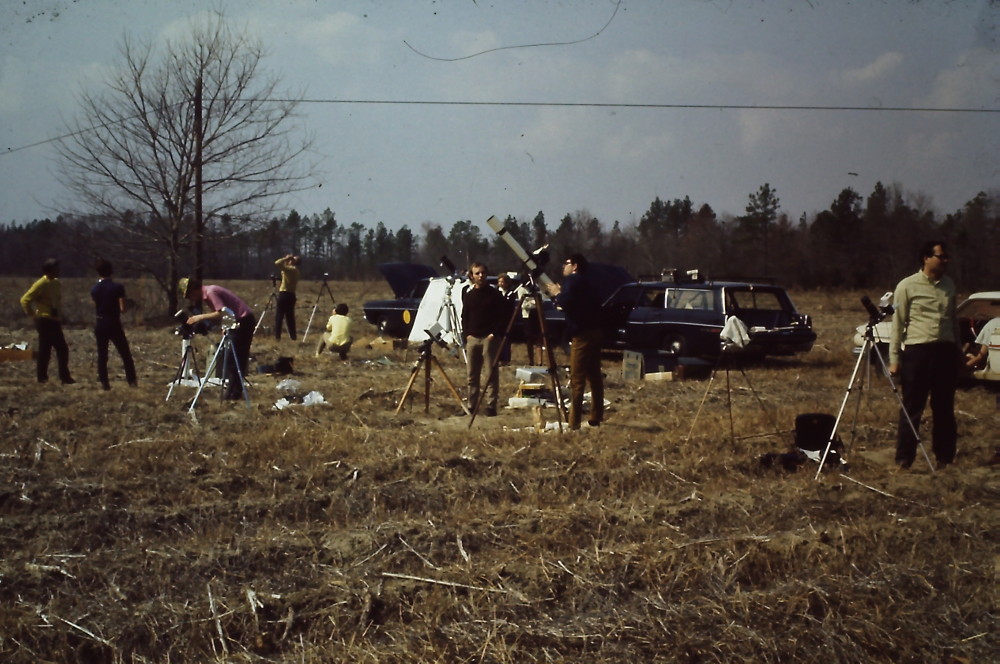
Everyone Else’s setup in the corn field. My equipment is off to the right out of sight. My photo.
We had students from the University of Michigan, Grand Valley State University, the Detroit Observational and Astrophotographic Association, and the Grand Rapids Amateur Astronomical Association, of which I was a member at that time. The farmer, whose land we were on, was quite drunk and was spending his time harassing the red-headed member of our group Dave DeBruyn while he was trying to set up his equipment.
It turned out that we didn’t quite escape the clouds.
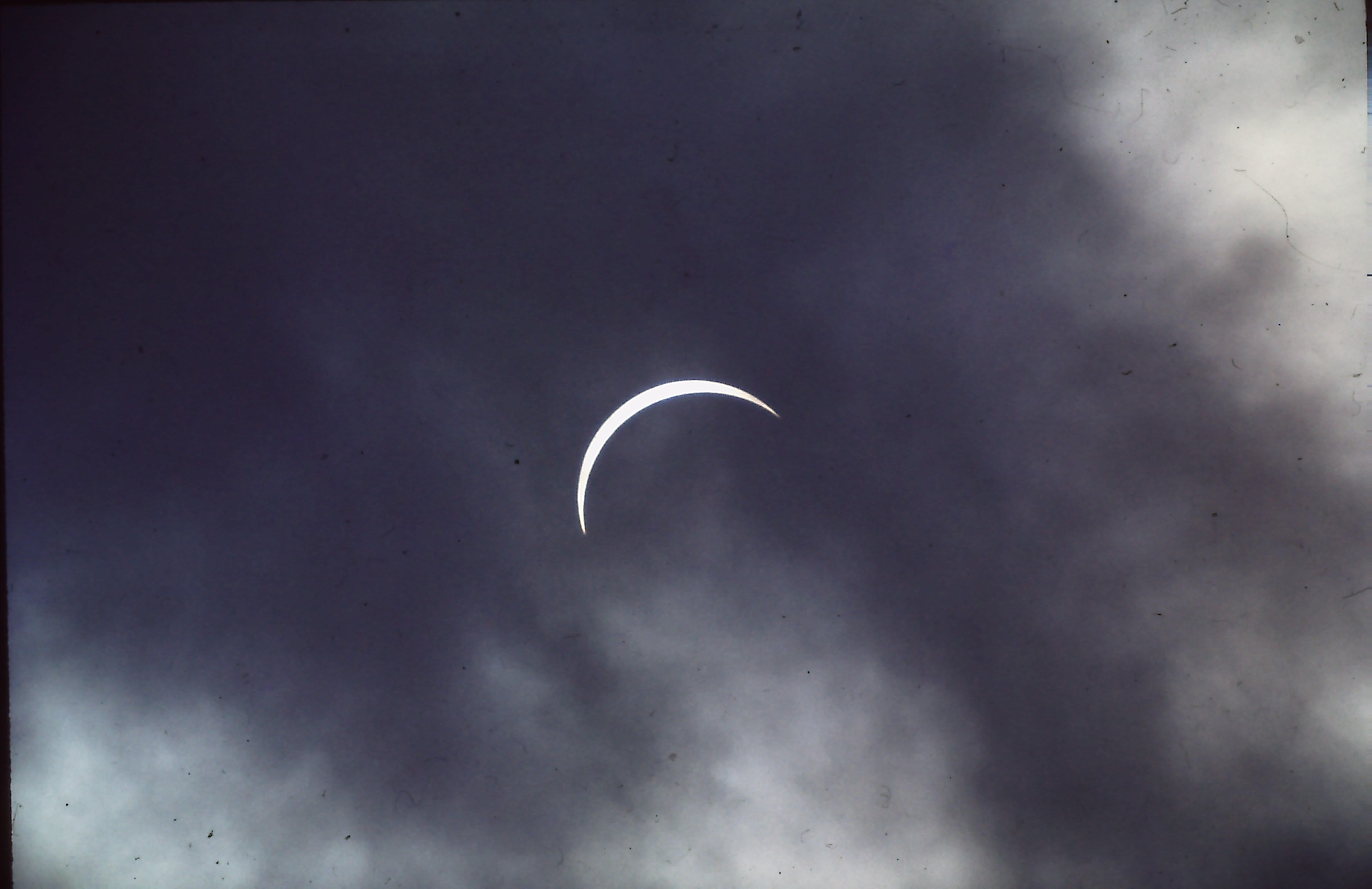
The Sun a few minutes before Totality taken through clouds and no filter. My photo.
It did eventually clear enough to see the eclipse, helped by all of us shouting at the clouds. Moving to the corn field meant no electricity. I did have an inverter, however I didn’t really test it, thinking we’d have power at our motel location. However the inverter couldn’t hold up its voltage under load and a relay meant to act as a safety for a problem I had at my first eclipse, dropped and made the camera inoperative. However I came prepared. I built what I called a contingency camera, with which I took the above photo, and got some good photos as seen below.
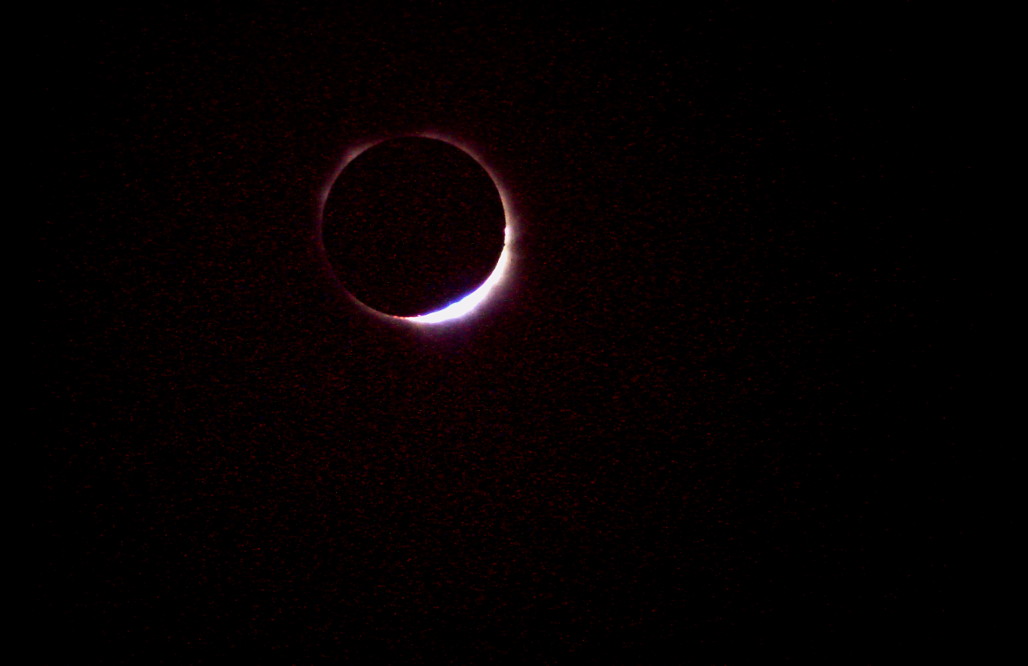
Inner corona. My photo.
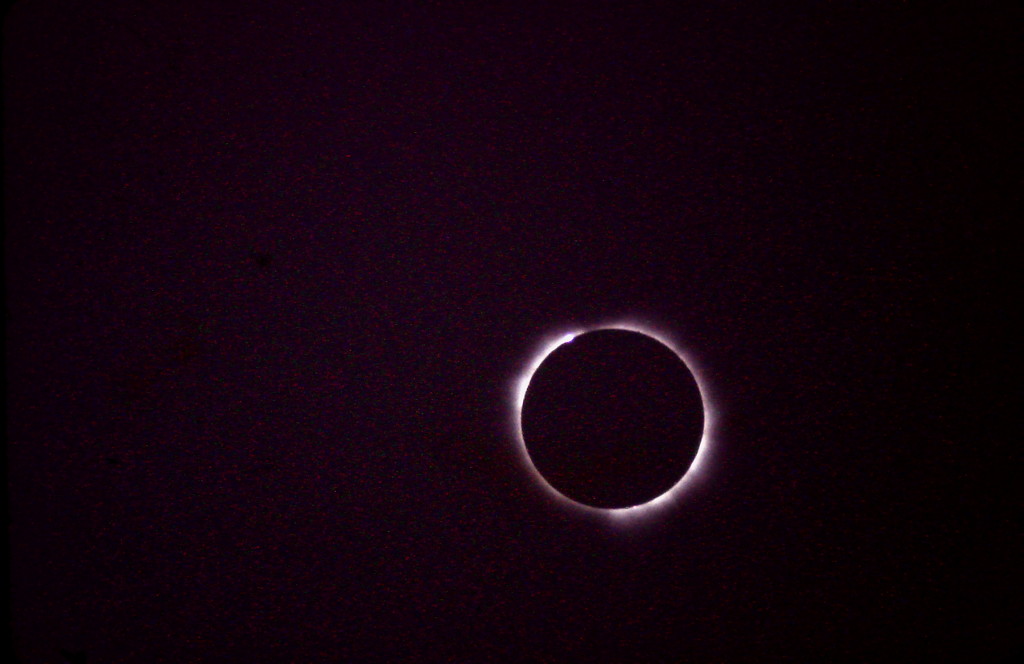
Inner corona near the center of totality. My photo.
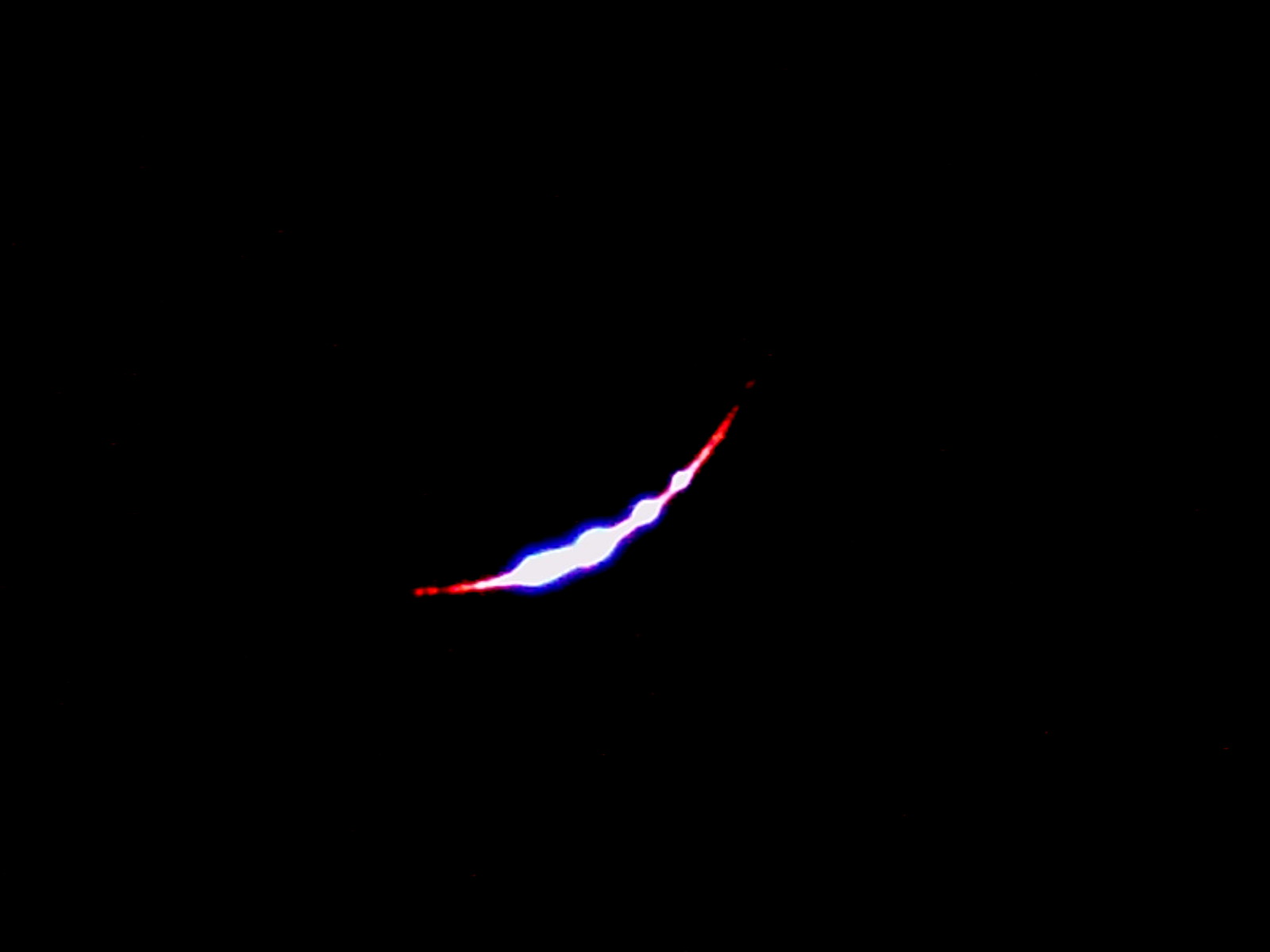
My best photo. Baily’s Beads and chromosphere as totality ends. My photo.
Some of our group decided to stay in Waycross, and were able to see the eclipse. Perry FL, the Eclipse Capital, had the eclipse rained out. That’s another proof of Moler’s First Law of Eclipses: Where the most crowds gather to see an eclipse, so do the clouds.
The story of my first total solar eclipse is here: https://bobmoler.wordpress.com/2017/07/20/07202017-ephemeris-only-one-month-and-a-day-to-the-great-american-eclipse-and-a-personal-note/
08/08/2017 – Ephemeris – Eclipse seasons
Ephemeris for Monday, August 7th. The Sun rises at 6:36. It’ll be up for 14 hours and 23 minutes, setting at 8:59. The Moon, at full today, will rise at 9:00 this evening.
At two weeks before the great solar eclipse, the world is experiencing another eclipse, this one is a partial lunar eclipse where the Moon will just clip the northern part of the Earth’s shadow this afternoon our time. It will be mainly visible from Asia. Eclipses occur in seasons of about a month long that occur at a bit less than six month intervals, so eclipses will occur a little earlier next year to the this. That’s because the crossing points of the Moon’s and the Earth’s orbital planes regress slowly westward. In an eclipse season two eclipses will occur: a solar and a lunar eclipse. On rare occasion when a lunar eclipse occurs in the center of a season a partial solar eclipse can occur two weeks before and again after the lunar eclipse, but they will affect the opposite polar regions of the Earth.
The times given are for the Traverse City/Interlochen area of Michigan. They may be different for your location.
Addendum
Table of this and next three eclipse seasons
| Date | Eclipse Type | Notes |
| 08/07/2017 | Lunar Eclipse – partial | Moon clips northern part of Earth’s umbra |
| 08/21/2017 | Solar Eclipse – total | Path of totality crosses US |
| 01/31/2018 | Lunar Eclipse – total | Moon crosses just south of center of umbra |
| 02/15/2018 | Solar Eclipse – partial | Visible mostly from Antarctica |
| 07/13/2018 | Solar Eclipse – partial | Seen from southern Australia |
| 07/27/2018 | Lunar Eclipse – total | Moon crosses center of umbra |
| 08/11/2018 | Solar Eclipse – partial | Seen from northern Europe, Asia |
| 01/06/2019 | Solar Eclipse – partial | Seen mostly from northern Pacific Ocean |
| 01/21/2019 | Lunar Eclipse – total | Moon crosses just north of center of umbra |
08/03/2017 – Ephemeris – The surreal world of totality
Ephemeris for Thursday, August 3rd. The Sun rises at 6:31. It’ll be up for 14 hours and 33 minutes, setting at 9:04. The Moon, half way from first quarter to full, will set at 3:43 tomorrow morning.
The brief world of solar eclipse totality is one everyone should experience at least once in their lifetime. The duration of totality is so brief that one cannot really absorb it all. As the Moon covers the last of the Sun’s bright photosphere there is a chill as the Sun’s heat is extinguished. Darkness of a deep twilight descends. Street lights come on, cocks will crow, as animals take the darkness as the approach of night. The approaching shadow of the Moon can be seen. During totality the Sun’s corona can be seen as a silvery apparition around the black spot of the Moon that’s covering the Sun’s disk. Bright planets and some stars will appear in a surreal image in the darkened sky, but the horizon is bright. Then suddenly the diamond ring appears and it’s over.
The times given are for the Traverse City/Interlochen area of Michigan. They may be different for your location.
Addendum
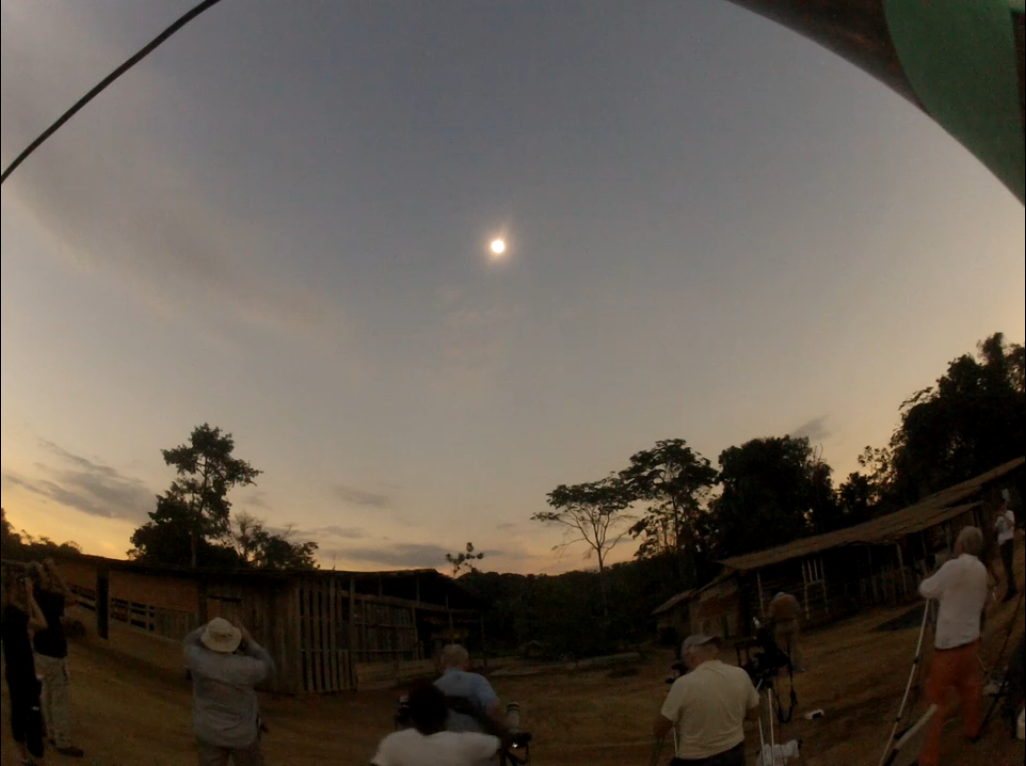
Screen capture from a video of a total solar eclipse of November 2, 2013 at the small village of Mikongo in the equatorial African country of Gabon. This video shows the eclipse expedition of Williams College led by Professor Jay Pasachoff. © 2013 Michael Zeiler. See the video at https://www.greatamericaneclipse.com/splendor/.
Check out the Great American Eclipse web site.
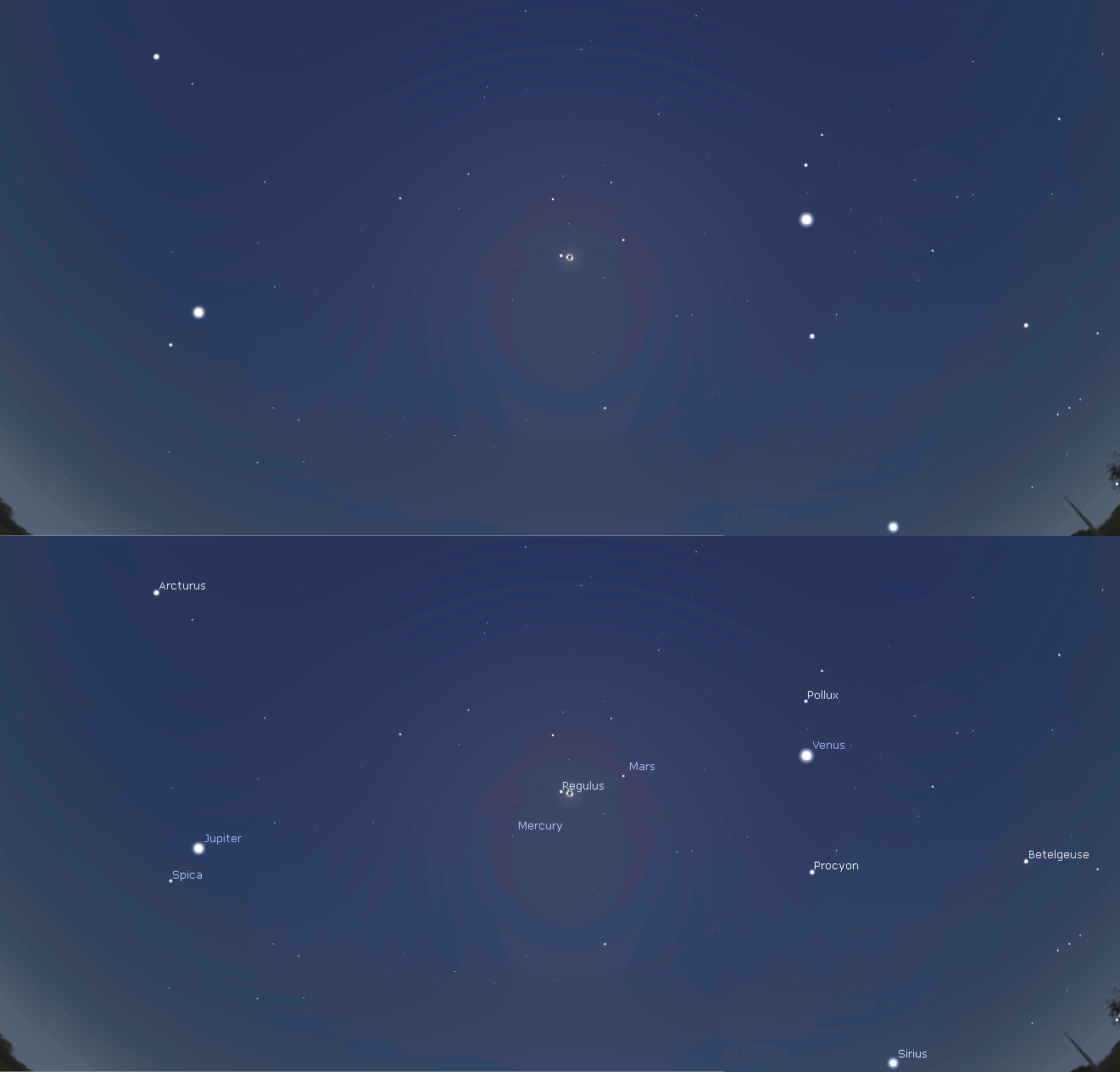
An animation of Stellarium’s version of the sky during totality of the August 21, 2017. My personal caveats based on 4 total eclipses are that Venus is always visible, Mercury only sometimes. I’ve never seen a star. Also the Sun’s corona is a whole lot brighter than seen here. See the image above. Click on this image to enlarge.
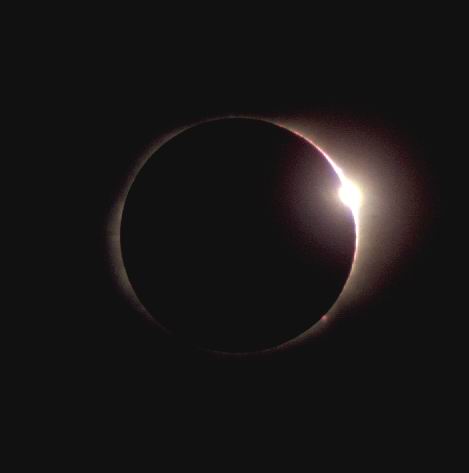
Diamond ring at the end of totality of the total solar eclipse July 10, 1972. Credit Bob Moler.
Additional notes:
The Sun’s corona is perfectly safe to view without a solar filter. Actually the Sun will disappear in solar eclipse glasses and projection viewers. That’s the time to look at the Sun with the naked eye or binoculars. However, when the corona brightens around the right side of the Moon, and the red chromosphere appears, drop the binoculars for the bright diamond ring will quickly appear.
The corona for the quiet Sun stretches out on either side of the Sun, with little at the poles. The active Sun, near a sunspot peak, tends to have a roundish corona. Below is the corona last evening via the Solar and Heliospheric Observatory (SOHO).
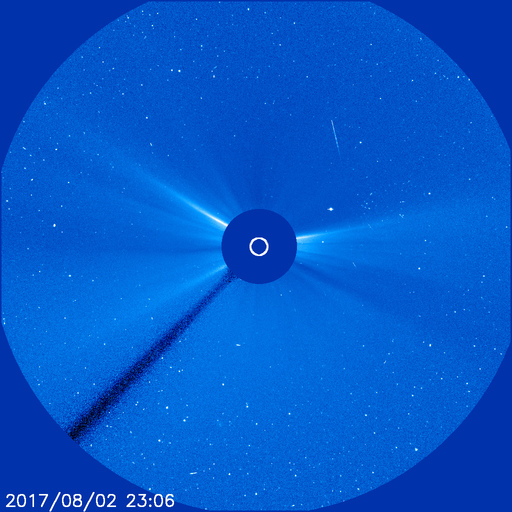
The black disk on the stalk is the occulting disk, hiding the bright photosphere and producing an artificial eclipse.. The white circle is the size of the Sun’s disk. Credit ESA and NASA
Part of the inner corona close to the Sun is covered by the disk. That is what is easiest to see during a total solar eclipse.
For a couple of minutes just before totality starts and again after it ends strange bands of light and shadow will flit along the smooth surface of the ground. They’re called shadow bands. I’ve seen the effect on a large concrete parking lot, an airport tarmac and a softball infield. The nearest thing I’ve seen to it the shadow ripples on the bottom of a swing pool on a sunny day. I finally saw them on my fourth total solar eclipse and two subsequent annular eclipses* which were viewed from or near smooth surfaces. It’s a product of air turbulence and shows up at night in the twinkling of stars.
* An annular eclipse is one in which the Moon is too far, and thus too small to completely cover the face of the Sun. The central part of this type of eclipse leaves a ring or annulus of the bright Sun surrounding the Moon.
07/31/2017 – Ephemeris – Only 3 weeks to the eclipse (E – 21 days)
Ephemeris for Monday, July 31st. The Sun rises at 6:28. It’ll be up for 14 hours and 40 minutes, setting at 9:08. The Moon, 1 day past first quarter, will set at 1:46 tomorrow morning.
Today is E minus 21 days. E stands for Eclipse, the Great American Eclipse that is. August 21st is the day the shadow of the Moon will completely cover the United States and most of North America. The path where the Moon will completely block out the face of the Sun, called the path of totality crosses the country from parts of Oregon, Idaho, Wyoming, Nebraska, Kansas, Missouri, Illinois, Kentucky, Tennessee, North Carolina, Georgia, to South Carolina. The path of totality is only 90 miles wide at most, and 600 miles or more from northern Michigan. From here the eclipse will start shortly before 1 p.m. and end around 3:40 p.m. The official viewing spot where there will be guides from the Grand Traverse Astronomical Society will the public help view the eclipse will be at the Sleeping Bear Dunes Dune Climb.
The times given are for the Traverse City/Interlochen area of Michigan. They may be different for your location.
Addendum
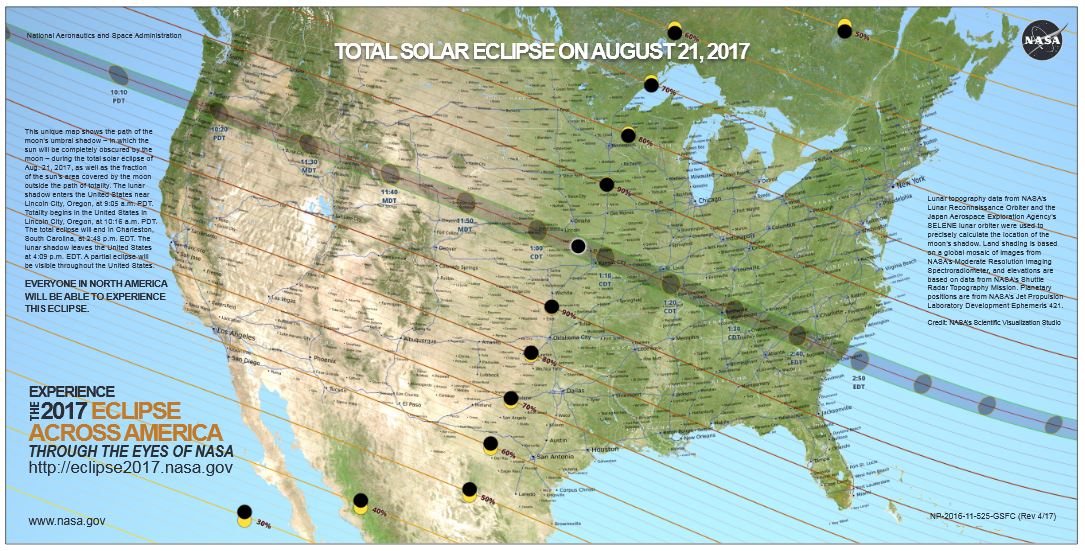
All 50 states will see some part of the August 21, 2017 solar eclipse. The face of the Sun will be totally covered by the Moon in the narrow band called the path of totality. Credit: NASA.
07/25/2017 – Ephemeris – Why do solar eclipses happen?
Ephemeris for Tuesday, July 25th. The Sun rises at 6:21. It’ll be up for 14 hours and 54 minutes, setting at 9:15. The Moon, 2 days past new, will set at 10:48 this evening.
We have a day less than 4 weeks before the Great American Total Solar Eclipse on August 21st will occur. Solar eclipses occur at new moon, when the moon is aligned so its shadow falls on the Earth. It doesn’t happen every new moon because the Moon is a long ways away, and its orbit is tipped some 5 degrees from the Earth’s orbit of the Sun, so usually the Moon is north or south of the Sun at new moon. About one in every 6 new moons produces an eclipse. They occur when the Moon is near the crossing point of the two orbital planes, called nodes. The point where the Moon is passing the node in northward direction is called the ascending node, and 180 degrees around the orbit there is the descending node, but you have to be in the right spot to see an eclipse.
The times given are for the Traverse City/Interlochen area of Michigan. They may be different for your location.
Addendum
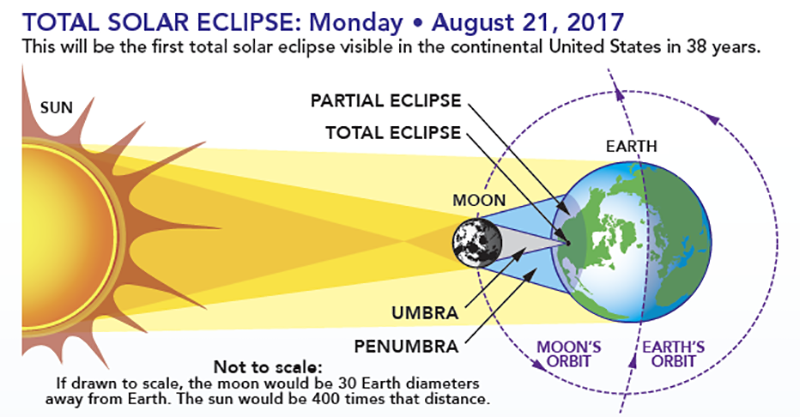
What happens to create a total solar eclipse. Note the Sun’ distance as being 400 times the distance of the Moon. The Sun is also 400 times the Moon’s diameter, so they appear nearly the same size from the Earth. Credit NASA and the Eclipse2017.NASA.gov website.
07/20/2017 – Ephemeris – Only one month and a day to the Great American Eclipse, and a personal note
Ephemeris for Thursday, July 20th. Today the Sun will be up for 15 hours and 4 minutes, setting at 9:20, and it will rise tomorrow at 6:17. The Moon, 3 days before new, will rise at 4:26 tomorrow morning.
As of tomorrow it will be one month to the Great American Eclipse, a total eclipse that will span the continental United States from Oregon to South Carolina. Here in northern Michigan, the Sun will be, at maximum 75 percent covered by the Moon around 2:20 p.m. The eclipse will last from 12:58 to 3:40 p.m. approximately. It will not be safe to look at the Sun without a solar filter or by projecting the image of the Sun on a white paper, either with a pinhole, one side of a binocular, or telescope. Hold the paper screen a foot or so behind the eyepiece. Try it before the eclipse. Or sit under a tree, and let the pinholes between the leaves project a myriad of suns on the ground. Check gtastro.org for lots of links to information about the eclipse.
The times given are for the Traverse City/Interlochen area of Michigan. They may be different for your location.
Addendum
All 50 states will see some part of the August 21, 2017 solar eclipse. The face of the Sun will be totally covered by the Moon in the narrow band called the path of totality for up to 2 minutes, 40 seconds. Credit: NASA.
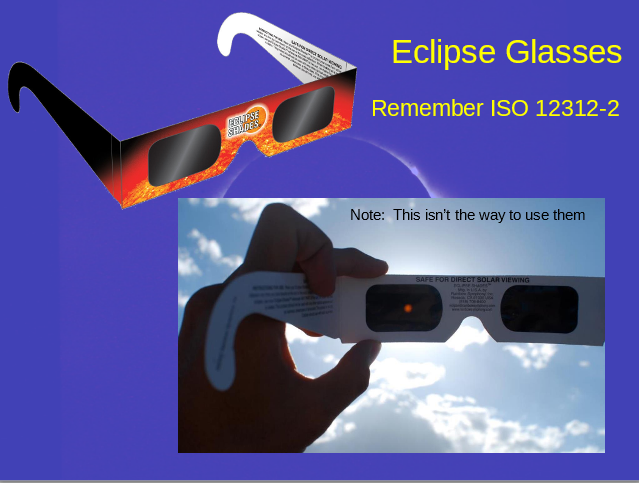
These are eclipse glasses which can be gotten for a couple dollars or less.
They are especially difficult to use, especially for people who wear glasses and can’t remove them because they are near-sighted.
Personally I do not recommend them, instead relying on one of the projection methods.
Be especially careful about children using them.
Remember the ISO 12312-2 compliance that should be printed on them. Do not use welders filters. Damaging exposure to the eyes is painless and may not show up for a day or two.
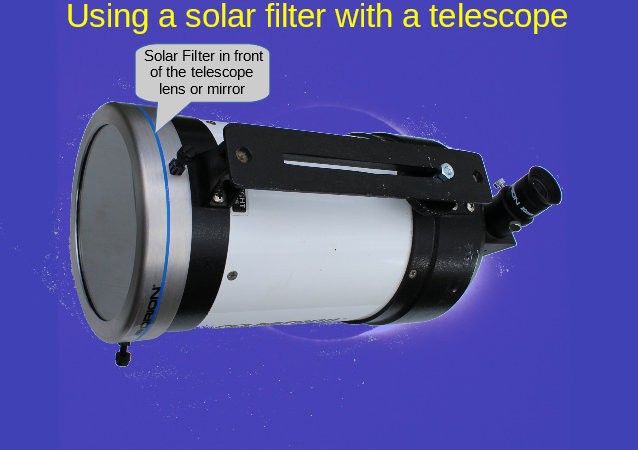
In using a solar filter with a telescope or binoculars the filter must be placed in front of the objective (front of the telescope).
Solar filters that fit into eyepieces are dangerous and can shatter with the heat.
Such filters should either be smashed and added to your favorite landfill, or taken to the bay to see how many times you can skip it on the water.
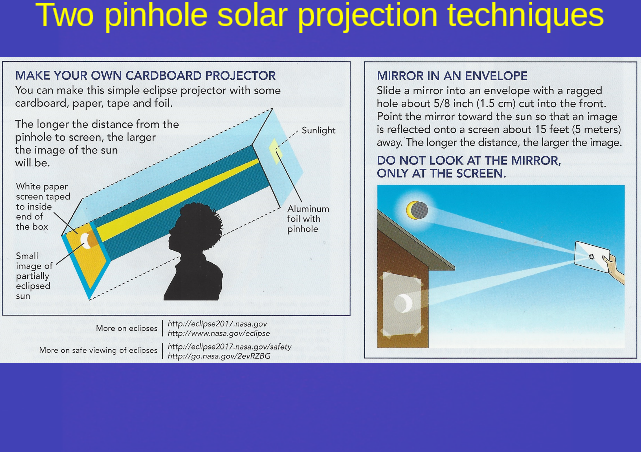
Pinhole projection is the simplest way to project the Sun’s image.
A long box can be used to project the image inside. The diameter of the pin hole is a compromise between sharpness and brightness of the image.
…The farther the image is projected the larger it is.
The throw of the image can be increased by using a mirror masked with a quarter of an inch or larger hole and sending the image 10 or more feet away.
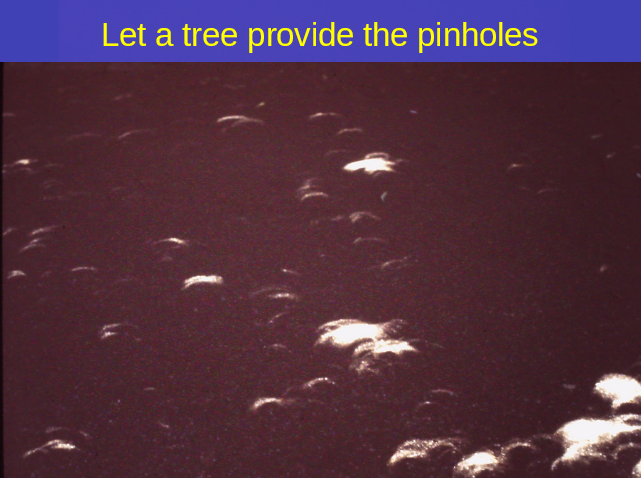
Let nature provide the pinholes. Sit under in the shade. Stay cool, And watch the Sun’s images on the ground.
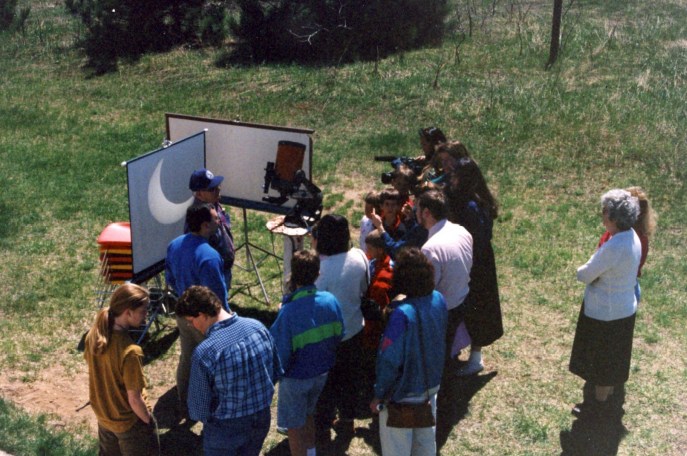
Here’s an 8” Schmidt Cassigrain telescope, with a low power eyepiece projecting a large image on a movie screen. For lots of people to view and photograph. Credit Eileen Carlisle.
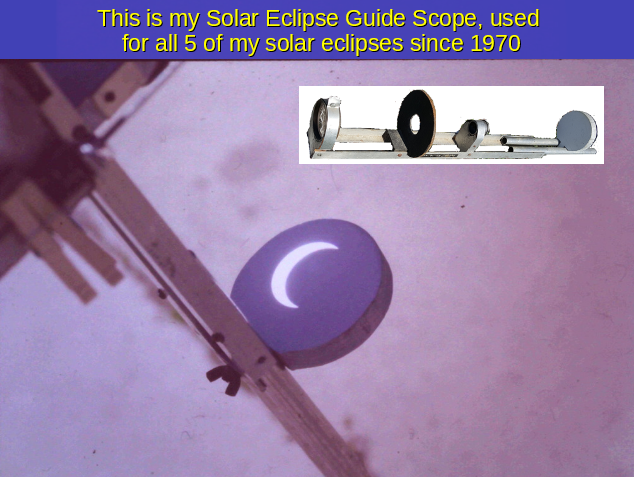
This is my Solar Guide Scope which I used for all my solar eclipses starting with 1970 (three total and 2 annular).
It is an open design, with an objective of about 300mm (12”) focal length, a shield to shield the screen from the Sun, a cheap 12mm (1/2”) focal length eyepiece and an adjustable screen to project the Sun’s image. I originally made it too short, so I extended it. It always attracts a crowd of eclipse watchers.
July 20th in history
48 years ago (1969) Apollo 11 landed on the Moon
41 years ago (1976) the Viking 1 Lander landed on Mars.
On a personal side: 54 years ago (1963) I saw my first total solar eclipse.
The 54th anniversary isn’t the big deal. The big deal has to do with the Saros, the period in which eclipses repeat. That interval is 6,585.3211 days or approximately 18 years 11 1/3 days, give or take a day, depending on the number of leap years in the interval. That one-third day is the kicker, because the next eclipse in the series will occur 120 degrees of longitude west of the last eclipse. There are many Saros series running at any given time, so eclipses don’t only happen every 18 years.
However after 3 Saros periods the eclipse will again occur at roughly the same longitude. If the Moon passes the Sun moving slightly southward, the eclipse series will trend southward on the globe. If northward, the series heads north.
The eclipse of August 21st 2017 is the third Saros eclipse after my first total solar eclipse
Since this upcoming eclipse tracks southward, the 1963 eclipse was farther north with the path of totality passing through Alaska, Canada and only the state of Maine.
On that day, friends John Wesley, Dave DeBruyn and several other members of the University of Michigan team, and Stan Carr, a member of the Muskegon Astronomy Club found ourselves on a hill overlooking the St. Maurice River in Quebec Province of Canada.
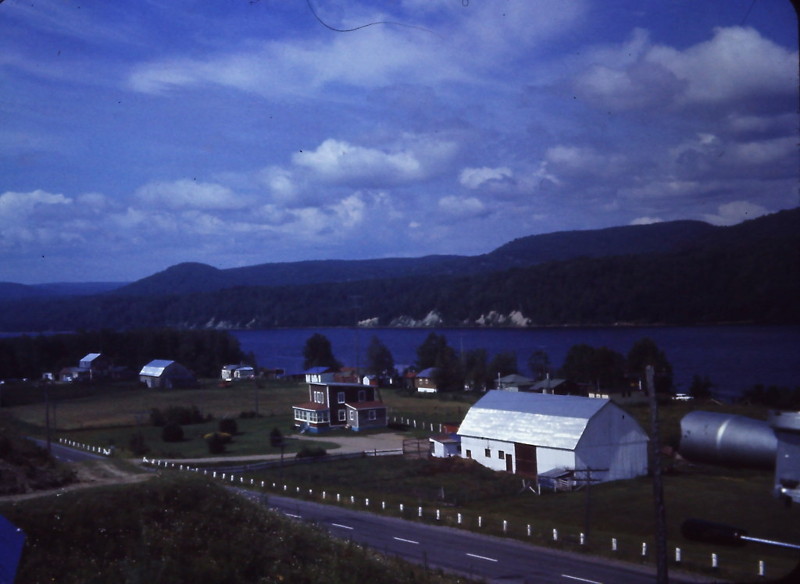
Overlooking the St Maurice River from our camp in the morning with the clouds then. But the eclipse would start about 4:30 in the afternoon.

At two p.m. and we’re socked in. Seen is John Wesley and our automated eclipse camera. 2 1/2 hours to totality.
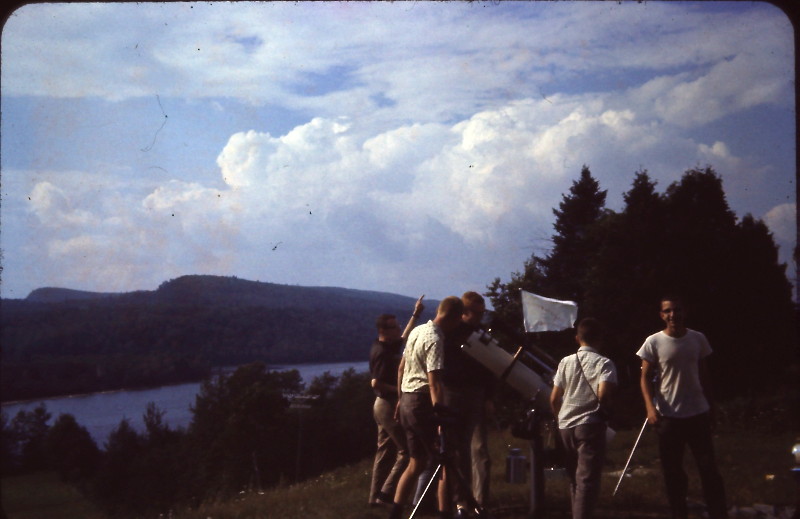
Happy day! The eclipse is starting, and it’s clearing up.
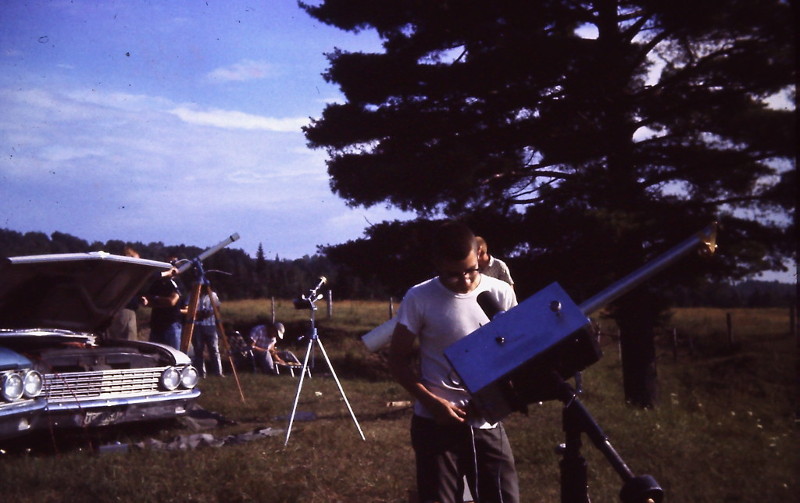
John Wesley checking the tracking of our eclipse camera.
It was for naught. Due to an operator error all the film was wound up when power was applied to the controller, because I left a switch in the wrong position.
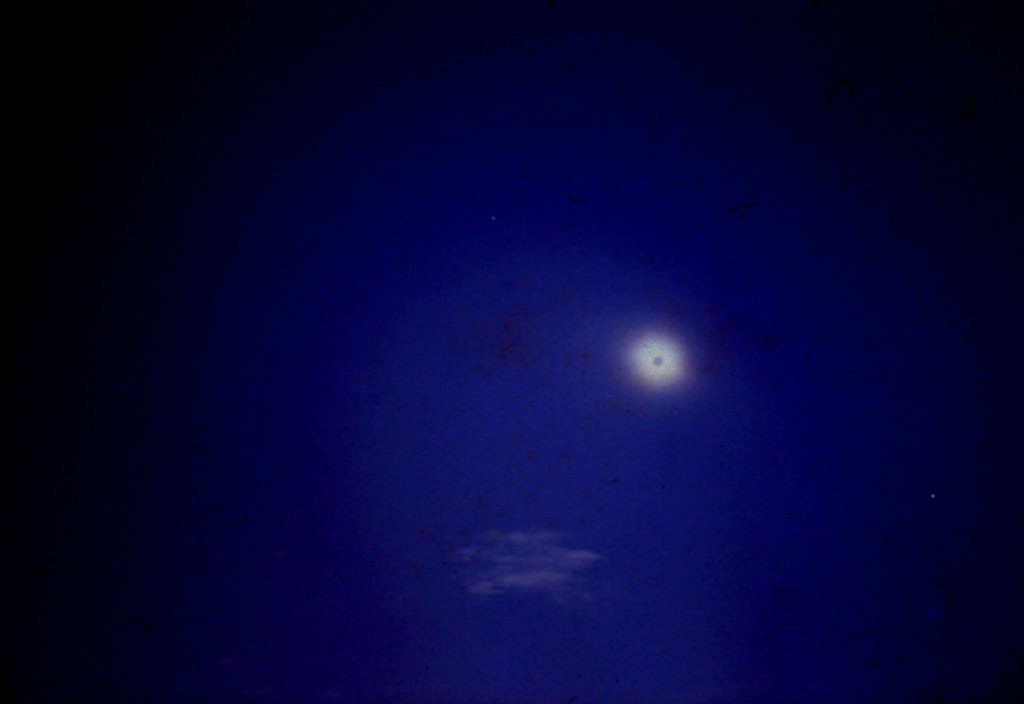
A shot with a 50mm lens with a guessed exposure. Thanks to GIMP and modern digital processing I was able to recover the over exposed image. But like all eclipse photographs, doesn’t really show it as the eye reveals the dynamic light levels of the corona.
12/30/2016 – Ephemeris – Looking ahead at the eclipses of 2017
Ephemeris for Friday, December 30th. The Sun will rise at 8:19. It’ll be up for 8 hours and 51 minutes, setting at 5:11. The Moon, 1 day past new, will set at 6:53 this evening.
Looking ahead at astronomical events of the 2017. There is one big one that all of us astronomers, both amateur and professional are looking forward to. That is the total eclipse of the Sun on August 21st, where the center of the Moon’s shadow will sweep across the continental United States from Oregon to South Carolina. The closest this path of totality will get to our area is around Carbondale, Illinois. For the Grand Traverse area the Sun will be some 75% covered by the Moon. As kind of a warm up event, we’ll have a slight eclipse of the Moon February 10th, where the Moon will enter the Earth’s outer partial shadow, nearly grazing the Earth’s inner shadow in the early evening. It’s called a penumbral lunar eclipse.
Times are for the Traverse City/Interlochen area of Michigan. They may be different for your location.
Addendum
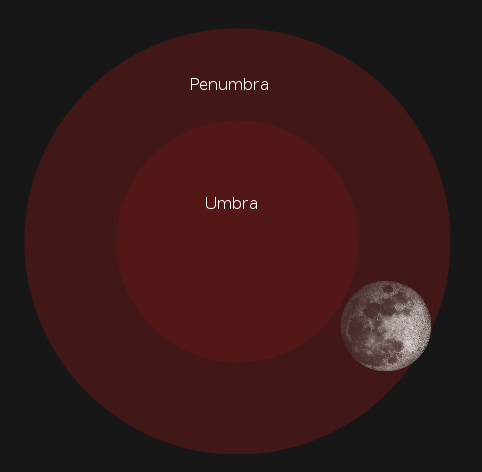
This is the maximum of the February 10th penumbral lunar eclipse. The Moon will appear to move diagonally down to the left. It is shown at maximum eclipse at 7:45 p.m. (0:45 UT February 11). Created using Cartes du Ciel.
Shadows are, of course, invisible unless they are cast on an object, so the Moon would appear alone, though the upper left part of it would be noticeably dimmer than the opposite side.
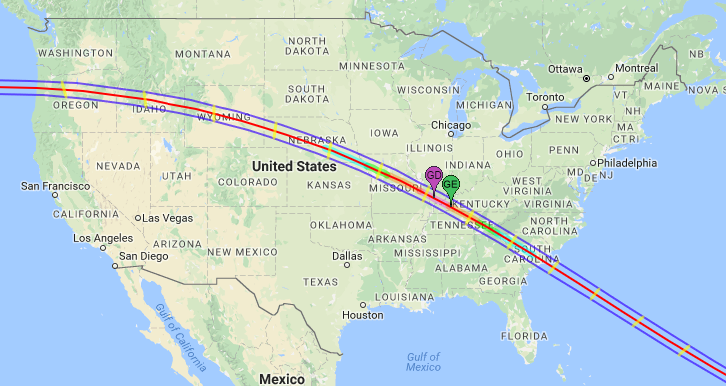
A screen cap of the map showing the path of totality of the August 21, 2017 total solar eclipse from NASA’s eclipse page. Credit: NASA and Google Maps. Click on image to enlarge.
Click here to go to the page where this interactive map is located. The magenta marker with GD is the point with the greatest duration of totality of 2 minutes 40.2 seconds. The green marker with GE denotes where the Moon’s umbral shadow is the widest. Clicking on any point on the map will pop a balloon shows all the eclipse information for viewing it from that place. The partial eclipse can be seen from all fifty states, though in Hawai’i the Sun rises with the eclipse in progress.
Here in the Grand Traverse Region, the Moon will encroach on about 8/10ths of the Sun’s diameter, covering 75% of the Sun’s face.
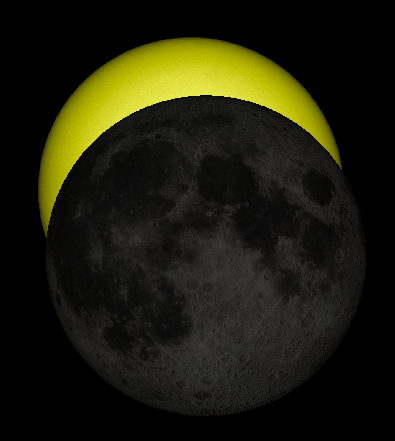
What the maximum eclipse would look like with proper filtering at Traverse City, MI. Created using Stellarium.
Eclipse Times for Traverse City
Eclipse Starts 12:58:03 p.m.
Maximum Eclipse 2:20:15 p.m.
Eclipse Ends 3:40:51 p.m.
Magnitude of the eclipse 0.798
Obscuration of the Sun 75.1%
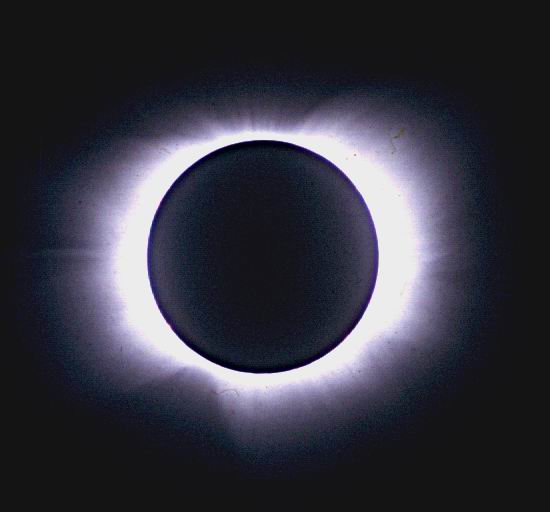
This is an inkling of what a totally eclipsed Sun looks like. No photograph can do it justice. Ya gotta be there! The solar corona displayed during the July 10, 1972* total solar eclipse from Prince Edward Island. Credit Bob Moler.
* Update: Thanks for the heads up on the typo: NationalEclipse.com.
Program Note:
I’ve developed a PowerPoint slide presentation highlighting my four total eclipses and a look at future eclipses. I will be happy to give this presentation to school groups and organizations free of charge except for mileage reimbursement over 50 miles. Contact me at bob@bjmoler.org.
December 31st – the longest day, really.
December 31st will be 24 hours and 1 second long. This “leap second” will be added as the 61st second of the minute 6:59 p.m. EST (23:59 UT). The reason is that the Earth’s rotation is slowing down ever so slightly, compared to the atomic clocks at the Bureau of Time. There is some discussion of eliminating this leap second. Most scientists want to use a constant time stream, and don’t give a hang about the rotation of the Earth. The exact time which is also affected by special and general relativity is used by GPS navigation satellites. A one second jump in time, at our latitude (45° north) is equivalent of the earth’s rotation of about two tenths of a mile. I hope everyone’s coordinated on this.
09/25/2015 – Ephemeris – There will be a great lunar eclipse Sunday night
Ephemeris for Friday, September 25th. The Sun will rise at 7:33. It’ll be up for 12 hours and 1 minute, setting at 7:35. The Moon, 2 days before full, will set at 5:34 tomorrow morning.
Lets check out Sunday’s total lunar eclipse. It will be visible from the entire contiguous 48 states, and in its entirety from Colorado, eastward. The partial phase will start at 9:07 p.m. Totality will begin at 10:11 p.m. and extend to 11:23 p.m. when the Moon should appear red in color, illuminated by the combined sunrises and sunsets occurring on the Earth at that moment. The eclipse will end at 12:27 a.m. The eclipse is perfectly viewable with the naked eye or binoculars. For those who want company and commentary as to what’s going on, the Grand Traverse Astronomical Society will provide two locations from which to view the eclipse. The NMC Observatory, south of Traverse City and Platte River Point, part of the Sleeping Bear Dunes National Lakeshore, both weather permitting.
Times are for the Traverse City/Interlochen area of Michigan. They may be different for your location.
Addendum
The next lunar eclipse visible from our area will be January 31, 2018 which will achieve totality just before the moon sets. The next lunar eclipse will be January 20-21, 2019 which will start late in the evening. The problem being that January is a pretty cloudy month around here.
We’re closer to the next solar eclipse, which will be a total eclipse visible at midday, and the center line of the path of totality which will pass from Oregon to South Carolina, passing just south of St. Louis Missouri and north of Nashville Tennessee. For more on the 2017 eclipse check out this NASA eclipse page.
09/11/2015 – Ephemeris – Astronomy from the dark skies of the Sleeping Bear Dunes this Saturday
Ephemeris for Friday, September 11th. The Sun will rise at 7:16. It’ll be up for 12 hours and 44 minutes, setting at 8:01. The Moon, 2 days before new, will rise at 6:39 tomorrow morning.
Tomorrow night will be the next to the last Star Party at the Sleeping Bear Dunes National Lakeshore of the year. It will be at the Dune Climb in the Parking lot nearest to the dunes. Featured will be the wonders of the Milky Way including globular and galactic star clusters and planetary and emission nebulae. The event starts at 9 p.m. We are entering the second eclipse season of the year.
On Sunday there will be a partial solar eclipse visible from South Africa, the Southern Ocean and part of Antarctica. Eclipses occur in no less a grouping than pairs, solar and lunar, the next eclipse is 16 days away. It will be total lunar eclipse visible from here on Sunday evening the 27th. In the week after next I’ll tell you all about it.
Times are for the Traverse City/Interlochen area of Michigan. They may be different for your location.
Addendum
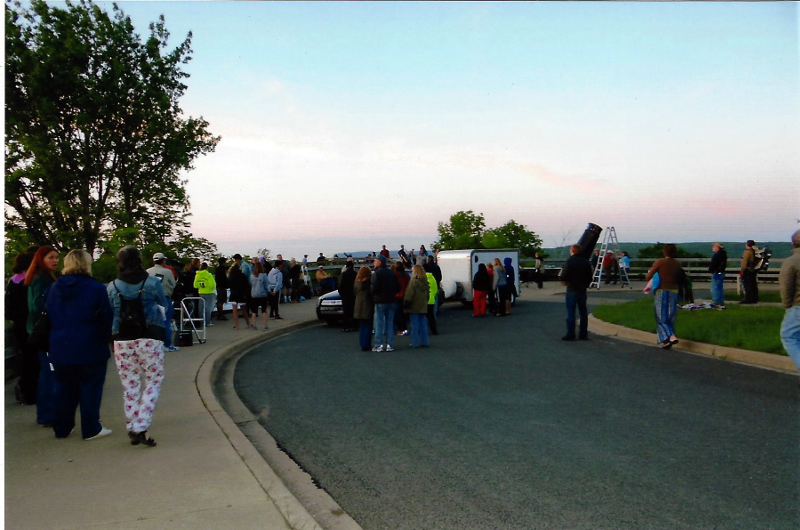
Star Party at the Dunes Overlook. Credit: Eileen Carlisle. I still don’t have a good picture of a star party at the Dune Climb where the dune rises up and blocks the lower 20º of the western sky.
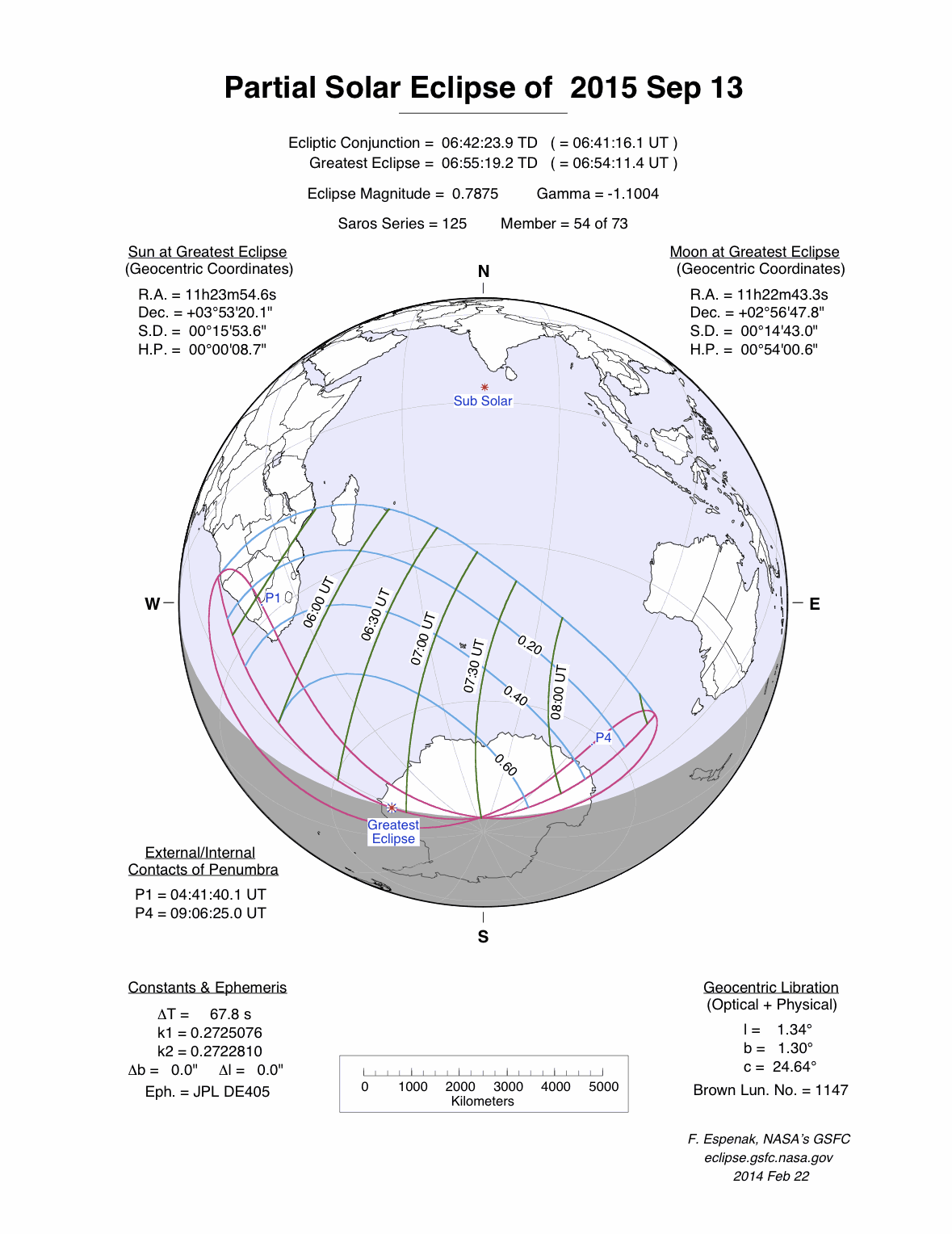
Partial Solar Eclipse of September 13, 2-15. Credit: NASA/GSFC/Fred Espenak.
 Bob Moler's Ephemeris Blog