Archive
12/05/2019 – Ephemeris – Artemis the new Moon program
Ephemeris for Thursday, December 5th. Today the Sun will be up for 8 hours and 58 minutes, setting at 5:02, and it will rise tomorrow at 8:05. The Moon, 1 day past first quarter, will set at 2:01 tomorrow morning. | NASA has a new program to return to the Moon, perhaps to stay. The program is called Artemis, named after the Greek god Apollo’s twin sister. NASA is building a massive rocket called the Space Launch System, or SLS, and the Orion
, which I’m sure will guarantee European astronauts a ride. This is not going to be an Apollo type one rocket up and back. There will be a space station called the Lunar Gateway of International partners that will orbit the Moon. There the crew of the Orion Spacecraft will transfer to a Lunar Lander for the trip to and from the surface of the Moon. It’s a heavy push to accomplish by 2024.
The times given are for the Traverse City/Interlochen area of Michigan. They may be different for your location.
Addendum
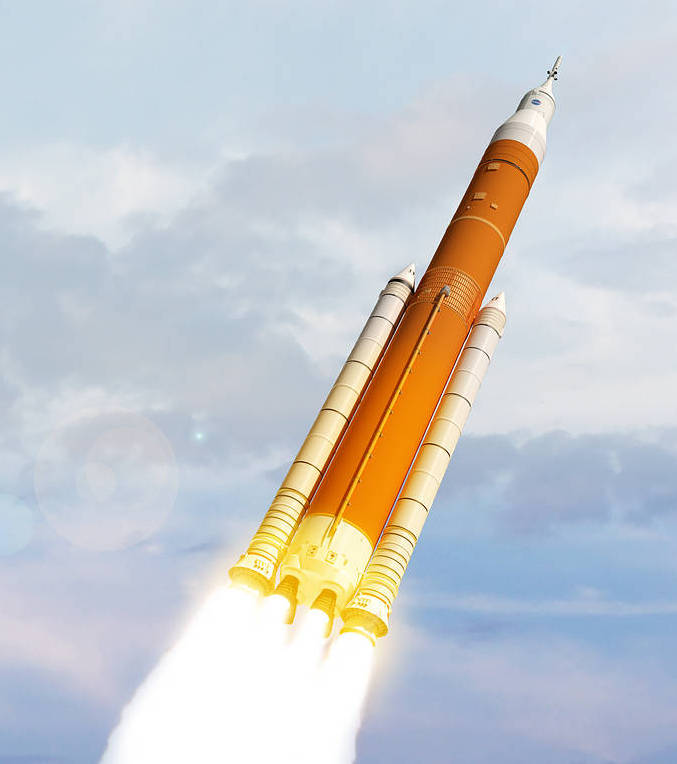
The Block 1b vrsion of the Space Launch System (SLS) which uses elongated Space Shuttle boosters and a core stage with 4 Space Shuttle main engines for the first stage. Credit NASA.
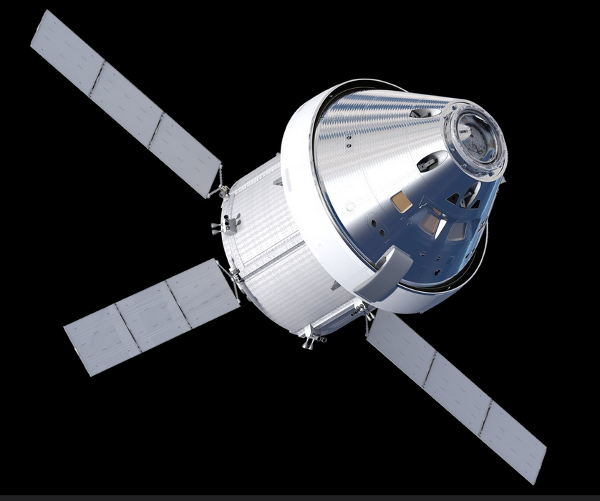
Cone-shaped Orion Multi-Purpose Crew Vehicle with a European Service Module. Credit NASA.
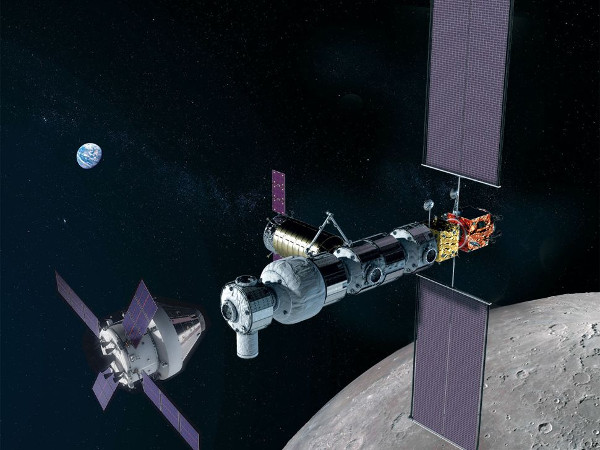
Lunar Gateway supplied by the same partners that built the International Space Station. It will orbit the Moon, Credit NASA.
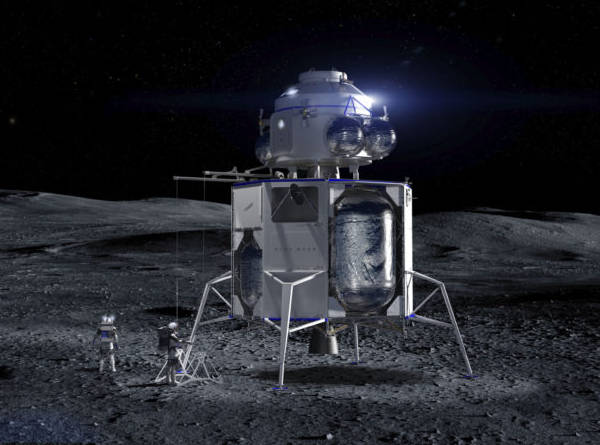
Lunar Lander. This vehicle has not been designed yet. This is Blue Origin’s Ascent Module on top of a yet to be designed propulsion module. Credit Blue Origin.
08/15/2019 – Ephemeris – Looking back at Apollo 12
Sorry for the late post. I had a short hospital stay due to something that happened to me early Wednesday.
Ephemeris for Thursday, August 15th. Today the Sun will be up for 14 hours and 3 minutes, setting at 8:48, and it will rise tomorrow at 6:46. The Moon, at full today, will rise at 9:17 this evening.
Apollo 11 wasn’t the only moon landing mission in 1969. Four months after Apollo 11 took off Apollo 12 lifted off into ominous skies on November 14th. The rocket was struck by lightning shortly after takeoff, and popped the circuit breakers in the command module, but didn’t affect the computers controlling the Saturn V. The astronauts were able to reset everything in time for TLI, Trans Lunar Injection. They landed as intended some 600 feet from the Surveyor 3 lander spacecraft sent to the Moon 2 and a half years earlier. They cut off the spacecraft camera to return to the Earth. The improved color TV camera they brought with them was damaged when it was inadvertently pointed to the Sun while setting it up.
The times given are for the Traverse City/Interlochen area of Michigan. They may be different for your location.
Addendum
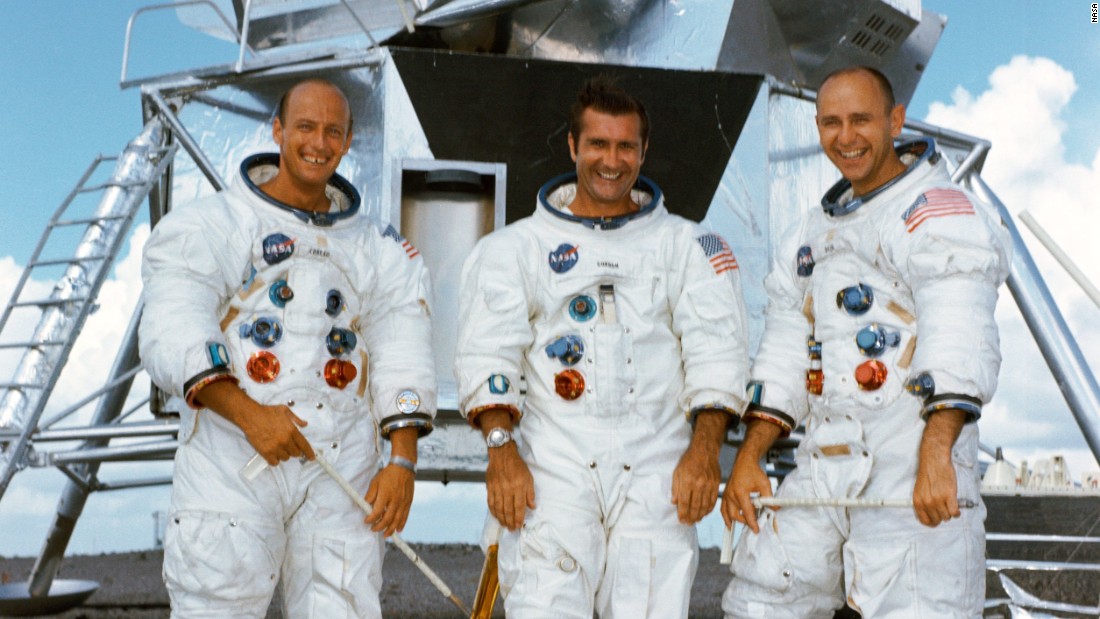
The crew of Apollo 12 left to right: Pete Conrad, Richard Gordon, and Alan Bean. Credit: NASA.
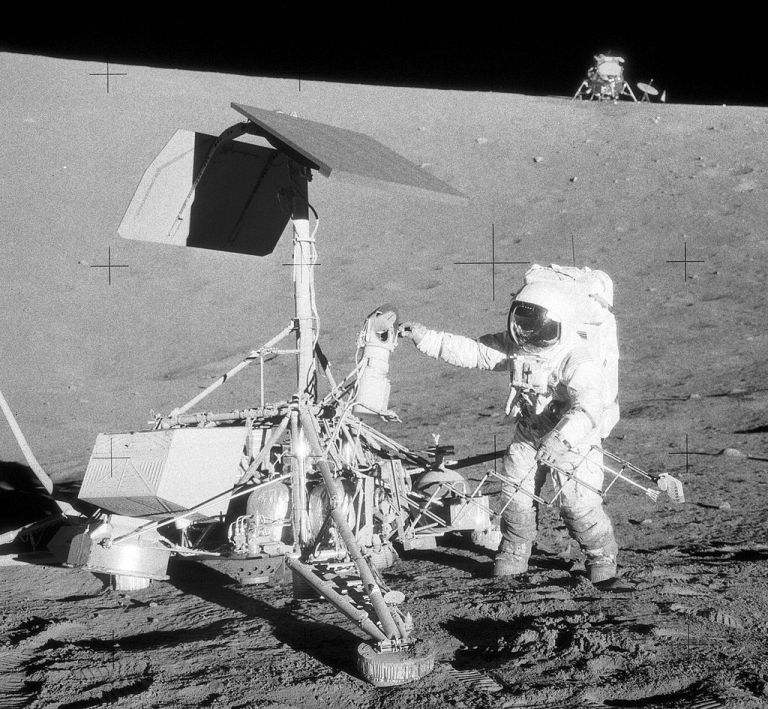
Pete Conrad visiting Surveyor 3. Credit NASA/Alan Bean.
08/13/2019 – Ephemeris – Apollo 11 at 50: Soviet Moon landing plans
Ephemeris for Tuesday, August 13th. Today the Sun will be up for 14 hours and 9 minutes, setting at 8:51, and it will rise tomorrow at 6:43. The Moon, 2 days before full, will set at 5:36 tomorrow morning.
The United States thought it was in a race to the Moon with the Soviets in the 1960s. The Russians in the meantime were pushing for space firsts, like the first man in space, first woman, first space walk. So they started too late with their Moon landing plans, on top of that their chief rocket designer Sergei Korolev died of a botched surgery in 1966 leading to a struggle for leadership. Despite their huge N-1 rocket, the payload to the lunar surface was less than the US had. They would have a 2 man crew in the Soyuz capsule and a one man lander they designated LK. The LK, much smaller than the US’s Lunar Module and to my knowledge was never tested and it never flew in space. The four moon rockets they built never flew more than a few seconds each.
The times given are for the Traverse City/Interlochen area of Michigan. They may be different for your location.
Addendum
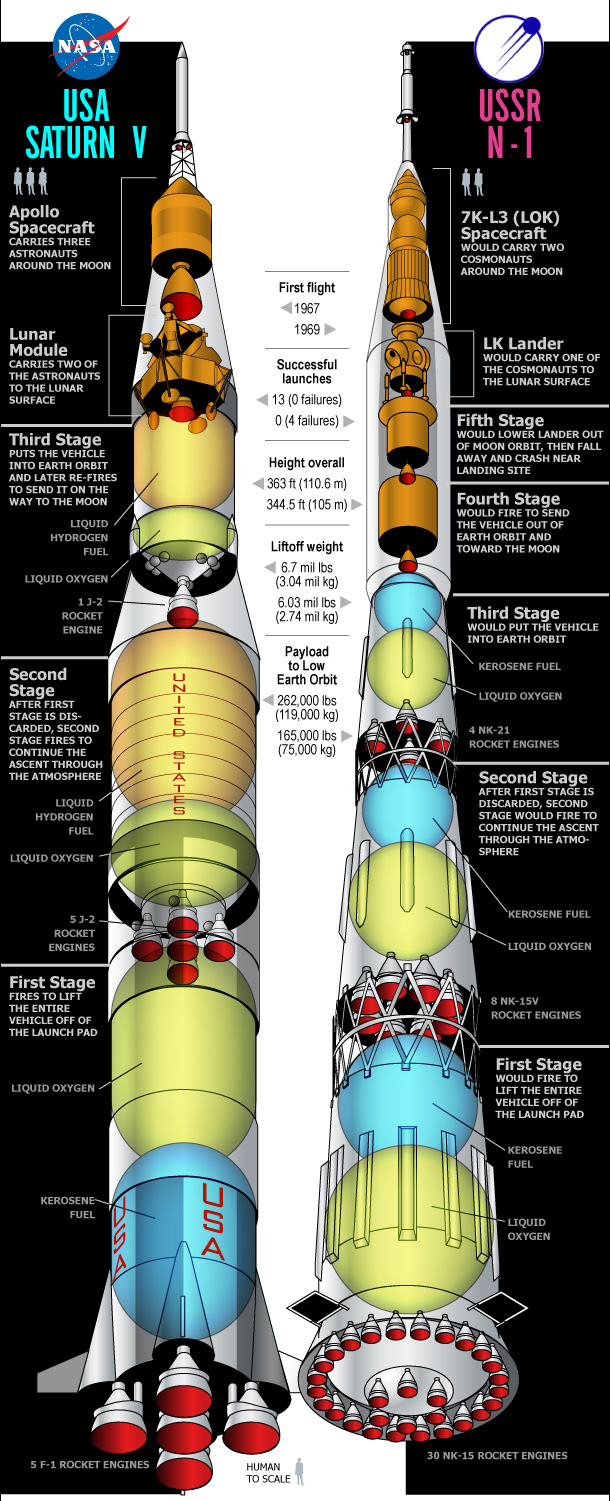
Comparison between The United States Saturn V and the Soviet N-1. Click on the image to enlarge. Credit Karl Tate, Space.com.
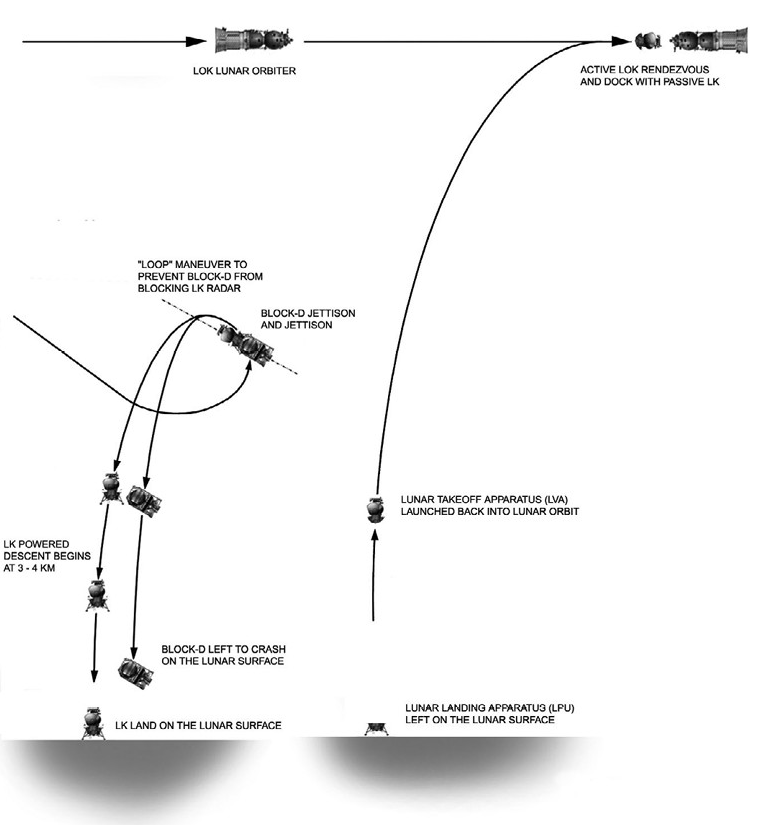
The Lunar landing strategy. When it comes to landing one cosmonaut space walks from the Soyuz (LOK) to the LK lander. The fifth stage called Block-D accomplishes the de-orbit burn of the lander, and is jettisoned. The LK is a two part vehicle somewhat like the American LM, except one engine accomplishes both landing and takeoff. On lunar rendezvous with the LOK the LK is the passive member of the docking. Credit: Rockets and People Volume IV The Moon Race by Boris Chertok/NASA.
The Rockets and People series can be downloaded from NASA.gov: https://history.nasa.gov/series95.html. Look under Memoirs.
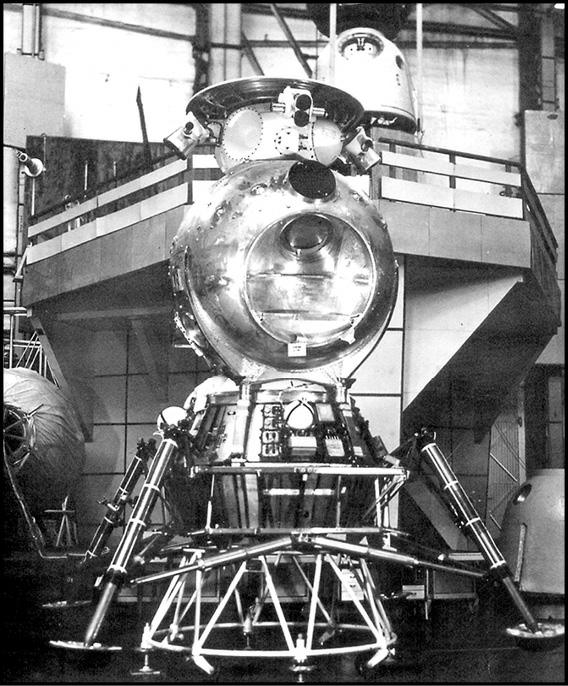
The LK Lander. Credit: Rockets and People Vol. IV/ NASA.
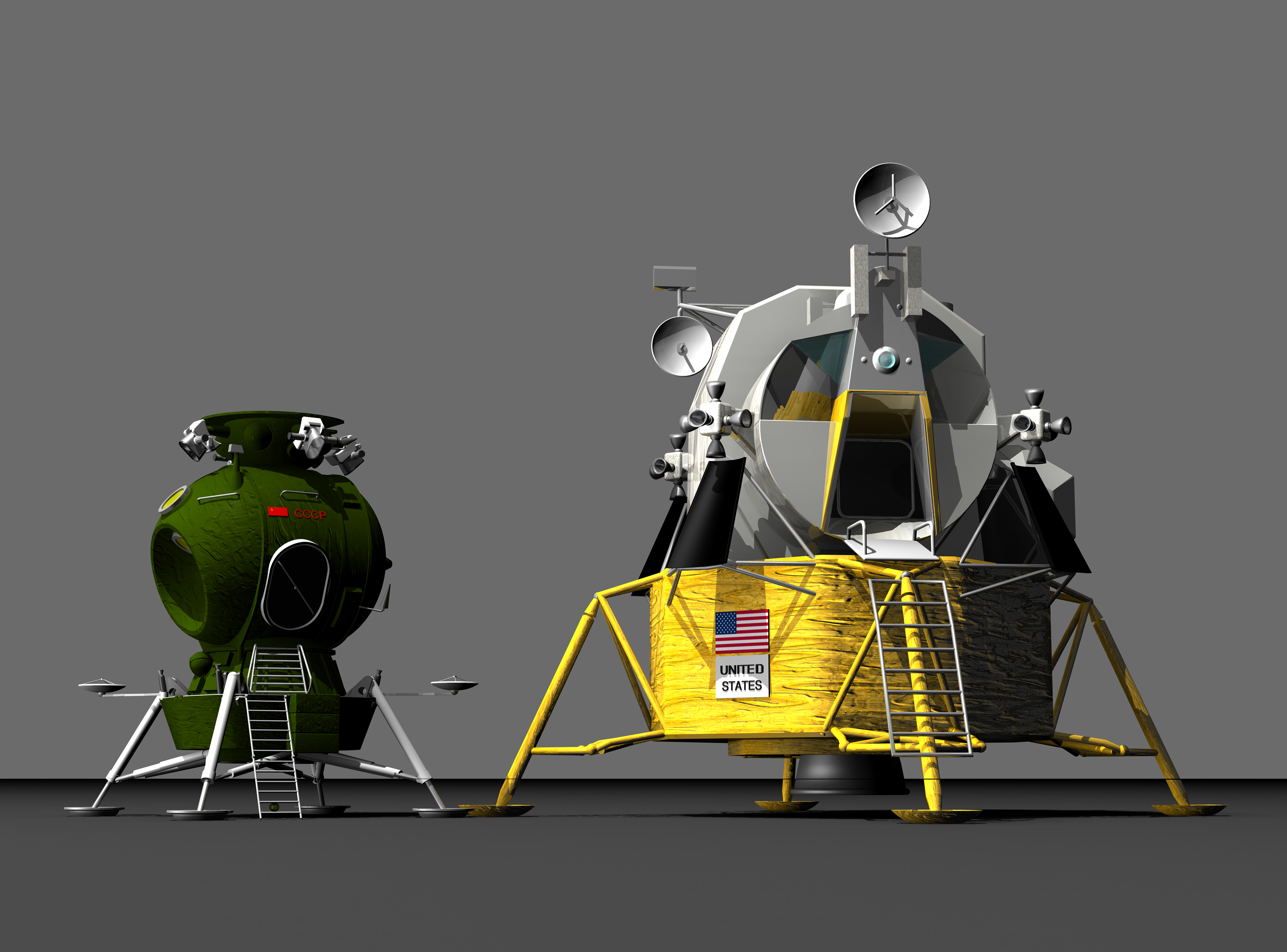
A comparison of the size of the LK Lander and the American Lunar Module (LM). Click on the image to enlarge. Credit Wikipedia/ebs08.
08/12/2019 – Ephemeris – Apollo 8’s giant leap to the Moon
Ephemeris for Monday, August 12th. Today the Sun will be up for 14 hours and 12 minutes, setting at 8:53, and it will rise tomorrow at 6:42. The Moon, 3 days before full, will set at 4:38 tomorrow morning. | On the road to the Apollo 11 landing on the Moon 50 years ago was Apollo 8’s Christmas orbiting of the Moon in 1968. Apollo 7’s shakedown of the Command and service modules in October that year meant that they had a good spacecraft. However on September 28th that year a US spy satellite photographed a giant rocket of approximately the same size as the Saturn V on a launch pad at the Tyuratam Missile Test Center in the Soviet Union. Were they going to get to the Moon before us? Also Grumman was behind schedule with producing the Lunar Module for Apollo 8’s scheduled shakedown of that module in Earth orbit. NASA then decided to send Apollo 8 to the Moon instead and not miss a launch opportunity.
The times given are for the Traverse City/Interlochen area of Michigan. They may be different for your location.
Addendum
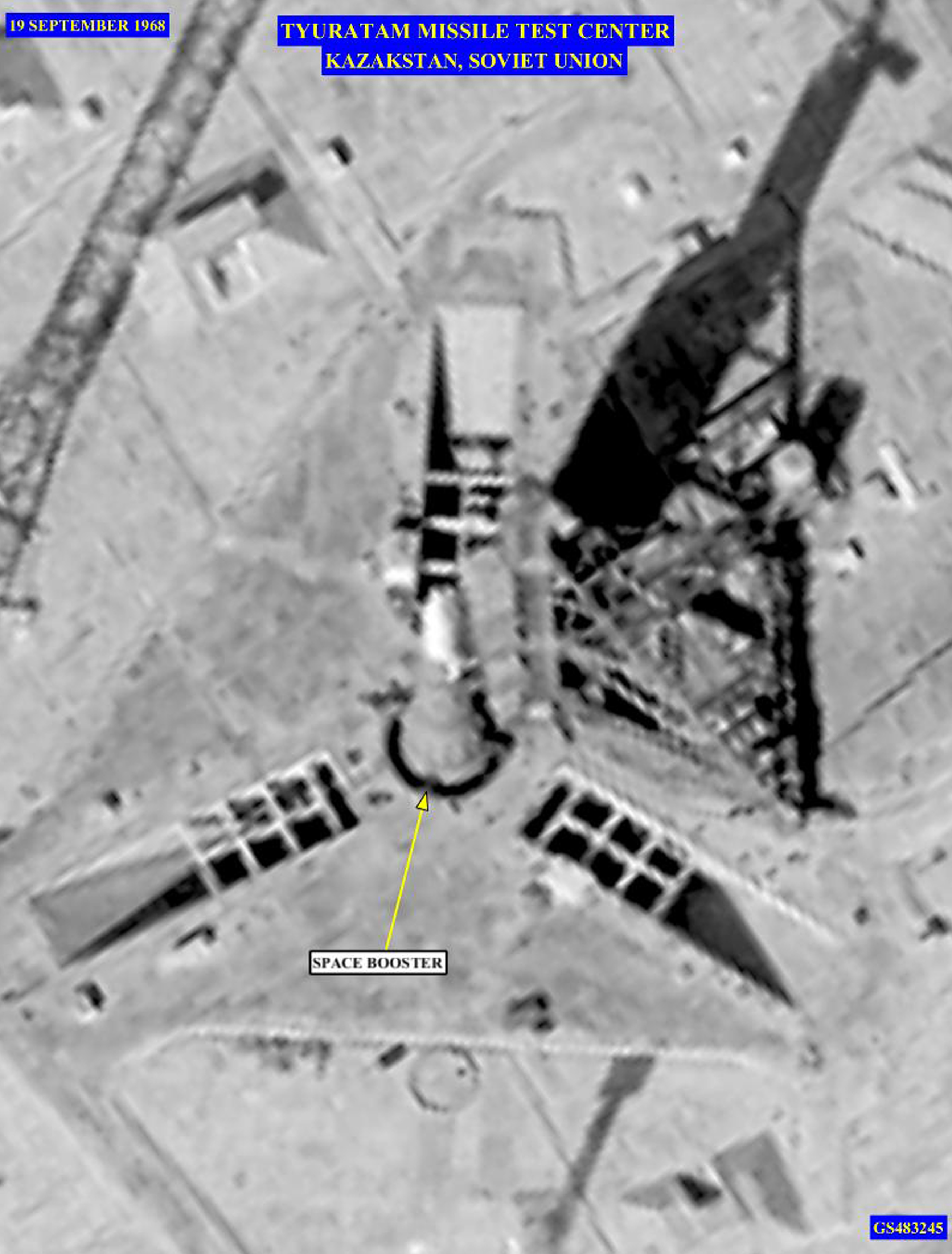
KH-8 spy satellite photo of an N-1 rocket on the launch pad on September 28, 1968.
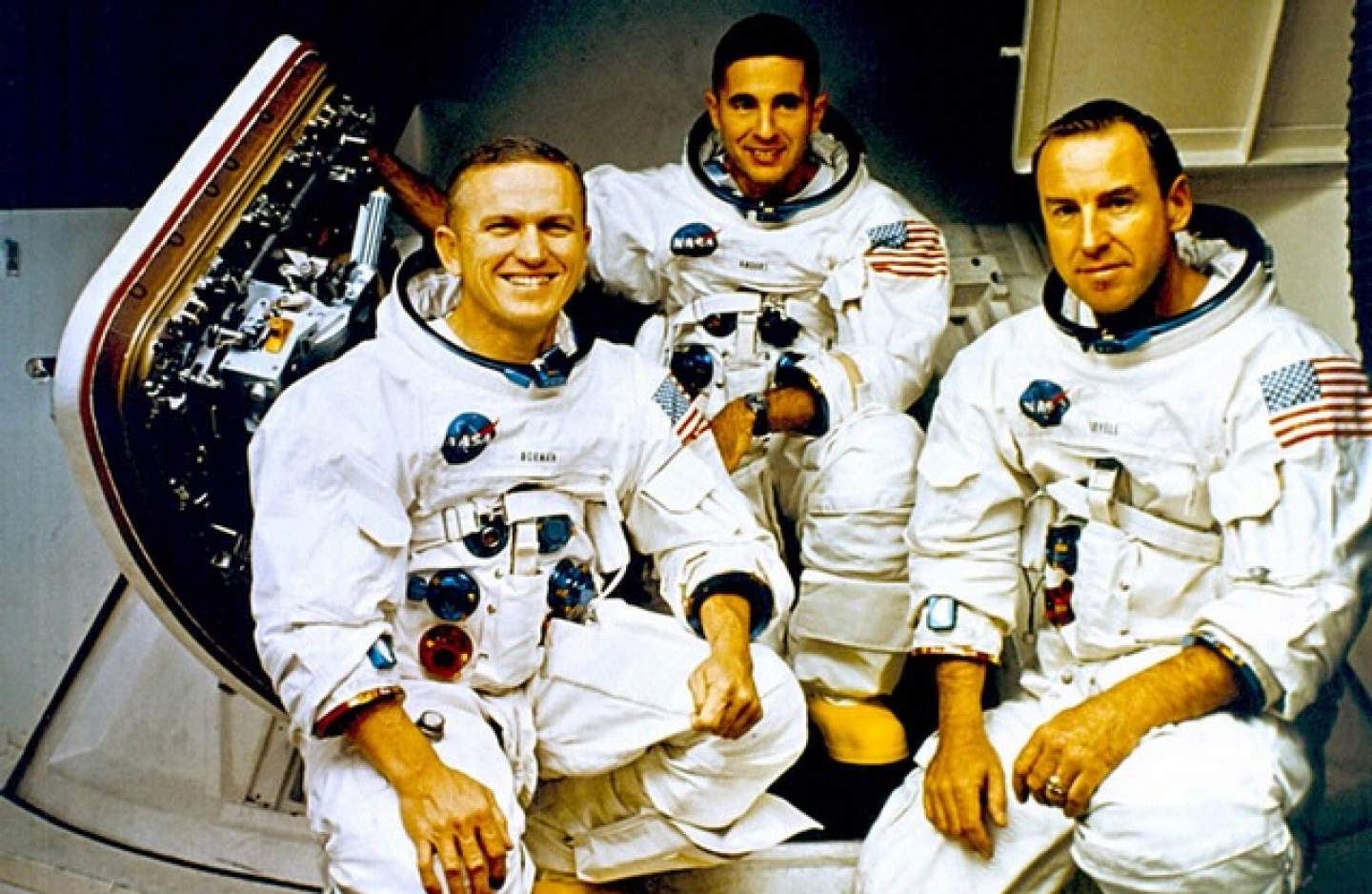
Apollo 8 crew from he left: Frank Borman, Bill Anders, and Jim Lovell.
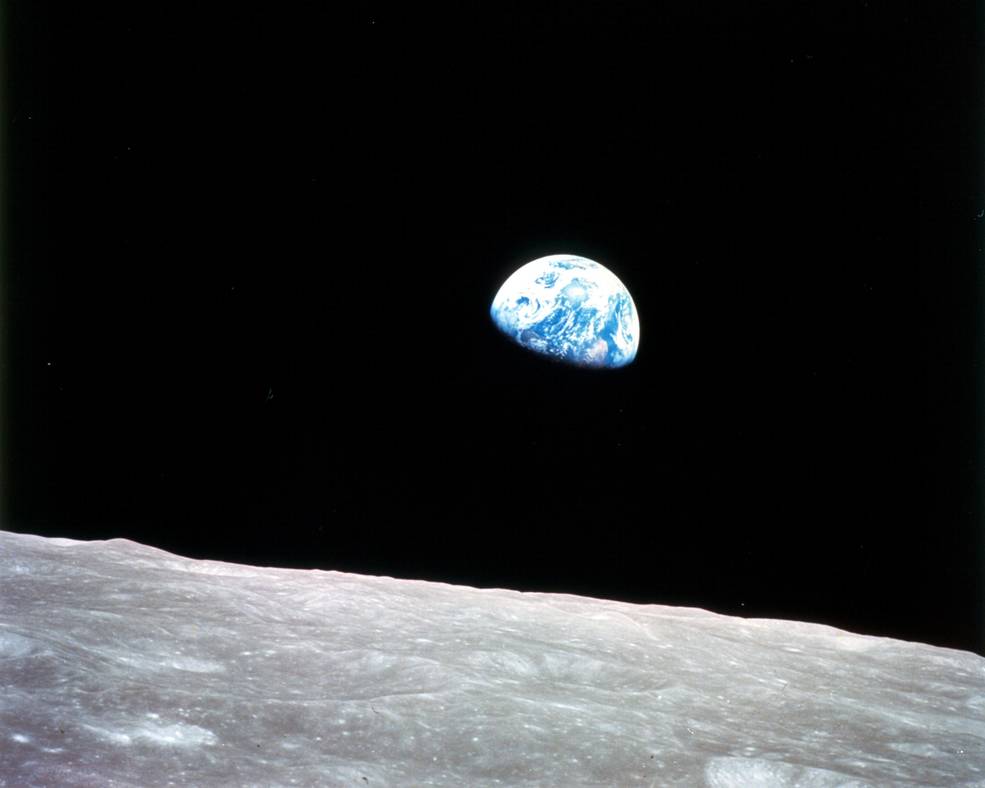
The famous Earthrise photograph: ”We went to the Moon and Discovered the Earth.” Credit NASA/Apollo 8/Bill Anders.
07/16/2019 – Ephemeris – 50 years ago today the Apollo mission left for the Moon
Ephemeris for Tuesday, July 16th. Today the Sun will be up for 15 hours and 12 minutes, setting at 9:25, and it will rise tomorrow at 6:13. The Moon, at full today, will rise at 9:30 this evening.
50 years ago today at 11:32 a.m. Eastern Daylight Time the most powerful rocket ever built roared into life. The Saturn V, a three stage rocket, 363 feet tall, which in turn launched two spacecraft, the Command and Service modules, and the Lunar Module, and three astronauts on their journey to destiny, Neil Armstrong, Edwin (Buzz) Aldrin, and Michael Collins. It was the start of the Apollo 11 mission. It happens that tonight the namesake of the rocket, the planet Saturn is to the right of the Moon. At launch the Moon was two days old, a thin crescent in the west that evening. Four days later they would be orbiting the Moon, and Armstrong and Aldrin would be descending to the Moon’s surface.
The times given are for the Traverse City/Interlochen area of Michigan. They may be different for your location.
Addenda
Apollo 11
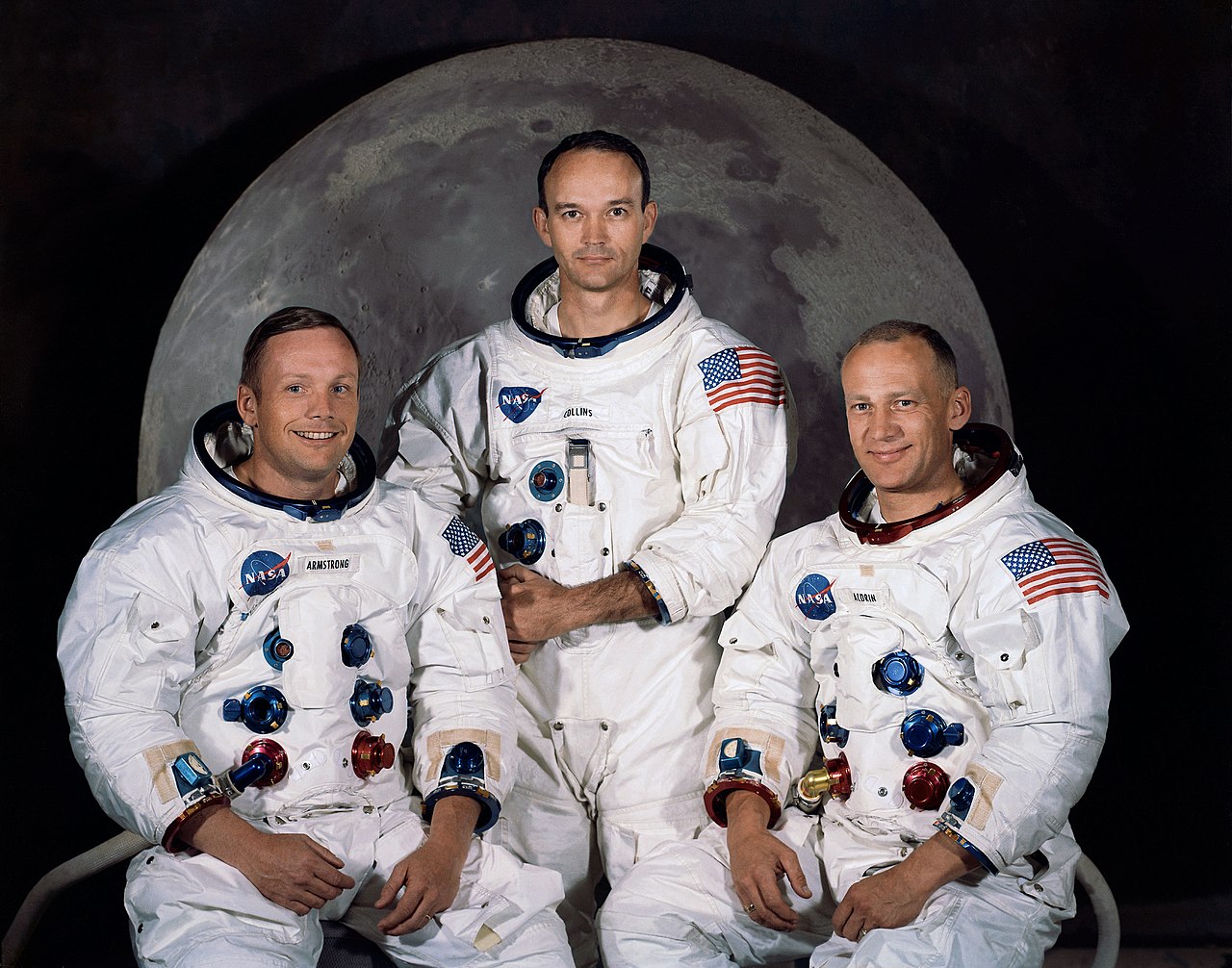
Left to right Neil Armstrong, Mission Commander; Michael Collins, Command Module Pilot; and Buzz Aldrin, Lunar Module Pilot. Credit: NASA.
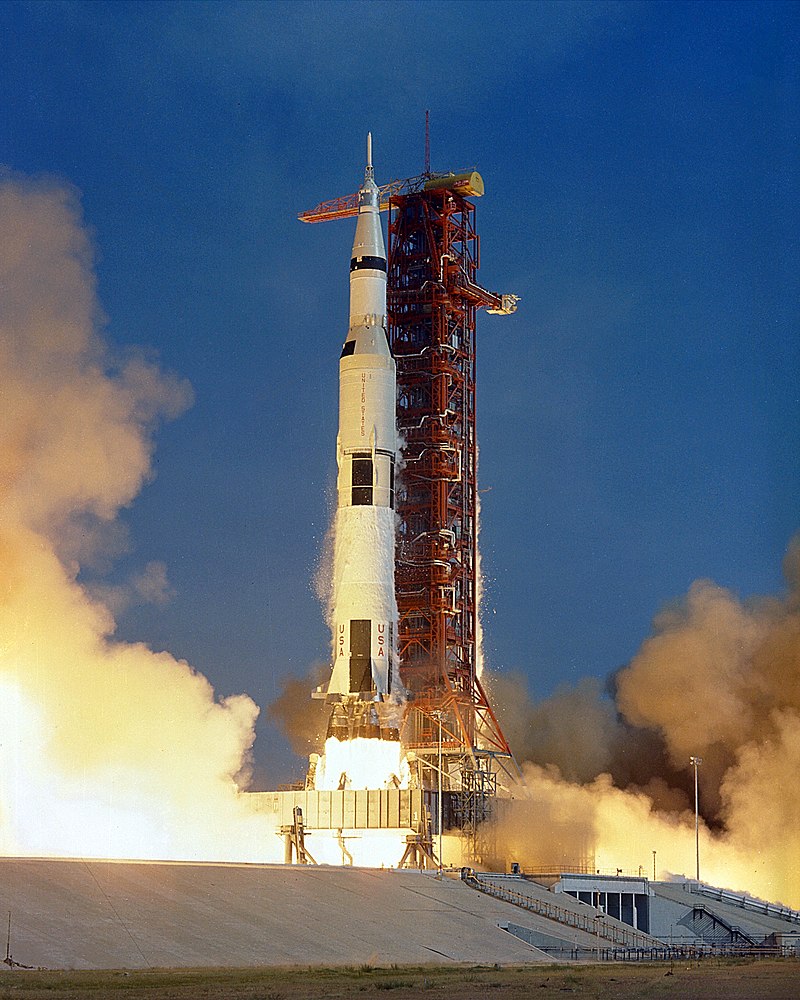
The Saturn V for the Apollo 11 mission lifts of from Pad 39A. Credit: NASA.
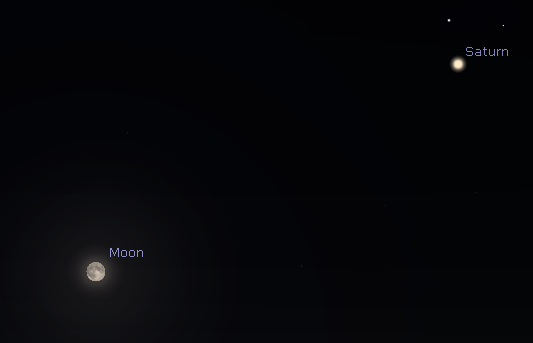
The Moon and Saturn tonight, 11 p.m. July 16, 2019. In reality the Moon will be so bright that Saturn will be almost overwhelmed. Created using Stellarium.
Here’s an excellent podcast series from the BBC: 13 Minutes to the Moon.
Partial Lunar Eclipse
The partial lunar eclipse today is not mentioned in the program because it is not visible locally.
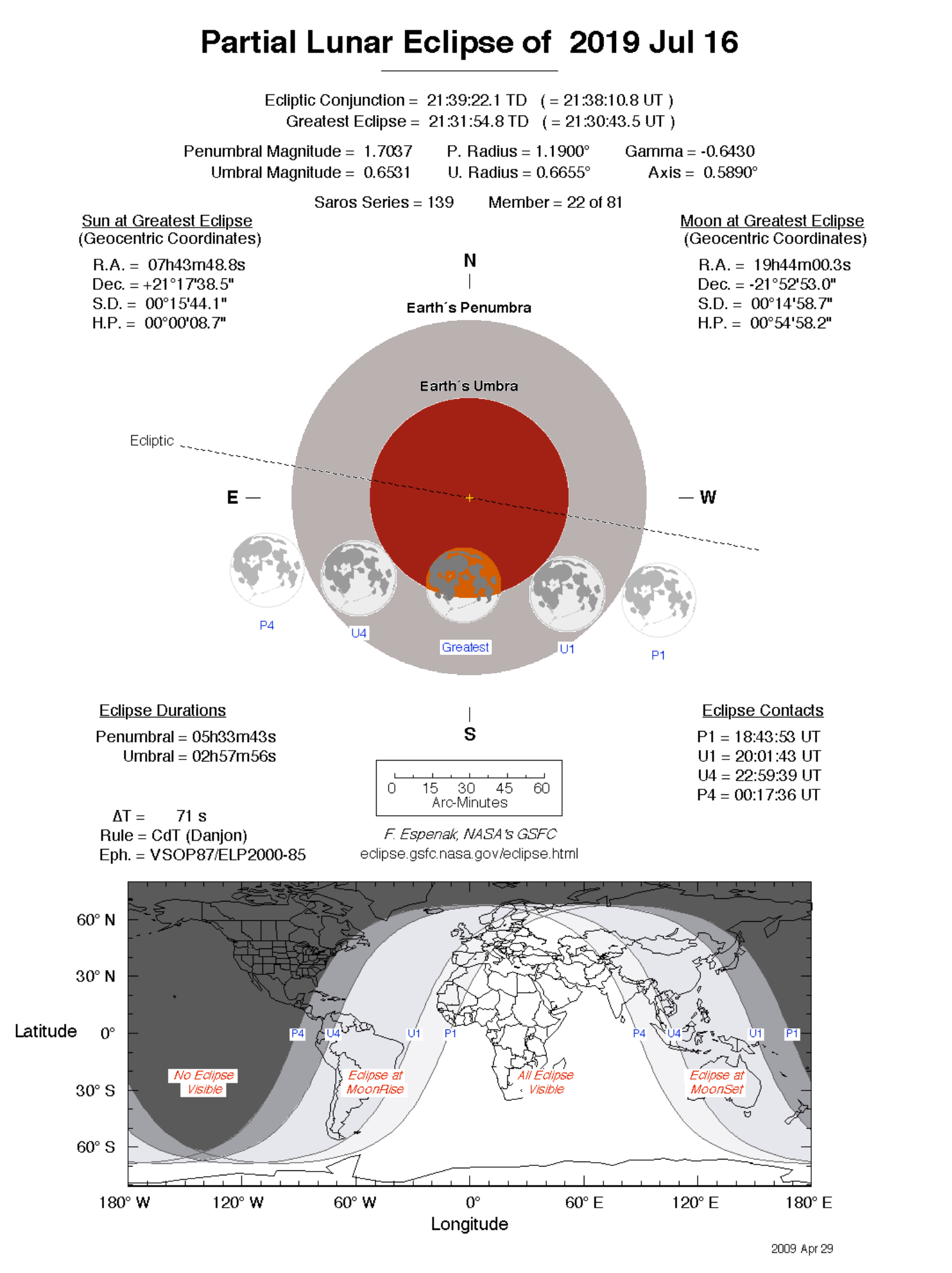
Partial Lunar Eclipse of July 16, 2019. Click on image to enlarge. Credit NASA/GSFC/F. Espenak.
07/11/2019 – Ephemeris – Road to the Moon: Project Gemini
Ephemeris for Thursday, July 11th. Today the Sun will be up for 15 hours and 20 minutes, setting at 9:28, and it will rise tomorrow at 6:08. The Moon, 2 days past first quarter, will set at 2:57 tomorrow morning.
In the steps to the Moon in the 1960’s The United States proved that humans could work in space for at least a day and a half with Project Mercury. Following that was Project Gemini to prove that humans could work and survive in space for the time it takes to get to the Moon and back, up to two weeks; to practice the techniques of rendezvous and docking of two spacecraft; and to learn how to work in space outside the spacecraft: Extravehicular Activities (EVAs), better known as space walks. Each took multiple flights to perfect. One of the hardest to perfect was working with Newton’s third law: For every action there is an equal and opposite reaction, especially when trying to tighten a bolt with a wrench.
The times given are for the Traverse City/Interlochen area of Michigan. They may be different for your location.
Addendum
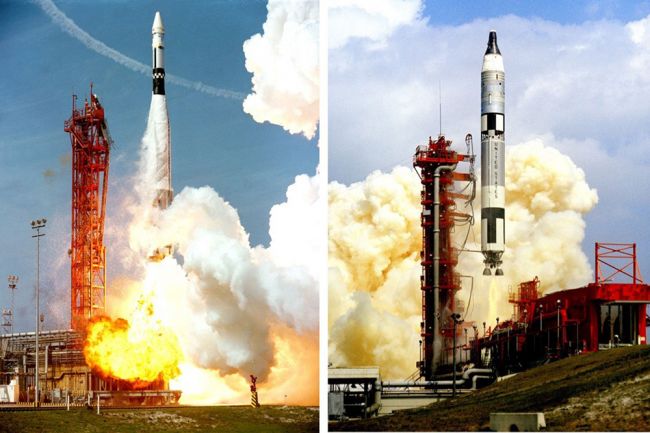
Rendezvous and docking practice. Atlas launches an Agena target vehicle first then one orbit later the Titan II launches the Gemini spacecraft. Credit NASA.
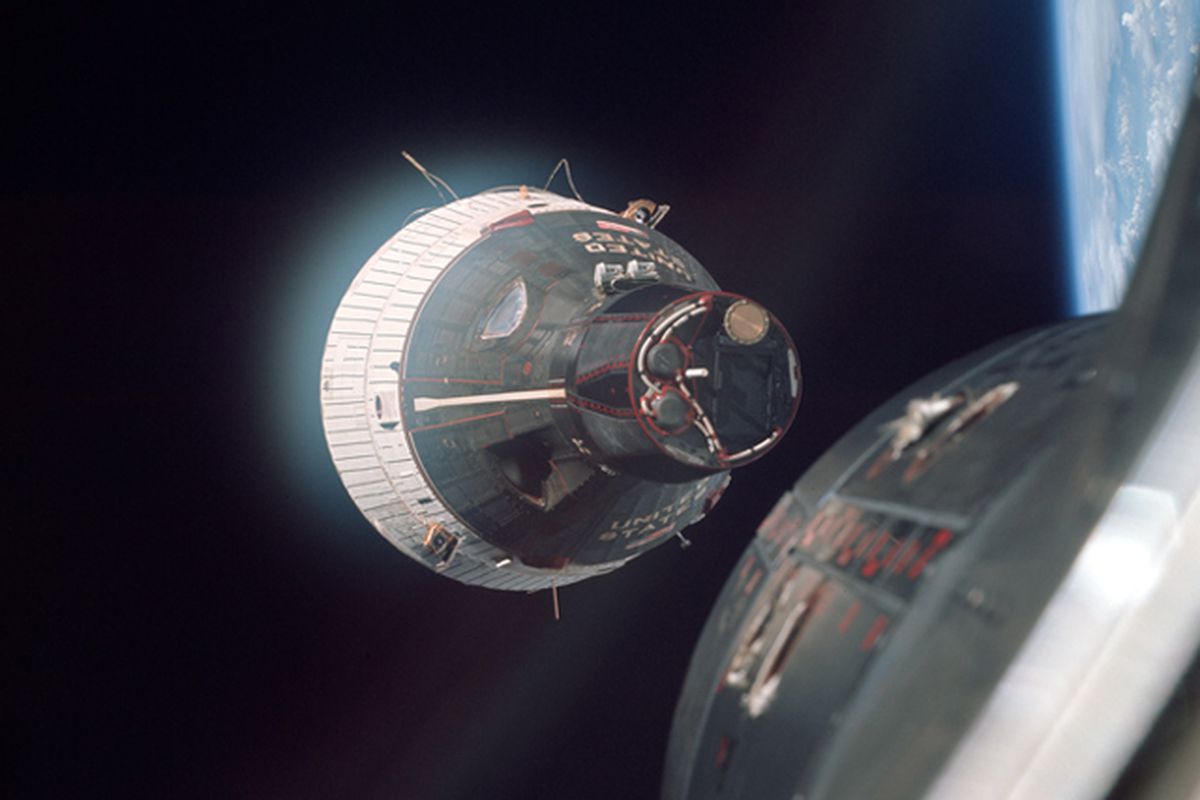
Gemini 6 rendezvous with Gemini 7 after the Agena for Gemini 6 failed to orbit. Gemini 7 was a two week endurance flight. Then Gemini 6 was sent up to meet it. Credit NASA.

Ed White in America’s first space walk on Gemini 4. Floating around was easy. but performing work was hard. Credit NASA.
05/07/2019 – Ephemeris – We’re starting to look at the race to the Moon that culminated 50 years ago
Ephemeris for Tuesday, May 7th. Today the Sun will be up for 14 hours and 30 minutes, setting at 8:54, and it will rise tomorrow at 6:23. The Moon, 3 days past new, will set at 11:58 this evening.
As we look at the Moon near the planet Mars tonight, we recall that fifty years ago today the United States was one week from launching Apollo 10, the penultimate lunar mission to test out the Lunar Module shortened to LM pronounced “Lem” in the vicinity of the Moon. President Kennedy announced the goal in 1961 to send a man to the Moon and return him safely by the end of the decade. This required a lot of learning steps and in the end a huge rocket, the Saturn V. That rocket’s chief designer was Wernher von Braun an ex-Nazi officer who designed the German V-2 during World War II. His counterpart on the Soviet side was Sergei Korolev, though we didn’t know his name until after he died in 1966. His death hampered the development of the Soviet’s N-1 moon rocket.
The times given are for the Traverse City/Interlochen area of Michigan. They may be different for your location.
Addendum
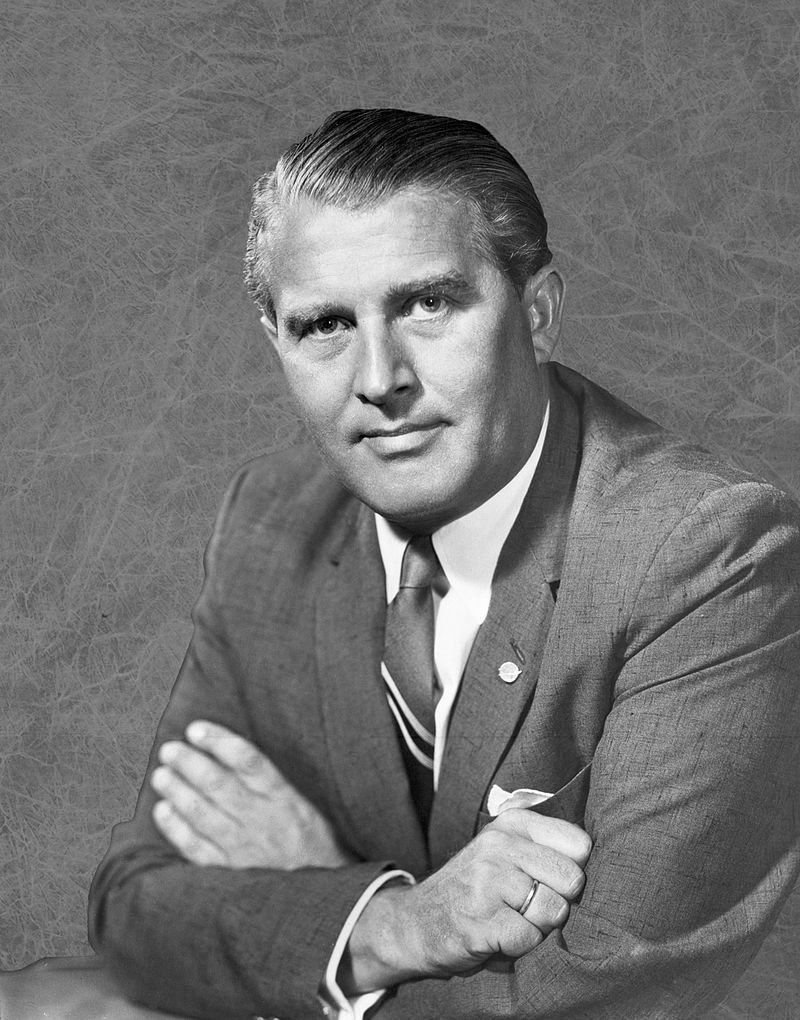
Wernher von Braun around 1960. Image is in the public domain.
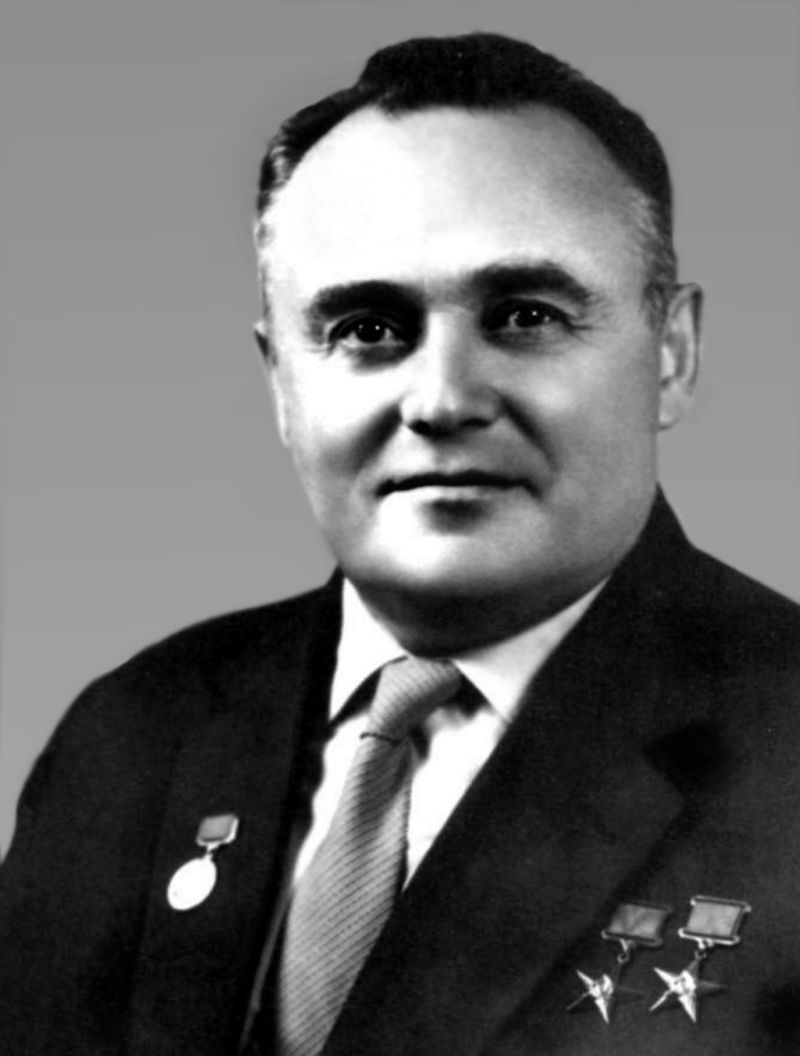
Sergei Korolev, undated image published after his death. Image is in the public domain.
A fascinating look of the Soviet side of the moon race can be found here: https://www.nasa.gov/connect/ebooks/rockets_people_vol4_detail.html. The ebook Rockets and People Volume IV, The Moon Race by Korolev’s deputy Boris Chertok. It’s available in epub, mobi and pdf formats. Volume 3 covers from 1961 to 1967. There are links to all the other volumes from that page.
04/12/2019 – Ephemeris – The proposed Deep Space Gateway
Ephemeris for Friday, April 12th. Today the Sun will be up for 13 hours and 19 minutes, setting at 8:23, and it will rise tomorrow at 7:02. The Moon, at first quarter today, will set at 3:55 tomorrow morning.
With international cooperation NASA is hoping it and its partners, the European Space Agency, The Japanese JAXA, The Canadian Space Agency and the Russian Roscosmos will a build the Deep Space Gateway, a way station between the Earth and Moon to exchange crews and vehicles traveling between the two bodies. This plan is an integral part of the returning to the Moon by around 2028. The gateway will also be a way station for the eventual exploration of Mars. How President Trump’s new demand to have the United States return to the Moon by the last year of his second term, if he has one, will affect current plans and international cooperation remains to be seen.
The times given are for the Traverse City/Interlochen area of Michigan. They may be different for your location.
Addendum
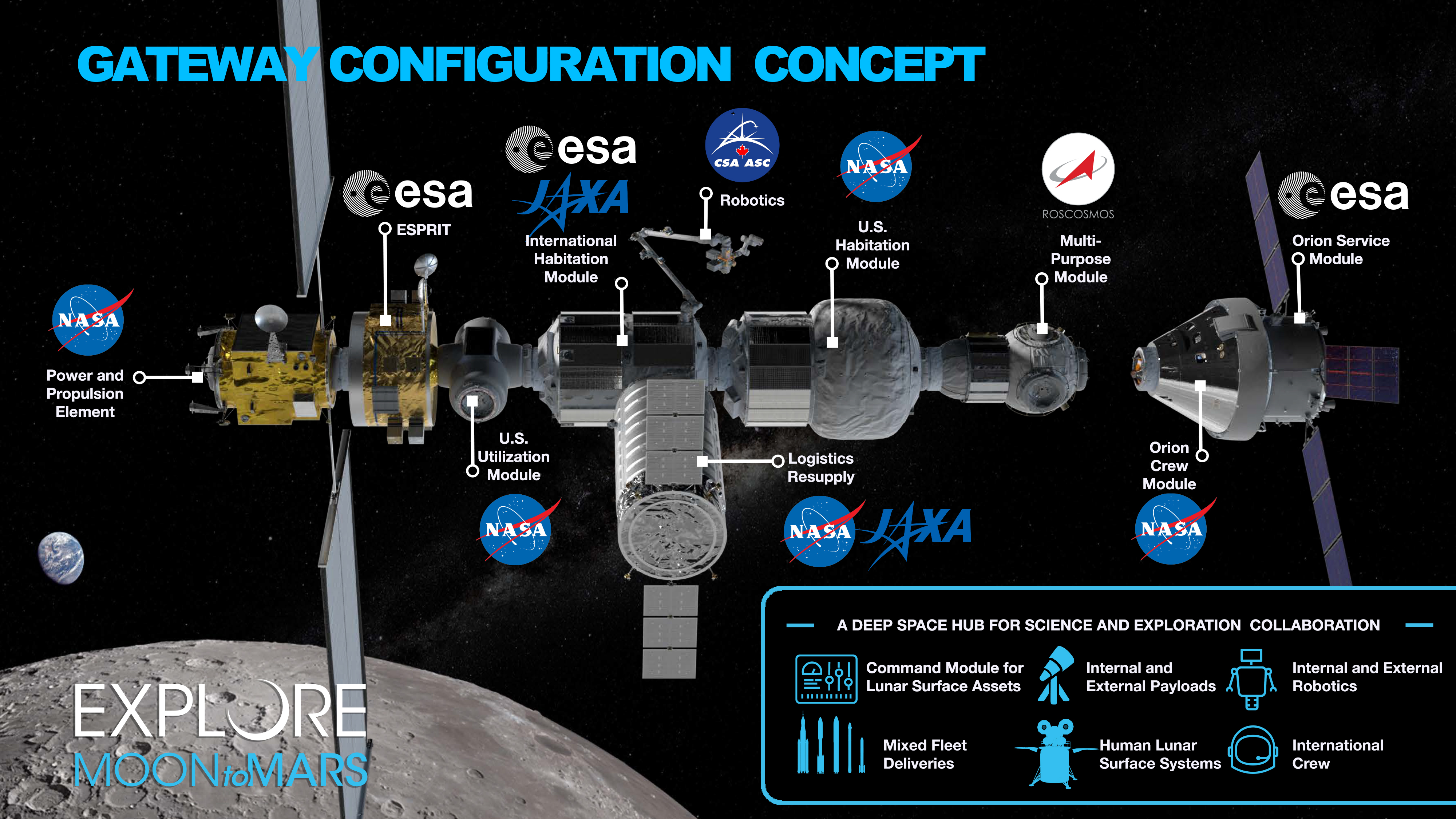
Deep Space Gateway configuration concept. This would orbit the moon is a long elliptical orbit. Click on the image to enlarge. Credit: NASA.
12/31/2018 – Ephemeris – New Year 2019 – A new solar system body is being explored right now!
Ephemeris for New Years Eve, Monday, December 31st. The Sun will rise at 8:20. It’ll be up for 8 hours and 51 minutes, setting at 5:11. The Moon, 2 days past last quarter, will rise at 3:54 tomorrow morning.
Later tonight the New Horizons spacecraft, which flew by Pluto and its retinue of moons, will fly by Kuiper Belt Object (KBO) 2014 MU69, nicknamed Ultima Thule. It’s probably an odd looking contact binary body with lobes 12 ½ and 11 miles (20 & 18 km) in diameter. That’s the guess as of a week ago. It will pass this body by 1,366 miles (2200 km), traveling at over 32 thousand miles an hour (52,000 kph). The spacecraft will pass closest approach at 33 minutes after the ball drops in Times Square. Nearly 4 hours later it will phone home. We won’t receive that message here on Earth until 10:28 a.m. due to the over 6 hours of time it takes the radio signal to reach Earth. We should get the first images by tomorrow night. The New Horizons spacecraft was built and is flown by Johns Hopkins Applied Physics Laboratory (JHAPL) is collaboration with NASA and the Southwest Research Institute (SwRI).
The times given are for the Traverse City/Interlochen area of Michigan. They may be different for your location.
Addendum
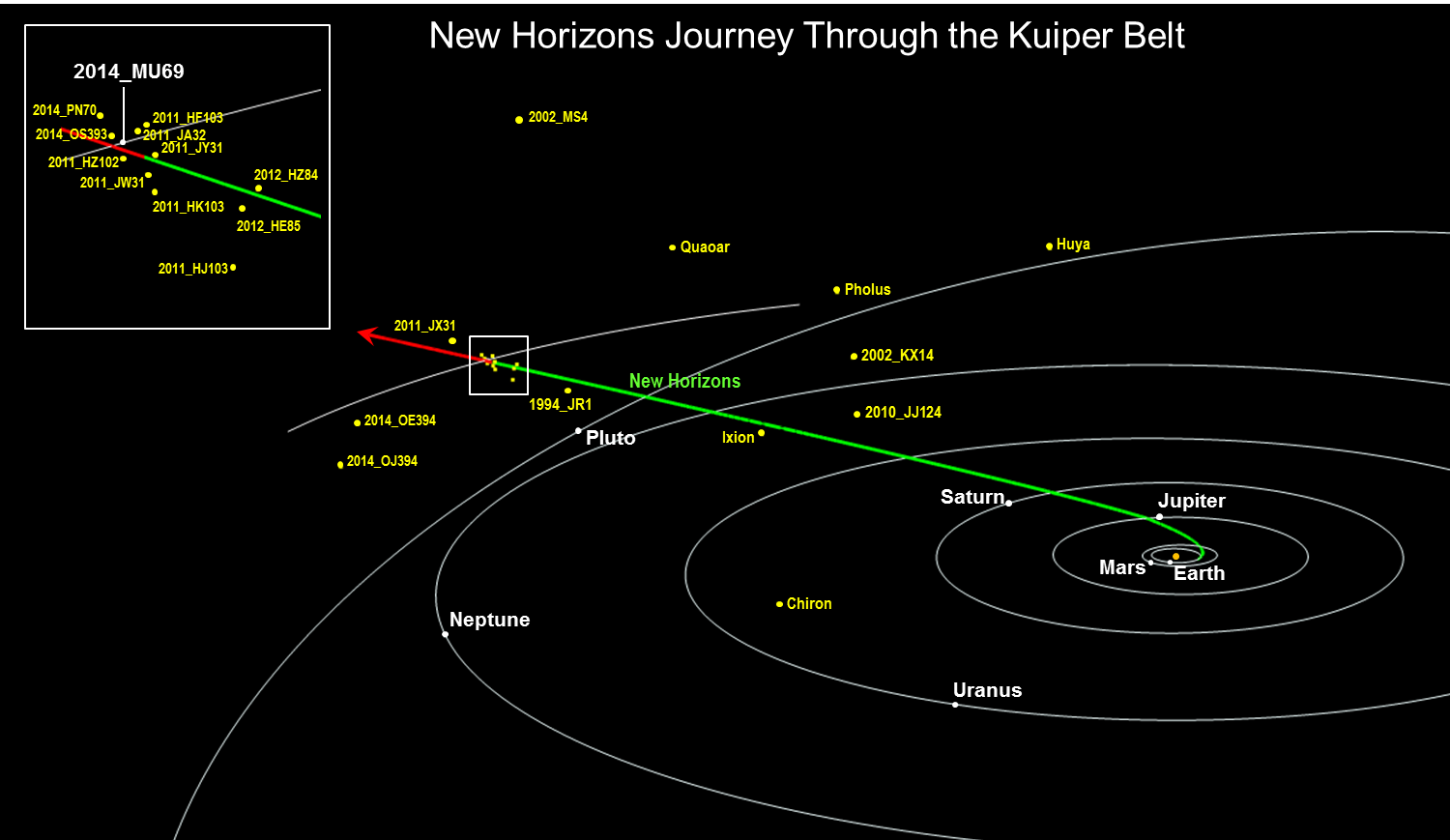
The Trajectory and position of New Horizons as it approached 2014 MU69 two months ago showing some of the KBOs recently discovered near its path. Credit JHAPL.
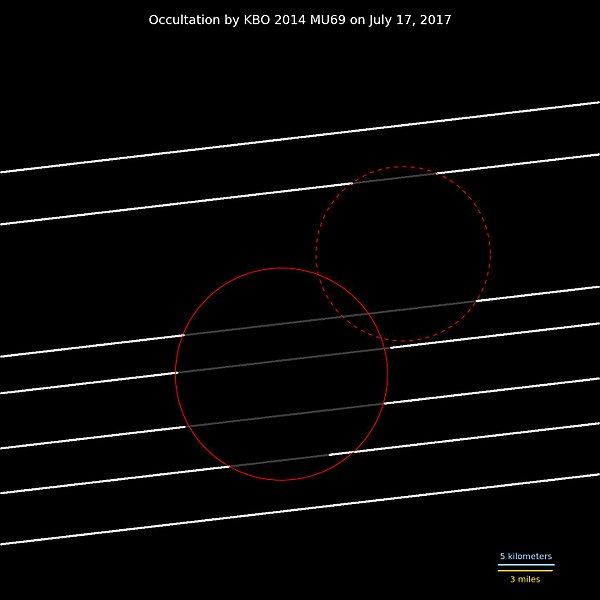
Silhouette of KBO 2014 MU69 (Ultima Thule) created by occultation timings on July 17, 2017 from southern Argentina. Credit NASA/JHUAPL/SwRI/Alex Parker.
Links to information can be found here: http://pluto.jhuapl.edu/News-Center/Where-to-Watch.php.
A cool app to follow New Horizons in real-time or to preview its passage of Ultima Thule is NASA’s Eyes: https://eyes.nasa.gov/.
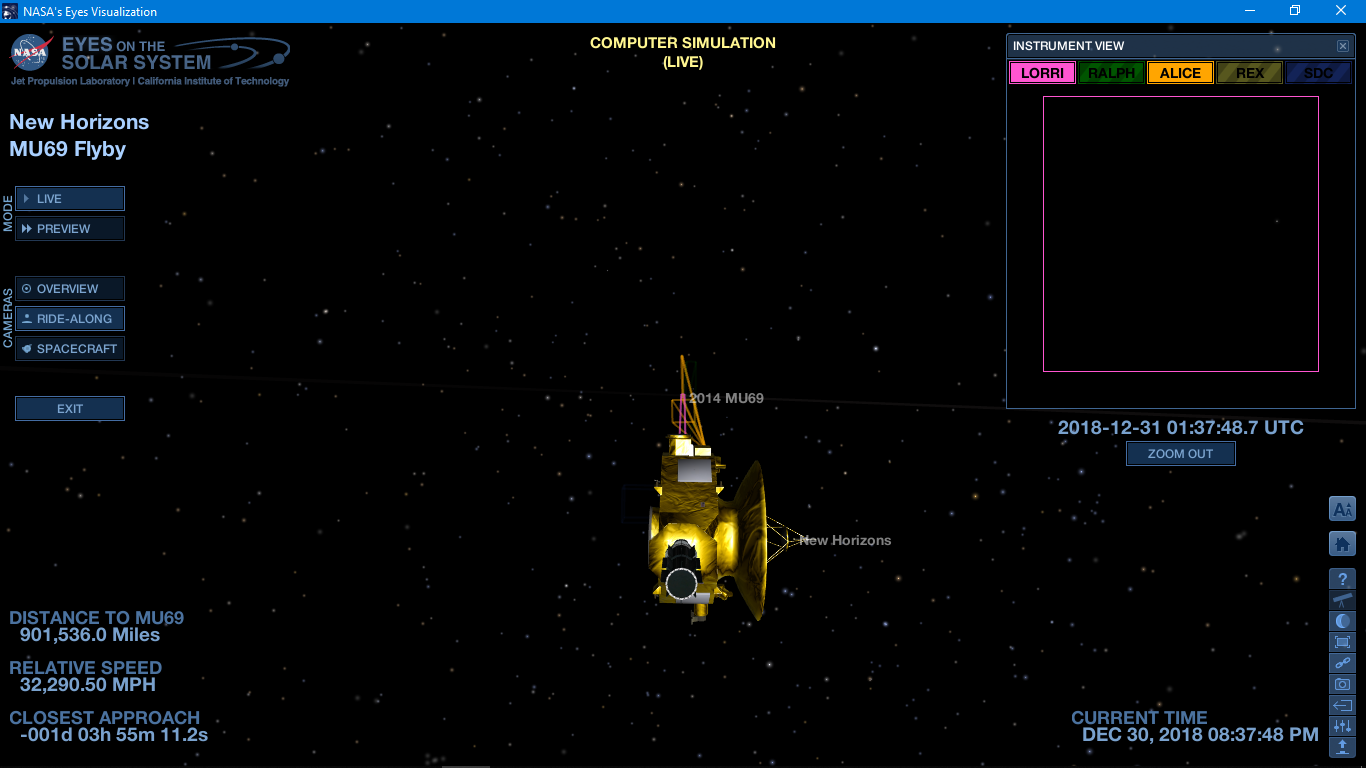
NASA’s Eyes screen Captured as a real-time simulation as I write this post. At this time two instruments are active, LORRI the long-range imager and ALICE the Ultraviolet imaging spectrometer. Click on the image to enlarge. Credit NASA/JPL
12/11/2018 – Ephemeris – The Chinese just launched a spacecraft to land on the far side of the Moon
Ephemeris for Tuesday, December 11th. The Sun will rise at 8:10. It’ll be up for 8 hours and 52 minutes, setting at 5:02. The Moon, half way from new to first quarter, will set at 9:06 this evening.
Last Friday the Chinese launched their Chang’e 4 spacecraft to land on the far side of the Moon in January. That side of the Moon has been mistakenly called the dark side. It actually gets more sunlight than the near, Earth facing, side. This will be an extraordinary feat. So how can they tell what’s happening on the other side? In preparation for this landing attempt the Chinese put a communications relay satellite in a halo orbit about the Earth-Moon L2 Lagrange point 38 thousand miles (61 thousand km) beyond the Moon. It is a kind of a gravitational point of equilibrium behind the Moon. One of five, and they are very useful. The satellite will lazily orbit that point, in view of the lander and the Earth for continuous communication between the Earth and the lander.
The times given are for the Traverse City/Interlochen area of Michigan. They may be different for your location.
Addendum
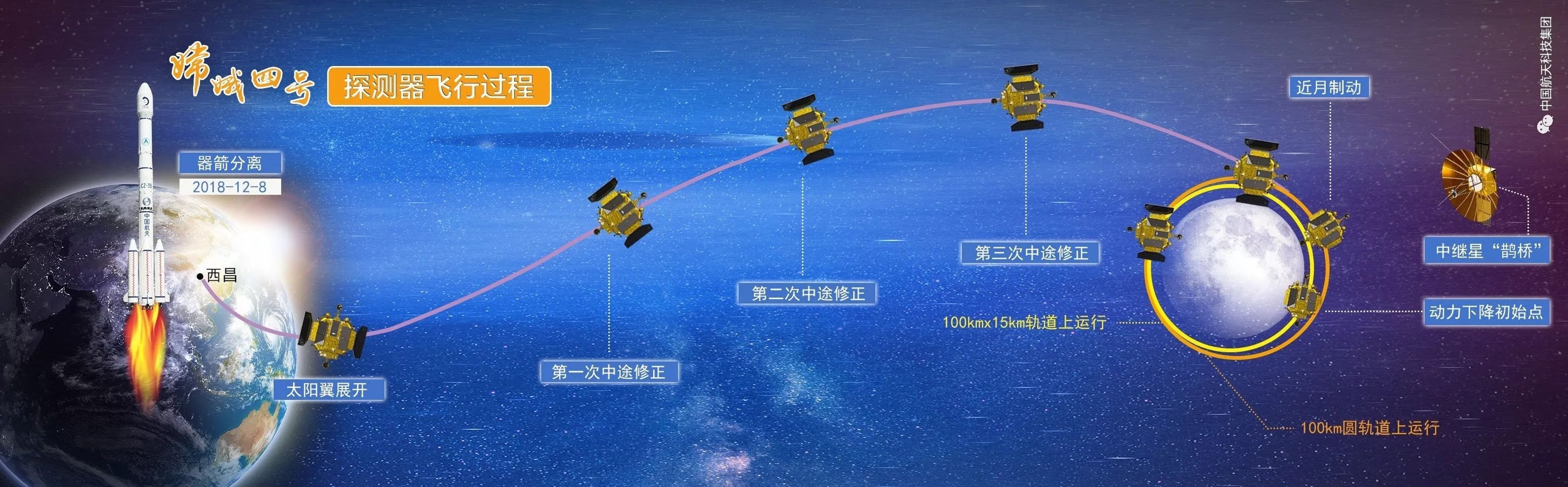
Chinese mission to land a lander and rover on the far side of the Moon. Click on the image to enlarge. It’s in Chinese except the numbers. Credit China Aerospace Science and Technology Corporation via Space.com.
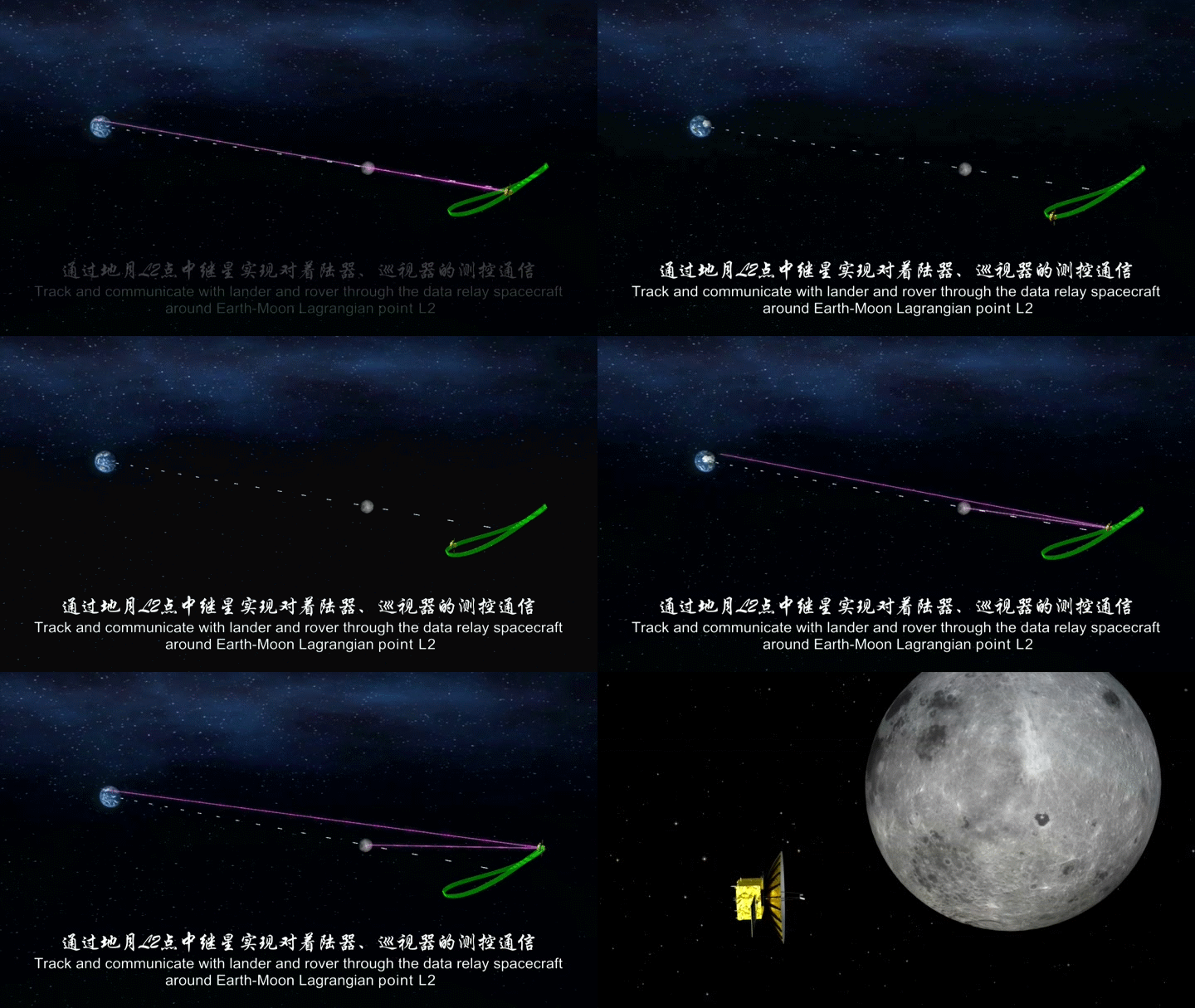
How Queuiao, the lunar communications satellite orbiting L2 performs its relay function. Click on image to enlarge. Credit CNSA via gbtimes.com.
Note: Next Monday’s program will be about Lagrangian points.
 Bob Moler's Ephemeris Blog