Archive
Ephemeris: 04/08/2025 – A look at Proxima Centauri
This is Ephemeris for Tuesday, April 8th. Today the Sun will be up for 13 hours and 9 minutes, setting at 8:19, and it will rise tomorrow at 7:08. The Moon, halfway from first quarter to full, will set at 5:57 tomorrow morning.
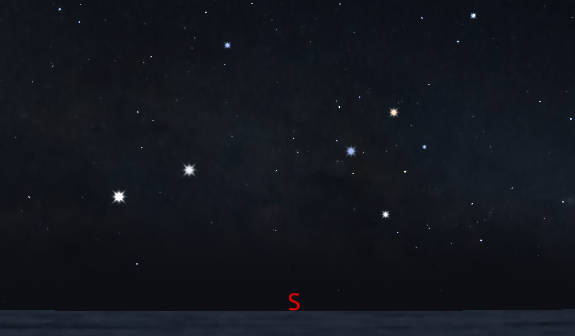
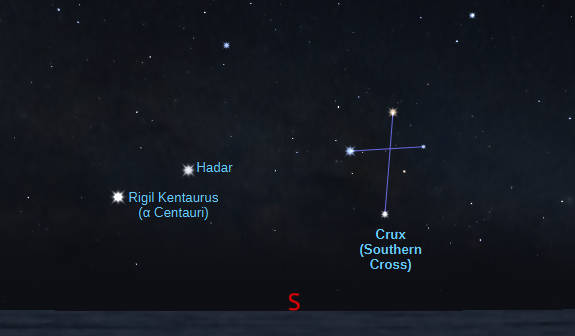
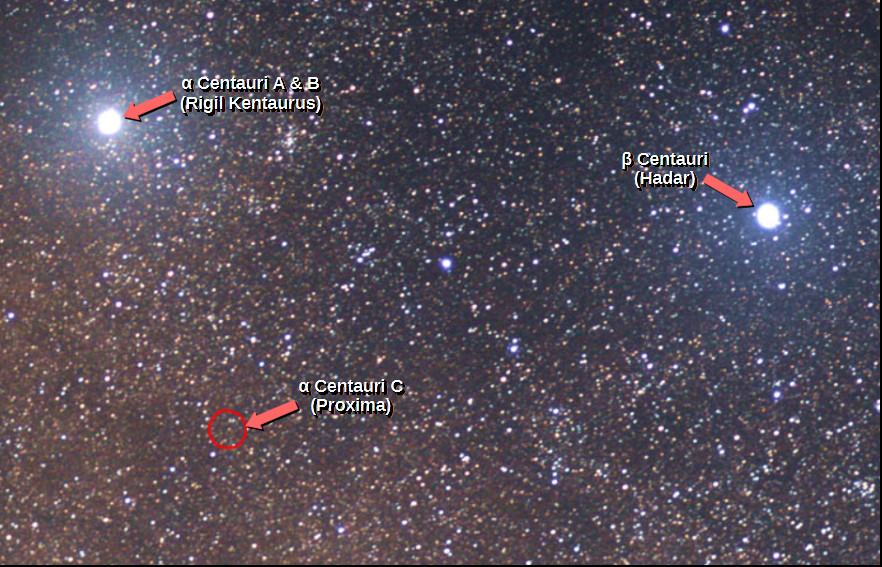
The nearest star to our Sun is a triple star system called Alpha Centauri or Rigil Kentaurus. It is in the skies of the Southern Hemisphere, but visible from the far southern parts of the United States. I’ve seen it from the Florida Keys and also from the latitude of the Big Island of Hawai’i. The closest member of that group this is a star we call Proxima Centauri or just Proxima for short. It is not visible to the naked eye. It is a red dwarf star maybe 12% the Sun’s mass, and at 11th magnitude. Proxima would be tough to spot with a pair of binoculars in a region of the sky which is filled with stars because it’s in the band of the Milky Way. Alpha Centauri, itself, is located near the Southern Cross, the farthest of the two bright stars to the east of it.
The astronomical event times given are for the Traverse City/Interlochen area of Michigan (EDT, UT – 4 hours). Times will be different for other locations.
Addendum
07/03/2023 – Ephemeris – The Sun is more massive than most stars
This is Bob Moler with Ephemeris for Monday, July 3rd. Today the Sun will be up for 15 hours and 29 minutes, setting at 9:31, and it will rise tomorrow at 6:02. The Moon, at full today, will rise at 10:28 this evening.
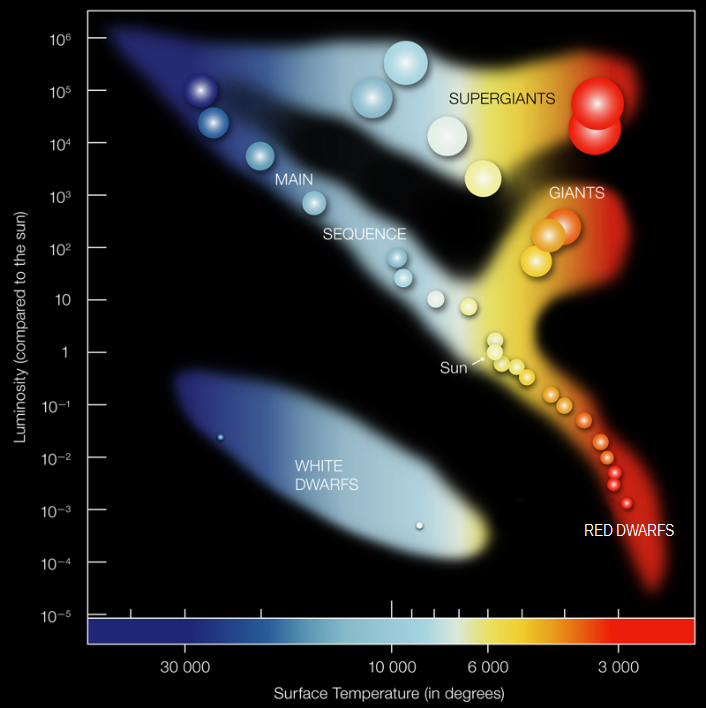
The Sun appears to be a singular object in the sky. There is none other. But is that true? No, it’s not. The Sun is a star, middle-aged for a star of its mass. The Sun is bigger than most stars, because most stars are runty red dwarf stars. In fact the closest star to our Sun is a red dwarf, called Proxima Centauri, the third, outlying star in the triple star system whose brightest star is called Rigil Kentaurus, though better known by its 1603 Bayer catalog designation, Alpha Centauri. Proxima is a challenge to spot even with binoculars. It turns out that stars visible to the naked eye are all brighter than the Sun. As far as the range of stellar masses go, the Sun is pretty much in the middle. Rigil Kentaurus itself is 8 percent more massive than the Sun and 50 percent brighter. Both Rigil Kentaurus and Proxima are too far south to see from Michigan.
The astronomical event times given are for the Traverse City/Interlochen area of Michigan (EDT, UT –4 hours). They may be different for your location.
Addendum
02/08/2018 – Ephemeris – The wonderfully named stars of Orion
Ephemeris for Thursday, February 8th. The Sun will rise at 7:53. It’ll be up for 10 hours and 8 minutes, setting at 6:01. The Moon, 1 day past last quarter, will rise at 3:09 tomorrow morning.
The constellation of Orion the hunter is visible in the south at 9 p.m. The stars of Orion are interesting in themselves. Starting at the top left of the seven bright stars of Orion’s torso is Betelgeuse the bright red star, whose name means something like “Armpit of the Giant”. The star in Orion’s other shoulder is Bellatrix the “Amazon Star”. Below are the three stars of Orion’s belt, from left to right; Alnitak, Alnilam and Mintaka. Their names mean “Girdle”, “Belt of Pearls”, and “Belt” respectively. Down to Orion’s knees we look on the left to the star Saiph pronounced ‘safe’ which means “Sword”, though it is some ways from the stars of Orion’s sword. Finally there’s the bright blue-white star Rigel whose name means “Left Leg of the Giant”.
The times given are for the Traverse City/Interlochen area of Michigan. They may be different for your location.
Addendum
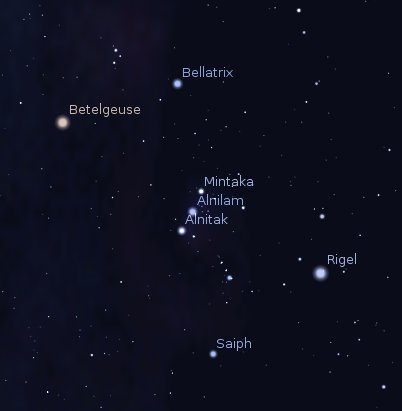
The named stars of Orion. Created using Stellarium.
Betelgeuse, pronounced Beetlejuice is the name of a 1988 movie, where Betelgeuse (spelled properly) is a particularly mischievous demon. Don’t say his name three times, or he’ll come and ‘help’ you. Oops, I did. It is a red giant star near the end of its life.
Bellatrix, is now known to most of us now as the first name as the first name of Bellatrix Lestrange from J. K. Rowling’s Harry Potter book and movie series. Other members of the Black family have astronomical names, such as Regulus (Leo) Black, and Sirius (Canis Major) Black.
The names of the belt stars were taught to me by Evelyn Grebel of the Grand Rapids Public Museum in the late 1950s. She was one of the founders of the Grand Rapids Amateur Astronomical Association. The names Alnitak, Alnilam and Mintaka have stuck with me ever since. It was through her that I was able to worm my way into working at the museum’s new then unnamed planetarium. I also remember being in her office with her, listening to the radio as Alan Shepard made his historic suborbital flight on May 5th, 1961.
Rigel is a hot blue-white star, and will probably become a red giant star like Betelgeuse. There is another bright star named Rigel, but most don’t know it. It’s Rigel Kentaurus, the leg of the centaur of Centaurus. It’s better known as Alpha Centauri, a catalog designation, and the nearest star to the solar system.
08/16/2016 – Ephemeris – Does Proxima Centauri have a planet? Also some information for southern observers about Mercury
Ephemeris for Tuesday, August 16th. The Sun rises at 6:46. It’ll be up for 13 hours and 59 minutes, setting at 8:46. The Moon, 2 days before full, will set at 5:53 tomorrow morning.
Proxima Centauri is the closest star to our solar system. It is a red dwarf star, and a distant third member of the Alpha Centauri star system. Recently the German weekly Der Spiegel announced that astronomers at the La Silla Observatory in Chile have detected a possible Earth-like planet at a distance that water may be liquid on its surface around this tiny star. Other than this one leak, no one is talking, and the European Southern Observatory is mum on the subject. There may be some kind of announcement at the end of the month. If true, this means that the closest earth-like planet orbits the closest star, only four and a quarter light years away. That’s nearly 25 trillion miles, and hundreds of years travel time with our current technology.
Times are for the Traverse City/Interlochen area of Michigan. They may be different for your location.
Addendum
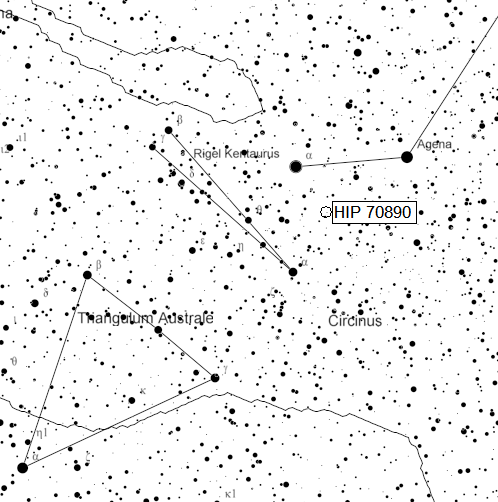
Chart showing the location of Proxima Centauri, labeled here HIP 70890. Alpha Centauri is labeled Rigel Kentaurus. Alpha Centauri is actually a catalog name in the style of Johann Bayer’s 1603 star atlas. Note also the alpha (α) Greek letter next to the star. Created using Cartes du Ciel (Sky Charts).
Note also the star labeled Agena. That is the more distant Beta (β) Centauri also known as Hadar.
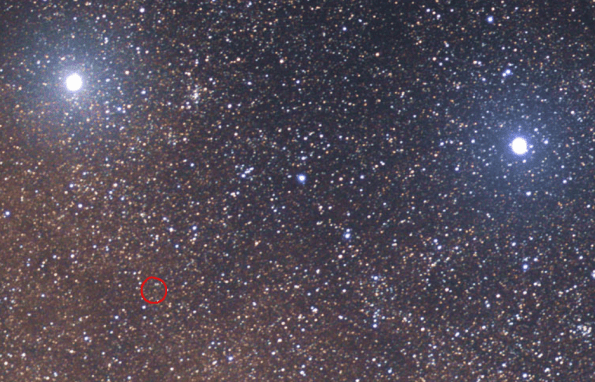
A section of a photograph of part of the field of view of the chart above. Credit: Wikipedia user Skatebiker.
Extra
For our southern observers: Today Mercury reaches its greatest eastern elongation of 27 degrees. So it’s visible in the west with Venus and Jupiter.
10/26/2012 – Ephemeris – The planet next door
Ephemeris for Friday, October 26th. The sun will rise at 8:12. It’ll be up for 10 hours and 26 minutes, setting at 6:39. The moon, 3 days before full, will set at 6:05 tomorrow morning.Last week some astronomers announced the discovery of a planet in the star system next door. Rigel Kentaurus, better known for some reason as Alpha Centauri, only 4.3 light years away, 25 trillion miles, if your odometer goes that high, is the closest star system to the solar system. I say star system, because it contains 3 stars. Star A is much like the sun, star B, somewhat larger and dimmer is orange in color. These two orbit each other at distances the range from Saturn’s distance from the sun to Pluto’s in about 80 years. The third star is a distant red dwarf, slightly closer to us than the other two and named Proxima Centauri. The new planet discovered is in essence hugging star B. Its designation is Alpha Centauri Capital B lower case b (Bb).
Times are for the Traverse City/Interlochen area of Michigan. They may be different for your location.
Addendum
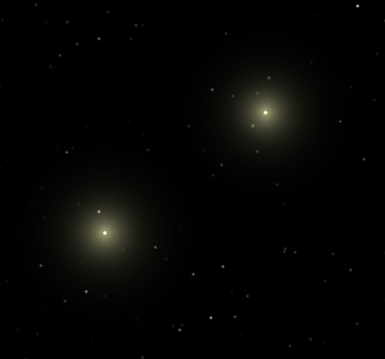
Alpha Centauri A and B. Created using Celestia.
Celestia doesn’t do Alpha Centauri justice. The A star, to the lower left, is about 1.5 times brighter than the sun. The B star is half the sun’s brightness. I wonder how far a planet could be from either star without being in an orbit that would be unstable and be ejected from the system.
 Bob Moler's Ephemeris Blog